
What if that glowing amber icon on your dashboard isn’t a sign of total engine failure, but simply your Honda struggling to breathe in our thin Colorado air? When the Honda check engine light Aurora drivers see suddenly illuminates, it’s natural to feel a sense of dread about potential repair costs or vehicle reliability. You might be tempted to settle for a free code scan at a local parts store, but those generic readings often miss the nuances of Japanese engineering.
We understand the anxiety that comes with an unexplained warning light, especially when you depend on your car for mountain commutes or unpredictable weather. This guide will help you decode exactly what your Honda is communicating. You’ll learn how Aurora’s altitude affects your sensors, why certain VTEC systems have specific quirks, and when it’s safe to continue your journey. We’ll explore the common causes behind these alerts and explain how a specialized diagnostic approach ensures your car remains safe for every Colorado adventure.
Key Takeaways
- Identify the urgency of your dashboard warning by distinguishing between a steady light and a more critical flashing indicator.
- Learn how local environmental factors, such as sub-zero cold starts, specifically affect Honda sensors and battery performance in Aurora.
- Understand why a professional diagnostic is necessary to find the root cause of a Honda check engine light Aurora, rather than just reading a surface-level error code.
- Use a practical troubleshooting checklist to evaluate your vehicle’s safety based on physical symptoms like shaking, noise, or visible leaks.
- Discover the benefits of choosing an independent Japanese import specialist who uses dealership-grade tools to ensure long-term engine health.
Decoding the Honda Check Engine Light: What is Your Dashboard Saying?
Your Honda’s dashboard isn’t trying to annoy you; it’s providing a vital status update from the Engine Control Unit (ECU). This system, officially known as the Malfunction Indicator Lamp (MIL), monitors hundreds of parameters to ensure your vehicle runs efficiently. When you see a Honda check engine light Aurora drivers often wonder if it’s a minor sensor glitch or a major mechanical failure. The ECU uses the On-Board Diagnostics (OBD-II) system to track everything from fuel tank pressure to precise cylinder firing intervals.
Living at 5,400 feet above sea level presents unique challenges for your Honda’s emissions system. Because the air is thinner in Aurora, your engine must constantly adjust its air-fuel mixture to maintain performance. This increased workload puts extra stress on oxygen sensors and the catalytic converter. Over time, these components can wear out faster than they would in coastal climates. This triggers a warning light that requires specialized local knowledge to diagnose correctly, as sea-level factory settings don’t always account for our specific atmospheric pressure.
Steady Light: The Warning Phase
A solid, non-blinking light usually indicates a non-critical but significant issue within the emissions or engine management system. It’s a signal that your Honda has detected a problem that needs attention soon, even if the car feels like it’s driving normally. Common culprits include a failing oxygen sensor or even a loose fuel filler cap that isn’t maintaining proper tank pressure. While it might seem tempting to ignore a steady light, doing so often leads to poor gas mileage. A faulty sensor can cause the ECU to default to a “rich” fuel mixture, wasting expensive gasoline and eventually clogging your catalytic converter.
Flashing Light: The Emergency Phase
A flashing check engine light is the highest level of urgency your car can communicate. This indicates a severe engine misfire is occurring right now. When a cylinder fails to fire correctly, unburned fuel is pushed out of the engine and into the exhaust system. Because your catalytic converter operates at extremely high temperatures, this raw fuel can ignite inside the converter, melting its internal honeycomb structure in minutes. If you see the Honda check engine light Aurora flashing while you’re on I-225 or E-470, pull over safely as soon as possible. Continuing to drive in this state risks turning a relatively simple ignition repair into a multi-thousand dollar exhaust replacement. It’s always best to stop the engine and consult a specialist who understands Honda’s specific engineering quirks.
Common Causes for a Honda Check Engine Light in Colorado
Colorado drivers face a unique set of variables that can trigger a Honda check engine light Aurora residents see more frequently than those in lower elevations. The “Colorado Cold Start” is a prime example of environmental stress. On sub-zero mornings, battery voltage can drop significantly during the initial cranking phase. This temporary dip often confuses sensitive electronic sensors, causing them to report “faulty” data to the computer. While these are sometimes ghost codes, they still require a professional eye to distinguish them from genuine mechanical failure.
Beyond the weather, high-altitude oxygen (O2) sensors fail more often here. At 5,400 feet, the air-fuel mixture is thinner, forcing these sensors to work harder to maintain efficiency. Similarly, worn spark plugs and failing ignition coils are the leading causes of engine misfires in high-mileage Accords and Civics. These components are the heart of your engine’s combustion, and when they falter, your Honda’s performance and reliability are immediately compromised.
VTEC System and Oil Pressure Issues
Honda’s Variable Valve Timing and Lift Electronic Control (VTEC) system is legendary for its engineering, but it’s remarkably sensitive to oil quality and levels. If your engine oil is low or has become too dirty, the VTEC solenoid cannot build the hydraulic pressure required to engage specific cam profiles. This lack of pressure triggers an immediate warning. In our climate, oil viscosity changes with the extreme temperature swings. Using the incorrect oil weight can lead to sensor inaccuracies and sluggish performance. Maintaining your vehicle at a specialized Japanese import repair Aurora shop ensures your VTEC system remains healthy and responsive throughout the year.
Emissions and Evaporative (EVAP) System
The “loose gas cap” is a common piece of advice, and while it’s the first thing you should check, it’s rarely the root cause of persistent lights. High-mileage Hondas in the Denver metro area often deal with aging catalytic converters that face stricter scrutiny during emissions testing. Additionally, Colorado’s seasonal dust and debris can contaminate Mass Air Flow (MAF) sensors. A dirty MAF sensor sends incorrect air intake data to the computer, resulting in a light and poor fuel economy. If you suspect your emissions system is struggling, a quick check-up can prevent a failed state inspection later. Our team can help you identify if a simple sensor cleaning is all you need to restore your car’s efficiency.
Diagnostic Code vs. Root Cause: The ‘Free Scan’ Trap
Many drivers begin their journey at a big-box parts store for a free scan. While these scans provide a starting point, they only reveal the symptom, not the underlying condition. If a Honda check engine light Aurora scan returns a P0420 code, it indicates the catalytic converter is performing below the required efficiency threshold. However, it doesn’t specify if the converter has physically failed, if an exhaust leak exists, or if an upstream sensor is sending faulty data. Following the ‘parts-cannon’ method, which is replacing components based solely on a code, often results in unnecessary expenses for parts that weren’t the actual problem. A master technician’s experience with the Honda software interface allows them to interpret these codes within the context of the vehicle’s entire history.
What a Professional Honda Diagnosis Includes
A professional Honda diagnosis is a multi-step investigation. We analyze the live data stream to observe how your vehicle performs under real-world conditions on Aurora roads. This allows us to see how the engine responds to acceleration and idling in real-time. We also conduct electrical circuit testing to ensure the issue isn’t a simple frayed wire or a corroded ground connection. Mechanical inspections are equally vital; we search for vacuum leaks or physical engine wear that electronic sensors are unable to see. This thoroughness ensures we address the root cause rather than just clearing a temporary code. It’s the difference between a guess and a guarantee of reliability.
Why Independent Specialists Offer Better Value
Independent specialists provide a level of personalized care that large dealerships struggle to match. Similar to the Toyota specialist Aurora model of service, we prioritize transparency and education. Our labor rates are often more approachable, and we have the freedom to select the best parts for your specific situation, whether they are OEM or high-performance alternatives. Building a relationship with a specialist who understands the engineering of all Japanese makes ensures your car stays reliable for years. You aren’t just a repair order; you’re a neighbor who deserves an honest assessment of their vehicle’s health. We aim to be your partner in vehicle longevity, helping you avoid the stress of recurring Honda check engine light Aurora alerts through methodical, expert care.
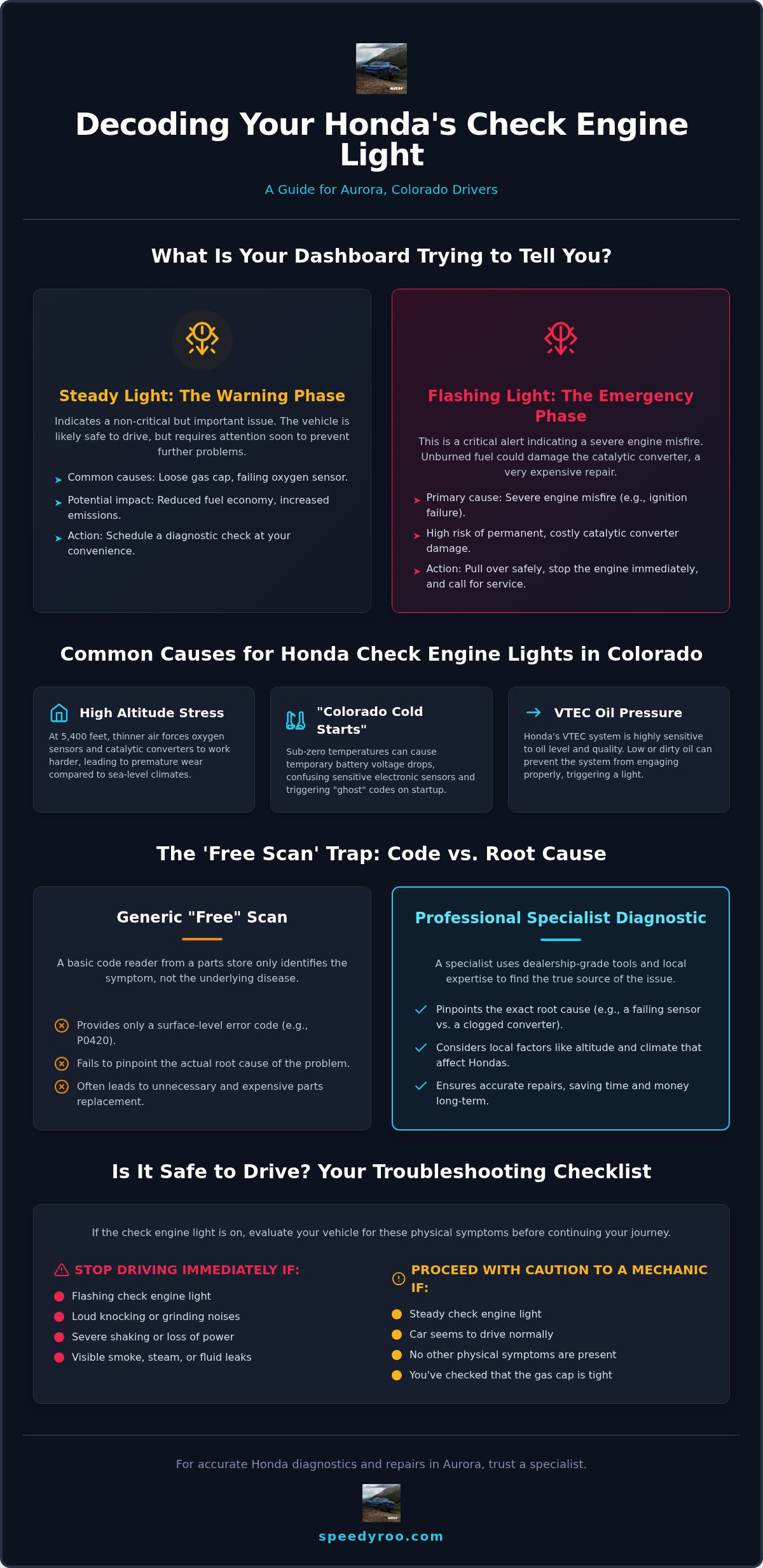
Is it Safe to Drive? Your Honda Troubleshooting Checklist
Perform a quick visual check under the hood. Look for steam or smoke, which indicates a coolant or oil leak. Check for obvious disconnected hoses or a battery terminal that looks corroded. These simple observations can help you explain the situation more clearly to your technician, moving the diagnostic process along faster. It’s often these physical cues that help us narrow down a complex electrical issue during the inspection.
The 3-Step Roadside Assessment
Step 1: Scan your entire instrument cluster. A check engine light accompanied by a red oil pressure light or a rising temperature gauge is an emergency. Shut the engine off immediately to prevent permanent damage. Step 2: Inspect your fuel cap. A cracked or improperly seated cap is a common cause of EVAP system codes. Tighten it firmly and inspect the rubber gasket for dry rot. Remember that the light may take 24 to 48 hours of normal driving to reset once the cap is secured. Step 3: Identify “limp mode.” This is a fail-safe state where the Honda ECU restricts engine RPM and transmission shifting to protect internal components. If your Civic or Accord suddenly lacks power, do not attempt to “push through” it.
Driving to the Shop: Best Practices
If your Honda feels stable enough to drive, modify your driving style to minimize engine load. Avoid hard acceleration and stay off the highways if possible. Aurora’s hilly terrain, particularly near the reservoir or eastern suburbs, can cause engine temperatures to spike when a sensor is failing. Monitor your gauges closely on every incline. If you are considering buying a used Honda and the seller claims a warning light was “just a sensor” that they recently cleared, be cautious. Scheduling a pre-sale vehicle evaluation Aurora can reveal hidden codes and provide peace of mind before you sign a title. For immediate help with your current vehicle, reach out to our master technicians for a comprehensive Honda repair and service assessment.
Why Aurora Honda Owners Trust Speedy Roo for Diagnostics
Since 2002, Speedy Roo Motorsports & Repair Inc has served as a cornerstone of the local automotive community. We specialize exclusively in Japanese imports, providing a level of focused expertise that general repair shops often lack. When you encounter a Honda check engine light Aurora, you deserve a diagnostic process rooted in transparency and technical precision. Our master technicians treat every vehicle with meticulous care, ensuring that we identify the specific root cause rather than just addressing a surface-level error code. We act as your expert neighbor, combining sophisticated technical abilities with honest, human interactions.
Our facility is equipped with the same high-level diagnostic tools used by major dealerships. This allows us to access deep-level ECU data to troubleshoot complex sensor issues or VTEC malfunctions accurately. Because we are an independent specialist, we provide this master-level service without the high labor rates or impersonal atmosphere of a dealership. We take pride in explaining the “why” behind every repair before we ever turn a wrench. This approach builds long-term trust and ensures you feel confident in your car’s safety on Colorado roads.
The Speedy Roo Motorsports & Repair Inc Advantage
Our deep experience with Subaru repair Aurora CO and other major Japanese brands translates into faster, more accurate Honda diagnostics. We understand the shared engineering philosophies of these imports and how they respond to our unique high-altitude climate. We also offer performance-minded diagnostics. We don’t just fix the light; we look for ways to optimize your engine’s health for the thin Aurora air. You won’t find hidden reset fees or high-pressure sales tactics here. We focus on stabilizing your vehicle’s health for the long haul.
Get Your Honda Back on the Road
Restoring your vehicle’s reliability is a methodical process. To help us provide the most accurate assessment, please share any recent symptoms or service history when you arrive. Whether you are driving from Denver, Centennial, or Parker, our convenient location makes it easy to access specialized care. We are genuinely invested in solving your car’s problems correctly the first time. Don’t let a dashboard warning cause unnecessary stress. Schedule your Honda diagnostic service at Speedy Roo Motorsports & Repair Inc today! and experience the difference that localized, honest expertise makes for your vehicle’s longevity.
Restore Your Honda’s Reliability and Performance
Addressing a Honda check engine light Aurora drivers encounter requires more than a simple code reset. It demands a thorough understanding of how our unique 5,400 foot elevation and extreme temperature swings impact sensitive Japanese engineering. By distinguishing between non critical sensor warnings and urgent mechanical failures, you can prevent minor issues from escalating into costly repairs. A professional diagnosis is an investment in your vehicle’s longevity, ensuring your car remains efficient and safe for every Colorado commute.
As an A+ rated local business and independent Japanese specialist since 2002, we provide master technician diagnostics with the transparency you deserve. We’re here to partner with you in maintaining your car’s health, offering dealership level precision without the added overhead. Don’t let dashboard uncertainty affect your peace of mind or your car’s performance. Schedule Your Honda Diagnostic Service at Speedy Roo Aurora today to get a clear, honest assessment of your vehicle’s needs. We look forward to helping you keep your Honda on the road for many miles to come.
Frequently Asked Questions
Will my Honda check engine light reset itself after I tighten the gas cap?
Yes, but it usually takes several drive cycles for the computer to verify the system is sealed. This typically requires 24 to 48 hours of normal driving. If the light remains on after three days of commuting, the issue likely lies within the broader EVAP system rather than just the cap seal. It’s best to have a specialist verify the pressure sensor is functioning correctly.
How much does a check engine light diagnostic cost in Aurora?
Diagnostic costs in the Aurora area vary based on the depth of the inspection required to find the root cause. While some shops offer basic scans, a comprehensive master-level diagnostic involves labor for electrical testing and live data analysis. You should expect to pay for the technician’s time and the specialized equipment used to pinpoint the exact failure within your Honda’s complex systems.
Can I pass a Colorado emissions test with the check engine light on?
No, you cannot pass a Colorado emissions test if your check engine light is illuminated. The “AIR Care Colorado” program requires an On-Board Diagnostic (OBDII) check as part of the inspection for most modern vehicles. An active light results in an automatic failure. This is because the light indicates the emissions control system is not functioning at peak efficiency, regardless of how the car drives.
Why does my Honda’s light only come on when it’s cold outside?
Extreme cold can cause battery voltage to drop or sensor heaters to fail during startup. In our Aurora climate, sub-zero mornings often trigger “lean” codes because the air is denser and intake manifold seals may shrink slightly. Once the engine warms up and components expand, the leak might seal itself; however, the fault code remains stored in the computer’s memory for a technician to review.
What are the most common Honda diagnostic codes for high-mileage Civics?
High-mileage Civics frequently trigger P0420 for catalytic converter efficiency and P0171 for a lean fuel mixture. You might also see P1259, which relates to the VTEC system and is often caused by low oil pressure or a clogged solenoid screen. These codes are common indicators of aging components that have been stressed by Colorado’s high-altitude driving conditions over many years of service.
Is a ‘free’ code scan at an auto parts store enough to fix my car?
A free scan only identifies the system reporting a fault, not the specific part that failed. For a Honda check engine light Aurora residents need to know that a code like “O2 Sensor” could actually be caused by an exhaust leak or a wiring problem. Professional diagnostics involve testing the component itself. This ensures you aren’t replacing parts that are still functional, saving you money.
Does a blinking check engine light always mean a misfire?
Yes, a blinking light is the standardized way your Honda communicates a severe engine misfire. This condition allows raw fuel to enter the exhaust system, which can overheat and destroy your catalytic converter very quickly. If the light is flashing, you should stop driving immediately. Seek a specialist’s help to avoid catastrophic and expensive engine damage that can occur within just a few miles of driving.
How many miles can I drive with a steady check engine light?
There is no specific mileage limit, but you should have the vehicle inspected as soon as possible. Driving with a steady Honda check engine light Aurora can lead to decreased fuel economy and increased emissions. While the car may feel normal, an unresolved sensor issue can eventually cause more expensive components to fail prematurely. This happens because the engine is likely running on a default, less efficient map.