
You are merging onto I-225 during the Friday afternoon rush when you notice your Nissan’s temperature gauge creeping toward the red zone. It is a sinking feeling that every driver in Aurora dreads, especially when the A/C stops blowing cold air just as the summer heat peaks. You aren’t alone in this frustration; Colorado’s high altitude and thin air create a demanding environment that tests even the most robust cooling systems. When the air is less dense, your radiator has to work much harder to dissipate heat, leaving very little room for mechanical error.
A professional Nissan overheating diagnosis Aurora is the only way to pinpoint whether the issue is a simple thermostat or a more complex CVT cooler failure. By identifying the root cause early, you can protect your engine from the devastating costs of a blown head gasket. In this article, we will explore why Nissans face specific challenges in our climate and how a specialized, community-focused approach provides a reliable solution. You will learn how to get your car back to peak health so it can handle the steepest mountain passes without the high overhead costs of a dealership.
Key Takeaways
- Learn to identify the warning signs of cooling failure, from the subtle scent of burning antifreeze to the specific operating range of your Nissan’s temperature gauge.
- Understand how Aurora’s 5,400ft elevation lowers the boiling point of your coolant and forces your radiator to work harder than it would at sea level.
- Discover how a professional Nissan overheating diagnosis Aurora uses pressure testing and visual inspections to find hidden leaks before they lead to permanent engine damage.
- Get insights into the common mechanical failures specific to Nissan models, including the vulnerability of plastic radiator end-tanks and stuck thermostats.
- Find out why choosing a local Japanese vehicle specialist provides dealership-level knowledge with the transparency and integrity of a neighborhood shop.
Common Symptoms of Nissan Overheating in Aurora
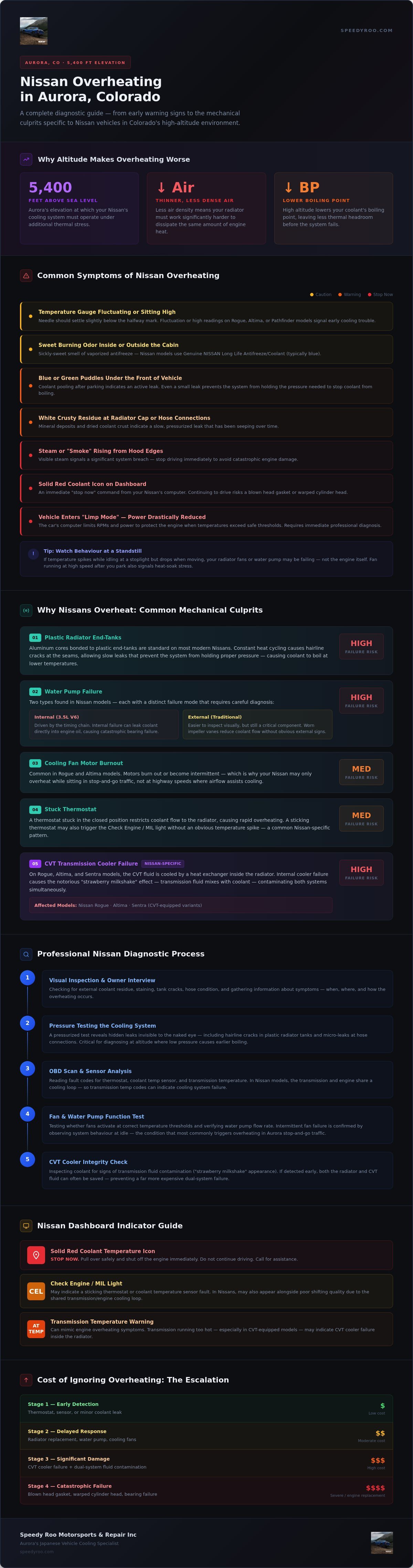
Recognizing the signs of a cooling failure before it leads to a warped cylinder head is essential for every Nissan owner in Colorado. Most modern Nissans, like the Rogue, Altima, or Pathfinder, feature a temperature gauge that should settle slightly below the halfway mark once the engine reaches operating temperature. If you notice the needle fluctuating or sitting higher than usual, it’s a clear indication that you need a professional Nissan overheating diagnosis Aurora to prevent permanent damage.
Beyond the gauge, your senses are often your best diagnostic tools. A failing cooling system frequently produces a distinct, sickly-sweet odor. This is the smell of vaporized Genuine NISSAN Long Life Antifreeze/Coolant, which is typically blue in modern models. You should also watch for these physical indicators during your weekly check:
- Blue or green puddles forming under the front of the vehicle after it has been parked.
- White, crusty residue around the radiator cap or hose connections, which indicates a slow, pressurized leak.
- Steam or “smoke” rising from the edges of the hood, suggesting a significant breach in the system.
Understanding How Car Cooling Systems Work helps you realize that even a small leak can eventually lead to “Limp Mode.” This is a protective state where the vehicle’s computer drastically reduces power and limits RPMs to protect the engine from a catastrophic meltdown when temperatures exceed safe limits.
Early Warning Signs You Should Not Ignore
Pay close attention to how your vehicle behaves at a standstill. If the temperature spikes while you are idling at an Aurora stoplight but drops once you start moving, your radiator fans or water pump may be failing. You might also hear your cooling fan running at high speed for several minutes after you park. Heat soak is a phenomenon where engine temperatures rise after the car is turned off because the coolant is no longer circulating, which can cause internal seals in your Nissan engine to become brittle over time if the system isn’t cooling properly before shutdown.
Nissan-Specific Dashboard Indicators
Nissan vehicles use a sophisticated network of sensors to monitor thermal health, but the lights can be confusing. A solid red coolant icon is an immediate “stop now” command, whereas the Malfunction Indicator Lamp (MIL) or “Check Engine” light might trigger if a thermostat is merely sticking. In many Nissan models, the transmission temperature and engine temperature are closely linked through a shared cooling loop. A transmission that is running too hot can mimic engine overheating, often triggering a “Check Engine” light alongside a noticeable drop in shifting quality. Seeking a Nissan overheating diagnosis Aurora at the first sign of these lights ensures that a minor sensor issue doesn’t turn into a major mechanical failure.
Why Nissans Overheat: Common Mechanical Culprits
Your Nissan’s radiator is a high-performance heat exchanger, but it has a built-in vulnerability. Most modern models utilize aluminum cores bonded to plastic end-tanks. Over time, the constant expansion and contraction of these materials lead to hairline cracks in the plastic, often at the seams. While a small leak might seem manageable, it prevents the system from holding the pressure required to keep your coolant from boiling. A precise Nissan overheating diagnosis Aurora can distinguish between a simple cracked tank and a more complex internal blockage within the radiator cores.
Moving parts like the water pump and cooling fans are also frequent points of failure. In models like the Rogue and Altima, cooling fan motors are known to burn out or become intermittent, which is why your car might only overheat while sitting in traffic. Water pumps present a different challenge. Some Nissan engines, like the 3.5L V6, feature internal water pumps driven by the timing chain, while others use traditional external pumps. Identifying an internal leak early is vital; if a pump fails internally, it can leak coolant directly into your engine oil, leading to catastrophic bearing failure.
The Role of the CVT Transmission Cooler
One of the most overlooked aspects of Nissan thermal management is the integration of the Continuously Variable Transmission (CVT) cooler. In many Rogue, Altima, and Sentra models, the transmission fluid is cooled by a heat exchanger located inside the radiator. If this internal cooler fails, it can lead to the “strawberry milkshake” effect, where transmission fluid and engine coolant mix. This cross-contamination destroys the transmission’s internal clutches and prevents the engine from shedding heat effectively. If you drive a Sentra or Versa, your vehicle is particularly sensitive to cooler efficiency. Ensuring these loops are clear is a standard part of our Nissan Service and Repair process.
Hose and Seal Degradation
The rubber compounds used in Nissan cooling hoses are designed for durability, but the intense heat-cycling of Colorado summers can eventually make them brittle or excessively soft. A “soft” hose is dangerous because it can collapse under the vacuum created by the water pump, suddenly cutting off all coolant flow to the block. We also pay close attention to the seals around the thermostat, which acts as the gatekeeper of your engine’s temperature. The radiator cap is a critical pressure-holding component that regulates the system’s boiling point and prevents coolant loss. If the cap’s internal spring weakens, the entire cooling system loses its ability to fight off the heat, even if every other part is in perfect condition.
The Aurora Factor: How Altitude Affects Cooling
Aurora sits at an elevation of approximately 5,400 feet, and this altitude changes the physics of how your car stays cool. At sea level, water boils at 212°F, but here in the Mile High region, that boiling point drops to about 202°F. This ten-degree difference significantly reduces the safety buffer your engine has before it starts to overheat. When you combine this with the thinner air found in Colorado, your radiator has fewer air molecules to interact with, making heat exchange much less efficient than it would be at lower elevations.
A professional Nissan overheating diagnosis Aurora must account for these atmospheric variables. It isn’t enough to just check for leaks; we must ensure your cooling system can maintain the higher internal pressures required to keep your coolant liquid at these heights. This is also why using the correct 50/50 mixture of Genuine NISSAN Long Life Antifreeze/Coolant and distilled water is non-negotiable. Pure water or the wrong ratio will boil off too quickly, leaving your engine vulnerable during a hot July afternoon on Colfax Avenue.
Pressure Testing for High-Altitude Performance
A cooling system is a pressurized environment. This pressure is what allows the coolant to reach temperatures well above 212°F without turning into steam. However, a cap or seal that holds steady in a lower-elevation state might fail under the stresses of Aurora’s climate. Our approach to Japanese import repair in Aurora involves high-pressure testing that simulates these local conditions. We pay close attention to the expansion tank, which manages the pressure fluctuations as your engine warms up and cools down. If the tank or its cap can’t maintain a seal, the lower atmospheric pressure will cause the coolant to boil prematurely.
Climbing the I-70 Corridor
Many of our customers first notice their temperature gauge rising when they leave Aurora and head west into the foothills. Climbing steep grades like those on I-70 puts an immense load on your Nissan’s engine, generating maximum heat while the thin mountain air struggles to provide cooling. If your radiator is even partially restricted by debris or internal scaling, these climbs will expose the weakness. A timely Nissan overheating diagnosis Aurora before your mountain trip can identify these hidden issues. To manage your temps during a steep ascent, consider these steps:
- Turn off the A/C to reduce the immediate load on the engine.
- Turn on the cabin heater to help pull excess heat away from the engine block.
- Downshift to a higher RPM range to keep the water pump and cooling fans spinning at maximum speed.
Our Professional Nissan Diagnostic Process
A simple code scan rarely tells the whole story of a thermal failure. At Speedy Roo, our Nissan overheating diagnosis Aurora follows a methodical, multi-step process to identify the root cause before we ever suggest a repair. We begin with a meticulous visual inspection of the entire engine bay, looking for the telltale signs of Nissan-specific leaks, such as the white or blue residue around the water pump weep hole or the radiator seams. Once the visual check is complete, we perform a cooling system pressure test. By forcing the system to hold a specific PSI, we can reveal hidden cracks in plastic end-tanks or weak hose clamps that only leak when the engine is under load.
If the external system is tight but the engine is still running hot, we look deeper. We use digital scanning tools to evaluate real-time data from the Engine Control Module (ECM). This allows us to compare what the sensors are reporting against the physical reality of the engine’s temperature. We also conduct combustion leak testing to rule out the most dreaded failure: the head gasket. If you suspect your vehicle is struggling, it’s time for a professional Nissan Service and Repair to ensure your engine is protected.
Testing the Cooling Fan and Relay
Nissan cooling fans are designed to operate at multiple speeds depending on the A/C demand and coolant temperature. We verify that both the low-speed and high-speed circuits are engaging correctly, as a failed relay often causes overheating only when the vehicle is stationary. We also inspect the fan shroud for any cracks or missing pieces that could disrupt the focused airflow required for efficient cooling. To rule out internal engine damage, we perform a block test, which is a chemical diagnostic that detects exhaust gases in the coolant to confirm if a head gasket has failed.
Thermostat and Flow Analysis
A thermostat that is “lazy” or sticking can be difficult to catch without specialized tools. We use infrared thermometers to map the temperature across your radiator’s surface. If we find significant “cold spots,” it indicates that internal passages are clogged and the radiator needs replacement. This thermal imaging also helps us verify the exact opening temperature of the thermostat and confirm that the water pump is circulating fluid at the correct rate. By analyzing the flow rather than just guessing at parts, our Nissan overheating diagnosis Aurora ensures your vehicle remains reliable for the long term.
Speedy Roo Motorsports & Repair Inc: Aurora’s Specialist for Nissan Cooling Repair
Speedy Roo Motorsports & Repair Inc has served the local community as a dedicated Japanese vehicle specialist since 2002. We’ve built our reputation on a foundation of transparency and meticulous care. While many general shops handle a wide range of makes, our team focuses specifically on the engineering nuances of brands like Nissan, Subaru, and Toyota. This specialized focus is critical when performing a Nissan overheating diagnosis Aurora, as it allows us to identify model-specific weaknesses that a generalist might overlook. We only use components that meet or exceed Nissan OEM standards, ensuring that every repair stands up to the rigors of Colorado’s climate.
Our approach at Speedy Roo Motorsports & Repair Inc combines technical precision with the approachable warmth of a community partner. We believe in empowering our customers with knowledge, explaining the “why” behind every diagnostic result. Whether we are identifying a failing water pump or a restricted radiator, our goal is to restore your vehicle’s reliability through honest, high-quality craftsmanship that respects your time and your budget.
Why Choose an Independent Nissan Specialist?
Choosing an independent specialist means you get dealership-level expertise without the impersonal atmosphere or high labor rates. Speedy Roo Motorsports & Repair Inc acts as your “Expert Neighbor,” providing personalized advice that prioritizes the long-term health of your vehicle rather than just a quick transaction. Our deep familiarity with Japanese engineering is evident in all our services, from cooling system overhauls to specialized Subaru repair in Aurora. We understand how these engines are designed to operate, which helps us find cost-effective solutions that keep your car on the road longer.
Preventative Maintenance for Peace of Mind
The best way to avoid the stress of an overheating engine is through consistent, proactive care. For most Nissan models, we recommend a comprehensive coolant flush every 60,000 to 100,000 miles. This process removes the old, degraded fluid and any accumulated debris that could clog your radiator or damage your water pump seals. Seasonal inspections are also vital in Aurora, where the transition from freezing winters to scorching summers can stress rubber hoses and plastic components. Catching a small hairline crack in a radiator tank during a routine check is far better than being stranded on the highway. If you’ve noticed your temperature gauge behaving strangely, Schedule your Nissan diagnostic service in Aurora today to get ahead of the problem.
Secure Your Nissan’s Performance for the Road Ahead
Protecting your vehicle from the unique thermal stresses of the Mile High City requires more than just topping off the coolant reservoir. We’ve explored how Aurora’s altitude lowers boiling points and why Nissan-specific components, like the integrated CVT cooler, demand a specialized eye. A professional Nissan overheating diagnosis Aurora is the most effective way to identify small leaks or failing relays before they escalate into expensive head gasket repairs. By choosing an independent specialist with expert diagnostic equipment for Nissan models, you ensure your car receives meticulous care without the high overhead costs of a dealership.
At Speedy Roo Motorsports & Repair Inc, we’ve been specializing in Japanese imports since 2002, serving our neighbors as a highly rated independent shop in Aurora. We’re committed to keeping your Rogue, Altima, or Pathfinder reliable for every mountain climb and daily commute. Don’t wait for a warning light to leave you stranded on the highway. Book Your Nissan Cooling Diagnosis at Speedy Roo Motorsports & Repair Inc today and drive with the confidence that your engine is healthy and protected.
Frequently Asked Questions
Is it safe to drive my Nissan if the temperature gauge is high?
No, it is not safe. Driving with a high temperature gauge can lead to warped cylinder heads or a blown head gasket within minutes. If the needle moves past the normal range or the red warning light appears, you should pull over immediately to a safe location and turn off the engine. Continuing to drive while the engine is hot risks catastrophic failure that could require a complete engine replacement.
How much does a Nissan overheating diagnosis cost in Aurora?
While we don’t list specific pricing here, the cost for a professional Nissan overheating diagnosis Aurora residents can expect generally covers a comprehensive system check. This includes a pressure test, visual inspection for leaks, and a digital scan of the engine control module. Investing in an expert diagnosis early is far more cost-effective than ignoring the problem and facing the massive expenses associated with internal engine damage or transmission failure.
Can a bad radiator cap really cause my Nissan to overheat?
Yes, a faulty radiator cap is a frequent but overlooked cause of overheating. The cap is designed to maintain a specific pressure within the system, which raises the boiling point of the coolant. If the seal fails or the internal spring weakens, the pressure drops, causing the coolant to boil at a lower temperature. This leads to coolant loss and air pockets that prevent the system from regulating heat effectively.
What is the most common cause of overheating in a Nissan Rogue?
One of the most common issues we see in the Nissan Rogue is a failure of the cooling fan assembly or a leaking radiator. In newer models, the CVT transmission cooler can also become restricted, which adds extra heat to the engine’s cooling loop. Because the Rogue is a popular choice for Colorado drivers, the stress of high-altitude mountain climbing often exposes these mechanical weaknesses sooner than in vehicles driven at sea level.
How often should I change the coolant in my Nissan?
You should generally replace your engine coolant every 60,000 to 100,000 miles, depending on your specific model’s maintenance schedule. However, because of Aurora’s extreme temperature swings and high altitude, we often recommend more frequent inspections. Using the correct Genuine NISSAN Long Life Antifreeze/Coolant is vital to prevent corrosion and ensure the chemical additives remain effective at protecting your water pump seals and aluminum radiator core from internal scaling.
Why does my Nissan overheat only when I turn on the air conditioning?
This symptom usually points to a failing cooling fan or a restricted radiator. Turning on the A/C places an additional thermal load on the cooling system because the A/C condenser, located in front of the radiator, releases a significant amount of heat. If your cooling fans aren’t pulling enough air through both units, or if the radiator is partially clogged, the system won’t be able to keep up with the added demand.
Do Nissans have common head gasket problems like some other brands?
Nissans aren’t specifically known for head gasket failures as a design flaw, but they can occur as a secondary result of chronic overheating. If a thermostat sticks closed or a water pump fails and the driver continues to operate the vehicle, the resulting heat will warp the cylinder head. This warping breaks the seal of the head gasket. Our specialized Nissan overheating diagnosis Aurora process includes a block test to rule this out early.
What should I do immediately if my car starts steaming on the road?
If you see steam, pull over safely and turn off the engine immediately. Do not attempt to open the radiator cap or the expansion tank while the engine is hot, as the pressurized steam can cause severe burns. Once the vehicle is safely parked, you can call for a tow to a specialist. It’s much safer to have the vehicle transported than to risk permanent engine damage by trying to limp it home.