
What if that glowing amber icon on your dashboard isn’t a warning of immediate engine failure, but rather a cry for a more precise level of care that a generic scanner simply can’t provide? It’s a common stressor for many drivers in our community. You see the light, and suddenly you’re worried about catastrophic damage or failing your next Colorado emissions test. We understand that frustration, especially when generic shops try to solve the problem by throwing parts at your car until something works. Securing a professional Honda check engine light diagnosis in Centennial is the first step toward regaining your peace of mind.
This specialized approach provides a clear, honest explanation of what’s actually happening under the hood of your Japanese import. By choosing a specialist who has focused on these specific systems since 2002, you can replace uncertainty with a reliable plan of action. This article explores how a meticulous diagnostic process saves you time and money compared to the “parts-cannon” approach. We’ll preview the specific technical steps that ensure your Honda stays on the road and passes local emissions requirements without unnecessary dealership markups. Our goal is to empower you with the knowledge needed to maintain your vehicle’s longevity through precision and transparency.
Key Takeaways
- Learn the difference between a steady and flashing light to determine the immediate safety and urgency of your Honda’s repair needs.
- Discover why a professional Honda check engine light diagnosis Centennial uncovers the actual source of a fault instead of just providing a generic error code.
- Understand how specialized diagnostic tools prevent the common mistake of replacing expensive components that haven’t actually failed.
- Find out how a precise repair plan helps your vehicle pass Colorado emissions tests and preserves the longevity of your engine.
- Explore the benefits of choosing a local specialist who offers dealership-level technology with a more transparent, community-focused approach.
The Stress of the Honda Check Engine Light: What It Means for Your Drive in Centennial
Seeing the amber glow of the Malfunction Indicator Lamp (MIL) on your Honda’s dashboard can trigger an immediate sense of dread. Whether you’re commuting along Arapahoe Road or heading home through Centennial, that small light represents a disruption to your routine and a potential threat to your budget. It’s natural to feel anxious about the possibility of a major engine failure. However, understanding what your car is trying to communicate is the first step toward a calm resolution. For many local drivers, securing a professional Honda check engine light diagnosis in Centennial is the most efficient way to replace that anxiety with a clear, actionable plan.
Ignoring the light rarely makes the problem go away. In fact, most Honda sensors are designed to catch small issues before they become expensive repairs. Addressing the light early is particularly vital in Colorado, where strict emissions standards mean a single sensor fault can prevent you from renewing your registration. Taking a proactive approach ensures your vehicle remains reliable and compliant with local regulations.
Steady Light vs. Flashing Light: Knowing the Urgency
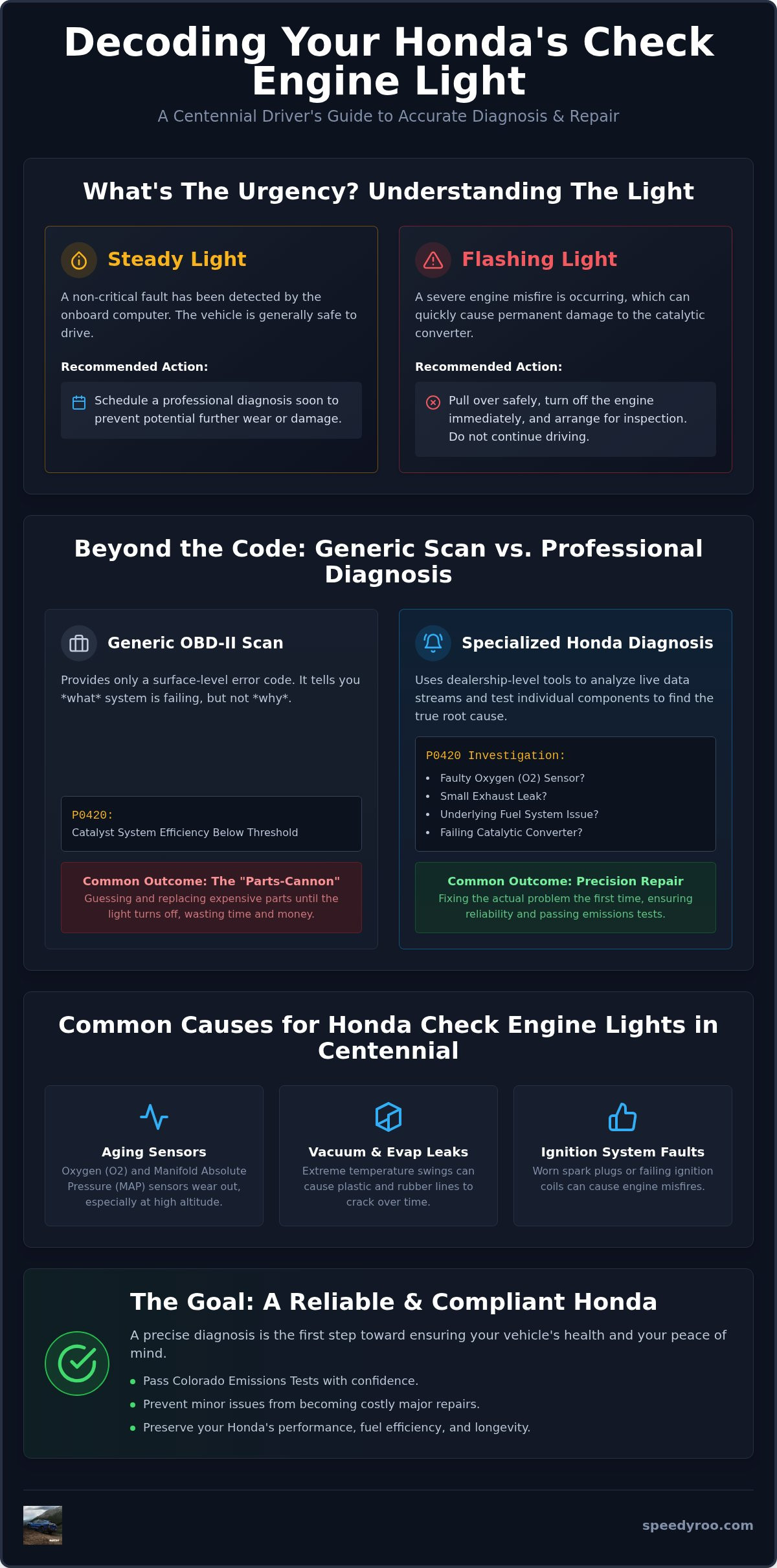
Honda vehicles use two primary signals to communicate the severity of an engine issue. A steady light indicates that the onboard computer has detected a fault in the system. While this isn’t an immediate emergency, it’s an urgent warning that something is operating outside of its normal parameters. You can usually continue your drive, but you should schedule a diagnosis soon to prevent further wear.
A flashing light is a much more serious signal. This indicates a severe engine misfire is occurring, which can cause immediate and permanent damage to your catalytic converter. If you see the MIL flashing while driving on I-25 or local Centennial streets, follow these steps:
- Reduce your speed immediately and avoid heavy acceleration.
- Find a safe place to pull over as soon as possible.
- Turn off the engine to prevent raw fuel from damaging the exhaust system.
- Arrange for a specialized technician to inspect the vehicle before driving it again.
Why Your Honda is Sensitive to Local Centennial Conditions
Centennial sits at an elevation where the air is significantly thinner than at sea level. This thin air directly impacts how your Honda’s engine calculates the ideal air-fuel mixture. Your oxygen sensors and manifold absolute pressure (MAP) sensors must work harder here to maintain the efficiency Honda is known for. When these sensors begin to age, the high-altitude environment often pushes them past their limit, triggering the check engine light sooner than it might in lower elevations.
Extreme Colorado temperature swings also play a role. The transition from freezing nights to warm afternoons can cause plastic sensor housings and rubber vacuum lines to expand and contract. Over time, these materials become brittle and develop small cracks. These “ghost” leaks can be difficult for generalist shops to find, but they are a common culprit for emissions-related faults in our region. Addressing these issues promptly helps you avoid the frustration of a failed emissions test and keeps your Honda running at peak performance.
Beyond the Code: Why Professional Honda Diagnostic Service is Essential
A common misconception is that the code stored in your Honda’s computer is a direct repair instruction. In reality, an OBD-II code is simply a starting point for a deeper investigation. While a generic code reader might tell you that a system is underperforming, it won’t tell you why. This is where a professional Honda check engine light diagnosis in Centennial becomes essential for long-term vehicle health. Our approach moves beyond surface-level readings to look at the “why” behind the fault, ensuring the actual problem is solved the first time.
Take the P0420 code, which indicates “Catalyst System Efficiency Below Threshold.” Many drivers assume this means they need an expensive new catalytic converter. However, a specialist knows this code could also be triggered by a faulty oxygen sensor, a small exhaust leak, or even an underlying fuel system issue. Without live data streaming and professional analysis, you might spend hundreds on a converter you didn’t actually need. Professional diagnostics identify these intermittent electrical gremlins by monitoring how components behave while the engine is running.
The Limitations of Free Parts Store Scans
It’s tempting to stop by a local parts store for a free scan, but these services have significant limitations. A free scan provides the “what” but never the “why.” Relying solely on these codes often leads to “parts-cannoning,” where owners replace perfectly functional sensors in a desperate attempt to clear the light. This trial-and-error method is expensive and rarely addresses the root cause. A professional diagnostic fee represents an investment in technical accuracy that prevents the much higher costs of trial-and-error part replacement.
Specialized Tools for Honda PGM-FI Systems
Honda’s Programmed Fuel Injection (PGM-FI) systems are remarkably sophisticated and require more than generic equipment to analyze. We use advanced diagnostic software that communicates directly with Honda’s proprietary systems. This level of access allows us to monitor critical performance metrics in real time, such as VTEC solenoid engagement and precise fuel trim levels.
We also cross-reference your vehicle’s data with Honda-specific Technical Service Bulletins (TSBs). These bulletins often contain information about known software glitches or specific component failures that a generalist shop might miss. This methodical process ensures we aren’t just guessing. If you’re looking for a clear answer regarding your vehicle’s health, scheduling a specialized inspection can provide the clarity you need while protecting your investment.
Common Causes for a Honda Check Engine Light in the Centennial Area
While many generalist shops claim a loose gas cap is the most common culprit, modern Honda engineering is more complex. In the Centennial area, the combination of high altitude and rapid temperature changes creates specific stresses on your vehicle’s emissions and performance systems. Getting a professional Honda check engine light diagnosis in Centennial helps identify these regional patterns before they impact your daily commute or lead to more expensive failures.
Oxygen (O2) sensors are particularly sensitive to Colorado’s thin air. These sensors monitor the exhaust to ensure the engine isn’t running too “rich” or “lean.” When they fail, your fuel economy can drop significantly before you even notice a change in how the car drives. Additionally, the VTEC system, which gives Hondas their signature balance of power and efficiency, relies on precise oil pressure. If your oil is low or dirty, the VTEC solenoid may trigger a light. We also frequently see EVAP system leaks, where the rubber hoses that prevent gasoline vapors from escaping become brittle and crack in our dry, high-desert climate.
Emissions and the Colorado Air Care Program
In Colorado, a lit check engine light is an automatic failure at any emissions testing station. Even if the car seems to run perfectly, the “Fail” result is certain because the light indicates the vehicle is polluting more than allowed. Simply clearing the code right before your test won’t work. This action resets the “Readiness Monitors,” which are internal self-tests the car performs. If these monitors aren’t set to “Ready,” the station cannot complete the test. We recommend Centennial residents seek a diagnosis at least a week before their registration expires. This ensures your Honda has enough “drive cycles” to reset these monitors after a repair is completed.
Model-Specific Patterns: Civic, Accord, and CR-V
Different Honda models often show unique failure patterns in our environment. For CR-V owners, a common “rattle” during cold starts often accompanies a VTC actuator code. This is a known issue where the timing component fails to lock properly. Civic and Accord owners frequently deal with cracked exhaust manifolds. Because the manifold is integrated into the cylinder head in many modern designs, these cracks allow air to enter the exhaust stream. This tricks the O2 sensor into reporting a false lean condition. On high-mileage vehicles, we often find that simple spark plug wear causes subtle misfires that the sensitive Honda computer detects long before the driver feels a physical shake. Addressing these model-specific quirks is part of our commitment to the long-term health of your Japanese import.
Choosing Between a Centennial Honda Dealer and an Independent Specialist
When that warning light appears, many owners feel they must return to the dealership to ensure a proper Honda check engine light diagnosis in Centennial. However, there is a significant difference between dealership overhead and the efficiency of a dedicated local specialist. Large dealerships often carry massive operational costs that are reflected in their labor rates. By contrast, an independent specialist focuses on technical precision and community-focused value. You often get to speak directly with the technician who worked on your car, providing a level of personalized care that large service bays simply can’t match.
A major benefit of the “Honest Specialist” approach is the focus on repairing components rather than just replacing entire assemblies. Dealerships are frequently incentivized to swap out large, expensive parts groups. A specialist who knows Japanese engineering inside and out can often identify the specific sub-component that has failed. It’s also important to remember that having your Honda serviced at an independent shop doesn’t void your manufacturer’s warranty. Federal law protects your right to choose where your vehicle is maintained, provided the service is documented and performed correctly.
Transparency and Integrity in Centennial Auto Repair
Building long-term trust starts with transparency. A quality shop will explain the “why” behind every recommendation, showing you the diagnostic data or the physical wear on a part. These Japanese import repair Aurora experts prioritize integrity over the “upsell” culture. Instead of a high-pressure sales pitch, you receive a clear report on what needs immediate attention and what can wait. This methodical approach ensures you aren’t spending money on unnecessary measures that don’t actually address the fault code.
Specialization vs. Generalization
Efficiency is the natural result of specialization. While a generic chain shop might work on dozens of different makes and models each week, a specialist sees the same Honda engines every day. They are already familiar with the common failure points and the specific quirks of the PGM-FI system. This deep knowledge, which also extends to our work as a Toyota specialist Aurora, allows for faster, more accurate troubleshooting. If you want a team that treats your Honda with meticulous care and technical precision, book your diagnostic appointment today to see the difference specialized expertise makes.
Diagnostic Process at Speedy Roo: Restoring Your Honda’s Reliability
At Speedy Roo, our process is rooted in technical precision and a deep respect for Honda engineering. We’ve refined our diagnostic workflow since 2002 to ensure we aren’t just clearing codes, but actually solving problems. Choosing a professional Honda check engine light diagnosis in Centennial means following a methodical path to resolution that prioritizes the long-term health of your vehicle. We treat every Japanese import with the meticulous care it deserves, replacing the typical stress of a repair with a sense of calm reliability.
We believe that transparency is the foundation of a good partnership. That’s why we utilize digital inspections that allow us to share exactly what our technicians see. You’ll receive a clear estimate that prioritizes repairs based on safety and urgency. This honest approach helps you make informed decisions without the pressure of unnecessary upsells. Our goal is to keep your Honda on the road for the long haul, especially given the unique stresses of driving in the Colorado climate.
The final step in our process is a verified repair. We don’t consider the job done until we’ve performed a post-repair test drive to ensure the onboard computer has successfully completed its self-tests. This verification step is vital for ensuring the light stays off and your vehicle is truly ready for its next emissions test. It’s this commitment to thoroughness that has built our reputation as a trusted “Expert Neighbor” in the South Metro Denver area.
What to Expect During Your Centennial Diagnostic Appointment
Your appointment begins with a detailed consultation to gather symptoms. We want to know if the light appears during cold starts, under heavy acceleration, or while idling at a stoplight. This initial symptom gathering helps us narrow down the potential culprits before we even connect our tools. Our technicians then use advanced diagnostic equipment to probe deep into the PGM-FI system, checking for everything from electrical continuity to vacuum leaks and mechanical timing issues. You’ll receive a final report that breaks down the fault in plain English, ensuring you understand the “why” behind our recommendations.
Booking Your Honda Service Near Centennial
Centennial residents, along with our neighbors in Lone Tree and Parker, deserve a repair experience that is both convenient and professional. Our location is specifically equipped to handle the complexities of Japanese imports, offering dealership-level technology without the dealership markup. Scheduling your inspection early is the best way to avoid the last-minute stress of a failed emissions test or a surprise registration block. Schedule your Honda check engine light diagnosis at Speedy Roo today and experience a more transparent, expert approach to automotive care.
Protect Your Honda’s Performance and Longevity
A check engine light doesn’t have to be a source of anxiety when you have the right partner. Professional diagnosis identifies the actual cause of a fault, saving you from the unnecessary expense of “parts-cannon” repairs. This technical precision is especially important for passing Colorado emissions tests and maintaining fuel efficiency in our high-altitude environment. Securing a specialized Honda check engine light diagnosis in Centennial ensures your vehicle receives the care it needs without the high overhead of a dealership.
Since 2002, our team has provided transparent solutions using advanced Honda-specific diagnostic software. We focus on technical accuracy and honest pricing to keep your Japanese import running reliably for years to come. By addressing sensors and mechanical issues early, you protect the investment you’ve made in your vehicle’s health. Book Your Honda Diagnostic Appointment at Speedy Roo to gain absolute clarity on your car’s condition. Your Honda is built for the long haul; we’re here to help you navigate every mile with confidence and peace of mind.
Frequently Asked Questions
Can I drive my Honda with the check engine light on?
You can usually continue driving if the light is steady, though you should schedule an inspection as soon as possible to prevent minor issues from escalating. A steady light indicates a non-emergency fault that still requires professional attention to maintain engine health. However, if the light is flashing, you must pull over immediately. Driving with a flashing light can cause permanent damage to your catalytic converter and engine components, leading to much higher repair costs later.
How much does a Honda check engine light diagnosis cost in Centennial?
Professional fees for a Honda check engine light diagnosis in Centennial cover the expert labor and specialized equipment required to identify the root cause of a fault. While generic shops might offer “free scans,” these only provide a code and not a verified solution. Our professional diagnostic service represents an investment in technical accuracy, ensuring we don’t replace functional parts. This methodical approach saves you money by providing a clear repair plan rather than a trial-and-error process.
Will my Honda pass Colorado emissions with a check engine light?
No, your Honda will not pass the Colorado Air Care emissions test if the check engine light is illuminated. The testing equipment automatically fails any vehicle with an active Malfunction Indicator Lamp (MIL), as it signifies the car is operating outside of its emissions parameters. Even if you clear the code right before the test, the “Readiness Monitors” will not be set, which also results in a failure. It is best to have repairs performed at least a week before your test.
Why did my check engine light come on after getting gas?
The most common reason for a light appearing immediately after refueling is a loose, damaged, or incorrect gas cap. This triggers a fault in the Evaporative Emission (EVAP) system, which is designed to prevent gasoline vapors from escaping into the atmosphere. If tightening the cap doesn’t clear the light after a few drive cycles, there may be a leak in a vacuum hose or a faulty purge valve. Our Centennial specialists can quickly verify if the issue is a simple cap replacement or a deeper system leak.
Is a flashing check engine light on a Honda dangerous?
Yes, a flashing check engine light indicates a severe engine misfire that is currently occurring. This condition allows raw, unburned fuel to enter the exhaust system, which can overheat and destroy your catalytic converter in a matter of minutes. To protect your engine and exhaust components, you should pull over safely and turn off the vehicle as soon as possible. Continuing to drive with a flashing light often turns a manageable repair into a catastrophic and expensive engine failure.
Can a low battery cause a check engine light in my Honda?
Yes, a weak or failing battery can trigger various warning lights, including the check engine light. Modern Honda electronics are highly sensitive to voltage fluctuations. When a battery struggles to provide consistent power, the onboard computer may receive “ghost” signals or temporary sensor errors that aren’t actually related to mechanical faults. We often test the charging system during our diagnostic process to rule out battery or alternator issues before moving on to more complex engine sensors or emissions components.
How long does a professional engine diagnosis take?
Most professional diagnostic appointments take between one and two hours to complete thoroughly. This timeframe allows our technicians to perform an initial scan, monitor live data streams, and conduct physical inspections of components like vacuum lines or electrical connectors. Some intermittent electrical issues may require more time for “pinpoint testing” to ensure we find the exact source of the problem. We prioritize technical precision over speed to ensure your Honda’s reliability is fully restored on the first visit.
Does Speedy Roo use the same diagnostic tools as the Honda dealer?
We utilize advanced diagnostic equipment and software specifically designed for Honda and Acura systems, providing the same level of technical insight as a dealership. Since 2002, we’ve invested in the specialized tools necessary to communicate with Honda’s proprietary PGM-FI systems. This allows our technicians to monitor VTEC performance and fuel trims with extreme accuracy. You receive dealership-level diagnostics combined with the transparent, community-focused approach of an independent specialist who knows Japanese engineering inside and out.