
What if the steep total on your routine maintenance bill has nothing to do with superior mechanical care? When wondering why is dealer service so expensive Lone Tree drivers are often surprised to learn that inflated estimates reflect showroom overhead rather than master craftsmanship. It’s frustrating to watch basic fluid exchanges and brake jobs escalate with mysterious shop fees, and it’s equally stressful to worry that visiting an independent shop might somehow invalidate your factory warranty.
You don’t have to choose between protecting your warranty and protecting your wallet. In this guide, we’ll break down the facility costs and advisor commission structures that drive dealership invoices, showing you how specialized independent technicians deliver identical diagnostic precision without the corporate markup. You will also discover your legal rights under the federal Magnuson-Moss Warranty Act and learn how to find dependable, transparent maintenance for your vehicle in South Denver.
Key Takeaways
- Uncover the facility and operational costs explaining why is dealer service so expensive Lone Tree motorists experience, from expansive commercial corridor real estate to corporate administrative overhead.
- Learn how flat-rate billing guides, OEM parts distribution markups, and commission-based advisor incentives drive up routine maintenance invoices.
- Understand your legal protections under the federal Magnuson-Moss Warranty Act, which ensures that qualified independent service never voids factory warranty coverage.
- Contrast the dealership model of rotating entry-level lube technicians with dedicated independent specialists who oversee your mechanical care from start to finish.
- Discover how partnering with an established local independent facility provides factory-grade diagnostic precision for Japanese imports without the corporate markup.
The Reality Behind Dealership Service Invoices in Lone Tree
When local drivers review an unexpected repair bill, understanding why is dealer service so expensive Lone Tree vehicle owners discover begins with the physical facility itself. Major franchised dealerships positioned along high-visibility corridors like C-470, Park Meadows Drive, and County Line Road operate massive commercial operations. When you drop off your keys, your invoice reflects much more than technician bench time. It actively finances an extensive retail infrastructure designed around luxury brand impressions.
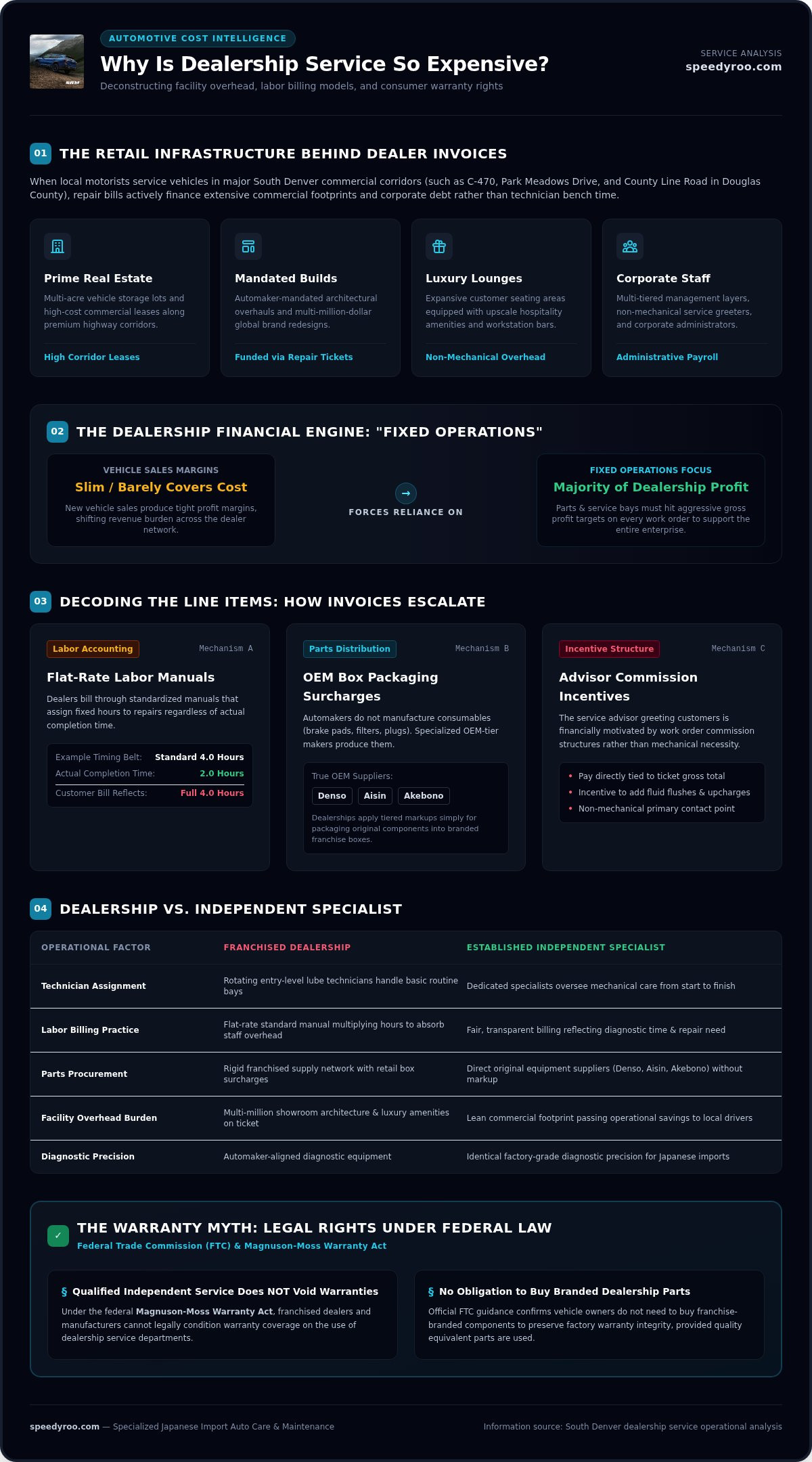
Dealership service departments carry substantial overhead that independent facilities simply do not have to absorb. When you pay for routine maintenance at a regional franchise, your bill covers several facility-wide operational costs:
- Sprawling multi-acre vehicle storage lots and premium commercial real estate leases
- Architectural showroom builds and mandated corporate brand redesigns
- Expansive customer lounges equipped with upscale amenities and workstation bars
- Multi-tiered management layers, non-mechanical service greeters, and corporate administrators
High Real Estate Overhead Along the South Denver Corridor
Commercial property in Douglas County ranks among the most valuable in Colorado. Franchised dealers along the I-25 corridor must comply with rigid automaker mandates that require periodic, expensive renovations to match global branding standards. Dealerships finance these multi-million-dollar architectural overhauls by spreading the debt across daily customer repair tickets. Independent regional facilities operate leaner commercial footprints, passing direct operational savings to local drivers without compromising diagnostic capabilities.
Fixed Operations as a Primary Dealership Profit Center
Automaker retail economics have shifted dramatically over the past two decades. New vehicle sales margins remain slim, which forces dealerships to maximize their “fixed operations,” the industry term for parts and service departments. According to industry analyses of the dealership profit and service department business model, service bays routinely produce the majority of franchised dealership profitability. Because showroom vehicle sales barely cover operating costs, service bays must hit aggressive gross profit targets on every work order. This corporate structure clarifies why is dealer service so expensive Lone Tree residents notice during routine visits, as simple maintenance tasks are systematically leveraged to support the entire enterprise.
Decoding the Dealership Bill: Labor Rates, Parts Markups, and Upcharges
Examining an itemized invoice reveals the mechanical accounting behind dealership totals. While facility overhead sets the foundation, line items for labor, parts distribution, and shop supplies account for the steep figures. Deciphering these specific charges explains why is dealer service so expensive Lone Tree drivers notice, separating legitimate mechanical care from calculated profit matrices.
Flat-Rate Labor vs. Actual Mechanical Time
Dealerships bill through flat-rate labor manuals that assign fixed hours to specific repairs. If a timing belt replacement standardizes at four labor hours, you pay for four hours of technician labor regardless of actual completion time. An experienced mechanic might complete the job in two hours, yet your invoice still reflects the full four-hour charge. Independent specialists prioritize fair, transparent billing without multiplying hours to absorb non-mechanical corporate staff costs.
OEM Parts Surcharges vs. Quality Equivalent Components
Dealership parts departments source items through rigid franchised supply networks. Automakers do not manufacture consumables like brake pads, filters, or spark plugs themselves. Specialized OEM-tier manufacturers like Denso, Aisin, and Akebono produce these components for the factory line. Dealerships apply steep tiered markups simply for packaging those same parts in branded franchise boxes. Choosing an established independent garage gives you access to original equipment supplier components that preserve factory durability without retail packaging markups. In fact, official FTC guidance on auto warranties confirms that vehicle owners do not need to purchase branded dealership parts to keep their factory protection intact.
Service Advisor Pay Structures and the Upsell Incentive
Your primary point of contact at a dealership is not a technician. Service advisors function as commissioned sales professionals whose compensation hinges on repair order dollar averages. This compensation structure explains why simple maintenance often results in recommendations for premature flushes:
- Power steering and transmission flushes urged well ahead of factory maintenance intervals
- Fuel induction and intake valve cleanings added to standard oil change requests
- Cabin and engine air filter replacements billed with elevated labor surcharges
- Miscellaneous shop supply and hazardous disposal percentages added to final totals
Distinguishing between immediate safety needs and commissioned add-ons protects both your car and your budget. Choosing a dedicated partner like Speedy Roo Motorsports & Repair Inc eliminates commission pressure, ensuring your maintenance schedule focuses strictly on mechanical longevity rather than sales quotas.
The Warranty Myth: Do You Void Coverage by Skipping the Dealership?
Many drivers tolerate high invoices simply because they fear that leaving the dealership cancels their new vehicle factory warranty. This anxiety is completely unfounded. When evaluating servicing your car at a dealership versus a local mechanic, the legal freedom to select your own repair facility is protected by longstanding federal legislation. Understanding these legal safeguards explains why is dealer service so expensive Lone Tree drivers ask about, because dealerships often rely on customer hesitation rather than legal reality to retain routine maintenance business.
Only two scenarios legally require franchised dealer execution:
- Official manufacturer safety recalls issued by the National Highway Traffic Safety Administration
- Repairs covered directly under automaker warranty claims performed entirely at manufacturer expense
For all standard maintenance, scheduled fluid changes, and mechanical repairs, you retain total consumer freedom to use qualified independent specialists without risking your warranty coverage.
Understanding the Magnuson-Moss Warranty Act
Passed by Congress in 1975, the federal Magnuson-Moss Warranty Act strictly prohibits automobile manufacturers from conditioning warranty coverage on the use of franchised dealer service bays. Under 15 U.S.C. § 2302(c), automakers cannot force you to purchase proprietary brand parts unless they supply those parts free of charge. If an automaker ever seeks to deny a warranty claim, federal law requires them to prove affirmatively that an aftermarket part or third-party installation error directly caused the failure.
Essential Record-Keeping for Complete Peace of Mind
Preserving your vehicle’s factory warranty coverage outside the dealership comes down to straightforward record-keeping. Dealership service advisors sometimes imply that third-party servicing lacks factory legitimacy, but simple documentation satisfies all manufacturer requirements:
- Retain clear, itemized repair orders detailing every service procedure performed
- Confirm receipts specify exact fluid viscosities and filtration ratings matching factory standards
- Track service dates alongside odometer readings to prove compliance with manufacturer logbook intervals
Independent shops document maintenance systematically, providing clear records that easily satisfy warranty audits. For a deeper look at common misconceptions surrounding independent vehicle care, explore our Japanese import repair in Aurora myth-busting guide to help make informed decisions about your vehicle.
Dealership vs. Independent Specialist: A Clear Comparison Framework
When asking why is dealer service so expensive Lone Tree drivers often assume the premium rate guarantees a master technician handles their car from start to finish. The operational reality inside large franchise service departments is quite different. Comparing corporate service lanes against specialized independent shops reveals distinct contrasts in technician qualifications, diagnostic tooling, and long-term customer care.
Technician Experience: Career Specialists vs. Rotating Lube Techs
Dealership express service lanes experience high employee turnover, regularly assigning routine maintenance, fluid services, and brake jobs to entry-level apprentice technicians. Master technicians are typically reserved for complex warranty overhauls and heavy mechanical failures. Dedicated independent specialty shops rely on career mechanics with decades of focused platform experience handling your car directly. This approach gives you direct access to the professional actually working under your hood, eliminating the communication breakdowns that happen when details pass through intermediary service desks.
Diagnostic Technology and Dedicated Tooling Capabilities
Dealerships no longer hold exclusive access to factory diagnostic technology. Leading independent facilities invest in identical factory-grade scan tools, digital oscilloscopes, and brand-specific diagnostic software. Concentrating on specific vehicle marques gives career mechanics deep familiarity with recurring engineering quirks, ensuring precise first-time troubleshooting without guesswork. Explore our Toyota specialist guide to see how focused tooling and brand mastery match dealership capabilities without corporate overhead.
Personalized Customer Relationships vs. Volume Processing
Franchise service centers operate on volume, cycling dozens of vehicles through their bays daily to satisfy corporate throughput targets. This quota-driven environment inevitably prioritizes fast vehicle turnaround over comprehensive, personalized inspections. Independent neighborhood shops build long-term relationships centered on vehicle preservation, recommending services based on your unique driving habits and genuine component wear. Much like how dedicated preservation studios such as D3 Auto Care LLC emphasize meticulous protection over dealership upcharges, independent repair shops put car owners first. Key advantages of choosing a specialized independent partner include:
- Prioritized safety repairs instead of aggressive, commission-driven package upsells
- Direct accountability from the technician who performs the physical work on your car
- Maintenance schedules customized for Colorado driving conditions rather than generic national dealership quotas
When you are ready to experience thorough mechanical craftsmanship without high corporate markups, connect with Speedy Roo Motorsports & Repair Inc to schedule your service.
Finding Reliable Japanese Import Service Near Lone Tree
Navigating past dealership pricing begins with knowing what to look for in a specialized independent shop. For Douglas County motorists driving Japanese vehicles, finding dependable care is not about choosing between high dealership invoices or risky, generalized corner garages. A short drive across the South Denver metro unlocks dedicated marque specialists who deliver factory-level diagnostic accuracy without retail showroom surcharges. Understanding these technical differentiators solves why is dealer service so expensive Lone Tree car owners often discover when seeking routine maintenance.
Key Criteria for Selecting an Independent Specialist
Selecting the right facility requires evaluating how a shop operates behind the service counter. Look for these baseline standards when choosing an alternative to the dealership:
- Dedicated platform focus: Prioritize facilities specializing in Japanese engineering rather than shops attempting to service every domestic and European make.
- Component standards: Confirm the shop utilizes factory-grade fluids, filtration, and Original Equipment Supplier components.
- Non-commissioned advisors: Choose facilities where service recommendations stem from genuine component wear rather than monthly sales quotas.
- Demonstrated community tenure: Look for a proven local operating history backed by long-standing regional customer feedback.
If you drive an all-wheel-drive platform, consult our Subaru repair in Aurora resource to learn how dedicated tooling directly benefits horizontal boxer engines and symmetrical drivetrains.
Why Lone Tree Drivers Choose Speedy Roo Motorsports & Repair Inc
Serving Denver metro and Douglas County drivers since 2002, Speedy Roo Motorsports & Repair Inc provides Lone Tree motorists with an established, honest alternative to dealership service lanes. We eliminate commissioned service advisors and corporate sales quotas entirely, focusing our mechanical capability on the vehicle brands we know intimately.
Our dedicated technicians specialize exclusively in Japanese import platforms, including:
- Subaru Repair and Service
- Toyota Repair and Service
- Lexus Service & Repair
- Honda Repair and Service
- Mazda Repair and Service
- Nissan Service and Repair
Our facility provides full mechanical capability, ranging from factory-interval scheduled maintenance and complex diagnostics to pre-sale inspections and performance Aurora Dyno Tuning. You receive master-level precision tailored to Colorado driving demands, completely free from the facility markups explaining why is dealer service so expensive Lone Tree drivers face. To partner with an honest neighborhood specialist dedicated to your vehicle’s mechanical longevity, schedule your inspection with Speedy Roo Motorsports & Repair Inc today.
Take Control of Your Vehicle Maintenance in Lone Tree
High repair bills do not guarantee superior mechanical attention. Understanding why is dealer service so expensive Lone Tree drivers face frees you to invest in actual vehicle care rather than commercial corridor real estate and advisor sales quotas. Federal law fully protects your right to choose independent maintenance, allowing you to preserve factory warranty coverage while receiving focused, transparent service.
Serving Denver metro and Lone Tree drivers since 2002, Speedy Roo Motorsports & Repair Inc provides a dependable alternative centered on mechanical integrity. Our dedicated specialists focus strictly on Japanese platforms, including Subaru, Toyota, Lexus, Honda, Mazda, and Nissan. Because our shop operates without corporate sales commissions or bloated facility overhead, every service recommendation centers solely on what your car genuinely needs to run reliably. Experience Honest Specialist Care at Speedy Roo Motorsports & Repair and enjoy true peace of mind on the road ahead.
Frequently Asked Questions
Will servicing my car at an independent shop void my factory warranty in Lone Tree?
No, servicing your vehicle at a qualified independent shop will not void your factory warranty. Under the federal Magnuson-Moss Warranty Act, automakers cannot mandate that maintenance happen at franchised dealerships to maintain coverage. You simply need to retain itemized invoices showing that scheduled services followed factory intervals with appropriate fluid specifications.
Why do dealership service departments charge significantly higher labor rates than independent shops?
Franchised dealerships inflate billable labor rates to subsidize massive non-mechanical operating overhead. Their higher hourly charges fund commercial real estate leases, corporate brand remodels, loaner fleets, and extensive administrative payroll. Independent facilities operate leaner physical locations, focusing their labor billing strictly on technician expertise rather than executive showroom amenities.
Do dealerships install better replacement parts than independent repair specialists?
No, dealerships install the same mechanical components that dedicated independent specialists source. Automakers rarely manufacture their own wear items; tier-one suppliers like Denso, Aisin, and Akebono build them. Independent shops source these identical Original Equipment Supplier parts directly, bypassing the retail packaging markup that helps explain why is dealer service so expensive Lone Tree drivers encounter.
Are independent mechanics trained to service complex modern Japanese imports like Subaru and Lexus?
Yes, career specialists at dedicated independent facilities possess extensive technical training on modern Japanese platforms. Many independent mechanics developed their expertise working directly within franchised dealership networks before moving to private practice. They invest in the exact same factory-level scan tools and technical software required to diagnose intricate boxer engines, hybrid systems, and all-wheel-drive drivetrains.
How do dealership service advisors get paid, and does it affect my repair quote?
Dealership service advisors work largely on commission matrices and bonus structures tied directly to repair order gross totals. This compensation model creates financial pressure to recommend non-essential fluid flushes and preventative services before factory-recommended intervals. Independent shops operate without commissioned advisors, ensuring your repair quotes reflect genuine component wear rather than monthly sales quotas.
Can an independent shop perform official software updates and computer diagnostics?
Yes, established independent facilities have full capability to run official diagnostics, calibrate sensors, and execute electronic control unit programming. Leading shops maintain commercial subscriptions to automaker technical networks and deploy factory-grade diagnostic scanners. This ensures your vehicle receives identical diagnostic precision without the high diagnostic fee schedules typical of franchised service lanes.
What automotive services legally require a visit to a franchised dealership?
Only official safety recall campaigns and repairs performed under active factory warranty coverage require a visit to a franchised dealership. Automakers legally mandate that franchise bays execute these specific tasks because the manufacturer pays the bill directly. For all other scheduled maintenance, brake jobs, fluid changes, and specialized services like key replacement—where independent resources such as Soxxi Master illustrate cost-effective alternatives to dealer markups—you have full freedom to choose an independent specialist.