
A clean-looking car can still have problems that aren’t obvious during a quick test drive. A used car inspection Centennial buyers arrange before committing can provide a clearer picture of the vehicle’s condition and help identify questions to ask before a hidden issue becomes an unexpected repair.
It’s understandable to feel rushed when a seller has other interested buyers. But an inspection isn’t just a pass-or-fail verdict. The findings can help you distinguish concerns that need attention from routine maintenance and decide what to ask before moving forward. No inspection can predict every future problem, but a professional assessment gives you useful information to weigh alongside the car’s history, price, and your own observations.
This checklist covers what to look for during your initial review, what to ask about a professional pre-sale inspection, and how to assess the findings without letting time pressure make the decision for you. If you’re considering a Japanese vehicle, Speedy Roo Motorsports & Repair Inc in Aurora specializes in Subaru, Toyota, Lexus, Mazda, Honda, and Nissan service, and serves nearby Centennial buyers.
Key Takeaways
- A used car inspection Centennial buyers arrange before purchase can reveal current concerns while there’s still time to ask questions and weigh options.
- Use the exterior, cabin, under-hood, underbody, tire, and road-test checklist as a guide, then confirm the inspection scope with the shop.
- Group findings into safety concerns, significant repairs, and routine maintenance, and ask the inspecting technician about urgency and recommended follow-up.
- When requesting an inspection, share the vehicle’s year, make, model, mileage, and known concerns. Review the findings before making a decision.
- Compare local shop options based on the vehicle and the inspection process each shop can confirm. Speedy Roo is an independent repair facility in Aurora serving nearby Centennial communities.
Why get a used car inspection in Centennial before you buy?
A promising used car can attract other buyers, and a seller may want a quick answer. Before you commit, a used car inspection Centennial buyers arrange independently can add a technician’s assessment to the seller’s description and your own test drive. It may reveal observable concerns to discuss, help you prioritize follow-up questions, or give you reason to reconsider.
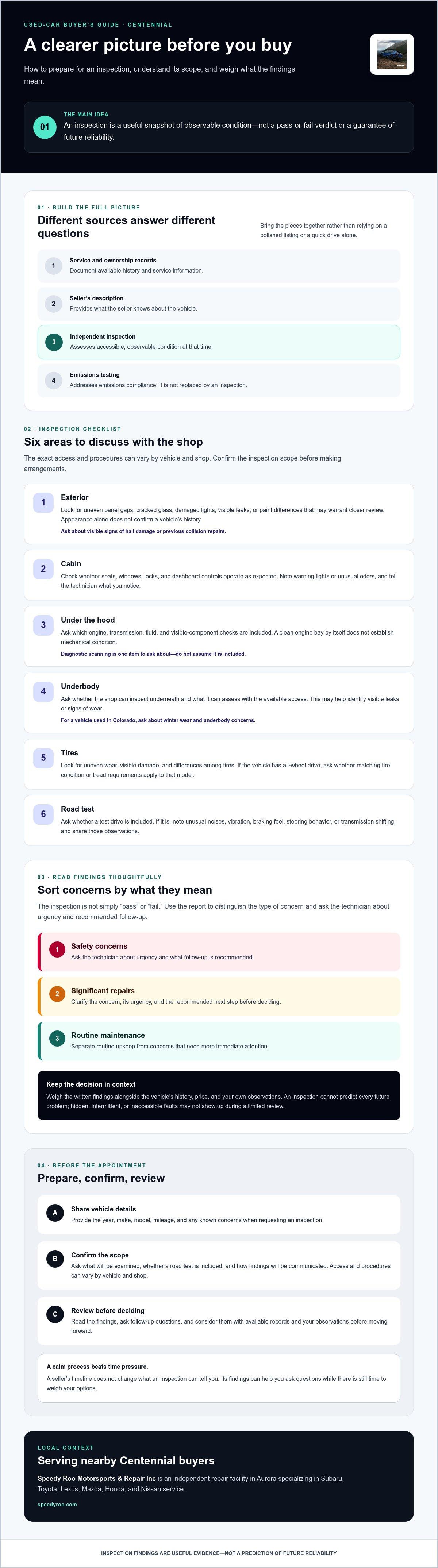
An inspection is a snapshot of the vehicle’s accessible, observable condition at that time, not a guarantee of future reliability. It also doesn’t replace the seller’s description, available maintenance records, or any emissions testing that may apply. Each source answers a different question: records document service history, the seller shares what they know, an inspection assesses condition, and emissions testing addresses emissions compliance.
A useful review brings several kinds of information together: service and ownership records, visible condition, a mechanical assessment, a road test when appropriate, and written findings. For a neutral overview of the concept, see Pre-purchase inspection. Ask the shop what its inspection currently covers before making arrangements, since access and procedures can vary by vehicle and shop.
What a pre-purchase inspection can, and cannot, tell you
A technician can report concerns observed during the agreed inspection, but hidden, intermittent, or inaccessible faults may not show up. A symptom that occurs only under certain conditions, for example, may not appear during a limited review or road test. Ask what will be examined, whether a road test is included, and how the shop communicates its findings. Treat the report as useful evidence, not a prediction.
Why Centennial buyers should check the vehicle’s history and condition together
Records and a physical review complement each other. Compare available maintenance documents and ownership details with the vehicle’s present condition, and ask about reported incidents when documentation is available. For a vehicle that has spent time in Colorado, ask the technician to look for signs of winter wear or underbody concerns. If hail damage is a concern, ask about visible indicators without assuming the car has been affected.
For more guidance on evaluating a Japanese import before purchase, read the Aurora pre-sale vehicle evaluation buyer’s guide. Reviewing both history and present condition can help you make a decision based on more than a polished listing or a seller’s assurances.
What should a professional used car inspection in Centennial check?
A used car inspection Centennial buyers arrange should provide a practical account of what a technician can observe, not just a quick look under the hood. The exact access and procedures depend on the vehicle and the shop’s confirmed scope, so ask what the inspection includes before booking. Diagnostic scanning is one item to ask about, but don’t assume it’s included.
Use these areas as a checklist to discuss with the shop:
- Exterior: Look for uneven panel gaps, cracked glass, damaged lights, visible leaks, or paint differences that may warrant closer review. Signs of previous hail or collision repairs can prompt questions, but appearance alone doesn’t confirm a vehicle’s history.
- Cabin: Check whether seats, windows, locks, and dashboard controls operate as expected. Note warning lights and unusual odors, and tell the technician what you notice.
- Under the hood: Ask which engine, transmission, fluid, and visible-component checks are included. A clean engine bay by itself doesn’t establish the vehicle’s mechanical condition.
- Underbody: Ask whether the shop can inspect underneath the vehicle and what it can assess with the available access. This can help check for visible leaks or signs of wear, including concerns about winter use.
- Tires: Look for uneven wear, visible damage, and differences among the tires. If the vehicle has all-wheel drive, ask whether the manufacturer’s requirements for matching tire condition or tread apply to that specific model.
- Road test: Ask whether a test drive is included. If it is, note unusual noises, vibration, braking feel, steering behavior, or transmission shifting, and share those observations.
Mechanical systems, warning lights, and the road test
Before the appointment, ask which engine, transmission, brake, steering, suspension, and fluid checks the shop performs, and whether it can scan diagnostic codes. A warning light or unusual sound may point to an area that needs further diagnosis, but it isn’t a complete diagnosis by itself. The FTC’s guidance on consumer rights when buying a used car also recommends considering an independent inspection and reviewing the dealer’s Buyers Guide.
If you’re considering a Subaru, learn more about Subaru repair and specialist care in Aurora. Speedy Roo Motorsports & Repair Inc is an independent Aurora facility serving nearby Centennial communities. You can ask Speedy Roo about its pre-sale inspection and confirm the current scope for the vehicle you’re considering.
How to evaluate inspection findings before buying a used car
A report from a used car inspection Centennial buyers arrange is evidence to guide a decision, not a price appraisal or guarantee of what the vehicle is worth. Read each finding in context. Ask what the technician observed, what could not be assessed, and whether further diagnosis is recommended. Urgency and repair implications depend on the specific vehicle and the technician’s assessment.
This framework can help organize the discussion. It doesn’t replace the technician’s judgment, and a note in one category doesn’t automatically mean a car is unsafe or defective.
| Finding group | How to follow up |
|---|---|
| Immediate safety concerns | Ask the technician to identify any safety-related issue and explain its practical significance before driving or proceeding with the purchase. |
| Significant repairs | Clarify which component or system is involved, whether further diagnosis is needed, and what the concern could mean for your intended use. |
| Routine maintenance | Ask what service appears due and whether the finding is based on an observed condition or an available maintenance record. |
Which findings should make a buyer pause?
Ask the inspecting technician to explain safety-related findings in plain language. Structural concerns, severe mechanical symptoms, or an unclear history are reasons to seek more information or further evaluation, not automatic verdicts based on a generic checklist item. If a report uses an unfamiliar term or gives a conclusion without context, ask what was observed and what remains uncertain. A clean inspection is not a guarantee against future failures.
When to proceed, negotiate, or walk away
Decide based on the findings alongside the ownership history, your budget for potential repairs, and how you plan to use the vehicle. If the report documents repair needs, discuss them factually with the seller and ask whether they’re willing to address them or reconsider the terms. An inspection can support that conversation, but it can’t guarantee a price reduction.
Consider pausing if a material concern is unexplained, the seller won’t allow reasonable follow-up, or you’re uncomfortable with the remaining uncertainty. Proceed only when the information you have fits your risk tolerance. You might request clarification, arrange further evaluation, continue with a clear understanding of the findings, or decline the purchase.
How Centennial buyers can prepare for a used car inspection
A little coordination can make a used car inspection Centennial buyers arrange more useful and reduce last-minute uncertainty. Confirm the shop’s process and the seller’s access arrangements before choosing a time. Don’t assume a particular inspection scope, turnaround, or drop-off arrangement. Verify the details directly.
Questions to ask the inspection shop and seller
Ask the shop which areas it currently inspects, what limitations apply, how findings are documented, and whether it can assess the vehicle’s make and model. Confirm who will arrange access and what the seller needs to do to make the vehicle available under conditions agreed with the shop. Request maintenance records from the seller and ask about known issues, warning lights, or symptoms. Keep the seller’s answers alongside the inspection findings so you can compare the vehicle’s history with its observed condition.
Use this sequence to stay organized:
- Contact the shop. Share the vehicle’s year, make, model, mileage, location, and any concerns already reported.
- Confirm scope and logistics. Ask what the inspection covers, how long the process may take, how the vehicle should be made available, and how you’ll receive the findings. Verify these details directly rather than relying on assumptions.
- Coordinate with the seller. Agree on access with the seller and confirm the vehicle will be available as the shop requests. Don’t treat a seller’s informal description as a substitute for an inspection.
- Gather what’s available. Request maintenance records and note ownership details, reported incidents, warning lights, or concerns you want the technician to consider.
- Separate emissions questions. Ask whether emissions testing requirements for the vehicle’s location are a separate step from the mechanical pre-purchase inspection. Confirm applicable requirements with the relevant source. Don’t assume one assessment includes the other.
- Review the report. Before deciding, ask the technician to explain unfamiliar terms, assessment limitations, and recommended follow-up.
Prepare vehicle-specific questions for a Japanese import
For a Japanese vehicle, share any available service history and describe symptoms as clearly as you can. An intermittent noise, a warning light that comes and goes, or a handling concern can help frame questions, even if it isn’t present during the inspection. Ask whether the model’s maintenance history needs closer review without assuming a particular defect. If you’re comparing repair expertise, see Japanese import repair myths explained.
Speedy Roo Motorsports & Repair Inc is an independent Aurora facility serving nearby communities, including Centennial, and offers pre-sale inspections. Ask Speedy Roo about arranging a pre-sale inspection and confirm the scope and logistics for the vehicle you’re considering.
Arrange a used car inspection near Centennial with Speedy Roo
Once you know what you want assessed, find a shop that can inspect the specific vehicle and explain its process clearly. Buyers arranging a used car inspection Centennial area can consider Speedy Roo Motorsports & Repair Inc, an independent repair facility in Aurora serving nearby communities, including Centennial. The shop offers pre-sale inspections and specializes in Subaru, Toyota, Lexus, Mazda, Honda, and Nissan vehicles.
Speedy Roo has operated since 2002. That history provides context about the business, but it isn’t a promise about the outcome of an inspection. An inspection can help you understand observed condition and potential concerns; it can’t identify every possible fault or guarantee future reliability. Confirm the current scope and arrangements directly before making plans.
What to confirm when contacting Speedy Roo
Share the vehicle’s make, model, and year, then ask whether the shop can inspect that specific car. Clarify what the pre-sale inspection currently covers, what limitations may apply, and how the findings will be shared. Confirm availability and how the vehicle can be made accessible, including who coordinates with the seller. Scheduling, inspection scope, and other service details must be confirmed with the shop.
Having these details ready can make the conversation more productive. Gather:
- The vehicle’s year, make, model, and mileage
- The seller’s contact information and any access instructions
- Available maintenance records and known concerns, such as warning lights or unusual noises
- Questions about the inspection process or how you’ll receive and discuss the findings
Take the next step with a clear decision framework
After the inspection, weigh the findings alongside the vehicle’s records, the seller’s information, and your own needs. Ask for clarification if a note is unfamiliar or doesn’t explain what was observed. Then decide whether the remaining concerns fit your comfort level. You might proceed, ask the seller follow-up questions, seek additional evaluation, or reconsider the purchase. The report is a tool for making an informed choice, not a verdict on the car’s value or future.
If you’re considering a Japanese vehicle or want to confirm the process for a particular model, contact Speedy Roo about a pre-sale inspection. Discuss the vehicle details, confirm the current scope and logistics, and determine whether the shop is a suitable fit before coordinating with the seller.
Make your next step an informed one
A used car inspection Centennial buyers arrange can provide an independent view of a vehicle’s observed condition before they commit. Use the findings alongside available records and the seller’s answers, then ask the technician to explain anything unclear. The report can help you weigh concerns and decide whether to proceed, seek more information, or keep looking, but it can’t guarantee future reliability.
If you’re considering a Japanese vehicle, Speedy Roo Motorsports & Repair is an independent Aurora shop serving nearby communities, including Centennial. It has operated since 2002, offers pre-sale inspections, and specializes in Japanese vehicles. Confirm directly whether the shop can inspect your specific vehicle, what the current inspection scope includes, and how to coordinate access.
Have the vehicle details and known concerns ready. When you’re prepared to ask about the inspection process, contact Speedy Roo about a pre-sale inspection. Taking time to understand the findings can help you move forward with greater clarity.
Frequently Asked Questions
Is a used car inspection worth it before buying in Centennial?
Yes. An independent inspection can help you understand a vehicle’s observable condition before you commit. It may reveal concerns that aren’t clear from a listing, seller description, or brief test drive, and give you specific questions to ask. A used car inspection Centennial buyers arrange is most useful alongside available maintenance records and vehicle history. It can inform your decision, but it can’t identify every hidden issue or predict future repairs.
What does a professional used car inspection include?
The inspection scope varies by shop and vehicle, so ask what’s included before arranging one. Areas to discuss may include the exterior, cabin, tires, visible engine components, underbody access, and a road test. Ask whether diagnostic scanning is included rather than assuming it is. Clarify how the shop documents its findings and what limitations apply. A written report can help you understand observed concerns and decide what needs follow-up.
Can I have a mechanic inspect a used car before I buy it?
Yes. Ask an independent repair shop whether it can perform a pre-sale inspection on the specific vehicle before you purchase it. Share the year, make, model, mileage, and known concerns, then confirm the scope and how the seller will make the vehicle available. Speedy Roo Motorsports & Repair is based in Aurora and serves local buyers in Denver, Centennial, Parker, and Lone Tree. Confirm details directly with the shop.
What happens if a seller refuses a pre-purchase inspection?
If a seller refuses, ask why and whether another reasonable inspection arrangement is possible. Don’t assume the refusal proves there’s a problem, but recognize that you’ll have less independent information about the car’s condition. Consider whether you’re comfortable proceeding based on the records and access you do have. If important questions remain unanswered or the seller won’t permit reasonable evaluation, pausing or choosing another vehicle may better fit your risk tolerance.
Can a used car inspection guarantee the vehicle will not need repairs?
No. An inspection reports the condition a technician can observe within the agreed scope at that time. It can’t guarantee future reliability or rule out every hidden, intermittent, or inaccessible fault. A symptom that appears only under certain conditions, for example, might not show up during an inspection. Ask the technician to explain any limitations and recommended follow-up. Use the report alongside service records and the seller’s answers.
Should I get a used Subaru or Toyota inspected before buying?
Yes. Having a used Subaru or Toyota independently inspected can help you understand its observed condition before purchase, regardless of its reputation or service history. Share available maintenance records and describe symptoms such as warning lights, unusual noises, or handling concerns. Speedy Roo specializes in Japanese vehicles, including Subaru and Toyota, and offers pre-sale inspections from its Aurora facility. Ask whether the shop can inspect the specific year and model, and confirm the current scope.
Is a pre-purchase inspection the same as an emissions test in Colorado?
No. A mechanical pre-purchase inspection assesses aspects of a vehicle’s condition within the shop’s agreed scope, while an emissions test addresses emissions requirements. Don’t assume one includes or replaces the other. Whether emissions testing applies depends on the vehicle and its location, so verify current requirements with the appropriate Colorado emissions authority. Ask the inspection shop what its assessment covers, and plan separately for any required emissions test.