
Could a warning light, CVT whine, or new vibration mean your Crosstrek is unsafe, or point to an issue that can be monitored? A search for Subaru Crosstrek problems Centennial drivers may encounter can bring up long lists of alleged failures, but a symptom alone doesn’t confirm a specific fault. The model year, maintenance history, and diagnostic findings all matter.
Before deciding whether to keep driving, schedule a repair, or reconsider a used Crosstrek, start with what the vehicle is doing and when. This guide explains which changes deserve prompt attention, how to separate model-year-specific concerns from broad online reports, and what information can help a technician investigate the cause.
We’ll cover common symptom categories, the role of recalls and vehicle-specific diagnosis, and when repair, monitoring, or a pre-purchase inspection may make sense. Speedy Roo Motorsports & Repair in nearby Aurora provides Subaru repair, maintenance, and diagnostic services for Centennial-area drivers, helping them make informed decisions based on the vehicle’s condition.
Key Takeaways
- Online lists of Subaru Crosstrek problems Centennial drivers find may not apply to every model year or vehicle. Treat reported symptoms as clues to investigate, not confirmed diagnoses.
- Note when a symptom occurs, whether it changes, and any warning messages. Those details give a technician useful diagnostic evidence.
- Choose between prompt assessment, scheduled diagnosis, and monitoring based on the symptom’s urgency and whether the vehicle feels safe to operate.
- Bring maintenance records and details of recent repairs to help put the current concern in context.
- Check the Crosstrek’s recall status by VIN, then use diagnostic findings to weigh repair recommendations and next steps.
What Subaru Crosstrek Problems Should Centennial Drivers Watch For?
Online problem lists rarely apply equally to every Crosstrek. A concern reported by one owner may depend on the vehicle’s model year, mileage, maintenance history, or a separate fault that produces a similar symptom. Use those lists to decide what to observe, not to conclude that a particular part has failed or that every Crosstrek has a known defect.
When researching Subaru Crosstrek problems Centennial drivers have reported, connect the symptom to its circumstances. Owner concerns can include oil consumption, CVT slipping or whining at higher mileage, suspension wear, and electrical quirks. These broad reports don’t establish a model-year-specific pattern for your vehicle. A technician needs to assess the Crosstrek and review relevant technical information before reaching that conclusion.
Which Crosstrek symptoms deserve prompt attention?
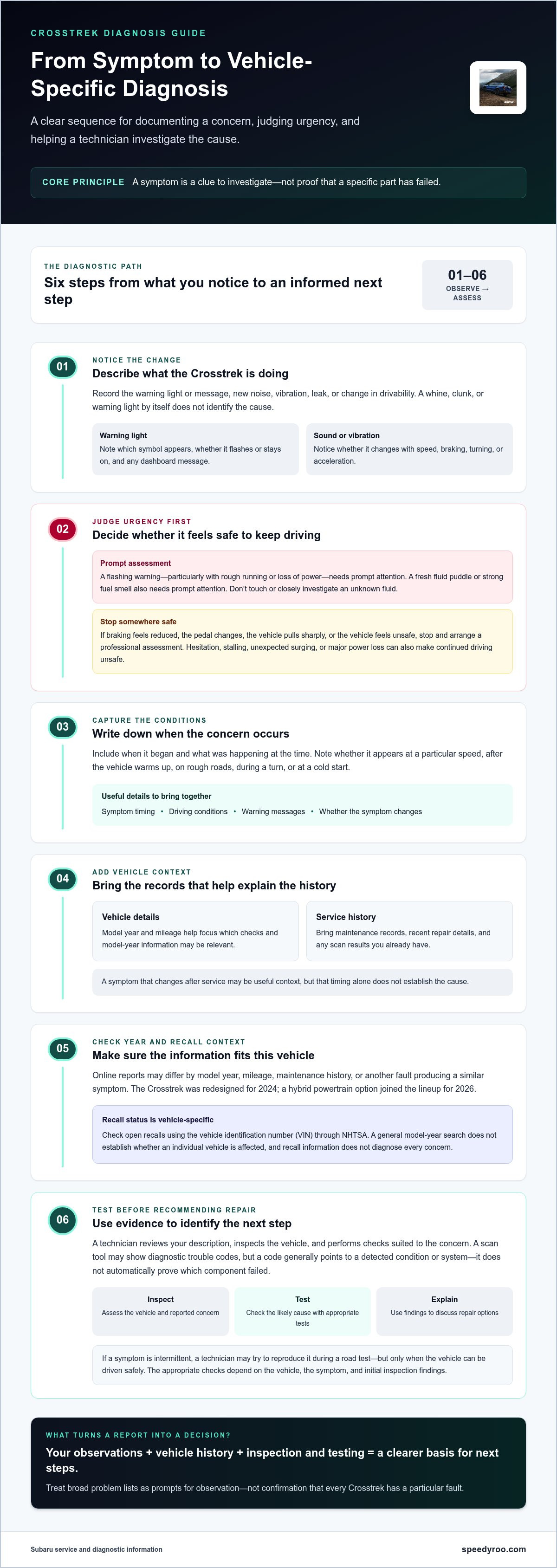
Pay attention to sudden changes, especially those affecting control or safe operation. A warning light’s meaning depends on which light appears, whether it flashes or stays on, and whether other symptoms occur at the same time.
- Warning lights: Note the symbol and any dashboard message. A flashing warning, particularly with rough running or loss of power, calls for prompt assessment.
- New noises or vibration: Record whether the sound changes with speed, braking, turning, or acceleration. A whine or clunk by itself doesn’t identify the cause.
- Fluid leaks: A fresh puddle or strong fuel smell needs prompt attention. Don’t touch or closely investigate an unknown fluid.
- Drivability changes: Hesitation, stalling, unexpected surging, or a major loss of power can make continued driving unsafe.
- Braking concerns: If braking feels reduced, the pedal changes, or the vehicle pulls sharply, stop somewhere safe and arrange a professional assessment instead of continuing to drive.
If the vehicle feels unsafe, stop in a safe place and arrange an assessment. Don’t diagnose a failed component from a sound or warning light alone.
Why do reported problems vary by Crosstrek model year?
Generations, available powertrains, mileage, and service history affect which checks are relevant. The Crosstrek was redesigned for 2024, and a hybrid powertrain option joined the lineup for 2026, so details from one year may not apply to another. For background on generations and specifications, see this overview of Subaru Crosstrek history.
Before seeking Subaru repair, note the model year, mileage, warning messages, and conditions when the symptom occurs, such as a cold start or a turn. Maintenance and recent repair records add context. Recall status is specific to the vehicle, so check it by VIN through NHTSA. For more on specialized service, see the Subaru repair guide for Centennial-area owners.
How a Technician Diagnoses Subaru Crosstrek Problems in Centennial
A good diagnosis follows evidence rather than a guess based on a familiar-sounding symptom. A technician starts with your description, inspects the vehicle, and performs tests suited to the concern. The findings help identify the cause and guide any repair recommendations.
Diagnostic testing gathers evidence to help identify the cause of a vehicle concern before repair recommendations are made. A scan tool may reveal diagnostic trouble codes, but a code generally points to a detected condition or system. It doesn’t automatically prove which component failed. Further inspection and testing help determine whether the cause involves a part, wiring, a connection, or another condition.
What information helps pinpoint a Crosstrek fault?
Your observations can focus the investigation, especially when a problem comes and goes. Note when it began and what was happening at the time. Does it occur at a particular speed, after the vehicle warms up, on rough roads, or during a turn? Include the model year and mileage, plus any warning messages and scan results you already have.
Share maintenance records and details of recent repairs, too. A change after service may provide context, but it doesn’t establish the cause on its own. If the symptom is intermittent, a technician may try to reproduce it during a road test, but only when the vehicle can be driven safely. The appropriate checks depend on the Crosstrek, the reported symptom, and what the initial inspection reveals.
How do model-year records and recalls fit into diagnosis?
Recall information is one part of the vehicle’s history. It can identify a manufacturer’s safety action that applies to specific vehicles, but it doesn’t diagnose every warning light, noise, or drivability concern. Check for open recalls using the vehicle identification number (VIN) through NHTSA recalls for Subaru Crosstrek. A general model-year search may not establish whether your individual vehicle is affected.
Service history shows what maintenance or repairs have been performed; current symptoms describe what’s happening now. Neither replaces an inspection and appropriate testing. A technician considers these details together, reviews relevant model-year information, and explains what the findings support before discussing repair options.
This process turns Subaru Crosstrek problems Centennial owners read about online into a vehicle-specific assessment. Speedy Roo Motorsports & Repair provides Subaru diagnostic and repair services in nearby Aurora, with clear explanations to help owners understand the findings and consider a practical next step.
Crosstrek Repair or Continued Driving: How Centennial Owners Can Compare Options
A reported Crosstrek issue doesn’t automatically mean a major repair is inevitable. The right next step depends on how the vehicle behaves, whether it feels safe to operate, and what an inspection finds. An online list can’t make that decision for your specific car.
Consider three paths: seek prompt assessment for a potentially unsafe change, schedule diagnosis for a recurring or concerning symptom that isn’t affecting safe operation, or monitor a mild, stable change while noting when it occurs. If you’re uncertain, an assessment can help clarify the concern before you decide whether to keep driving.
| Situation | Useful evidence | Next action |
|---|---|---|
| Vehicle feels unsafe, loses control, has a severe braking change, or shows signs of overheating | Warning messages, changes in handling or braking, temperature indication, and when the problem began | Stop somewhere safe and arrange assistance and professional assessment. Don’t continue driving if the vehicle may be unsafe. |
| A recurring noise, warning light, or drivability change without an immediate safety concern | When it happens, how often, and whether speed, temperature, or road conditions affect it | Schedule diagnosis and share your observations. |
| A mild, stable change with no warning messages or effect on safe operation | Notes on whether it changes, plus relevant maintenance or repair records | Monitor and arrange an assessment if it worsens, persists, or affects driving. |
When should you stop driving and seek an assessment?
Loss of control, a substantial change in braking, or an overheating indication deserves prompt attention. These signs don’t identify a failed part, but they can make continued driving unsafe. Pull over somewhere safe and arrange appropriate assistance rather than trying to reach a shop under your own power. If the vehicle remains controllable and the symptom is mild, a scheduled assessment may be reasonable. A general online list can’t determine whether your Crosstrek is safe to drive.
When does a second look or pre-purchase inspection help?
A second assessment can help when a diagnosis is unclear or you’re considering a used Crosstrek and want a clearer picture of its current condition. Bring available service records and the seller-provided vehicle history. They add context but don’t replace an inspection. For an AWD vehicle, maintenance history and drivetrain condition are useful parts of that review. See the Subaru AWD maintenance reference for related service considerations.
For Subaru Crosstrek problems Centennial owners are weighing, Speedy Roo Motorsports & Repair in nearby Aurora provides Subaru repair and pre-sale inspections. A vehicle-specific assessment can help turn uncertainty into practical next steps. Explore Subaru repair and service.
What Centennial Subaru Owners Can Do Before a Repair Appointment
A clear symptom history helps a technician decide where to begin, especially when a concern appears only under certain conditions. Before your Subaru repair appointment, write down what you’ve noticed rather than trying to identify the failed part yourself. For Subaru Crosstrek problems Centennial owners are tracking, useful details include when the issue began, how often it occurs, and whether it has changed.
How can Colorado driving conditions affect symptom reports?
Note relevant conditions such as a cold start, a temperature change, snow, or a rough or slippery road. For example, record whether a sound occurs only after the vehicle has been parked outside, or whether a warning appears during a particular drive. A connection to weather or road conditions can help with diagnosis, but it doesn’t prove the cause or establish a unique problem pattern for Centennial.
What should you bring to a Subaru diagnostic appointment?
Gather the basics before heading from Centennial to Speedy Roo’s Aurora repair shop. A short timeline and supporting records can help the technician understand what needs investigation.
- Vehicle details: Bring the vehicle identification number (VIN), model year, and current mileage.
- Symptom timeline: Note when the concern started, how often it happens, and whether it is getting worse.
- Driving conditions: Include speed, temperature, road surface, cold starts, and other circumstances that seem relevant.
- Warnings and evidence: Record dashboard messages and scan results, if available. Photos or a short recording may document a sound or visible change.
- Vehicle history: Bring maintenance records and details of recent repairs, including when the work was done and what concern led to it.
These details support focused testing but don’t replace an inspection. A useful description narrows the possibilities; the technician still needs to assess the vehicle and determine what the evidence shows.
Preparing these notes can make the conversation clearer and help you understand the next step. Talk with Speedy Roo about Subaru service.
Subaru Crosstrek Repair in Centennial: A Clear Path from Symptoms to a Decision
A warning light, unfamiliar sound, or change in how your Crosstrek drives is a reason to investigate, not assume the worst. A practical decision starts with the symptom, then considers the vehicle’s details and what an inspection shows. That approach helps Centennial owners move from online concern to a vehicle-specific plan.
The process is straightforward:
- Describe the symptom: Note what changed and when it happens.
- Verify vehicle details: Share the model year, mileage, maintenance history, and relevant recall information.
- Diagnose the concern: Use inspection and appropriate testing to gather evidence about the cause.
- Compare recommendations: Review the findings, urgency, and options before deciding whether to repair, monitor, or investigate further.
Speedy Roo Motorsports & Repair is an independent shop in nearby Aurora specializing in Subaru and other Japanese vehicles. The team provides Subaru repair, maintenance, and diagnostic services for drivers in Centennial, Aurora, Denver, Parker, and Lone Tree.
What should a clear Subaru repair recommendation explain?
A useful recommendation connects the finding to the evidence. It explains what the inspection or test showed, how that relates to the reported symptom, and whether the issue affects safe operation. The next step should be clear, including which work is recommended and what may be monitored. Understanding priorities helps you make an informed decision before authorizing repairs, without relying on a part name or code alone.
How can Centennial drivers move forward with confidence?
A reported problem doesn’t mean a major repair is inevitable. Thorough diagnosis can clarify whether the concern calls for prompt attention, a scheduled repair, or continued monitoring. Ask for an explanation of the findings and how each recommendation relates to the evidence, then weigh the options against the vehicle’s condition and your needs. For more on local Subaru service, read the Subaru repair specialist guide.
If you’re ready to discuss a Crosstrek concern, schedule Subaru service with Speedy Roo. A clear account of the symptoms gives the diagnostic process a useful place to start.
Turn Crosstrek Concerns Into a Clear Next Step
A warning light, unusual noise, or change in how your Crosstrek drives is a reason to investigate, not a diagnosis. Model year, mileage, maintenance history, and test results help distinguish a vehicle-specific fault from broad online claims. If the vehicle seems unsafe, prioritize an assessment. For less urgent concerns, careful symptom notes can help guide diagnosis.
Understanding Subaru Crosstrek problems Centennial owners may encounter starts with evidence. Note when the symptom occurs, bring relevant service records, and review the findings before deciding whether repair or monitoring makes sense. A clear recommendation should explain what testing found and why a next step is advised.
Speedy Roo Motorsports & Repair is an independent Japanese-vehicle repair shop in nearby Aurora, serving drivers in Centennial, Aurora, Denver, Parker, and Lone Tree with Subaru repair and diagnostic services. If your Crosstrek needs attention, schedule Subaru service with Speedy Roo.
Frequently Asked Questions
Are Subaru Crosstrek problems common across every model year?
No. Reported problems don’t apply equally to every Crosstrek. Model year, powertrain, mileage, maintenance, and the vehicle’s individual history affect which concerns are relevant. A complaint about one generation isn’t proof of a defect in another. If you’re researching Subaru Crosstrek problems Centennial owners may encounter, use online reports as background, then base decisions on the specific vehicle’s symptoms and diagnostic findings.
What are the most common Subaru Crosstrek problems to investigate?
Reported owner concerns include engine oil consumption, CVT slipping or whining at higher mileage, suspension wear, and electrical quirks. These are prompts for investigation, not confirmed diagnoses or universal defects. Note what you observe, such as when a sound occurs or whether a warning message appears, and share those details with a technician. Verify any model-year-specific pattern against relevant technical information before applying it to your Crosstrek.
Can I keep driving my Subaru Crosstrek if a warning light comes on?
It depends on the warning and how the vehicle behaves. Check the owner’s manual for the light’s meaning, and note whether it’s flashing or accompanied by rough running, loss of power, overheating indications, or braking changes. If the vehicle seems unsafe to operate, pull over somewhere safe and arrange assistance. Don’t assume a warning light identifies a failed part or that it’s safe to keep driving without assessing the specific situation.
How can I check whether my Subaru Crosstrek has an open recall?
Use the National Highway Traffic Safety Administration’s recall lookup and enter your vehicle identification number (VIN) to check for open recalls tied to your vehicle. A model-year search can provide general information, but it won’t establish whether a specific Crosstrek is affected. Recall status is separate from diagnosing a current noise, warning light, or drivability concern, so share relevant recall information as part of the vehicle’s history.
Is a Subaru Crosstrek expensive to repair?
Repair expense depends on the specific fault, model year, parts required, and work needed, so there’s no reliable cost that applies to every Crosstrek. A warning light or online complaint alone can’t establish the repair scope. Ask for an explanation of the diagnostic findings and which work is recommended first. Comparing the vehicle’s overall condition and maintenance history with the proposed repair plan can help you decide whether to repair, monitor, or reassess.
What should I do if my Crosstrek makes a new noise or loses power?
If power loss is sudden, severe, or makes the vehicle difficult to control, stop somewhere safe and arrange assistance rather than continuing to drive. For a new noise without an immediate safety concern, note when it occurs, such as during acceleration, braking, turning, or a cold start, and schedule an assessment. Share warning messages, recent repairs, and maintenance records. A noise or power change can have several causes, so testing is needed before recommending repairs.
Where can Centennial drivers get Subaru Crosstrek problems diagnosed?
Centennial drivers can get Subaru repair, maintenance, and diagnostic services from Speedy Roo Motorsports & Repair Inc, an independent Japanese-vehicle repair shop in nearby Aurora. Bring the Crosstrek’s model year, mileage, service records, and a clear description of its symptoms to help guide the assessment. Speedy Roo serves drivers in Aurora, Denver, Centennial, Parker, and Lone Tree.