
What if an overheating Honda doesn’t need a new radiator at all? A rising temperature gauge, coolant loss, or a puddle beneath your car can point to radiator trouble, but other cooling-system problems can cause similar symptoms. If you’re researching Honda radiator replacement Lone Tree options, start with a careful diagnosis.
It’s understandable to worry that continuing to drive could lead to engine damage, or that you may be facing an unnecessary replacement. The right recommendation depends on finding the source of the problem and assessing whether the radiator can be repaired or needs to be replaced. Symptoms are clues, not a diagnosis.
This guide covers common radiator warning signs, how technicians distinguish radiator failure from other cooling-system issues, and what to consider when choosing a repair or replacement. Speedy Roo Motorsports & Repair Inc is an independent Japanese-vehicle specialist in Aurora, serving Honda owners in Lone Tree, Denver, Centennial, Parker, and nearby communities. You’ll come away with a clearer idea of what to do next.
Key Takeaways
- Overheating, coolant loss, and visible leaks can signal trouble, but symptoms alone don’t confirm radiator failure.
- A systematic inspection helps distinguish radiator damage from problems involving hoses, the cap, fans, the thermostat, or coolant.
- Localized damage may be repairable, while broader deterioration can make radiator replacement the more appropriate recommendation.
- Record temperature changes, coolant loss, and recent repairs to prepare for Honda radiator replacement Lone Tree service.
- Speedy Roo serves Lone Tree Honda owners from Aurora and has specialized in Japanese vehicles since 2002.
Honda Radiator Replacement in Lone Tree: Warning Signs You Shouldn’t Ignore
A rising temperature gauge, unexplained coolant loss, a wet spot beneath your Honda, or repeated overheating deserves attention. These signs can indicate a cooling-system problem, but none proves by itself that the radiator has failed. For Honda radiator replacement Lone Tree drivers should treat symptoms as a reason to investigate, not as a replacement decision.
Watch for these clues:
- The temperature gauge climbs above its usual range or fluctuates unexpectedly.
- You need to top up coolant, or a puddle appears where the vehicle was parked.
- You notice a sweet odor, visible steam, or overheating that returns after the engine cools.
- The problem occurs in a particular situation, such as while idling, in traffic, or after a drive.
Repeated overheating can put added stress on engine components. If the engine runs too hot, the risk of more serious damage can increase, so prompt attention matters. But not every leak calls for a new radiator. A hose, cap, fan, thermostat, or another cooling-system issue can produce similar symptoms. An inspection helps establish what’s actually wrong.
What Honda radiator trouble can look or smell like
Coolant can appear in different colors, so color alone can’t identify the source or confirm a radiator leak. A sweet coolant odor, steam from the engine area, or a temperature change is also a warning sign, not a diagnosis. The radiator helps release heat from coolant as part of the engine’s cooling system. This overview of automotive radiator function explains the basic role.
Make a note of when the symptom occurs. Does the gauge rise during a longer drive, or does overheating happen while the car is idling? Does a puddle appear after parking? Has coolant loss happened once or more than once? These details give a technician useful context without requiring you to identify the failed part yourself.
When to stop driving and arrange an inspection
If the temperature gauge is rising or you see steam, respond promptly. Pull over somewhere safe, switch off the engine, and leave it off. Don’t remove the radiator cap while the engine is hot, since pressurized coolant can cause burns. Avoid driving on to your destination. Continuing to operate an overheating vehicle may increase the chance of engine damage.
Once you’re safely stopped, arrange a professional diagnosis rather than trying to judge the radiator by the symptom alone. Note what the gauge showed, whether you saw a leak or steam, and when the issue began. If overheating returns, treat it seriously. A technician can use your observations as a starting point for finding the cause and explaining the next step.
How Technicians Diagnose a Honda Radiator Before Recommending Replacement
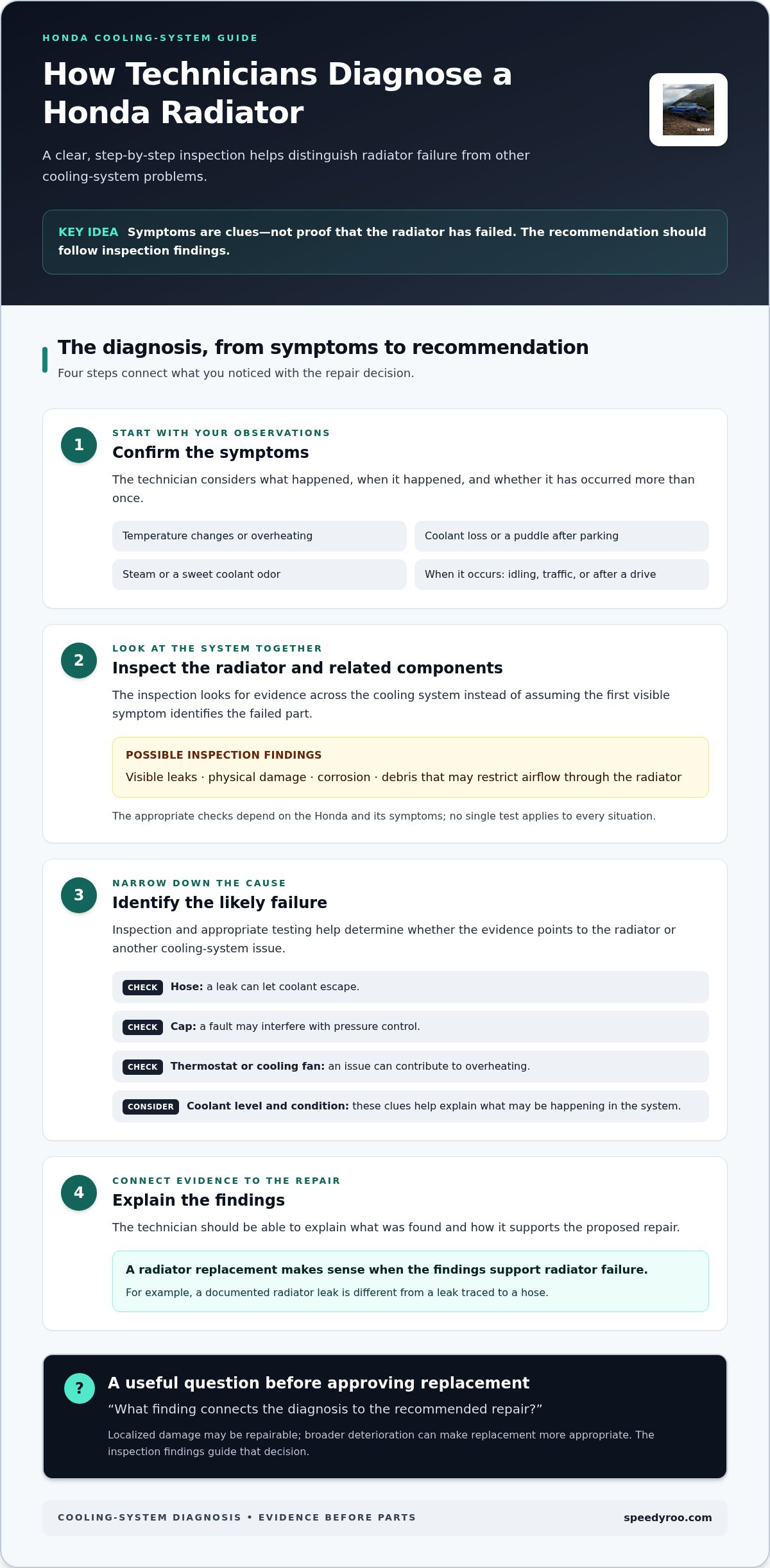
A radiator replacement recommendation should follow evidence, not just an overheating gauge or a coolant spot on the ground. Diagnosis starts with the vehicle’s symptoms and history, then narrows down which part or condition could explain them. The goal is to connect what you noticed with inspection findings before deciding on a repair.
Radiator diagnosis means identifying the source of a cooling problem before choosing the repair. A clear explanation of the findings helps you understand why a radiator is, or isn’t, the recommended fix.
- Confirm the symptoms. The technician considers what you observed, when it occurred, and whether it has happened more than once. Details such as recent coolant loss or a temperature change can help focus the inspection.
- Inspect the cooling system. The radiator and related components are considered together, rather than assuming the first visible symptom points to one part.
- Identify the likely failure. Inspection and appropriate testing help distinguish a radiator concern from another possible cause.
- Explain the findings. You should be able to understand what was found and how it supports the proposed repair.
What a cooling-system inspection helps establish
An inspection can look for visible leaks, physical damage, corrosion, or debris that may restrict airflow through the radiator. The appropriate checks depend on the Honda and its symptoms, since no single test applies to every situation. The goal is to determine whether the evidence points to the radiator or another part of the cooling system, rather than recommending parts based on guesswork.
Why the radiator may not be the only possible cause
A leaking hose can let coolant escape, while a faulty cap may interfere with pressure control. A thermostat that doesn’t regulate coolant flow properly or a cooling fan that isn’t operating as needed can also contribute to overheating. These are possibilities to investigate, not automatic replacement recommendations. A radiator replacement makes sense only when the findings support radiator failure.
Coolant condition and level can also be part of the picture. Low coolant may accompany a leak, while an issue elsewhere may affect how the system circulates or releases heat. A technician considers how the clues fit together, including whether symptoms appear under particular driving conditions. That context helps prevent treating one sign as proof that a specific component has failed.
Before approving Honda radiator replacement Lone Tree service, ask what finding connects the diagnosis to the recommendation. For example, a documented radiator leak supports a different decision than a leak traced to a hose. The explanation should make clear what was identified and why the proposed repair addresses it.
Speedy Roo Motorsports & Repair Inc provides Honda repair, diagnostics, and radiator replacement from its Aurora facility for drivers in Lone Tree, Denver, Centennial, and Parker. Explore Honda repair and diagnostic service to take the next step toward an informed repair decision.
Repair or Replace a Honda Radiator? How to Weigh the Recommendation
Radiator replacement can feel like a major decision, especially when a leak or overheating symptom might have another cause. The recommendation should be supported by evidence that the radiator itself is damaged or no longer able to function reliably. A repair may be possible in some cases, but it isn’t suitable for every type or location of damage.
The comparison below is a starting point, not a diagnosis. The radiator’s overall condition and the specific Honda’s requirements also matter.
| Finding | How it may shape the decision |
|---|---|
| Localized damage | If the issue is confined to a specific area, a technician can assess whether a reliable repair is feasible. The location and condition of the surrounding radiator material matter. |
| Broader deterioration | Widespread corrosion, damage, or weakening may make a localized repair unsuitable. The technician considers whether the radiator as a whole can continue to function reliably. |
| Confirmed radiator failure | If the radiator itself has failed and can’t be reliably repaired, replacement may be appropriate. The findings should explain why repair isn’t a sound option. |
When repair may be considered, and when replacement makes sense
Repair feasibility depends on where the leak or damage is, whether it’s isolated, and the condition of the rest of the radiator. A small affected area doesn’t automatically mean repair is practical. Damage elsewhere can change the assessment. Replacement makes sense when the findings indicate that the radiator can’t be reliably repaired. Neither choice should be assumed before the condition is evaluated.
What to understand before approving the repair
Ask for a plain-language explanation of what failed, how the inspection supports that conclusion, and what the recommended work is intended to address. If the radiator is the confirmed issue, the explanation should connect the evidence to repairing or replacing it. If another concern remains, such as a separate cooling-system fault, ask how it affects the plan. Clear answers help you understand the work without assuming every related part needs attention.
The repair choice should follow diagnosis, not assumption. That principle matters when an initial symptom could have more than one cause. Coolant loss alone, for example, doesn’t establish that the radiator is the source. A recommendation should identify the confirmed problem and distinguish it from possibilities that were considered but not found to be the cause.
For Honda radiator replacement Lone Tree service, the decision should account for the specific damage, radiator condition, and vehicle requirements. Speedy Roo Motorsports & Repair Inc serves Honda owners from Aurora and explains diagnostic findings before discussing a repair decision. Explore Honda repair and service for a clear, vehicle-specific recommendation.
Planning Honda Radiator Replacement Near Lone Tree
Good preparation makes it easier to explain what your Honda is doing and understand the recommended next step. Before arranging Honda radiator replacement Lone Tree service, make a concise record of the symptoms and any recent work. The repair plan depends on the vehicle’s model and what diagnosis finds, so don’t assume every overheating concern calls for the same procedure.
What information helps the technician assess your Honda
Have the Honda’s year, model, and mileage ready, along with a short timeline of what you’ve noticed. Include dashboard warnings, temperature changes, visible fluid, and any overheating episodes. Note whether the symptoms happened while idling, during a drive, or after parking, and mention recent cooling-system repairs or maintenance. These details provide useful context, but inspection is still needed to identify the cause.
- Record the pattern: Note when the temperature changed and whether it returned to normal or rose again.
- Describe coolant loss: Include how often you’ve noticed a low level or fluid beneath the vehicle. Don’t touch hot components.
- List recent work: Share any cooling-system repairs or other service that may help explain when the symptoms began.
- Bring relevant records: Service history can clarify what has already been addressed.
A few clear observations are more useful than trying to diagnose the part yourself. If you’re unsure about a detail, describe what you saw or heard. The technician can compare your account with the inspection findings.
What to expect from a clear repair recommendation
A useful explanation connects your symptoms to the diagnostic findings, identifies the confirmed issue, and describes the recommended work in straightforward terms. If alternatives are relevant, the explanation should clarify how they differ and why one may better address the condition found. It should also distinguish the radiator concern from any separate issue, so you understand what the recommendation covers.
Speedy Roo Motorsports & Repair Inc is an independent Japanese-vehicle specialist in Aurora, serving Honda owners in Lone Tree, Denver, Centennial, and Parker. The business is locally rated for honest pricing, supporting a straightforward conversation about findings and repair decisions. For broader context on specialist care, explore this guide to Japanese import repair guidance.
Make sure the service discussion stays specific to your Honda. The model, symptoms, and diagnostic results shape the appropriate service plan, so general advice can’t replace vehicle-specific findings. If your Honda has shown cooling-system symptoms, schedule Honda repair service with Speedy Roo Motorsports & Repair Inc.
Choose Speedy Roo for Honda Radiator Replacement Serving Lone Tree
A radiator concern calls for a clear answer: is the radiator itself failing, and what repair fits the findings? Speedy Roo Motorsports & Repair provides Honda radiator replacement and other Honda service from its Aurora location for drivers in Lone Tree. As an independent Japanese-vehicle specialist, the shop brings experience with Honda and other Japanese brands to the diagnostic process.
Why Honda owners choose an independent Japanese-vehicle specialist
Experience working across Japanese vehicles gives technicians a focused context for servicing Honda owners. Speedy Roo has served Japanese-vehicle owners since 2002, with Honda among the brands it services. That background supports a vehicle-specific approach, while the inspection findings remain central to any repair recommendation.
Good communication matters just as much as technical assessment. A clear explanation helps you understand what was found, why radiator work is recommended, and whether another issue is involved. Each vehicle and symptom deserves its own assessment, so the recommendation should reflect your Honda’s condition.
Your next step for Honda radiator service
If your temperature gauge keeps rising, coolant loss returns, or you see a leak or steam, arrange an inspection instead of guessing at the failed part. If the engine is overheating or steaming, pull over safely and switch it off rather than continuing to drive. Share your Honda’s year and model, when the symptoms occur, and any recent cooling-system work to give the technician useful context.
Speedy Roo serves Honda owners in Lone Tree from its Aurora shop, along with drivers from Denver, Centennial, and Parker. Its Japanese-vehicle focus and experience with Honda offer a relevant starting point for discussing radiator concerns. The recommendation should be grounded in your vehicle’s diagnostic findings and explained in plain language.
For Honda radiator replacement Lone Tree drivers can turn to Speedy Roo Motorsports & Repair for Honda service from its Aurora shop. If your Honda is showing cooling-system warning signs, schedule Honda service with Speedy Roo.
Take the Next Step Toward a Clear Repair Decision
Use the service conversation to get a plan that fits your Honda, not a guess based on one symptom. Share what you’ve noticed and what you need from the vehicle, then use the diagnostic findings to understand which repair addresses the confirmed problem. That gives you a practical basis for deciding what to do next and what questions to resolve before approving work.
If you’re considering Honda radiator replacement Lone Tree service, you don’t have to determine the failed part on your own. A professional assessment can clarify whether the radiator is the source and explain the recommended repair in plain language. The goal is a decision grounded in your vehicle’s condition.
Begin planning Honda radiator service with Speedy Roo and take the next step toward caring for your Honda.
Frequently Asked Questions
Can I drive my Honda with a coolant leak?
It’s safest not to keep driving with a suspected coolant leak, especially if the temperature gauge rises or a warning appears. Even a small leak can worsen, and coolant loss may affect the engine’s ability to manage heat. If you see fluid, note where it is and arrange an inspection rather than repeatedly topping up and carrying on. Don’t open the cooling system while the engine is hot.
What coolant should I use in my Honda?
Use the coolant specified for your Honda’s model and year, as listed in its owner’s manual or service information. Coolant products can differ in chemistry and requirements, so don’t choose by color alone or assume products are interchangeable. If the manual isn’t available, share the vehicle details with a technician before adding coolant. Only check the reservoir when the engine is cool, and follow the level markings.
How often should a Honda radiator be replaced?
There isn’t one replacement interval that applies to every Honda radiator. Replacement is generally considered when inspection finds a failure or deterioration that can’t be reliably repaired, rather than simply because the vehicle has reached a certain age or mileage. Keep records of cooling-system work and pay attention to recurring changes in coolant level or temperature. A technician can assess the radiator’s condition against the needs of your specific Honda.
Can a low coolant level damage a Honda engine?
Yes, running with too little coolant can contribute to overheating and may put engine components at risk. A low reservoir level is a clue to investigate, not a reason to assume coolant just needs topping up. If the level drops again after you add the correct coolant, there may be a leak or another fault. Avoid continued operation if the temperature rises, and have the cause assessed.
Does a Honda radiator replacement always include a thermostat?
No. A thermostat isn’t automatically part of every radiator replacement. Whether it needs attention depends on the diagnostic findings, the vehicle’s requirements, and the scope of the recommended repair. Ask which parts have been confirmed as faulty and which are being considered separately. That distinction helps you understand whether the thermostat is needed to address an identified problem or is simply a related component under discussion.
What should I do if my Honda overheats near Lone Tree?
Pull over as soon as it’s safe, switch off the engine, and don’t remove the radiator cap while the system is hot. Don’t continue driving to see whether the gauge settles. Arrange professional help and share your location and what the temperature gauge showed. Speedy Roo Motorsports & Repair is based in Aurora and serves Honda owners in Lone Tree, Denver, Centennial, and Parker.
Can a radiator leak be sealed instead of replacing the radiator?
Sometimes a repair may be considered, but sealing a leak isn’t appropriate for every radiator or type of damage. The leak’s location, the radiator’s overall condition, and the Honda’s requirements all affect the decision. A temporary product or patch shouldn’t be treated as proof the problem is resolved. Have the source assessed, then ask whether a repair is likely to address the confirmed fault reliably or whether replacement is recommended.