
A trustworthy second opinion starts with an independent diagnosis, not just a second look at the first quote. For a second opinion on auto repair in Centennial, bring a written, itemized estimate and describe the symptoms before sharing the original diagnosis. This gives the next technician a clearer basis for assessing the problem and recommended work.
It’s reasonable to want clear evidence before approving a costly repair. A useful second assessment should explain what each part, labor charge, and fee covers, and whether further diagnosis is needed. Estimates can also be difficult to compare when the shops inspected different things.
This guide explains how to describe symptoms without steering the diagnosis, review repair estimates, and compare shop credentials and inspection costs. You’ll also learn what to do when assessments don’t agree, so you can make a more informed decision about your vehicle’s next step.
Key Takeaways
- Get a written, itemized estimate so you can compare parts, labor, and fees rather than relying on a single total.
- Describe what your vehicle is doing before sharing the first shop’s diagnosis to help the next mechanic assess it independently.
- Ask to see evidence behind an unexpected repair recommendation, such as a photo or inspection report.
- Compare repair credentials and diagnostic scope, not just the final price; a very low estimate may reflect a missed issue.
- Before arranging another assessment, ask about the diagnostic fee and what the inspection includes.
1. How to understand parts, labor, and fees
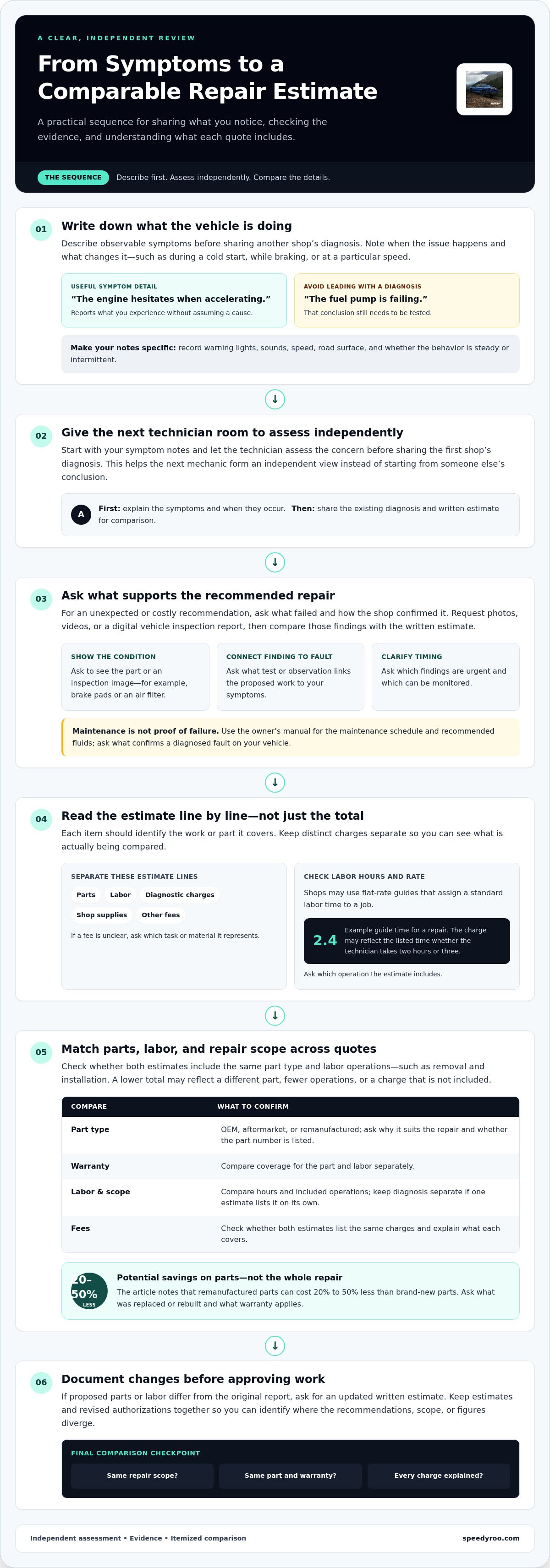
Read the estimate line by line, not just the total. Separate parts, labor, diagnostic charges, shop supplies, and other fees. Each line should identify the work or part it covers. If a fee is unclear, ask what task or material it represents before comparing the estimate with another shop’s findings.
Check the labor hours as well as the hourly rate. Repair shops may use flat-rate guides that assign a standard labor time to a job. For example, a guide may list 2.4 hours for a repair. The labor charge may then reflect 2.4 hours, whether the technician completes the work in two hours or three. Compare the listed hours with industry flat-rate guides, and ask which operation the estimate includes.
Parts descriptions matter, too. An estimate may specify an original equipment manufacturer (OEM) part or an aftermarket alternative. Ask which type is proposed, why it suits the repair, and whether the part number appears on the paperwork. Compare the warranty terms for the part and labor separately. A clear written answer helps you understand what each option covers without assuming the parts are identical.
Remanufactured parts offer another category to compare. A remanufactured part is typically used, disassembled, and rebuilt with worn components replaced by repaired or new parts. Auto experts say these parts can cost 20% to 50% less than brand-new parts. That percentage describes potential parts savings, not the complete repair bill. Ask whether the estimate uses a remanufactured part, what has been replaced, and what warranty applies.
Use a simple comparison: match each estimate’s part type, labor hours, and listed fees. A lower total may reflect a different part, fewer labor operations, or an omitted charge. For example, check whether both estimates include removal, installation, and the same repair scope. If one lists diagnosis separately, keep that amount distinct from repair labor.
Before approving work, ask for an updated written estimate if the proposed parts or labor differ from the original report. Keep the estimate and any revised authorization together. This record makes it easier to compare the actual recommendation with the second assessment and identify exactly where the figures or repair plans diverge.
2. Checking unexpectedly large repair recommendations
An expensive recommendation can justify asking for evidence, especially when the car seemed to have a minor issue. Before approving work, ask the mechanic to explain what failed, how the failure was confirmed, and what could happen if repairs wait. Request photos, videos, or a digital vehicle inspection report showing the condition. Then compare the evidence with the written estimate.
Look at the recommended repair, not only its total. If the shop recommends brake pads, ask to see their condition and how it supports replacement. If it suggests a new air filter, ask to inspect the filter. Seeing the part can clarify whether it is worn or dirty and whether the recommendation addresses your reported symptom. You can also ask which findings are urgent and which can be monitored.
Small checks can add useful context, but they don’t replace a mechanic’s inspection. Check tire tread for uneven wear and note any obvious differences between tires. Review fluid levels only as directed by the owner’s manual, with the vehicle parked safely and the engine cool where appropriate. Look for visible leaks, but don’t touch hot components or investigate a strong fuel or burning odor yourself.
Use the owner’s manual to understand the vehicle maker’s maintenance schedule and recommended fluids. Compare the shop’s proposed work with the relevant service information, distinguishing scheduled maintenance from a repair for a diagnosed fault. A maintenance interval alone doesn’t prove a component has failed. Ask what test or observation connects the repair recommendation to your vehicle’s symptoms.
Alignment concerns deserve careful interpretation. A car pulling to one side can have several causes, including tire condition or alignment. If the vehicle feels stable and safe, a brief check on a quiet, non-busy street at about 20-30 miles per hour may reveal whether it veers when you briefly release the steering wheel. Don’t perform this check if steering feels unreliable. Brake problems, chassis vibration at speed, visible fuel leaks, or a strong fuel or burning odor may make driving unsafe. Arrange another way to have the vehicle assessed.
If a shop refuses to release your vehicle or disputes a second opinion, ask for its position and an itemized account of authorized work in writing. Keep estimates, approvals, and messages together, and seek neutral consumer guidance before deciding what to do next.
For a Toyota needing follow-up work after you understand the findings, Toyota repair and service may be a relevant next step.
3. Avoiding bias when describing symptoms
Describe what the vehicle does before sharing another shop’s diagnosis. This gives the next mechanic a chance to form an independent assessment rather than starting with someone else’s conclusion. Use observable details, such as “the engine hesitates when accelerating,” rather than “the fuel pump is failing.” The first statement reports a symptom; the second suggests a cause that still needs testing.
Write down when the problem occurs and what changes it. Note whether it happens during a cold start, after driving, while braking, or on a particular road surface. Record whether a warning light appears, whether a sound is steady or intermittent, and whether the vehicle’s behavior changes with speed. These details help technicians reproduce the concern and choose relevant diagnostic checks.
Keep your notes honest and specific. For example, “a brief rattle comes from the front when starting uphill” gives more useful context than “the car sounds bad.” If you’re unsure where a noise comes from, say so. Don’t guess at its location or name a component unless you’ve identified it. Distinguishing what you noticed from what you suspect helps prevent assumptions from becoming part of the diagnosis.
At the second shop, describe the symptoms first, then share the first shop’s findings after the technician has heard your account. You might say, “The steering wheel vibrates during highway driving,” without initially mentioning a suspected wheel bearing. Once the technician has recorded an initial assessment, provide the earlier diagnosis and ask whether it changes the next test. This order can reduce anchoring on the first explanation.
Bring relevant records, but keep them separate from your symptom notes. Include the first inspection report, recent repair invoices, and any dashboard warning messages you photographed. Tell the technician which repairs happened before the symptom began. For example, a noise that appeared after brake work gives useful timing context, but doesn’t prove that the work caused it.
During the assessment, ask the technician to explain which test supports the diagnosis and what result would point elsewhere. If the first shop suspects an electrical fault, ask what measurements or observations support that conclusion. Record the answer in plain language. If the assessments differ, compare the evidence and diagnostic steps, not just the suspected parts. Additional testing or another assessment can help resolve conflicting conclusions.
4. Choosing ASE-certified and RepairPal Certified shops
In Centennial, search for repair shops by location, vehicle make, and repair type, then compare credentials and recent reviews. ASE certification involves passing standardized tests in specific repair categories. That can help you identify technicians with tested knowledge in a relevant area. For example, while a local mechanic may handle engine issues, dedicated repair teams like NW Houston Auto Repair and Collision demonstrate how specialized expertise and certifications are essential when evaluating body and structural repairs.
Check what a credential covers before treating it as proof of every skill. ASE certification applies to specific repair categories, so match the category to your car’s problem. A credential in one area doesn’t establish expertise in every other area. If an expensive repair involves several systems, look for evidence that the shop can assess the system involved and explain its diagnostic approach.
RepairPal Certified is another designation you may encounter while comparing shops. Read the listing carefully and note the services and details it describes. Treat the designation as one point of comparison, not a substitute for understanding the diagnosis. Before approving work, ask the shop to connect its findings to the repair recommendation. A useful assessment explains what was inspected and why the proposed work addresses the symptoms.
Reviews can add context, especially when you read several rather than relying on a single rating. Search the shop name with “Centennial” and your vehicle make or repair type. Look for specific accounts of diagnosis, communication, written estimates, and updates. A review describing how a mechanic explained a recurring warning light offers more useful detail than general praise such as “great service.” Consider whether repeated comments identify a pattern relevant to your concern.
Separate review facts from opinions. A customer may praise fast service, but that doesn’t show whether a complex diagnosis was accurate. Look for details about the work performed, how the shop explained its findings, and whether the review concerns a similar repair. Note dates and context as you compare accounts. One complaint or enthusiastic review can’t establish what your own inspection will find.
5. Repair quote review and inspection pricing
Start with a written, itemized estimate before seeking another assessment. It should separate parts, labor, diagnostic work, and fees so you can compare equivalent scopes. For a Colorado repair, ask the shop to document the estimate and record your approval before proceeding with additional work. Don’t assume approval of the original estimate covers a later recommendation.
An estimate above $500 is a reasonable point to consider a second opinion. That threshold is a prompt to examine the details, not proof that the recommendation is wrong. Compare what each shop inspected, the evidence behind its diagnosis, and whether both estimates cover the same repair. A lower total may leave out diagnostic steps or parts included in the original estimate.
Ask the second shop to assess the vehicle independently before showing the original estimate. This can help prevent its figures or conclusions from anchoring the review. Give the mechanic your symptom notes, then ask what inspection or testing supports the proposed work. A second assessment may save significant expense, but its value depends on whether it clearly answers the repair question.
Can you get a second opinion without authorizing repairs or paying a diagnostic fee? You can seek an assessment without approving repairs, but a detailed diagnosis may involve a charge. Ask what the inspection includes and whether its fee is credited toward repairs performed by that shop. The cost depends on the diagnostic work, vehicle, and complexity; request a quote for the assessment.
Before scheduling, describe the vehicle and concern, then ask what the shop’s diagnostic process covers. A physical inspection examines the vehicle, while a document-only review evaluates the written recommendation. A quick visual review may not answer a question that requires testing or access to components.
Compare the explanation as carefully as the total. Ask which findings support the repair, what remains uncertain, and whether the shop recommends further testing before replacement. If two assessments differ substantially, ask each shop to explain the difference in scope or evidence. A clear answer helps you decide whether the original work is justified, whether more diagnosis is useful, or whether the estimates aren’t directly comparable.
If an in-person inspection would help you assess a vehicle before purchase, you can arrange a vehicle inspection.
Speedy Roo Motorsports & Repair: Subaru Repair and Service
Speedy Roo Motorsports & Repair provides Subaru Repair and Service when you need an assessment or an agreed repair. Bring your symptom notes, inspection findings, and existing estimate so the discussion can focus on your vehicle’s condition and the work proposed.
The shop also provides Toyota Repair and Service, Honda Repair and Service, and Nissan Service and Repair, using OEM parts for each make. If your vehicle is one of these makes, the information you gathered during your second-opinion process can help clarify the next diagnostic or repair step. A second assessment is most useful when you understand what was inspected and why the recommended work addresses the concern.
Contact Speedy Roo Motorsports & Repair to discuss your vehicle’s repair needs.
Make Your Next Repair Decision With Confidence
A second assessment can be a useful turning point: it gives you a chance to decide what happens next with clearer information and less pressure. For a second opinion on auto repair in Centennial, choose a next step that suits your vehicle and the work under consideration. If the assessment supports the repair, you can move forward with greater understanding. If it raises new questions, pause and ask for a clear explanation before authorizing work.
Speedy Roo Motorsports & Repair Inc offers Subaru Repair and Service, Toyota Repair and Service, and Honda Repair and Service, using OEM parts for each make. If one of these vehicles needs attention after you’ve reviewed its diagnosis, estimate, or inspection findings, the shop can help you discuss the repair.
Bring the information that matters to your decision, and focus the conversation on the vehicle’s symptoms and the recommended work. Contact Speedy Roo Motorsports & Repair Inc to discuss your repair needs. Take the next step at your pace, with the facts in hand and a clearer path forward.
Frequently Asked Questions
How do you find a trustworthy source for a second opinion?
Choose a shop that can explain its diagnostic process and connect its findings to your vehicle’s symptoms. Look for technicians with relevant credentials, such as ASE certification in a repair category that matches the problem. Read reviews for specific examples of clear communication and diagnosis, not only general praise. A useful assessment explains what was tested, what the results show, and what additional information could change the recommendation.
Can honest and skilled mechanics misdiagnose a problem?
Yes. Even a careful mechanic can reach the wrong conclusion if symptoms are intermittent or testing is incomplete. AAA has described a case where a partial test led a shop to mistake a faulty VVT solenoid for a timing chain problem. That example shows why a diagnosis should rest on appropriate tests, not just a symptom that seems to match a familiar repair. Ask how the findings support the conclusion.
Does getting a second opinion mean you distrust your mechanic?
No. Seeking another assessment can simply help you understand a major repair before deciding what to do. You can tell your mechanic you want to review the recommendation, especially if you’re comparing options or need time to plan. Keeping the conversation respectful helps preserve a working relationship. Focus your questions on the evidence, the repair’s purpose, and what could change if you wait.
Should you tell the second shop what the first shop said?
Yes, but first describe the symptoms in your own words so the second technician can form an initial view. Then share the first shop’s diagnosis and any tests already performed. This gives the technician useful history without making the original conclusion the starting point. If a test has ruled something out, include that result and explain when and how the first shop obtained it.
What documentation should you request from each shop?
Keep the estimate, inspection findings, diagnostic test results, and written records of approved work. Ask each shop to identify the parts and labor included, plus any recommendations that remain unperformed. For example, if one shop reports a sensor fault and another suspects wiring, their written test results can help clarify why the diagnoses differ. Save invoices and messages with those records.
Where can I get a second opinion on auto repair in Centennial, Colorado?
For a second opinion on auto repair in Centennial, choose a shop that works on your vehicle’s make and can assess the issue. Speedy Roo Motorsports & Repair Inc serves Centennial and offers Subaru Repair and Service, Toyota Repair and Service, Honda Repair and Service, and Nissan Service and Repair, using OEM parts for each make. Its Aurora location makes it a nearby option for drivers seeking Japanese-vehicle repair and service.
How much does an independent mechanic charge to inspect a repair estimate in Centennial?
The price depends on the vehicle and scope of the assessment. A document-only review differs from a physical inspection, which involves examining the vehicle and may include diagnostic testing. Before arranging an assessment, decide whether you need an estimate reviewed or the fault independently diagnosed. Ask for the inspection scope and applicable charge together so you know what the quoted work includes.
What documents and information should I bring for a second-opinion auto repair inspection?
Bring the current estimate, prior diagnostic reports, repair invoices, and records of recent maintenance related to the concern. Write down when symptoms occur and what seems to trigger or relieve them. Photos of warning lights or visible leaks can provide useful context. Also note questions you want answered, such as which test supports the proposed repair and whether earlier work affects the current diagnosis.