
What if a single rubber belt, hidden deep within your engine, was the only thing standing between a reliable commute and a total engine failure? For many local drivers, the uncertainty surrounding Honda timing belt replacement in Aurora is a source of constant stress. It’s natural to feel skeptical when a shop recommends a major service while your car still seems to be running perfectly. You want your Honda to reach that legendary 200,000 mile mark, but you also don’t want to pay for work that isn’t absolutely necessary.
We understand that balance. As specialists who have focused on Japanese imports since 2002, we’ve seen firsthand how Colorado’s bone-dry air and dramatic temperature shifts can cause rubber components to degrade faster than the owner’s manual might suggest. This guide will clarify exactly why timely replacement is the single most important insurance policy for your engine’s survival. You’ll learn how our local climate impacts your belt’s lifespan, which parts should be replaced at the same time to save on labor, and how to spot the subtle warning signs before a catastrophic snap occurs.
Key Takeaways
- Understand why the timing belt is the backbone of your engine and how it prevents catastrophic internal damage in Honda interference engines.
- Learn how Aurora’s specific climate accelerates rubber degradation, making visual inspections more reliable than mileage alone.
- Discover why a professional Honda timing belt replacement Aurora service should always include the water pump and tensioner to avoid redundant labor costs.
- Identify the subtle visual cues of belt wear, such as glazing or oil contamination, that signal an impending failure before it happens.
- Find out why choosing an independent Japanese vehicle specialist provides dealer-level precision with a more transparent, community-focused approach.
Understanding the Critical Role of Your Honda Timing Belt
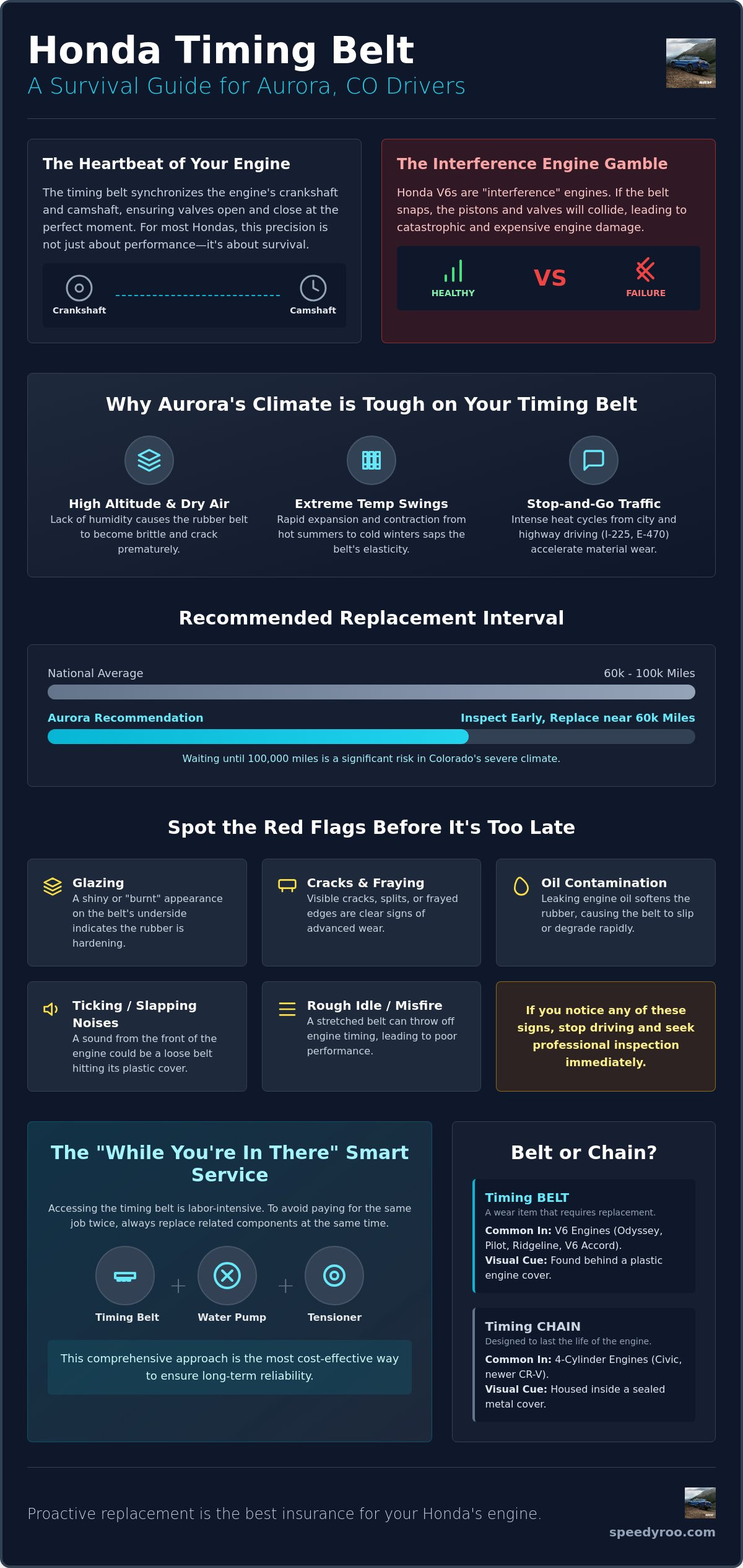
The timing belt is often described as the heartbeat of your engine. In technical terms, it is a reinforced rubber component that synchronizes the rotation of the crankshaft and the camshaft. This ensures that the engine’s valves open and close at exactly the right time during each cylinder’s intake and exhaust strokes. To understand the mechanics better, you can read more about what a timing belt does and why its precision is so vital. For Honda owners, this synchronization isn’t just about performance; it’s about survival.
Most Honda engines are “interference” designs, meaning the pistons and valves occupy the same space at different times. If the belt snaps, they collide, often leading to a total engine rebuild or replacement. This is why a proactive Honda timing belt replacement Aurora drivers can rely on is the single most effective way to protect your vehicle’s longevity.
Timing Belt vs. Timing Chain: What Does Your Honda Have?
Not every Honda uses a belt. Most modern four-cylinder models, like the Civic or newer CR-Vs, use metal timing chains that are designed to last the life of the vehicle. However, the larger V6 engines found in the Honda Odyssey, Pilot, Ridgeline, and V6 Accords still rely on rubber belts. These are wear items that require a scheduled Honda timing belt replacement Aurora owners shouldn’t ignore. If you aren’t sure which one you have, a quick look at your engine cover can help. A plastic cover usually indicates a belt, while a sealed metal cover suggests a chain.
The High-Altitude Factor: Colorado Driving and Belt Wear
Living in Aurora presents unique challenges for automotive rubber. Our high-altitude environment is notoriously dry, and the lack of humidity causes rubber to become brittle and crack over time. When you combine this with the heavy stop-and-go traffic on I-225 or E-470, your engine experiences intense heat cycles. These cycles, followed by the extreme cold of a Colorado winter, cause the belt to expand and contract rapidly. This process saps the elasticity from the material.
Because of these conditions, we recommend that Aurora drivers follow the “severe weather” maintenance schedule. While the national average for replacement is often cited between 60,000 and 100,000 miles, the local climate often necessitates action closer to that 60,000-mile mark. Waiting for the maximum interval in a high-desert climate increases the risk of a failure that could have been avoided with a simple inspection.
Signs Your Honda Needs Timing Belt Service in Aurora
The most dangerous thing about a timing belt is that it rarely gives you a warning before it fails. In the automotive world, we often call it the “silent killer.” Unlike brake pads that squeal or a radiator that leaks, a timing belt can look perfectly fine one moment and snap the next. This lack of clear signals is why a professional Honda timing belt replacement Aurora service is typically based on preventive intervals rather than waiting for a symptom to appear. If you wait for the belt to break, it’s already too late to save the engine.
However, if you are able to inspect the belt or have a technician perform a check, there are specific signs of timing belt wear to look for. Glazing, which gives the belt a shiny or “burnt” appearance on the underside, indicates the rubber is hardening and losing its grip. You might also see fraying along the edges or small cracks in the teeth. Oil contamination is another major red flag; if a front engine seal is leaking, the oil will soften the rubber and cause the belt to slip or degrade prematurely. If you notice any fluid pooling under the front of your engine, it’s wise to have an expert neighbor take a look to prevent a bigger disaster.
Occasionally, your Honda might provide some audible or performance-based clues. A stretched belt can cause the engine timing to be slightly off, leading to a rough idle or an occasional misfire. You might also hear a distinct ticking or slapping sound coming from behind the plastic timing covers. This often means the belt has lost its tension and is physically hitting the cover as it rotates. If you hear this, stop driving immediately to avoid a total mechanical failure.
The Interference Engine Risk Explained
The stakes are incredibly high for Honda owners because of the engine’s internal architecture. An interference engine is a design where valves and pistons share the same space at different times. If the belt breaks while the engine is running, the synchronization is lost instantly. The pistons continue to move up while the valves remain stuck in the down position, leading to a violent collision. The financial reality is stark. A proactive maintenance service might cost around $1,200, but a snapped belt often results in bent valves and ruined pistons, pushing repair costs toward $6,000 for a full engine replacement.
Mileage Intervals: When to Act
Most Honda models require service between 60,000 and 105,000 miles. However, the rubber degrades with age regardless of how much you drive. If your vehicle is seven years old or older, the belt is likely becoming brittle due to time alone. You should consult your Honda maintenance schedule Aurora drivers use to stay ahead of these risks. In our local climate, being a year early is always better than being a second too late.
The “While You’re In There” Rule: Maximizing Your Investment
A professional Honda timing belt replacement Aurora service involves a significant amount of disassembly. To reach the belt, our technicians must remove the drive belts, various engine covers, and often an engine mount. Because this process takes several hours, it’s financially logical to replace other wear-prone components that are only accessible during this specific job. Bundling these services can save you between 4 and 6 hours of redundant labor costs in the future.
We don’t view these additions as optional extras; we see them as essential components of a complete repair. Replacing only the belt while leaving a 100,000-mile water pump or a worn tensioner in place is a gamble that rarely pays off. Our goal is to ensure your Honda doesn’t need to be opened up again for this same area of service for another 100,000 miles.
The Water Pump Synergy
In the majority of Honda V6 engines, the water pump is physically driven by the timing belt. This creates a critical dependency. If the water pump bearings begin to fail or the pump seizes entirely, it can immediately snap or shred the timing belt, leading to the engine failure we discussed earlier. By installing a new pump during your Honda timing belt replacement Aurora visit, you’re refreshing your entire cooling and timing system simultaneously. This proactive approach is a cornerstone of Japanese vehicle maintenance, similar to the Nissan cooling system service Aurora drivers rely on to manage engine temperatures during our intense Colorado summers.
Tensioners and Idler Pulleys
A timing belt is only effective if it’s held at the precise tension required by the manufacturer. The hydraulic tensioner and idler pulleys are the components responsible for this task. Over time, and especially with Colorado’s dramatic temperature shifts, the seals in a hydraulic tensioner can leak. A weak tensioner allows the belt to “slap” or skip teeth on the gears, which can be just as catastrophic as a broken belt. We prioritize using high-quality Japanese-spec components for these parts. Reusing old pulleys or tensioners is one of the most common causes of premature belt failure, and it’s a risk we simply don’t take with our customers’ vehicles.
We also take this opportunity to inspect and usually replace the camshaft and crankshaft seals. These rubber seals prevent engine oil from leaking into the timing cover area. If oil contaminates a new belt, it will soften the rubber and lead to a much shorter lifespan. Replacing these seals “while we’re in there” is a small investment that prevents a major headache down the road.
Choosing the Right Aurora Mechanic for Honda Engine Work
Choosing a shop for a Honda timing belt replacement Aurora is a decision that impacts your vehicle’s health for the next several years. Many owners feel tethered to the dealership, believing it’s the only place with the necessary expertise. However, adopting a Toyota dealer service alternative Aurora mindset allows you to find specialized, independent care that matches factory standards without the inflated pricing. You want a team that views your car as a long-term investment, not just another ticket in the service bay.
When interviewing a potential shop, you should ask if they use a complete timing kit or just the belt. A generalist shop might quote a lower price by omitting the tensioner or water pump. As we discussed, this often leads to premature failure and double the labor costs later. You should also ask about their specific tools. Removing a Honda crankshaft pulley requires a high-torque weighted socket and specialized holding tools. A shop without these may resort to methods that can damage the crankshaft or surrounding components.
Finding a garage that invests in the right equipment and adheres to strict quality protocols is essential; for instance, dsrautocare.co.uk illustrates how professional accreditation ensures that these technical standards are consistently met.
Why Specialization Matters for Timing
Precision is everything in a V6 engine. “Timing the marks” requires aligning the camshafts and crankshaft to the exact degree. Even being a single tooth off can result in “ghost” check engine lights, poor fuel economy, or a rough idle that generalist scanners struggle to diagnose. Our team understands these nuances because we live and breathe Japanese import repair Aurora drivers trust. We ensure the belt is seated perfectly and the hydraulic tensioner is set to factory specifications before the engine is ever started.
Transparency and Digital Inspections
You deserve to see exactly what is happening under your hood. We utilize digital inspections to provide photos of your belt’s condition, showing you the cracks or glazing we find. This level of transparency is what you should expect from an honest specialist neighbor. It’s also vital to verify the warranty. A quality shop will stand behind both their parts and their labor, giving you peace of mind as you drive away. We believe that an informed customer is a confident driver.
Don’t leave your engine’s survival to chance; schedule your Honda timing belt inspection today to ensure your vehicle is ready for the road ahead.
Why Speedy Roo is Aurora’s Choice for Honda Timing Belt Replacement
Since 2002, Speedy Roo has served as a cornerstone of the Aurora automotive community. We’ve built our reputation on a simple premise: providing specialized, high-level expertise for Japanese imports without the impersonal atmosphere or inflated costs of a large dealership. When you choose us for your Honda timing belt replacement Aurora, you’re partnering with a team that has spent over two decades mastering the specific engineering of Honda, Subaru, and Toyota vehicles. We don’t just fix cars; we act as a dedicated partner in the longevity of your vehicle.
Our approach to engine work is rooted in transparency and integrity. We recognize that a timing belt service is a significant investment. That’s why we offer pricing that beats dealership quotes while maintaining a much higher standard of meticulous care. We never cut corners to lower a quote. The “Speedy Roo” standard ensures that every timing service includes a complete component kit. This means you receive a new belt, water pump, hydraulic tensioner, and idler pulleys every single time. We believe in doing the job correctly the first time so you can drive with absolute certainty for the next 100,000 miles.
Expertise Beyond the Belt
Our technical proficiency extends across the most complex Japanese engine designs. The precision required for our Subaru boxer engine repair Aurora service translates perfectly to the intricate timing requirements of a Honda V6. Both systems demand a methodical, detail-oriented technician who understands that a fraction of a millimeter can make the difference between peak performance and a costly error. We apply this same level of scrutiny to every Honda that enters our shop, from the Odyssey to the Ridgeline. As your “Expert Neighbor,” we take pride in our craftsmanship and the trust we’ve built with families in Aurora, Centennial, and Parker.
Schedule Your Aurora Honda Service
We’ve streamlined our process to respect your time and ensure technical accuracy. When you contact us for a quote, we’ll ask for your Vehicle Identification Number (VIN). This allows us to source the exact Japanese-spec parts required for your specific model year, eliminating any guesswork. Most Honda timing belt replacement Aurora services are completed within the same day, meaning you won’t be stranded without your vehicle. We’re here to answer your questions, show you the condition of your old parts, and ensure you feel empowered as a vehicle owner. Your engine’s survival is our priority. Book your Honda timing belt inspection at Speedy Roo today and experience the difference that specialized care makes.
Secure Your Honda’s Future on the Road
Your Honda’s longevity depends on a few critical maintenance decisions. By prioritizing a proactive Honda timing belt replacement Aurora service, you avoid the high costs and stress of an unexpected engine failure. Remember that Colorado’s dry climate and temperature swings make visual inspections just as important as tracking your mileage. Bundling your water pump and tensioner replacement ensures your engine remains synchronized and reliable for years to come.
Since 2002, our team at Speedy Roo has served as Aurora’s independent Japanese vehicle specialist. Our technicians possess deep expertise in Honda, Subaru, and Toyota engine architecture, ensuring your vehicle receives dealer-level precision with the personal touch of an expert neighbor. We’re committed to helping you reach those high-mileage milestones with confidence and transparency. Protect your engine—schedule your Honda timing belt service at Speedy Roo today! We look forward to helping you keep your Honda running at its best for the long haul.
Frequently Asked Questions
How much does Honda timing belt replacement cost in Aurora?
The total cost depends on your specific model and whether you choose to replace the water pump and seals simultaneously. While we don’t provide flat-rate pricing without seeing the vehicle, most of the expense comes from the extensive labor required to access the belt. Choosing a kit that includes the water pump and tensioner is the most cost-effective way to handle this service; it prevents paying for the same labor twice later.
Can I drive my Honda if the timing belt is squeaking?
You shouldn’t ignore a squeak, but it’s likely an external drive belt rather than the timing belt. Timing belts are notched and don’t typically slip or squeal like serpentine belts do. However, a squeak can also signal a failing idler pulley or water pump bearing. Since these components are connected to your timing system, an immediate inspection is necessary to prevent a more serious mechanical failure.
What happens if my Honda timing belt breaks while driving?
Breaking a belt while driving leads to an immediate and violent engine failure. Because Honda uses interference engine designs, the pistons will strike the open valves. This collision bends the valves and can damage the cylinder heads or pistons. In most cases, the cost of repairing this internal damage exceeds the value of the engine; this makes preventive replacement your best financial strategy.
Is it worth replacing the water pump with the timing belt?
It’s absolutely worth replacing the water pump because it’s only accessible when the timing belt is removed. On most Honda V6 engines, the timing belt physically drives the water pump. If the pump fails later, you’ll have to pay for the entire timing belt labor process all over again. Bundling these parts into a single Honda timing belt replacement Aurora service ensures your entire cooling and timing system is refreshed at once.
How long does a Honda timing belt replacement take at a shop?
You can generally expect your vehicle to be in the shop for one full business day. The actual labor time typically ranges from four to six hours, depending on the specific model and whether additional seals are being replaced. We aim for same-day service for most timing belt jobs so you can get back to your routine without a lengthy disruption.
Do all Honda models have timing belts?
No, Honda uses both timing belts and timing chains depending on the engine type. Most four-cylinder engines in newer Civics and CR-Vs use chains; these are designed to last the life of the engine. However, the larger V6 engines found in the Odyssey, Pilot, Ridgeline, and some Accords still use belts that require scheduled maintenance to prevent engine damage.
Can I replace my own Honda timing belt?
Replacing a timing belt is a complex task that we don’t recommend for the average DIY enthusiast. It requires specialized tools, such as a high-torque crankshaft pulley wrench, and absolute precision when aligning the timing marks. If the alignment is off by even a single tooth, you risk catastrophic engine damage the moment you turn the key. Most owners find the peace of mind offered by a specialist is worth the investment.
Does a timing belt replacement improve engine performance?
A new belt maintains your engine’s factory performance rather than increasing it. Over time, an old belt can stretch slightly; this subtly retards the engine timing and can lead to a minor loss in fuel efficiency or throttle response. By restoring the exact synchronization between your crankshaft and camshafts, you ensure your Honda continues to operate with the precision and reliability it had when it was new.