
Have you ever merged onto I-70 heading into the mountains, only to feel your Toyota struggle as the air thins and your transmission constantly hunts for the right gear? It’s a common frustration for Colorado drivers who rely on their trucks and SUVs for both daily commutes and rugged weekend adventures. You likely chose a Toyota for its legendary reliability, so the thought of performance modifications might feel risky if you’re worried about compromising that longevity. We understand that hesitation, especially when many shops focus on raw speed rather than the long-term health of your vehicle.
Professional Toyota performance tuning Aurora doesn’t have to be a gamble. When approached with a focus on precision, it is the most effective way to reclaim the power that our high altitude takes away. This article explains how specialized calibrations can provide smoother power delivery, better towing capability, and improved efficiency for your specific model. You’ll discover how our in-house chassis dyno and two decades of Japanese vehicle expertise allow us to optimize your Toyota for the unique demands of the Front Range while maintaining the reliability you depend on every day.
Key Takeaways
- Understand the vital difference between “one-size-fits-all” software and a custom ECU recalibration designed for your vehicle’s unique condition.
- Learn how in-house chassis dyno testing uses real-world data to ensure your engine stays within safe operating limits while maximizing performance.
- Discover why prioritizing low-end torque and “area under the curve” provides a better driving experience for Colorado’s steep grades than chasing peak horsepower.
- Get a professional pre-tuning checklist to confirm your vehicle is mechanically prepared for Toyota performance tuning Aurora.
- See why an “Honest Specialist” approach focuses on sustainable power gains that protect your Toyota’s legendary reliability for years to come.
What is Toyota Performance Tuning and Why Does it Matter in Aurora?
Toyota performance tuning Aurora is about more than just adding horsepower. It’s the precise recalibration of your vehicle’s Engine Control Unit (ECU) and hardware to work in harmony with your specific environment. Toyota is a global manufacturer, which means they design their engines to operate reliably in every corner of the world. They have to account for low-quality fuel in developing nations, extreme humidity, and varying emissions standards. To ensure every car survives these “worst-case” scenarios, they use conservative factory settings. For a driver in Colorado, this means you’re driving a vehicle tuned for an average that doesn’t exist here.
There is a significant difference between “off-the-shelf” flash tunes and custom dyno tuning. A basic flash tune is a generic software file designed to work on any vehicle of a certain model. While it offers some improvement, it lacks the precision of a custom tune. Custom tuning involves making adjustments based on the unique health of your engine and our local atmospheric conditions. This specialized approach ensures that your Toyota performs optimally without sacrificing the longevity the brand is known for.
The Role of the ECU in Modern Toyota Engines
Your Toyota’s ECU acts as the central brain, managing critical functions like fuel maps, ignition timing, and throttle response. Factory programming is often restricted to keep the vehicle within very broad operating margins. By refining these maps, we can unlock better efficiency and smoother power delivery. ECU remapping is the software-based optimization of engine parameters to improve performance and efficiency. This process allows us to tailor how the engine breathes and reacts to your input, making the vehicle feel more responsive in daily traffic.
Why Aurora Drivers Face Unique Performance Challenges
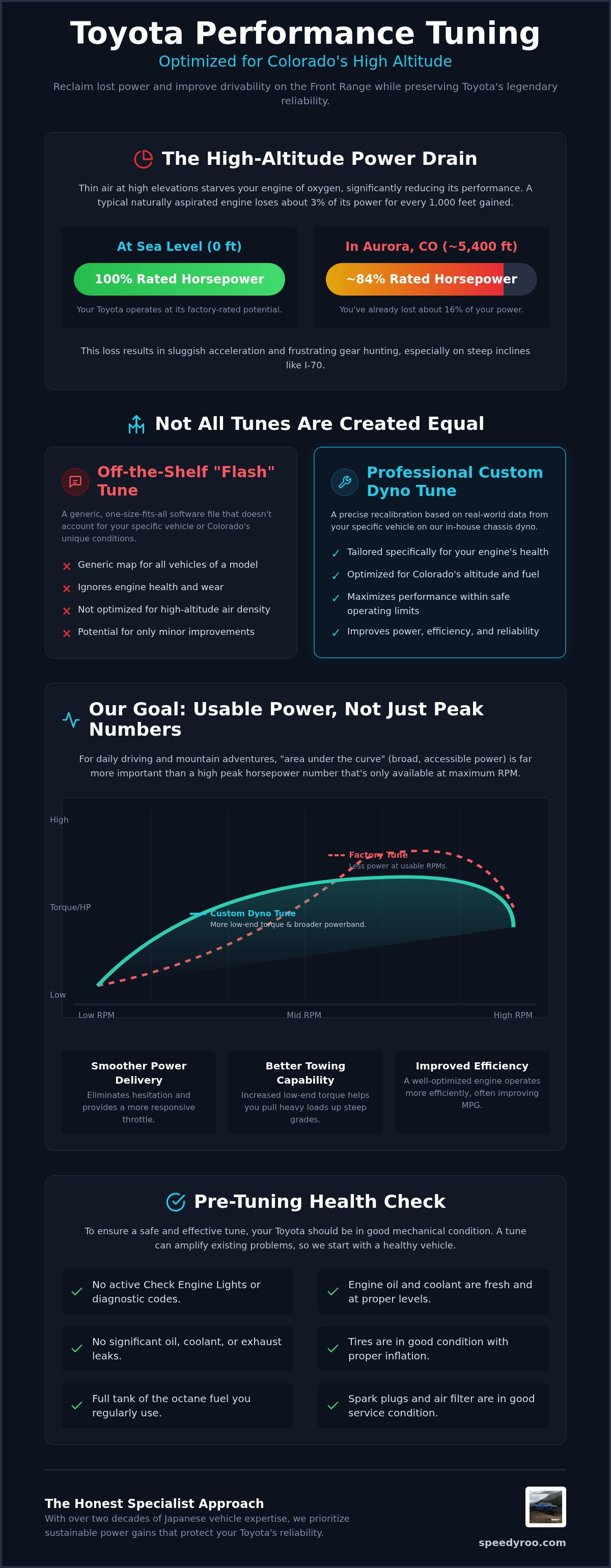
Living at an elevation of roughly 5,400 feet in Aurora presents a physical hurdle for internal combustion engines. Thin air contains less oxygen, which is essential for combustion. Most naturally aspirated engines lose approximately 3% of their power for every 1,000 feet of elevation gain. By the time you reach Aurora, your 4Runner or Tacoma has already lost about 16% of its rated sea-level horsepower. When you head further west into the mountains, that loss only increases.
This power loss often manifests as sluggish acceleration or a transmission that “hunts” for the right gear while you’re climbing the I-70 corridor. Professional Toyota performance tuning Aurora helps compensate for these altitude-related issues. By optimizing the air-fuel ratio and adjusting how the engine handles the thinner air, we can reclaim lost capability. Whether you’re driving a turbocharged GR Supra or a naturally aspirated Tundra built for towing, tuning bridges the gap between factory compromises and Colorado reality.
The Science of the Tune: ECU Remapping and Dyno Calibration
Effective Toyota performance tuning Aurora relies on objective data rather than guesswork. Our process centers on the use of an in-house chassis dyno, which measures real-world wheel horsepower and torque. Unlike manufacturer ratings that measure power at the crankshaft, a dyno shows exactly how much energy reaches the pavement. This is essential for understanding how your vehicle handles the mechanical load of Colorado’s steep inclines and varying terrain.
A truly professional tune is data-driven. While the vehicle is on the rollers, we monitor critical parameters like Air-Fuel Ratios (AFR) and knock sensors. This level of scrutiny ensures that the engine is never running too lean or experiencing “pinging,” which can lead to long-term damage. By watching these metrics in real time, we can find the perfect balance between increased output and mechanical safety. The growth of the automotive aftermarket industry reflects a growing demand for this kind of precision, as drivers seek to tailor their vehicles to specific regional needs.
Modern Toyota platforms, such as the 3.5L V6 found in the Tacoma or the newer 2.4L Turbo engines, have significant potential hidden behind factory limiters. Software adjustments can “wake up” these engines by refining fuel delivery and ignition timing. Many owners worry that tuning compromises reliability, but the opposite is often true. A well-optimized engine operates more efficiently, reducing internal heat and stress during heavy use. If you want to ensure your vehicle is ready for these upgrades, a Toyota specialist in Aurora can provide a comprehensive health check before any calibration begins.
Custom Dyno Tuning vs. Mail-Order Flashes
A “one-size-fits-all” mail-order tune can be problematic at our elevation. Aurora sits above 5,000 feet, where the air is significantly thinner than at sea level. A generic flash tune designed in a low-altitude state may not account for our specific air density, potentially leading to poor performance or engine knock. A Toyota specialist in Aurora makes real-time adjustments on the dyno to compensate for these local variables. We maintain healthy safety margins to protect your investment while delivering a noticeable boost in capability.
Unlocking Throttle Response and Transmission Logic
Many late-model Toyotas suffer from “rev-hang” or a disconnected feeling in the electronic throttle. We can recalibrate these settings to make the accelerator feel more linear and responsive. We also focus on transmission logic. By adjusting shift points, we can prevent the frustrating “gear hunting” that occurs when an automatic transmission struggles to find the right gear on a mountain grade. This results in a much smoother, more confident driving experience whether you are navigating city traffic or climbing toward the Continental Divide.
Tuning for Colorado: Off-Road Torque vs. Street Horsepower
Performance isn’t a one-size-fits-all concept. A GR Supra owner chasing quick lap times has very different requirements than a Tundra owner preparing for a cross-country towing trip. Effective Toyota performance tuning Aurora focuses on the specific way you use your vehicle. While peak horsepower numbers look impressive on a spec sheet, we prioritize the “area under the curve.” This term refers to the usable power available across the entire RPM range. For the majority of Colorado drivers, having more torque at 2,500 RPM is far more valuable than a slight increase in power at the 6,000 RPM redline.
Many owners begin their journey with bolt-on modifications like cold air intakes or high-flow exhaust systems. While these parts physically improve airflow, your Toyota’s factory ECU is programmed to maintain very specific parameters. Without a proper calibration, the computer often detects the change and adjusts fuel trims or timing to bring the engine back to factory-spec performance. This essentially nullifies the money you spent on hardware. To ensure these parts work in harmony, the experts at Speedy Roo Motorsports & Repair Inc use our in-house equipment to align the software with your new hardware. Our specialists follow rigorous dynamometer calibration standards to provide precise, repeatable results. For a deeper look at our technical process and equipment, you can explore our comprehensive resource on Aurora Dyno Tuning.
The Truck & SUV Perspective: Towing and Overlanding
The 1GR-FE 4.0L V6 and the 2GR-FKS 3.5L V6 are the backbone of the Colorado Toyota community. If you’ve ever pulled a trailer or a heavy camper through the Eisenhower Tunnel, you’ve felt how the combination of grade and altitude saps your momentum. Tuning these platforms is about maximizing low-end torque and mid-range pulling power. If you’ve modified your truck with larger tires and re-geared your differentials, a custom tune is the final essential step. It recalibrates your shift points and throttle mapping so your transmission doesn’t hunt for gears every time the road inclines.
The Enthusiast Perspective: GR Supra, GR86, and 86/BRZ
For the sports car crowd, tuning is about refining the driving experience and addressing factory quirks. The first-generation 86 and BRZ platforms are well-known for a “torque dip” in the mid-range that can make the car feel breathless during spirited driving. We smooth out this dip to provide a linear, predictable power delivery. For GR Supra owners, the B58 engine offers massive potential for safe power gains. Our approach focuses on balanced performance, where we emphasize cooling and oil management alongside increased boost to ensure your engine remains reliable during track days or mountain runs.
Preparing Your Toyota for the Dyno: A Pre-Tuning Checklist
A performance tune is an optimization of a healthy engine, not a solution for underlying mechanical issues. Before scheduling your Toyota performance tuning Aurora session, it is vital to ensure your vehicle is in top operating condition. The process of dyno tuning puts your engine and drivetrain under significant load to simulate real-world driving conditions. If there are weak points in your cooling system, ignition, or fuel delivery, the stresses of a high-load pull will likely expose them. We prioritize the longevity of your vehicle, which is why we perform a visual inspection before any car goes on the rollers.
To get the most accurate results and ensure a safe calibration, follow this preparation checklist:
- Fresh Engine Oil: Ensure your oil and filter have been changed within the last 500 miles.
- New Spark Plugs: High-load testing requires a strong, consistent spark. Plugs should be fresh and gapped to the correct specification for your specific engine.
- Clean Air Filter: A clogged filter restricts airflow and skews the air-mass readings the ECU relies on for fueling.
- No Active Leaks: Check for oil, coolant, or transmission fluid leaks. These pose a safety risk on the dyno.
- Full Tank of Quality Fuel: Fill up with the exact octane you plan to use daily.
- Check Engine Light: Ensure there are no active codes or “stored” faults in the ECU.
Pro-tip: Fuel octane is a critical variable. Because we calibrate the ignition timing based on the fuel currently in your tank, you must arrive with the premium fuel you intend to run. If we tune for 91 octane and you later fill up with 85 or 87, the engine may experience “knock,” forcing the ECU to pull timing and reduce power to protect the internals.
Mechanical Health and Maintenance
Proper airflow is the foundation of a successful tune. For turbocharged models like the GR Supra or the new 2.4L Tundra, even a small boost leak can prevent the turbo from reaching its target pressure. Similarly, vacuum leaks in naturally aspirated engines can cause erratic idling and inconsistent air-fuel ratios. If you are driving a high-mileage 4Runner or Tacoma, we recommend a Pre-Sale Vehicle Evaluation to establish a mechanical baseline before modifying the software.
Drivetrain and Tire Considerations
Tire condition directly impacts dyno accuracy. Your tires should have adequate tread and be inflated to the manufacturer’s recommended pressure. On all-wheel-drive models like the RAV4 or Highlander, it is especially important that tire tread depth is consistent across all four wheels to prevent damage to the center differential during testing. If your vehicle is ready for a professional health check and calibration, you can schedule an appointment with our Toyota specialists today to begin the process.
Why Speedy Roo Motorsports & Repair Inc is Aurora’s Trusted Toyota Performance Shop
Speedy Roo Motorsports & Repair Inc has operated as an independent Japanese vehicle specialist in Aurora since 2002. For over two decades, we’ve focused on building a reputation for transparency and technical excellence. We serve as the professional alternative to “big box” dealerships that often lack the specialized equipment or the willingness to work with performance modifications. Our “Honest Specialist” approach means we prioritize the long-term health of your vehicle over simply chasing high numbers for “bragging rights.” If your vehicle isn’t mechanically sound enough to handle a tune, we will tell you exactly what needs to be addressed first.
Our location in Aurora makes us a convenient choice for Toyota owners in Centennial, Parker, and Lone Tree who want expert care without the stress of a dealership. We treat every vehicle with meticulous care, ensuring that your Toyota remains a reliable partner for your Colorado adventures. Whether you use your truck for weekend overlanding or your sports car for spirited mountain drives, we provide the localized expertise necessary to make your performance goals a reality.
Specialized Equipment and Local Expertise
The core of our Toyota performance tuning Aurora service is our in-house chassis dyno. This equipment allows us to perform precise, real-world testing at our local altitude, ensuring your engine is calibrated for the specific air density of the Front Range. The team at Speedy Roo Motorsports & Repair Inc consists of enthusiasts who share a deep passion for Japanese imports and a methodical approach to engine health. We believe in total transparency throughout the tuning process. You’ll receive a clear explanation of every adjustment we make and how it impacts your vehicle’s power delivery and efficiency. This “Expert Neighbor” philosophy ensures you feel empowered and informed about your vehicle’s performance.
The Road Ahead: Your Performance Journey
Starting your performance journey with us is a straightforward, professional process designed to deliver confidence. We begin with a comprehensive consultation to understand your driving needs and goals. From there, we perform a baseline dyno run to measure your vehicle’s current health and output. Only after we’ve confirmed your Toyota is ready do we move into the final calibration phase. We are committed to your satisfaction and the continued health of your property, providing a steady and honest service you can trust for years to come. If you’re ready to unlock the full potential of your vehicle, schedule your Toyota performance consultation with Speedy Roo Motorsports & Repair Inc today!
Take the Next Step for Your Toyota’s Performance
Your Toyota is a masterpiece of engineering, but it was likely tuned for a global average rather than the thin air and steep grades of the Rocky Mountains. By focusing on the “area under the curve” and refining transmission logic as discussed, you can reclaim the driving experience you expected when you first bought your vehicle. Toyota performance tuning Aurora isn’t just about gaining speed; it’s about making every mile more efficient and every mountain pass more manageable while preserving the reliability you depend on.
At Speedy Roo Motorsports & Repair Inc, we combine our independent Japanese specialization with the precision of an in-house dyno to ensure your engine remains healthy for the long haul. We serve drivers across Aurora, Denver, and Centennial who refuse to settle for sluggish factory performance or the gear-hunting frustrations of a stock calibration. If you’re ready to see what your truck or car is truly capable of, Schedule Your Toyota Performance Consultation at Speedy Roo Motorsports & Repair Inc today. We look forward to becoming your partner in automotive excellence.
Frequently Asked Questions
Will performance tuning void my Toyota factory warranty?
Modifying your ECU can affect your factory powertrain warranty. While federal law protects consumers, a dealer can deny a specific claim if they prove the modification caused the failure. It is best to assume that powertrain issues won’t be covered by Toyota once the software is altered. We prioritize safe operating parameters to minimize risk while delivering the performance you want.
How much horsepower can I expect from an ECU tune on my Tacoma or 4Runner?
Most naturally aspirated models like the Tacoma or 4Runner see gains of 15 to 25 horsepower. However, the real benefit of Toyota performance tuning Aurora is the increase in mid-range torque. This extra “grunt” makes a noticeable difference when you’re merging onto highways or climbing steep mountain passes. We focus on making the power usable across the entire RPM range.
Does performance tuning significantly decrease fuel economy?
Your fuel economy depends largely on your driving habits after the calibration is complete. Many owners report a slight increase in miles per gallon during highway cruising because the engine operates more efficiently. If you frequently utilize the additional power for aggressive acceleration or heavy towing, your fuel consumption will naturally increase. A balanced tune optimizes fuel maps for both capability and efficiency.
Is custom dyno tuning safe for high-mileage Toyotas?
Custom tuning is safe for high-mileage vehicles as long as they are in good mechanical condition. We perform a thorough evaluation before any session to check for leaks, worn spark plugs, or other aging components. If your Toyota is well-maintained, a tune can actually reduce engine strain by optimizing how it handles the load at Colorado’s high altitudes.
Do I need to use premium fuel (91 or 93 octane) after a tune?
Yes, you should plan to use 91 octane premium fuel after your vehicle is tuned. We calibrate the ignition timing to take advantage of the higher knock resistance found in premium gasoline. Using lower octane fuel can cause the ECU to pull timing to prevent engine damage, which effectively cancels out the performance gains and efficiency improvements provided by the tune.
What is the difference between a ‘pedal commander’ and an actual ECU tune?
A “pedal commander” only changes the sensitivity of your accelerator pedal to reduce perceived lag. It doesn’t increase the engine’s actual power output or change how it breathes. An actual ECU tune recalibrates fuel delivery, ignition timing, and transmission logic. This provides a genuine increase in horsepower and torque while improving the overall driving dynamics and response of your vehicle.
Can you tune my Toyota if it has a lift kit and larger tires?
We can certainly tune Toyotas equipped with lift kits and larger tires. In fact, tuning is highly beneficial for these builds because it helps the engine and transmission compensate for the added weight and rolling resistance. We can adjust shift points to prevent the transmission from “hunting” for gears, making your modified truck feel much more responsive and capable on the road.
How long does a typical Toyota performance tuning session take?
A typical Toyota performance tuning Aurora session usually takes between three and five hours. This timeframe allows us to perform a safety inspection, secure the vehicle on the dyno, and complete several calibration runs to find the optimal settings. We take the time necessary to ensure the final result is both powerful and reliable before we hand the keys back to you.