
If you are driving a performance vehicle at 5,000 feet, your standard factory settings or a generic “off-the-shelf” tune might actually be working against you. In the thin air of the Front Range, a car that hasn’t been calibrated for the altitude often suffers from inconsistent power delivery and sluggish response. Many local drivers worry that pushing for more speed might lead to a catastrophic engine failure if the tune isn’t handled with precision. We understand that your vehicle is a significant investment, and you want it to perform reliably whether you are merging onto I-225 or heading into the mountains.
This guide will show you how professional Toyota performance tuning Aurora services can unlock your engine’s true potential while prioritizing safety and longevity. By using a specialized AWD-capable dynamometer, we can correct the air-fuel ratios that the Colorado environment disrupts. You will learn how a custom calibration provides optimized horsepower, smoother driveability for your daily commute, and the peace of mind that comes with a professional data log of your car’s health. We are going to walk through the essential steps of dyno tuning so you can feel confident and empowered in your vehicle’s performance.
Key Takeaways
- Understand how Aurora’s 5,403-foot elevation impacts your engine’s oxygen intake and why altitude-specific calibration is necessary for consistent power delivery.
- Discover why custom ECU remapping outperforms “one-size-fits-all” flash tunes by accounting for your vehicle’s specific modifications and local environmental factors.
- Follow a professional pre-dyno checklist to ensure your vehicle is mechanically sound, helping you avoid common issues like fluid leaks that can interrupt a tuning session.
- Learn about the specialized benefits of Toyota performance tuning Aurora for Japanese imports, including how an AWD-capable dyno provides the most accurate data for your car.
The Science of Power: Why Dyno Tuning in Aurora, CO is Different
Recalibrating a vehicle’s Engine Control Unit (ECU) on a chassis dynamometer is often described as a treadmill for cars. It allows a technician to run the vehicle through its entire RPM range in a controlled environment to monitor performance data in real-time. This process, often referred to as The Science of Power, is the only way to ensure your engine is operating at its peak efficiency. In a place like Aurora, this calibration isn’t just about gaining speed; it’s about correcting the physical limitations imposed by our environment.
Aurora sits at an elevation of 5,403 feet. At this height, the air is significantly thinner than it is at sea level, which means there is less oxygen available for the combustion process. If you are seeking Toyota performance tuning Aurora specialists can provide, you likely already know that a car tuned for the thick air of California or Texas will struggle here. Without a local calibration, your vehicle may suffer from inconsistent power delivery or sluggish throttle response because the ECU is trying to use a map designed for a completely different atmosphere.
Altitude and Air Density Compensation
The change in barometric pressure at high altitude directly impacts how a turbocharger or naturally aspirated engine breathes. In our thin air, a turbocharger must spin much faster to achieve the same boost levels it would reach at sea level. This can lead to “over-speeding” the turbo, which generates excessive heat and reduces overall efficiency. Professional dyno tuning adjusts the wastegate duty cycles to manage this spooling process safely. By using real-world atmospheric correction factors during a session, we ensure the engine isn’t working harder than it needs to, which preserves the life of your hardware while maximizing the available oxygen.
Fuel Quality and Octane Management
Another unique factor for Colorado drivers is our fuel. While many coastal states offer 93 octane as their premium grade, the Rocky Mountain region typically tops out at 91 octane. This lower octane rating means the fuel is less stable under high pressure. If your car is running a sea-level tune, it likely has aggressive ignition timing that 91 octane cannot support at this altitude. We balance the ignition timing with local fuel volatility to prevent engine damage. Knock is the primary enemy of high-altitude performance engines. By carefully managing these parameters, we create a tune that is both powerful and resilient against the varying quality of local pump gas.
How Professional Dyno Tuning Works: Inside the Service Bay
Safety is the foundation of every session. We secure the vehicle using heavy-duty straps attached to high-strength floor anchors. This prevents any lateral movement while the tires spin the heavy rollers to simulate road conditions. Once the car is stationary, we connect a suite of sensors to monitor its vitals in real-time. A primary tool in this process is the Wideband O2 sensor. Unlike standard factory sensors, a Wideband unit provides a precise measurement of the air-fuel ratio across the entire power band. This technology is so reliable that it mirrors the standardized testing cycles used by regulatory agencies to verify vehicle efficiency and scientific performance data.
The Baseline Pull and Diagnostic Phase
We never start by adding power. Every session begins with a baseline pull to understand the car’s current state. This phase is essentially a stress test that reveals hidden mechanical issues. We monitor oil pressure, coolant temperatures, and intake air temperatures (IATs) to ensure the engine is healthy. It’s common to find boost leaks or exhaust leaks that are invisible during normal street driving but become apparent under the heavy load of the dyno. Identifying these problems early saves you from wasting money on a tune that your hardware can’t support.
ECU Calibration and Mapping
Once we confirm the car is mechanically sound, the iterative process of remapping begins. We adjust the fuel map to prevent the engine from running “lean,” a dangerous condition where there is too much air and not enough fuel. We also fine-tune the ignition curve to ensure power delivery is smooth rather than jerky. This iterative process is the core of high-quality Toyota performance tuning Aurora owners rely on for long-term reliability. Modern tuning also allows us to calibrate “drive-by-wire” throttle response for better daily driveability. If you want to see how this precision impacts your own vehicle, you can explore our Aurora dyno tuning services to learn more about our methodical approach.
Custom Dyno Calibration vs. Off-the-Shelf (OTS) Flash Tunes
Many enthusiasts start their performance journey with an off-the-shelf (OTS) flash tune. These are pre-packaged maps downloaded onto a handheld device and uploaded to the car’s ECU. While they offer a quick boost, they’re designed as “one size fits all” solutions. They typically ignore the specific environmental variables that define our driving experience in Colorado. A generic map developed in a sea-level state like Florida assumes a density of air that doesn’t exist at 5,000 feet. If your ECU expects sea-level oxygen levels while you’re climbing a mountain pass, the resulting air-fuel mismatch can cause significant hesitation or even internal damage. For a deeper look at how to navigate these thin-air challenges safely, our comprehensive guide on performance car tuning Aurora CO enthusiasts rely on explains why starting with Stage 0 maintenance is the most critical step for any build.
Custom dyno calibration is fundamentally different. It accounts for every specific modification you’ve bolted onto your car, from high-flow intakes to larger fuel injectors. By measuring how your specific engine responds on the rollers, a tuner can optimize for both peak power and daily efficiency. This precision often results in better fuel economy and overall engine health because the motor isn’t constantly fighting against a mismatched software map. This methodical approach ensures that your Subaru, Toyota, or Honda operates within its mechanical limits while still delivering the excitement you expect.
The Limitations of Handheld Flash Devices
Handheld devices often rely on broad labels like “Stage 1” or “Stage 2” to categorize performance levels. These categories are frequently too vague for high-mileage engines or unique part combinations. A professional tuner can see data points that a handheld device simply ignores, such as subtle fluctuations in fuel trims or fine-knock learning. For owners looking at Toyota performance tuning Aurora platforms, seeing these nuances is the difference between a car that merely runs and a car that thrives. We use our in-house equipment to identify exactly where your specific setup needs more support or where it can safely handle more boost.
Safety Margins and Reliability
Reliability is the most significant benefit of a custom session. We build in safety buffers based on the actual health and wear of your engine. This is critical for the high-mileage Japanese imports common in our community. We adjust parameters to ensure the engine remains stable even when the weather changes or fuel quality dips. A custom tune is a bespoke suit for your engine compared to the off-the-rack fit of an OTS map. Just as a tailor adjusts for your specific measurements, we adjust for your engine’s compression, wear, and unique modifications. This creates a level of localized, trustworthy expertise that generic software simply cannot match.
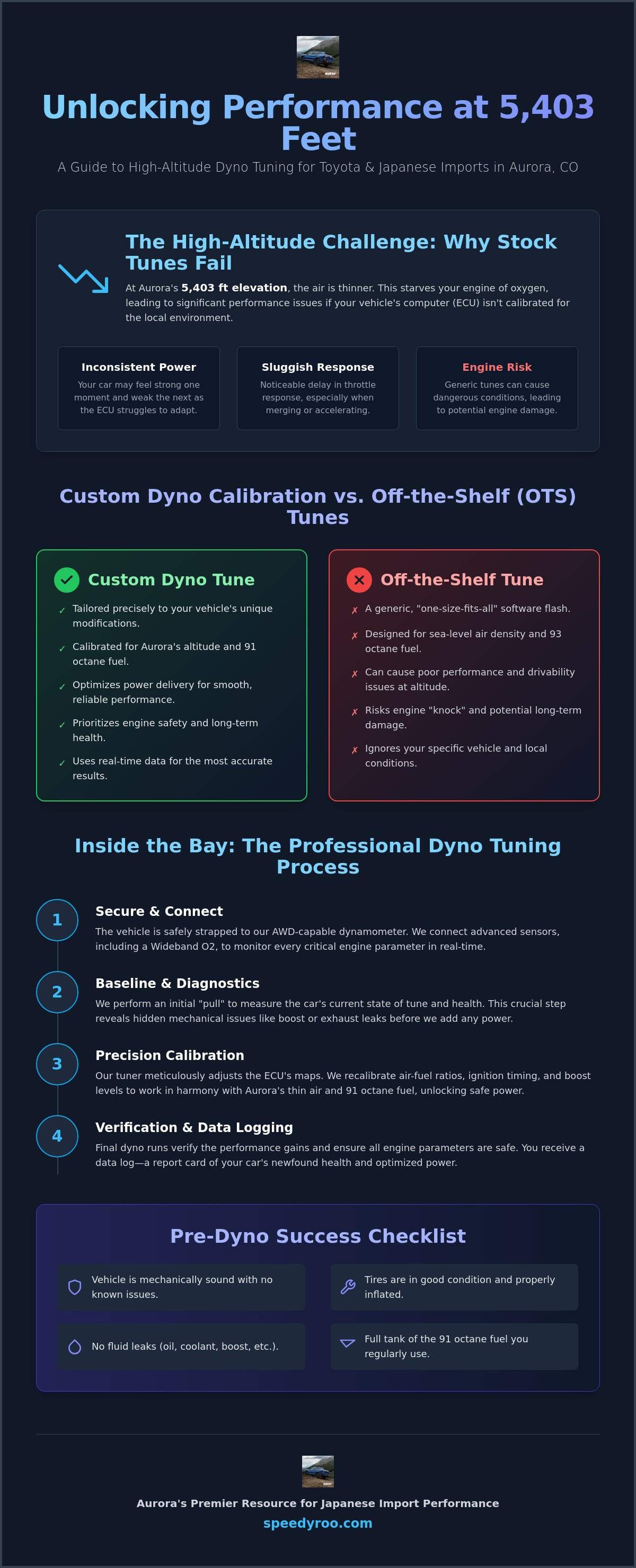
Pre-Dyno Checklist: Preparing Your Japanese Import for Success
The excitement of a dyno day can quickly turn into frustration if your car isn’t mechanically ready. In the industry, we call this “The Walk of Shame.” It happens when a vehicle is strapped to the rollers, but the session is cut short because of a simple, preventable mechanical failure. You still pay for the professional’s time, but you leave without the power gains you wanted. Arriving prepared ensures that every minute on the dynamometer is spent optimizing your software rather than troubleshooting basic hardware issues. If you’re preparing for Toyota performance tuning Aurora sessions, remember that the tuner can only optimize what is already working correctly.
Your preparation should start with a thorough fluid check. Fresh oil and a full cooling system are non-negotiable. We also look for any active leaks. If a car drips oil or coolant onto the rollers, the session ends immediately for safety and cleanliness. Spark plugs are another critical factor. They should be fresh and gapped to the specific requirements of your build. High boost levels can “blow out” the spark if the gap is too wide, leading to misfires under load. Finally, verify your drivetrain health. For AWD vehicles, all four tires must have matching tread depth. Significant differences in tire diameter can put undue stress on the center differential during high-speed pulls. Many owners overlook how Colorado’s extreme temperature swings and altitude affect these mechanical components, which is why a thorough Japanese car inspection Aurora specialists recommend can catch hidden issues before they derail your dyno session. If you’re also in the market for a used Japanese import to tune, a pre-sale vehicle evaluation Aurora buyers rely on can reveal hidden maintenance debt and costly mechanical issues before you commit to a purchase.
Mechanical Soundness and Leak Testing
A boost leak test is the single most important preparation step for any turbocharged vehicle. Even a tiny pinhole leak in a vacuum line or intercooler coupler will prevent the engine from reaching its target boost safely. The tuner will see the turbocharger working harder than necessary to compensate for the lost air, which raises intake temperatures and reduces safety margins. You must also ensure your fuel system is robust. Your fuel pump and injectors need enough overhead to handle the increased flow demands of a high-performance calibration. If you suspect your turbocharger or supporting hardware isn’t up to the task, it’s wise to schedule Subaru turbo repair Aurora services to address these issues before your session begins.
Electrical and Sensor Integrity
Electrical stability is often the silent killer of a good tuning session. Ensure there are no active “Check Engine Lights” (CELs) that could force the ECU into a “limp mode.” Your battery and alternator must also be in top condition to provide a stable 13.5 to 14.4 volts. If the voltage fluctuates, the sensor readings provided to the ECU can become inaccurate, making it impossible to find a precise “sweet spot” for timing and fuel. Finally, arrive with at least a half-tank of the specific fuel you plan to use, such as 91 Octane or E85. To ensure your vehicle is fully prepared for the rollers, you can schedule a pre-dyno inspection with our team to verify every item on this list.
Speedy Roo Motorsports: Aurora’s Premier Dyno Tuning Resource
Speedy Roo Motorsports & Repair Inc. has been a staple of the Aurora automotive community since 2002. We aren’t a generalist shop that tries to work on every make and model under the sun. Instead, we’ve dedicated our careers to mastering the “Big Six” Japanese brands: Subaru, Toyota, Lexus, Nissan, Mazda, and Honda. This specialized focus allows us to understand the unique engineering nuances of these vehicles, from the thermal management needs of a Boxer engine to the intricate ECU logic required for high-quality Toyota performance tuning Aurora drivers expect. When you bring your car to us, you’re working with technicians who live and breathe Japanese performance.
Our facility is equipped with a modern, AWD-capable dynamometer, which is the gold standard for the Colorado car scene. While many local shops are limited to 2WD rollers, our AWD setup is essential for the massive Subaru community and owners of modern all-wheel-drive performance cars. This equipment allows us to simulate real-world road loads on all four wheels simultaneously, providing the most accurate data for your calibration. This precision is what allows us to find the perfect balance between aggressive power and long-term engine safety.
We’ve built our brand on a legacy of transparency and integrity. We’re “Expert Neighbors” first, and that means we won’t tune a car that isn’t mechanically safe. If our pre-dyno inspection identifies a worn belt, a failing sensor, or a dangerous leak, we’ll tell you honestly rather than risking your engine on the rollers. The “Speedy Roo” advantage is our ability to combine master-level repair work with high-end performance expertise. We can diagnose, repair, and tune your vehicle all under one roof, ensuring a seamless process that protects your investment.
Expertise in Subaru and Toyota Platforms
Our team has extensive experience with the most popular performance platforms in the region, including the WRX/STI, the GR Supra, and the 86/BRZ. We understand the specific challenges these engines face when climbing through the Rockies. We focus on balancing raw horsepower with the reliable driveability you need for a daily commute. If you’re looking for altitude-specific calibrations for your flat-four, explore our resources on Subaru performance tuning Aurora to see how we maximize efficiency at 5,000 feet and above.
Schedule Your Aurora Dyno Session
We believe in clear communication and transparent pricing. Every session starts with a consultation where we discuss your specific goals and the current state of your build. We’ll walk you through the process so you feel empowered and informed about the changes being made to your vehicle’s software. Whether you’re finishing a major build or just want to optimize a few bolt-on parts, we’re ready to help. Schedule your Aurora Dyno Tuning appointment with Speedy Roo today! and experience the difference that specialized Japanese expertise makes.
Experience the Peak of Colorado Performance
Achieving reliable power in Aurora’s unique high-altitude environment requires more than just high-quality parts. It demands a calibration that respects the thin air and local fuel volatility. By prioritizing a custom tune over a generic flash, you ensure your engine remains healthy while delivering the smooth, consistent performance you expect. Remember that a successful session starts with a well-prepared car. Following a pre-dyno checklist prevents wasted time and keeps your vehicle’s vitals within safe limits throughout the testing process.
Speedy Roo Motorsports has served the Aurora community since 2002. As specialized Japanese import experts, we have the specialized knowledge and the in-house AWD-capable dynamometer needed to handle your build with precision. Whether you are seeking Toyota performance tuning Aurora owners trust for daily driveability or a high-horsepower track setup, we are here to partner in your vehicle’s longevity. Our methodical approach replaces the stress of performance modifications with the confidence of data-driven results.
Book Your Dyno Tuning Consultation at Speedy Roo Motorsports today. Let’s work together to unlock your car’s true potential safely.
Frequently Asked Questions
How much horsepower will I gain from a dyno tune in Aurora?
Horsepower gains vary significantly based on your specific engine type and the modifications you’ve installed. A naturally aspirated vehicle might see a modest 5% to 10% increase in power, while turbocharged engines often see gains of 20% to 40% with a custom calibration. We focus on creating a usable torque curve and smooth power delivery rather than just chasing a single peak number that might compromise your driveability.
Is dyno tuning safe for high-mileage Toyotas or Subarus?
Dyno tuning is perfectly safe for high-mileage vehicles provided they pass a thorough mechanical inspection first. We prioritize engine longevity by building in conservative safety buffers that account for natural engine wear. For those seeking Toyota performance tuning Aurora services, we ensure your older Tacoma, 4Runner, or Supra is robust enough to handle the increased load before we ever start the rollers; if you are also looking for aesthetic or functional wheel upgrades, you can check out Elite Custom Rims.
How long does a typical dyno tuning session take at Speedy Roo?
A standard tuning session usually takes between two and four hours to complete correctly. This timeframe includes the initial process of strapping the vehicle down, connecting our sensors, and performing baseline pulls to check for existing issues. More complex builds or vehicles requiring multiple maps for different fuel types will naturally take longer to ensure every data point is verified for safety and performance.
Do I need a custom tune if I only have a cold air intake and exhaust?
While your car will likely run with basic bolt-on parts, you won’t see the full benefit of those investments without a tune. A custom calibration allows the ECU to actually utilize the increased airflow those parts provide. In Aurora’s thin air, a tune is especially helpful to correct the air-fuel ratios that factory software often struggles to manage when hardware changes are made.
Can you tune for E85 or Flex Fuel in Aurora?
We provide comprehensive tuning services for E85 and Flex Fuel systems. Ethanol is a popular choice in Colorado because its high octane rating allows for more aggressive ignition timing and boost without the risk of engine knock. We can set up a dedicated E85 map or a sophisticated Flex Fuel system that automatically adjusts your engine’s parameters based on the ethanol content in your fuel tank.
What happens if my car breaks while it is on the dyno?
If we detect a mechanical issue or a sensor reading that falls outside of safe limits, we stop the session immediately. Our real-time monitoring allows us to catch most problems, like a failing fuel pump or a boost leak, before they cause damage. Since we are a full-service repair shop, we can often diagnose the failure and provide a repair estimate right on the spot.
Will a custom dyno tune void my vehicle manufacturer warranty?
Modifying your ECU software generally gives a manufacturer grounds to deny warranty claims related to the powertrain. Most modern vehicles have internal counters that show when the software has been altered. If maintaining a factory warranty is your primary concern, it’s important to understand that performance tuning is usually considered an aftermarket modification that falls outside of standard coverage agreements.
Do I need to bring my own tuning software or hardware?
The requirements depend entirely on your specific vehicle and the tuning platform we use. Some cars allow us to flash directly to the factory ECU using our in-house software, while others require a handheld device like a Cobb Accessport. When you call to discuss Toyota performance tuning Aurora, we’ll verify your model year and modifications to let you know exactly what hardware is necessary for a successful session.