
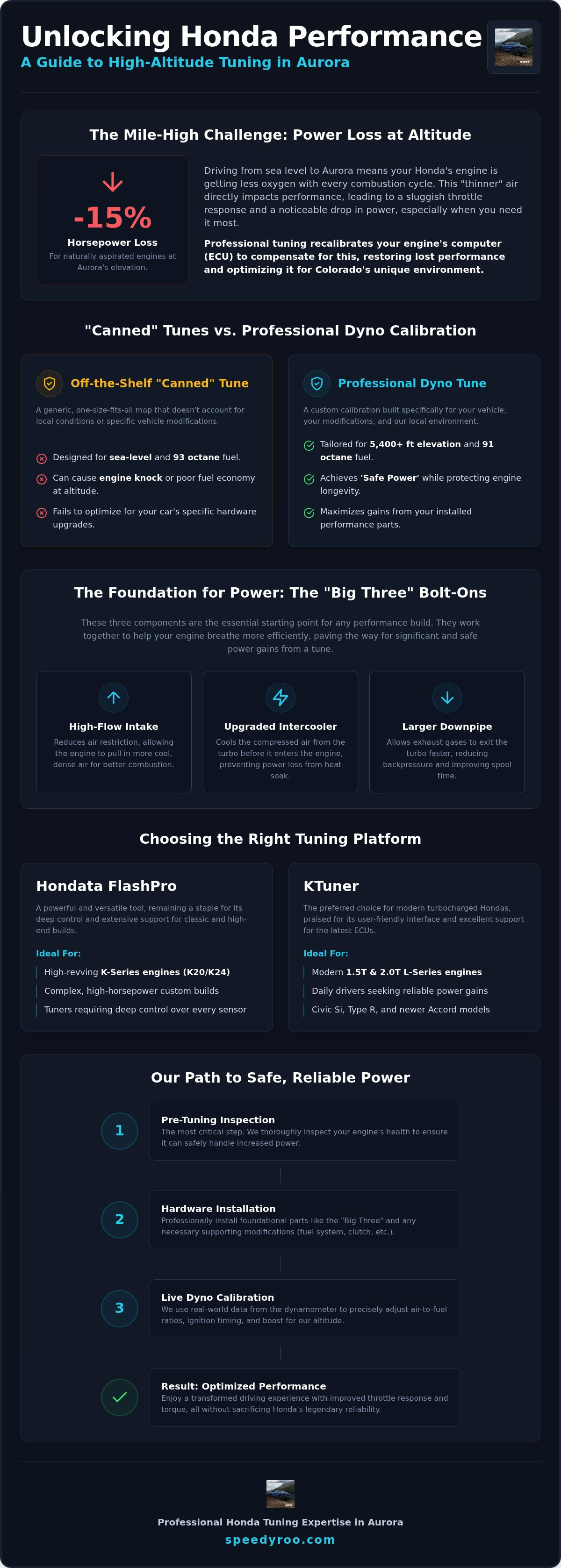
Did you know your Honda loses nearly 15% of its naturally aspirated horsepower the moment you drive it into Aurora from sea level? It’s frustrating to feel that sluggish throttle response when you’re merging onto I-225 or climbing toward the foothills. You likely chose a Honda for its precision engineering, yet the thin Colorado air can make the engine feel like it’s struggling to breathe. Professional Honda performance tuning Aurora addresses this specific environmental challenge, ensuring your car performs exactly as intended at 5,000 feet.
We understand the hesitation that comes with modifying a reliable daily driver. You want more torque, but you don’t want to risk engine knock or compromise the longevity of your vehicle. This article will show you how to safely unlock your Honda’s potential with engine calibrations tailored for our unique climate. We’ll clarify the differences between platforms like Hondata and KTuner while explaining how a professional dyno session provides the proof of gains you need. By the end, you’ll know how to transform your driving experience without sacrificing the reliability your Honda is known for.
Key Takeaways
- Learn why the “turbo compensation” myth isn’t enough to overcome Aurora’s 5,471-foot elevation without precise ECU recalibration.
- Identify the “Big Three” bolt-on upgrades-intake, downpipe, and intercooler-that provide the most efficient foundation for power gains.
- Understand how professional Honda performance tuning Aurora uses real-world dyno data to optimize air-to-fuel ratios specifically for Colorado’s thin air.
- Discover why a comprehensive pre-tuning inspection is the most critical step to ensuring your engine remains safe and reliable under increased load.
- Find out how balancing software-driven performance with specialized mechanical expertise protects the long-term health of your daily driver.
Why Honda Performance Tuning in Aurora Matters in 2026
In 2026, the definition of a high-performance vehicle has changed. It’s no longer just about heavy mechanical changes like swapping camshafts or pistons. Instead, Engine tuning has become a digital art form centered on the Engine Control Unit (ECU). For local enthusiasts, Honda performance tuning Aurora is the most effective way to bridge the gap between factory settings and the reality of Colorado driving. By recalibrating the software that manages fuel, ignition, and boost, we can optimize how your engine breathes in our thin air.
Modern Hondas, from the turbocharged Civic Si to the latest hybrid-assisted models, rely on complex algorithms to maintain balance. As we move into 2026, these systems have become even more integrated. Professional tuning isn’t about pushing a car to its breaking point. It’s about finding ‘Safe Power.’ This means achieving noticeable gains in torque and throttle response while maintaining the 200,000-mile reliability that made you buy a Honda in the first place. We focus on longevity as much as we do on horsepower.
The Difference Between ‘Canned’ Tunes and Professional Calibration
Many owners start with ‘canned’ or ‘off-the-shelf’ maps. While these are convenient, they’re often designed for sea-level conditions and high-quality 93 octane fuel. Aurora sits at over 5,400 feet, where oxygen is scarce and our premium fuel tops out at 91 octane. Running a sea-level tune here can lead to engine knock or poor fuel economy because the ECU is constantly fighting to compensate for the lack of air. A professional calibration is built specifically for your car, your modifications, and our local atmosphere. It ensures your engine isn’t working against itself.
Honda’s Performance Heritage: From VTEC to Earth Dreams Turbo
The evolution of Honda powerplants has created two distinct tuning worlds. The legendary K-Series engines, like the K20 and K24, remain favorites for their high-revving nature and VTEC engagement. Custom mapping allows us to lower that VTEC crossover point, providing a much broader power band that’s more useful in daily driving. Conversely, the modern L-Series 1.5T engines found in newer Accords and Civics offer massive torque gains through precise boost control. Whether you drive a Civic Type R or a daily-driven CR-V, the goal remains the same: making the car feel more alive without compromising its long-term health.
For enthusiasts who want to go beyond the driver’s seat and master the technical skills of automotive modification and classic restoration, Restomod Academy offers an online educational platform to help you refine your craft.
Core Components of a High-Performance Honda Build
Building a high-performance Honda in Colorado requires more than just buying the most expensive parts you find online. It requires a strategy that balances increased power with the physical limits of the hardware. Most successful builds start with the “Big Three” bolt-ons: a high-flow intake, a larger downpipe, and an upgraded intercooler. These components work together to reduce restriction and lower the temperature of the air entering your engine. Without these foundations, even the best Honda performance tuning Aurora has to offer will be limited by the physical constraints of the factory plumbing.
As you push for higher horsepower, your factory fuel system will eventually reach its limit. Upgrading to high-flow fuel injectors and a more robust fuel pump becomes necessary to maintain safe air-to-fuel ratios under heavy load. This is especially true if you plan to run E85 or high-boost applications. Additionally, don’t overlook the drivetrain. Manual Hondas seeing significant torque gains often require a clutch upgrade, as the stock pressure plate isn’t designed to hold the aggressive bite of a tuned engine. Heat management is another critical factor. Aurora’s dry, hot summers can lead to “heat soak,” where the engine loses power because it can’t shed heat fast enough. Upgraded radiators and oil coolers help ensure your car stays reliable during spirited drives up the canyon.
Choosing the Right Platform: Hondata vs. KTuner
Deciding between Hondata and KTuner depends largely on your specific vehicle and goals. Hondata FlashPro remains a staple for older K-Series engines and high-end builds that require deep control over every sensor. Conversely, KTuner has become the preferred choice for modern 1.5T and 2.0T platforms due to its user-friendly interface and excellent support for newer ECUs. Both devices interface seamlessly with our professional software, allowing us to build a map that is as unique as your car. If you aren’t sure which hardware fits your project, a pre-tuning consultation can help you make an informed choice.
Airflow and Exhaust: Letting the Engine Breathe
The Mile High Factor: Adjusting for Aurora’s Altitude
Aurora sits at 5,471 feet above sea level. This isn’t just a statistic; it’s a physical barrier for your Honda’s engine. At this elevation, the air is significantly less dense, containing roughly 17% less oxygen than at sea level. When oxygen is scarce, your Engine Control Unit (ECU) must work much harder to maintain the correct air-to-fuel ratio. Without professional Honda performance tuning Aurora, your car effectively runs a compromised version of its factory map, leading to sluggish acceleration and poor fuel economy.
Many enthusiasts fall for the “Turbo Compensation” myth. The idea is that because a turbocharger forces air into the engine, it automatically makes up for the altitude. This is only partially true. While a turbo can hit its target boost, it has to spin much faster to do so in thin air. This leads to “over-spinning,” which pushes the turbocharger outside of its efficiency range and generates massive amounts of heat. Because thin air is also a poor heat conductor, your intercooler becomes less effective at shedding that heat. A sea-level tune doesn’t account for these stresses, which is why local calibration is vital for the longevity of your turbo.
Oxygen Density and Air-Fuel Ratios
During the tuning process, we focus heavily on “Target Lambda.” This is the specific air-to-fuel ratio the engine aims for under load. In Aurora’s thin air, we calibrate the ECU to be more sensitive to knock sensors. Thinner air and our local 91 octane fuel create a higher risk of detonation, so we must be precise. We also adjust ignition timing. Combustion actually happens slower in less dense air, so we optimize when the spark plug fires to ensure we’re extracting every bit of energy from the fuel without risking engine damage.
Maximizing Naturally Aspirated (NA) Performance
Naturally aspirated Hondas, such as the legendary S2000 or older Civic Sis, feel the “altitude tax” most acutely. These engines rely entirely on atmospheric pressure to fill the cylinders. Without a turbo to help, they often feel gutless in the mid-range when driving through the Denver-Aurora metro area. We use cam-angle optimization to claw back that lost torque. By adjusting when the valves open and close, we can improve the engine’s volumetric efficiency even when oxygen is low. While we specialize in these high-revving Honda platforms, our expertise in high-altitude calibration also applies to other Japanese imports, including the specialized needs of AWD systems found in Subaru Repair in Aurora.
The Speedy Roo Dyno Tuning Process
At Speedy Roo Motorsports & Repair Inc, we approach performance with a “maintenance first” mindset. We’ve seen many cars pushed to their limits on the dyno only to fail because of a simple, overlooked mechanical issue. Our process for Honda performance tuning Aurora starts long before the engine ever hits the rollers. We treat your vehicle as a complete system, ensuring every component is healthy enough to handle the increased stress of a performance map. This methodical approach is why we’ve been a trusted independent specialist in Aurora since 2002.
Step 1: The Pre-Performance Health Check
Before we strap your car down, our technicians perform a thorough diagnostic sweep. We look for specific Honda vulnerabilities like oil dilution in newer turbo models or worn components in high-mileage engines. If your vehicle is approaching a major service interval, such as a Honda timing belt replacement Aurora, we recommend completing that work first to ensure total reliability. We also perform a smoke test on the intake system to find “phantom” boost leaks that could skew our data. Tuning a car with existing mechanical flaws is not only ineffective; it’s dangerous for the longevity of your engine.
Step 2: Calibration and Refinement
Once the car is cleared for the dyno, we begin the optimization phase. We start by loading a conservative base map and gradually refining the parameters. During these runs, we monitor critical data points like Exhaust Gas Temperature (EGT) to ensure your catalytic converter and internal components stay within safe limits. A professional dyno graph serves as a visual tool to measure the “area under the curve,” which represents usable torque across the entire rev range rather than just a single peak horsepower number. This focus on the power band ensures your Honda feels faster in every gear, not just at redline.
Our in-house dyno facility allows us to simulate real-world Colorado driving conditions, including the heavy loads of mountain climbs. We log data across multiple pulls to ensure the calibration remains stable as engine temperatures rise. After the session, we provide a full walkthrough of your power graphs and explain the safety parameters we’ve set to protect your daily driver. If you’re ready to see what your car is truly capable of, you can schedule your dyno session with our specialist team today.
Choosing the Right Aurora Honda Specialist
Selecting a shop for Honda performance tuning Aurora is a decision that impacts both your car’s speed and its long-term health. You need a team that understands the nuance of Japanese engineering rather than a generic mechanic who treats every engine the same. Speedy Roo Motorsports & Repair Inc was founded in 2002, and we’ve spent more than 20 years focusing exclusively on Japanese brands. This specialized focus allows us to identify potential issues before they become expensive failures on the dyno. We aren’t just completing a transaction; we’re helping you maintain a vehicle you take pride in driving.
Our facility on Girard Ave is an “all-under-one-roof” shop. This means we can handle everything from routine brake service to complex engine calibrations in a single location. This integration provides a level of quality control that most performance shops can’t match. When the person tuning your car also knows how to rebuild its transmission, you get a much more reliable result. Our community in Aurora trusts us because we combine honest, transparent pricing with the meticulous craftsmanship required for high-performance builds. We treat every Honda as if it were our own, ensuring it remains a safe, reliable daily driver even after we’ve unlocked its full potential.
The Synergy of Repair and Performance
There is a critical link between maintenance and performance. A tuner who doesn’t understand the mechanical foundations of your car might push the software too far. Because our technicians are experts in Japanese import repair, we ensure your vehicle’s hardware is ready for the software changes we make. We check that your suspension can handle the increased load and that your cooling system is efficient enough for Colorado’s thin air. This specialized knowledge isn’t limited to one brand, which is why we also provide expert Toyota performance tuning Aurora for local enthusiasts. We believe that a faster car must also be a safer car.
Ready to Unlock Your Honda’s Potential?
Unlocking your car’s potential is a structured process that starts with a simple consultation. When you prepare for your appointment, make sure your car has fresh fluids and a full tank of 91 octane fuel. We’ll walk you through the entire process, explaining the data and the safety margins we use to protect your engine. Our goal is to replace the typical stress of automotive performance with a feeling of calm reliability. You’ll leave our shop with a car that feels more responsive and a dyno graph that proves the gains. Schedule your Aurora Dyno Tuning appointment today! and let’s start building the Honda you’ve always wanted.
Ready to Transform Your Driving Experience?
Aurora’s altitude doesn’t have to be a performance bottleneck for your vehicle. By addressing the specific challenges of thin air and fuel quality, you can enjoy a more responsive and powerful driving experience. We’ve explored how the right blend of bolt-on components and professional engine calibration ensures your car remains a reliable daily driver. Choosing a specialist who prioritizes the longevity of your engine is the most important step in any build.
Since 2002, Speedy Roo Motorsports & Repair Inc has served as the A+ rated local specialist for Japanese imports. Our in-house dyno facility and over 20 years of expertise allow us to provide precise Honda performance tuning Aurora enthusiasts can rely on for real-world results. We invite you to experience the difference that meticulous craftsmanship and specialized knowledge make for your car. Book Your Honda Tuning Consultation at Speedy Roo and let our team help you safely maximize your power today.
Frequently Asked Questions
Will tuning my Honda void my manufacturer warranty?
A dealership cannot legally void your entire warranty because of a modification, but they can deny specific powertrain claims if they prove the tune caused a failure. Most modern Honda ECUs can be “flagged” once the software is altered. It is best to assume that any engine or transmission related warranty coverage will be scrutinized. We prioritize safe calibrations to minimize risk while maximizing your driving enjoyment.
How much horsepower can I expect from a basic Stage 1 tune?
For a turbocharged model like the Civic 1.5T, a Stage 1 tune typically yields gains of 20 to 30 horsepower and a significant increase in torque. Naturally aspirated models generally see smaller peak gains but benefit from much better throttle response and a broader power band. These results depend on the specific engine health and how the car reacts to Colorado’s unique atmospheric conditions during the session.
Do I need to use 91 octane fuel after my Honda is tuned?
Yes, you must use 91 octane fuel once your vehicle is calibrated for it. Performance maps rely on the knock resistance of premium fuel to safely manage increased ignition timing and boost. Using lower grade fuel like 85 or 87 octane can lead to engine detonation. This is especially dangerous in Aurora, where the thin air already requires the ECU to work harder to maintain safe combustion.
Is it safe to tune a Honda with high mileage?
It is safe to tune a high mileage Honda if the engine is mechanically sound and maintenance is up to date. We perform a pre-tuning health check to verify the condition of spark plugs, coils, and fluid levels. If the car passes this inspection, we can build a conservative map that improves performance without overstressing aging components. Longevity is always our primary goal when working with older vehicles.
What is the difference between a street tune and a dyno tune?
A street tune involves logging data on public roads, while a dyno tune happens in a controlled facility on rollers. Dyno tuning is superior because it allows us to measure exact torque changes in real time and simulate various load conditions safely. Professional Honda performance tuning Aurora utilizes our in-house dyno to ensure every software adjustment is backed by measurable data rather than just guesswork or feel.
Can you tune my Honda if it has a CVT transmission?
We can tune Honda models with CVT transmissions, but we use specific torque management strategies to protect the belt and pulleys. CVTs are more sensitive to high torque than manual gearboxes. We focus on smoothing out the power delivery and improving throttle response rather than pushing for maximum peak numbers. This approach ensures your car feels more alive while keeping the transmission reliable for your daily commute.
How long does a typical Honda tuning session take at Speedy Roo?
A typical Honda performance tuning Aurora session usually takes between three and five hours to complete. This timeframe includes the initial pre-performance health check, strapping the vehicle to the dyno, and performing multiple calibration runs. We are meticulous with our process, taking the necessary time to ensure the final map is stable and safe under all driving conditions. We never rush the calibration of your daily driver.
Do I need to upgrade my intercooler before getting a tune?
An upgraded intercooler is not strictly required for a basic tune, but it is highly recommended for turbocharged Hondas in Colorado. Factory intercoolers often suffer from “heat soak” during our hot summers and at high altitudes. Upgrading this component helps maintain consistent power levels by keeping intake air temperatures lower. It provides a much larger safety margin, allowing your engine to perform better during long mountain climbs.