
Did you know that a difference of just 1/4-inch in tire circumference can lead to a total drivetrain failure in your Subaru? It’s a startling reality for many Colorado drivers who realize too late that their Symmetrical All-Wheel Drive system requires more than just a standard oil change. If you’ve ever felt confused by strict tire matching rules or worried about the high cost of a 30,000-mile dealer visit, you aren’t alone. Finding a reliable Subaru AWD service Aurora specialist shouldn’t be a source of stress, especially when over 72% of vehicles sold in Colorado are equipped with AWD or 4WD to handle our rugged terrain.
We understand that you want a vehicle that’s reliable and winter-ready without the anxiety of unexpected repairs. This guide provides a clear roadmap for maintaining your vehicle’s precision mechanical ecosystem and ensuring it handles our toughest roads with ease. You’ll learn the essentials of the AWD maintenance schedule, how to comply with the latest Colorado Traction Law requirements, and why specialized local care is the key to longevity. By the end of this reference, you’ll have the confidence to handle any mountain pass, knowing your drivetrain is calibrated for peak performance.
Key Takeaways
- Understand how Colorado’s extreme temperature swings stress your drivetrain and why specialized Subaru AWD service Aurora is essential for protecting sensitive seals.
- Learn why the “2/32nd Rule” for tire matching is non-negotiable for preventing mechanical binding and preserving your Symmetrical AWD system.
- Identify the specific sounds and sensations, such as low-speed shuddering or high-pitched whines, that signal your differentials need immediate attention.
- Discover the critical maintenance intervals for changing differential and transfer case fluids to ensure your vehicle remains winter-ready and reliable.
- Gain insight into how advanced diagnostic tools can monitor real-time AWD clutch engagement to catch minor issues before they become major repairs.
Why Subaru Symmetrical AWD Requires Specialist Maintenance in Aurora
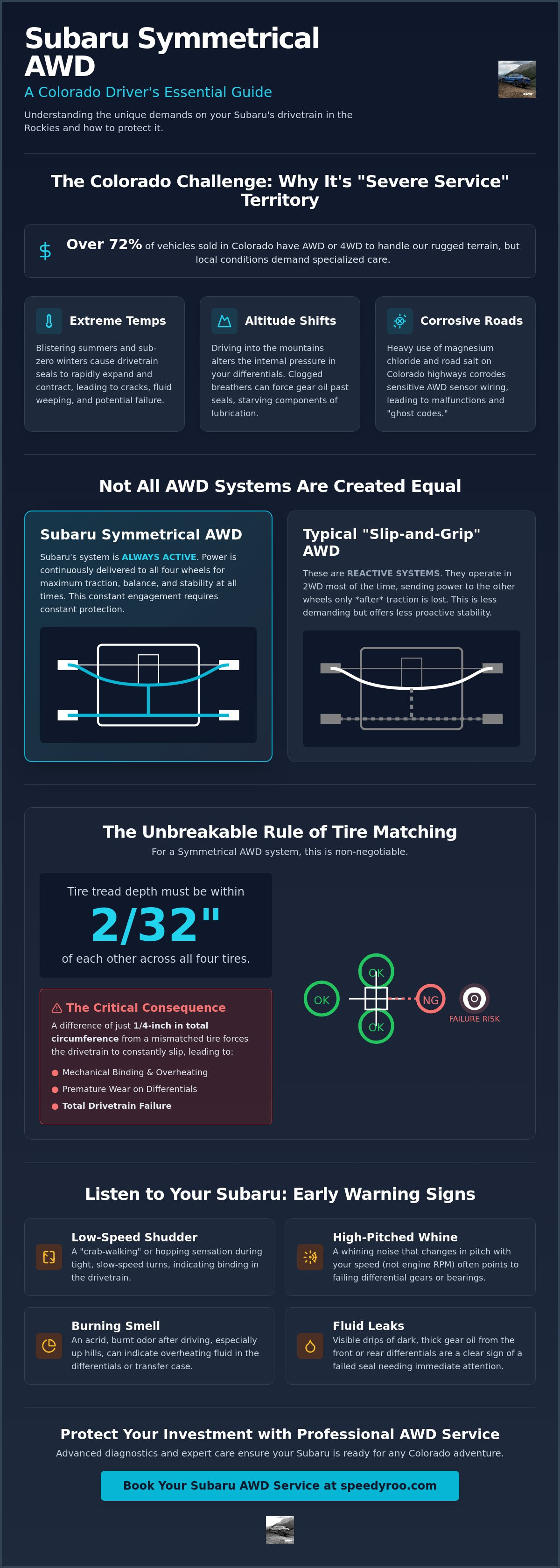
Subaru vehicles are engineered differently than almost any other car on the road. At the heart of this design is Subaru Symmetrical AWD, a continuous and linear drivetrain layout that provides exceptional balance. Unlike the “slip-and-grip” systems found in many other Japanese brands, which only send power to the rear wheels after the front tires lose traction, Subaru’s system is always active. This permanent engagement offers superior stability on slick roads, but it also puts constant mechanical load on every component. Because the system is always working, the fluids and seals don’t get a break.
In a city like Aurora, this constant activity makes regular Subaru AWD service Aurora a necessity rather than a suggestion. We categorize most Colorado driving as “Severe Service” due to our unique environment. Between the blistering summer heat during a commute on I-225 and sub-zero winter mornings, your drivetrain seals face relentless stress. These extreme temperature swings cause rubber components to expand and contract rapidly, which can lead to fluid weeping or total seal failure if they aren’t inspected by a specialist who understands these specific wear patterns.
The Colorado Factor: Altitude and Temperature Swings
Driving from the plains of Aurora up into the Rockies involves massive altitude shifts. These changes affect the internal pressure of your front and rear differentials. If the differential breathers are clogged with road debris, pressure builds up and forces gear oil past the seals. Rapid elevation changes can also cause fluid aeration, which creates tiny bubbles in the oil and reduces its ability to lubricate high-friction metal surfaces. Beyond the physics of altitude, the heavy use of magnesium chloride and road salt on E-470 can corrode AWD sensor wiring. This often leads to “ghost codes” or system malfunctions that a general repair shop might struggle to diagnose correctly.
Symmetrical AWD vs. Traditional All-Wheel Drive
The mechanical advantages of the Symmetrical layout include equal-length half-shafts and a longitudinal engine mounting. This creates a lower center of gravity, which reduces wear on CV joints during tight mountain cornering. However, this design also means the drivetrain is a tightly integrated ecosystem. A small problem in the transfer case can quickly migrate and affect the transmission or the differentials. This level of technical sophistication is exactly why you need a Subaru repair Aurora CO specialist. We use precision tools to ensure that every part of this complex system is aligned and lubricated to handle the high-torque demands of Colorado driving.
Key Components of a Comprehensive Subaru Drivetrain Service
Maintaining the Symmetrical AWD system involves more than a quick visual check. It requires a detailed inspection of the mechanical links that transfer power from your Boxer engine to the Aurora streets. A proper Subaru AWD service Aurora focuses on the high-friction zones where metal meets metal, ensuring every component is lubricated and sealed against the elements. We don’t just look for leaks; we evaluate the health of the entire torque-delivery path.
Differential Fluid: The Lifeblood of Your Traction
Your front and rear differentials are responsible for allowing wheels to turn at different speeds while maintaining power. This process generates significant heat. While some manufacturers suggest “lifetime fluids,” this is a myth for vehicles driven in the Rocky Mountains—a view supported by the experts at Euro Performance Auto Shop LLC who emphasize specialized care for European drivetrains. The steep grades and heavy loads of mountain driving shear gear oil, reducing its protective properties. During a service, we check for a burnt odor or the presence of fine metal shavings on the magnetic drain plug. Most Subaru models require a high-quality 75W-90 gear oil, though high-performance variants often need specific limited-slip additives to prevent “chatter” during tight turns.
The Center Differential and Transfer Clutch
The method your car uses to split power between the front and rear depends on your transmission. Most modern Subarus with a CVT use a Multi-Plate Transfer (MPT) clutch system. This electronically controlled clutch pack requires precise fluid levels to manage engagement and cooling. Manual transmission models usually feature a Viscous Coupling center differential, which uses a specialized silicone fluid that thickens when wheels slip. If the fluid levels in these systems are even slightly off, the clutch packs can’t engage smoothly, leading to “torque bind” or premature wear. If you suspect your AWD isn’t engaging correctly, a specialized drivetrain check can identify if a simple fluid exchange will solve the problem.
Beyond the fluids, we meticulously inspect the physical hardware. This includes checking CV axles and rubber boots for tears. In Colorado, road grit and magnesium chloride act like sandpaper once they enter a torn boot, quickly ruining the joint. We also examine the drive shaft and U-joints for play or signs of imbalance. A slight vibration felt through the seat at highway speeds is often the first warning that a U-joint is reaching the end of its life. Catching these issues early prevents a broken axle from leaving you stranded on a snowy mountain pass.
The Golden Rule: AWD Tire Matching and Drivetrain Health
Precision is the defining characteristic of the Subaru drivetrain, and that precision starts where the rubber meets the road. Many owners are surprised to learn that their tires are actually a critical component of the all-wheel-drive system. While a front-wheel-drive car can handle mismatched tires with little more than a slight pull, a Subaru requires all four tires to be nearly identical in circumference. This is known as the “2/32nd Rule.” All tires must be within 2/32nds of an inch of each other in tread depth. If they aren’t, the different rolling diameters force the drivetrain to work against itself, leading to a condition called mechanical binding. During a Subaru AWD service Aurora, we prioritize these measurements because ignoring them is an expensive mistake. Replacing one damaged tire today might save a few hundred dollars, but it can easily lead to a $3,000 differential or transmission repair tomorrow.
Why You Can’t Just Replace One Tire
Your vehicle’s speed sensors are constantly monitoring the rotational speed of each wheel. If one tire is newer and has a larger diameter than the others, it rotates slower. The AWD system’s computer interprets this rotational difference as a loss of traction. It then attempts to compensate by engaging the center differential or transfer clutch. On a dry, high-grip Aurora road, there’s no “slip” to allow for this correction. This creates immense internal friction and heat within the drivetrain. Over time, this heat cooks the gear oil and fries the clutch packs, leading to a total system failure. We ensure these tolerances are met during every Subaru maintenance schedule Aurora appointment to protect your long-term investment.
Tire Rotations and Pressure Management
Consistent maintenance is the only way to ensure even wear across all four corners. We recommend a tire rotation every 5,000 miles to account for the different loads placed on the front and rear axles. Colorado’s climate also plays a role in your drivetrain’s health. Rapid cold snaps in Aurora can cause tire pressure to drop significantly overnight. Lower pressure reduces the rolling circumference of the tire, which can trigger the same mechanical binding issues as mismatched tread. For drivers who frequently head into the mountains, we often suggest a dedicated set of winter tires. This not only provides superior grip on icy passes but also preserves your primary set of tires, making it easier to keep the entire set within the required 2/32nd tolerance for the life of the vehicle.
Just as your vehicle needs the right setup for the snow, you also need the right gear for the slopes. For those looking for high-quality equipment and expert advice, check out Snowride Sports to explore a wide range of premium winter sports gear.
Warning Signs and Maintenance Schedules for Colorado Drivers
Your Subaru communicates its health through subtle sounds and physical feedback. Recognizing these signals early can be the difference between a routine fluid change and a major component replacement. One common symptom is “torque bind,” which feels like a jerking or shuddering sensation during tight, low-speed turns. You might notice this hopping feeling when you’re pulling into a parking spot or making a U-turn. This happens when the center differential can’t allow the front and rear axles to rotate at different speeds properly. Another red flag is a high-pitched “differential whine.” If you hear a whistle or hum that increases in pitch as you accelerate, your gear oil may be depleted or contaminated.
If you notice these issues, it’s time for a professional Subaru AWD service Aurora. Ignoring these signs often leads to the “AWD” or “AT OIL TEMP” light illuminating on your dashboard. While the AWD light often indicates a tire circumference mismatch, a flashing AT OIL TEMP light is a serious warning that your drivetrain or transmission is overheating. In Colorado’s thin air and steep grades, heat is the primary enemy of your vehicle’s longevity. We recommend addressing these lights immediately to avoid being stranded during a winter storm.
Symptoms of a Failing Subaru AWD System
- Clicking or popping sounds during acceleration: This usually points to a failing CV joint, often caused by a torn boot that allowed Colorado road salt and grit to enter the joint.
- Vibration at highway speeds: If you feel a rhythmic shaking while cruising on I-70 that isn’t related to tire balance, your drive shaft or U-joints may be reaching their limit.
- Hesitation on steep grades: A loss of precision during power delivery when climbing toward the mountains can signal that your center differential’s clutch packs are slipping.
The 30/60/90k Drivetrain Checklist
The 30,000-mile mark is the most critical milestone for any Subaru in Colorado. Because of our “Severe Service” conditions, waiting until 60,000 miles to change drivetrain fluids is often too late for optimal protection. A comprehensive Subaru AWD service Aurora includes several vital steps to ensure your car remains winter-ready. The same principle applies to other Japanese vehicles on Colorado roads — for example, the myth of “lifetime” transmission fluid is just as damaging for Mazda owners, which is why understanding the Mazda transmission service Aurora specialists recommend is equally important for long-term reliability:
- Step 1: Draining and filling front and rear differential gear oil to remove moisture and metal wear particles.
- Step 2: Meticulously inspecting all CV boots for leaks or heat-related cracking.
- Step 3: Performing a specialized test drive to check for center differential binding or clutch slippage.
- Step 4: Measuring tire tread depth across all four wheels with a precision gauge to ensure you’re within that vital 2/32nd-inch tolerance.
Don’t wait for a warning light to tell you there’s a problem. Schedule your 30k drivetrain inspection with a specialist who understands the specific demands of Colorado driving.
Professional AWD Diagnostics and Repair at Speedy Roo Motorsports
Choosing a specialist for your Subaru AWD service Aurora makes a significant difference in the longevity of your drivetrain. Since 2002, our team has focused on the unique engineering of Boxer engines and Symmetrical All-Wheel Drive systems. This specialization is vital in Colorado, where Subaru holds an 8.3% market share, nearly double the national average. Because we see these vehicles every day, we’ve developed a “Subaru Guru” level of intuition for the specific ways these cars react to our high-altitude environment. We don’t just follow a checklist; we understand the mechanical nuances that general repair shops often overlook.
One of the biggest advantages of choosing an independent specialist is the transparency in pricing and diagnostic depth. In the Denver and Aurora area, dealership labor rates typically range from $175 to $200 per hour, often accompanied by diagnostic fees as high as $200. We believe in providing a more accessible alternative for our community in Aurora, Centennial, and Parker. Our goal is to build a long-term partnership with you, ensuring your vehicle remains safe for every mountain pass without the typical stress of high-pressure dealership sales tactics. Aurora drivers who own multiple Japanese vehicles will find that the same commitment to specialized care applies whether you drive a Subaru or are looking for a trusted Toyota specialist Aurora residents can rely on for dealer-level diagnostics without the dealership price tag.
Specialist Tools for a Specialized System
General repair shops often rely on universal scanners that can’t access the proprietary data within a Subaru AWD controller. We use factory-level diagnostic tools to monitor real-time AWD clutch engagement and solenoid duty cycles. This allows us to see exactly how the system is distributing torque before we ever take a wrench to the car. We also prioritize the use of high-quality fluids that meet the strict friction requirements of your differentials. Using the wrong gear oil can lead to the “chatter” and binding issues we discussed earlier, so we never compromise on the chemical specifications of our supplies.
Your Local Aurora Subaru Experts
Our shop is conveniently located for drivers throughout Denver, Centennial, and Lone Tree who need reliable, honest care. The precision we apply to every Subaru AWD service Aurora is rooted in our high-performance background. Our expertise in dyno tuning Aurora CO requires a deep understanding of drivetrain tolerances and power delivery. We bring that same level of mechanical exactness to every routine inspection and fluid change. Whether you’re prepping for a ski trip or addressing a new vibration, we have the tools and experience to keep your Subaru performing at its peak. Drivers who are also tired of overpaying at the dealership for their other vehicles will appreciate learning about a quality Toyota dealer service alternative Aurora drivers can count on for the same specialist-level care without the inflated dealership pricing.
Schedule your Subaru AWD inspection at Speedy Roo today!
Ready Your Subaru for the Colorado Road Ahead
Maintaining your Symmetrical All-Wheel Drive system is about more than just checking boxes; it’s about protecting the mechanical precision that makes your vehicle so capable in our rugged environment. By following the 2/32nd rule for tire matching and adhering to a strict 30,000-mile fluid service interval, you prevent the friction and heat that cause expensive drivetrain failures. A professional Subaru AWD service Aurora ensures that every differential and clutch pack is calibrated to handle the steep grades of I-70 and the freezing winters of the plains.
Since 2002, our team at Speedy Roo Motorsports has served the Aurora, Denver, and Centennial communities as independent Subaru specialists. We provide the expert diagnostics and specialized care your car deserves without the typical dealership stress. Book Your Subaru AWD Service at Speedy Roo Motorsports to ensure your vehicle is winter-ready and reliable. We’re here to help you drive with confidence through every season, providing the honest, expert advice you need to keep your Subaru on the road for years to come.
Frequently Asked Questions
Can I replace just one tire on my Subaru if I get a flat?
No, you typically cannot replace just one tire unless the other three are nearly brand new. All four tires must stay within 2/32nds of an inch of each other in tread depth to prevent mechanical binding. A single new tire has a larger circumference, which forces the center differential to work constantly to compensate for the speed difference, leading to premature failure.
How often should I change the differential fluid in my Subaru?
We recommend changing your front and rear differential fluid every 30,000 miles. While some service manuals suggest longer intervals, Colorado’s steep mountain grades and extreme temperature swings qualify as severe driving conditions. Regular changes at this interval remove metal wear particles and moisture, ensuring the high-friction gear sets remain properly lubricated and cooled.
What is the ‘Torque Bind’ I feel when turning into a parking spot?
Torque bind is a physical shuddering or “hopping” sensation caused by the front and rear axles being locked together during a tight turn. This happens when the center differential or transfer clutch fails to allow the necessary rotational differences between the axles. It is often a sign of contaminated fluid, mismatched tires, or a failing solenoid within the AWD system.
Why is my Subaru AWD light flashing on the dashboard?
A flashing AWD light is a warning that the system has detected a significant difference in wheel speeds or a fault in the electronic controller. This is often triggered by a spare tire being used or a tire with incorrect air pressure. If you see this light, check your tire pressures and seek a professional Subaru AWD service Aurora to avoid overheating the drivetrain components.
Does Colorado’s weather affect how often I need AWD service?
Yes, the rapid temperature shifts and high altitude in Colorado put additional stress on your drivetrain seals and fluids. Cold winter starts followed by high-heat mountain climbs cause gear oil to break down faster than it would in flatter, more temperate climates. Frequent exposure to road salts also requires more regular inspections of your CV boots and AWD sensor wiring.
Is it okay to tow a Subaru with two wheels off the ground?
No, you must never tow a Symmetrical AWD Subaru with only two wheels on the ground. Doing so forces the front and rear axles to spin at different speeds, which will destroy the center differential or viscous coupling very quickly. Always insist on a flatbed tow truck to ensure all four wheels are off the ground during transport.
What is the difference between AWD and 4WD in a Subaru?
Subaru uses a full-time All-Wheel Drive system that is always engaged and automatically adjusts power delivery to all four wheels. Traditional 4WD systems are often part-time and require the driver to manually engage the system for off-road use. Subaru’s system is integrated into the drivetrain for continuous stability and better handling on both dry pavement and slick Aurora roads.
How much does a typical Subaru AWD service cost in Aurora?
The total for a Subaru AWD service Aurora depends on the specific model and whether you are performing a basic fluid exchange or a full drivetrain inspection. Prices vary based on the type of gear oil required and the condition of wear items like CV boots or U-joints. We recommend a professional evaluation to get an accurate estimate tailored to your vehicle’s current maintenance needs. Aurora drivers with multiple vehicles in the household may also want to explore our guide on Mazda transmission service in Aurora to understand how Colorado’s severe driving conditions affect other Japanese vehicles’ maintenance requirements.