
Have you ever felt your Subaru shudder or “buck” while making a sharp turn into a grocery store parking lot? That unsettling sensation often points to torque bind, a common symptom that leaves many owners fearing a massive dealership bill or a total transmission failure. When you depend on your vehicle to navigate a sudden Colorado snowstorm, any compromise in your drivetrain feels like a threat to your safety. Finding reliable Subaru AWD repair Aurora residents can trust shouldn’t add to that stress.
We understand that your Symmetrical All-Wheel Drive is the heart of your vehicle’s performance and your peace of mind. You deserve a solution that prioritizes the long-term health of your car over a quick, expensive fix. In this guide, we will break down the complexities of your AWD system and explain why specialized calibration is the only way to ensure your traction remains consistent on icy roads. You’ll learn how a transparent diagnostic process can restore your smooth handling and give you back the confidence you need for another winter in Aurora.
Key Takeaways
- Learn to identify “torque bind” symptoms, such as vehicle hopping during tight turns, to catch drivetrain issues before they lead to major failures.
- Discover why specialized Subaru AWD repair Aurora owners rely on is essential for maintaining the delicate balance of the Symmetrical All-Wheel Drive system.
- Understand the technical differences between rebuilding a center differential and replacing a transmission to make the most cost-effective choice for your vehicle’s longevity.
- Master the “Quarter-Inch Rule” for tire matching and learn the specific fluid maintenance intervals required to protect your drivetrain in Colorado’s high-altitude climate.
- Find out how an independent specialist’s transparent diagnostic approach ensures long-term vehicle health without the pressure of unnecessary dealership upsells.
Recognizing Symptoms of Subaru AWD Failure in Aurora
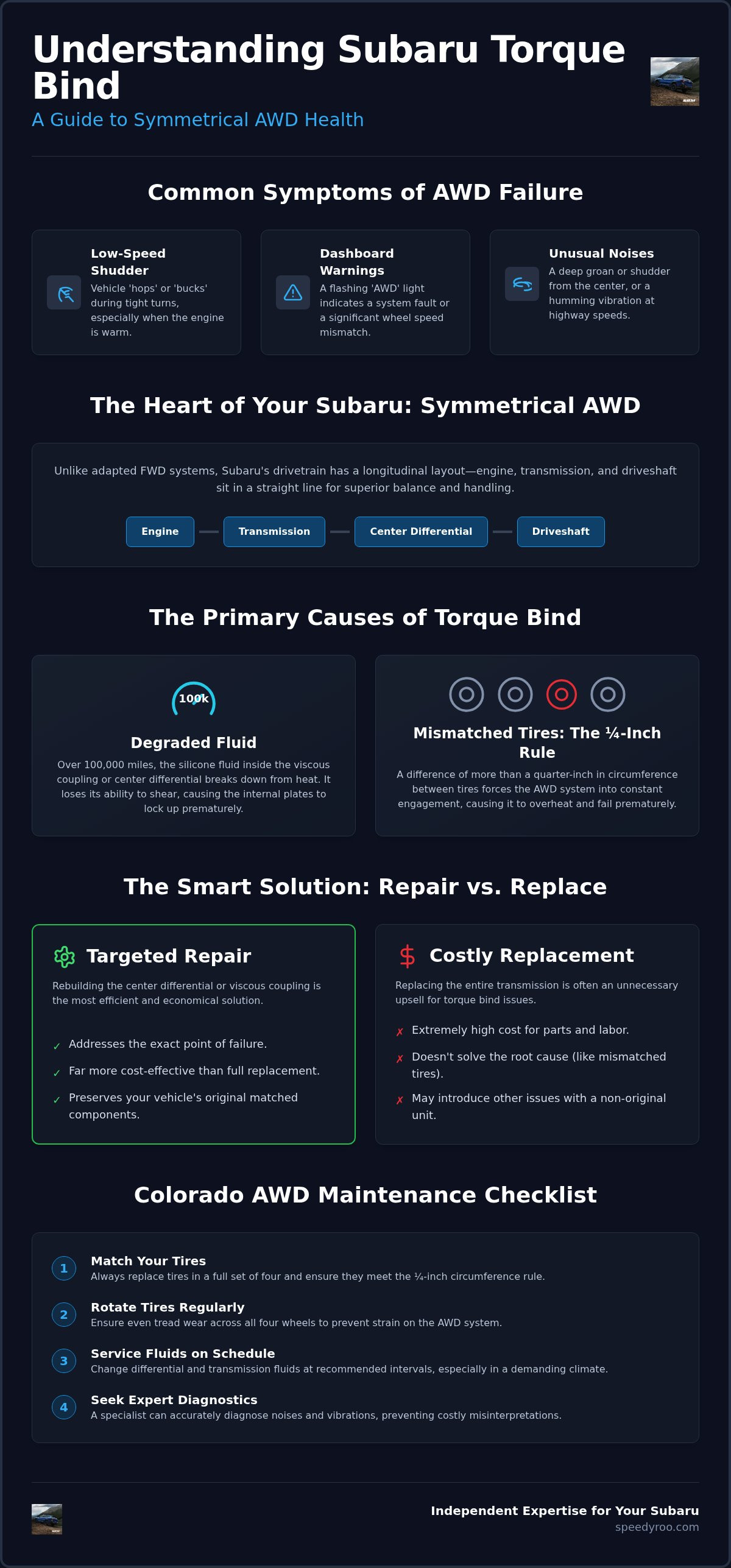
Subaru owners in Aurora often notice the first signs of trouble during the most mundane tasks. You might be pulling into a tight spot at the Town Center at Aurora when your car suddenly feels like it’s “hopping” or resisting the turn. This isn’t just a quirk of your vehicle; it’s a specific mechanical failure known as torque bind. Unlike a standard front-wheel drive car, your Symmetrical All-Wheel Drive relies on all four wheels rotating at specific speeds. When the system fails to allow for the necessary speed difference between the front and rear axles during a turn, the drivetrain binds up, creating that rhythmic bucking sensation.
Identifying the source of a noise is vital. A rhythmic clicking while turning usually indicates a failing CV axle, but a deep, guttural groan or shudder is more likely coming from the center differential. If you see a flashing AWD light on your dashboard, your Subaru is warning you that the system has detected a significant speed mismatch or an electronic fault. In Aurora’s heavy stop-and-go traffic on I-225, the constant shifting of power puts extra strain on these components. This frequent cycling can accelerate wear on the viscous coupling, making expert Subaru AWD repair Aurora services a necessity for local drivers.
The Infamous Low-Speed Shudder
This shudder typically stays hidden until your car is fully warmed up. After twenty minutes of driving, the silicone fluid inside the viscous coupling reaches operating temperature. If the fluid is degraded, heat causes it to expand and lock the internal plates together prematurely. This creates a jerky “binding” effect. Ignoring these warnings forces the transmission to fight against itself, which eventually leads to catastrophic internal gear failure.
Vibration and Humming at Highway Speeds
A steady hum that changes pitch with speed often points to a failing wheel bearing or a worn driveshaft carrier bearing. Colorado road salt is particularly harsh here; magnesium chloride can seep into seals and cause premature corrosion of rotating AWD parts. Professional Subaru AWD repair Aurora ensures these subtle vibrations are diagnosed correctly using specialized tools to isolate whether the noise is coming from a specific wheel or the central assembly.
The Mechanics of Symmetrical All-Wheel Drive and Torque Bind
Subaru’s drivetrain is a masterpiece of balance. Unlike many competitors that adapt front-wheel drive platforms to include rear traction, Subaru utilizes a longitudinal layout. This means the engine, transmission, and driveshaft sit in a straight line along the vehicle’s center axis. This symmetry provides better weight distribution and handling, but it also creates a highly interdependent system. When you require Subaru AWD repair Aurora, the technician must understand how this specific layout affects every other component in the drivetrain.
The “heart” of many manual Subaru AWD systems is the viscous coupling. This unit is a sealed drum filled with alternating steel plates and a specialized silicone fluid. When comparing AWD vs. 4WD, Subaru’s approach is distinct because it is full-time; power is always moving to all four wheels. Most modern automatic models use an Active Torque Split system, which relies on an electronically controlled multi-plate transfer clutch. Higher-performance models may feature Variable Torque Distribution (VTD), which uses a planetary gear set to provide a more rear-biased power delivery. Calibrating these systems after a repair requires specialized tools to ensure the torque split remains within factory specifications.
What Causes Torque Bind?
Torque bind occurs when the internal components of the differential can no longer allow for different wheel speeds. Over 100,000 miles, the silicone fluid in a viscous coupling undergoes thermal breakdown. It loses its ability to “shear” properly and instead stays locked. Mismatched tires are another primary culprit. If one tire is significantly more worn than the others, the system perceives constant wheel slip and works 100% of the time, leading to premature failure of the internal clutch plates.
Subaru AWD vs. Traditional 4WD
You cannot simply “turn off” a Subaru’s AWD system to troubleshoot a noise like you might with a traditional truck. On older models, a specific “FWD” fuse slot allowed technicians to temporarily disengage the rear wheels for diagnosis, but modern CVTs are far more complex. Our diagnostic process focuses on mechanical health rather than just reading computer codes. If your car feels sluggish or heavy during turns, our specialists can perform a thorough drivetrain evaluation to determine if a simple fluid service or a more targeted repair is necessary. This precision prevents the high costs associated with replacing an entire transmission when only a center differential component has failed.
AWD Repair vs. Replacement: Making the Right Call
Facing a drivetrain issue often leads to a crossroad: do you repair the specific component or replace the entire assembly? Because Subaru’s Symmetrical all-wheel drive is a full-time system integrated directly into the transmission, the stakes for this decision are high. A misdiagnosis can lead to spending thousands on a new transmission when a targeted center differential repair would have sufficed. Conversely, patching a severely damaged unit only delays the inevitable. We prioritize a transparent cost-benefit analysis that looks at the total health of your vehicle.
Before committing to a major Subaru AWD repair Aurora residents should consider the overall condition of their car. If your Subaru is approaching a milestone that requires a timing belt replacement or if there are signs of head gasket weeping, we factor those into our recommendation. Our goal is to ensure that your investment in the AWD system makes sense for the remaining lifespan of the vehicle. We don’t believe in “band-aid” fixes that fail to address the root cause of mechanical binding.
Rebuilding the Center Differential
Rebuilding is often the most efficient path when the failure is isolated to the viscous coupling or the transfer clutch assembly. This process requires extreme precision to shim and seal the unit correctly. We often see vehicles where owners tried “quick fix” fluid additives to stop torque bind. These additives usually fail because they cannot restore the physical properties of burnt silicone fluid or repair scarred metal plates. For comprehensive care that addresses both the drivetrain and the engine, our Subaru Repair in Aurora services provide a holistic approach to keeping your boxer-powered vehicle on the road.
Transmission Swaps: When AWD Damage is Too Deep
There are times when the damage has spread beyond the AWD components. If a diagnostic drain of your transmission fluid reveals “glitter” or silver metal shavings, it indicates that internal bearings or gears have started to disintegrate. In these scenarios, a transmission swap is the most reliable option. We take the stress out of this process by sourcing high-quality, verified replacement units. We pay meticulous attention to matching gear ratios; installing a unit with even a slightly different final drive ratio will cause immediate and severe binding, potentially destroying the replacement drivetrain within a few miles of driving.
Preventing AWD Failure: The Colorado Maintenance Guide
Living in Aurora presents unique challenges for your drivetrain. Our rapid temperature swings and high-altitude climbs put more stress on mechanical components than a coastal environment would. While the Symmetrical AWD system is robust, it is also sensitive to neglect. Preventing a costly Subaru AWD repair Aurora starts with understanding that maintenance in the Rockies isn’t just about following a generic owner’s manual; it’s about adapting to our specific geography.
A pre-winter inspection is your best defense against the first Aurora snowstorm. We check for fluid leaks, boot tears, and bearing play before the salt and ice arrive. Proper tire rotation is equally critical. On a Subaru, tires should typically be rotated every 6,000 miles to ensure even wear across all four corners. This simple step preserves the delicate balance of the center differential and prevents the premature binding that leads to expensive repairs. Consistency is the key to drivetrain longevity.
The Crucial Role of Tire Matching
The most common cause of AWD failure we see is mismatched tires. Subaru requires all four tires to be within 1/4 inch of each other in circumference. Even a tread depth difference of 2/32 of an inch can be enough to overheat the center differential. When tires aren’t identical, the smaller tires must spin faster to keep up with the larger ones. This forces the viscous coupling or clutch plates to work 100% of the time to compensate for the speed mismatch. Replacing just two tires instead of all four is a direct path to drivetrain damage. For a more detailed look at these requirements, see our Subaru AWD Service in Aurora guide.
Fluid Services for the Rear and Center Diffs
Many manufacturers claim their differential fluids are “lifetime,” but this doesn’t apply to the demanding Colorado climate. Mountain towing, heavy loads, and the thin air of the Front Range cause fluids to break down faster than expected. We recommend changing differential fluids every 30,000 to 50,000 miles, depending on your driving habits. Using the correct gear oil weights is vital for Aurora’s temperature extremes. This ensures the fluid remains viscous enough to lubricate in sub-zero winters while maintaining protection during hot summer commutes. If you haven’t had your drivetrain fluids inspected recently, we recommend you schedule a comprehensive AWD maintenance check to protect your investment.
Why Aurora Subaru Owners Trust Speedy Roo for AWD Service
Since 2002, Speedy Roo has served as a reliable partner for drivers throughout the Denver Metro area. We aren’t a general repair facility that tries to fix every make and model on the road. Instead, we’ve built our reputation on a specialized focus on Japanese imports. This dedication allows our ASE-certified technicians to master the unique engineering of the Symmetrical AWD system. When you choose us for Subaru AWD repair Aurora residents receive the benefit of over two decades of hands-on experience with these specific drivetrains.
Our “Honest Specialist” philosophy is built on transparency. We understand the stress that comes with drivetrain noises, and we aim to replace that anxiety with calm reliability. We utilize advanced diagnostic equipment specifically calibrated for Japanese vehicles to pinpoint issues with surgical precision. This methodical approach ensures we address the root cause of your concern, whether it’s a minor fluid service or a complex mechanical repair. We prioritize the long-term health of your vehicle, providing you with the information you need to make empowered decisions about your car’s care.
The Independent Specialist Advantage
Working with an independent specialist offers a distinct advantage over generic shops. Because we focus exclusively on Japanese brands, we see the same AWD patterns and issues daily. This repetition leads to faster, more accurate diagnostics and repairs that stand the test of time. We provide the same high-level technical expertise you’d expect from a dealership but with the approachable warmth of a neighborhood business. When it comes to Subaru AWD repair Aurora owners deserve a team that doesn’t just complete a transaction but genuinely invests in the longevity of their vehicle. We take immense pride in our craftsmanship and our commitment to getting it right the first time.
Ready for the Next Colorado Winter?
Your safety on the road depends on a healthy drivetrain. A compromised AWD system doesn’t just affect your comfort; it impacts your traction and stability during our intense Colorado winters. We recommend regular health checks to ensure your vehicle is prepared for sub-zero temperatures and icy climbs. Our team is ready to help you maintain the smooth handling and reliable performance your Subaru was designed for. Don’t wait for the first blizzard to address a drivetrain concern.
Book your Subaru AWD inspection at Speedy Roo today!
Secure Your Subaru’s Performance for the Road Ahead
Maintaining a Symmetrical All-Wheel Drive system is essential for navigating the unpredictable weather of the Front Range. By recognizing early signs of torque bind and adhering to the strict tire-matching rules we discussed, you can prevent minor shuddering from turning into a total transmission failure. Protecting your drivetrain isn’t just about avoiding high costs; it’s about ensuring your vehicle remains a reliable partner during every mountain pass and winter commute.
Since 2002, our team of specialized Japanese import technicians has provided the Denver Metro area with honest, transparent solutions. We believe in providing expert diagnosis without the stress of unnecessary dealership upsells. If you’ve noticed unusual vibrations or low-speed binding, don’t wait for the next snowstorm to address it. For professional Subaru AWD repair Aurora drivers can depend on, we are here to help you get back on the road with confidence.
Schedule Your Subaru AWD Diagnostic in Aurora today and experience the difference that localized, expert care makes for your vehicle’s longevity. We look forward to being your partner in keeping your Subaru safe and capable for years to come.
Frequently Asked Questions
Can I drive my Subaru with torque bind?
Driving with torque bind is not recommended because it leads to severe transmission damage. When the system binds, the internal plates and gears are forced to rotate at mismatched speeds, creating intense friction and heat. In Aurora’s heavy traffic, the frequent low-speed turning causes these components to wear out rapidly. Addressing this early with a specialized diagnostic can save you from the high cost of a total transmission replacement.
Do I really need to replace all four tires on my Subaru if only one is flat?
You must replace all four tires if the circumference difference between them exceeds 1/4 inch. Subaru’s Symmetrical AWD system is highly sensitive to tire diameter; even a tread depth difference of 2/32 of an inch can cause the center differential to overheat. While buying a full set of tires is an investment, it is significantly more affordable than the Subaru AWD repair Aurora residents face when a mismatched tire destroys their drivetrain.
How much does a Subaru center differential repair usually cost in Aurora?
The cost of a center differential repair depends on whether the unit can be rebuilt or if a full replacement is necessary. We provide transparent diagnostic results to determine the most cost-effective path for your vehicle’s long-term health. While we don’t provide flat labor rates without an inspection, our independent specialist approach often allows for targeted Subaru AWD repair Aurora services that are more affordable than the complete transmission swaps typically recommended by dealerships.
What is the difference between AWD and 4WD in a Subaru?
Subaru’s Symmetrical All-Wheel Drive is a full-time system, whereas traditional 4WD is usually a part-time system designed for off-road use. Subaru vehicles continuously send power to all four wheels, providing immediate traction on icy Denver roads without any driver intervention. This longitudinal layout offers superior balance and stability compared to 4WD trucks, which can be difficult to handle on dry pavement when the system is engaged.
How often should I change the differential fluid in my Subaru?
We recommend changing your differential fluid every 30,000 to 50,000 miles to account for Colorado’s demanding driving conditions. The steep climbs in the Rockies and our extreme temperature swings in Aurora cause gear oil to break down faster than “lifetime” fluid claims suggest. Regular fluid services are the most effective way to prevent the thermal breakdown of the viscous coupling and ensure the long-term health of your drivetrain.
Will a bad AWD system affect my gas mileage?
A compromised AWD system will negatively impact your gas mileage by creating unnecessary mechanical drag. When internal components like the viscous coupling begin to bind, the engine must work significantly harder to overcome that resistance. You may notice a drop in fuel efficiency during your daily commute in Centennial or Parker. Restoring smooth operation through proper repair often returns your fuel economy to its factory-rated levels.
What does the flashing ‘AWD’ or ‘T.OIL TEMP’ light mean?
A flashing AWD light typically indicates a significant speed mismatch between your tires, while the T.OIL TEMP light means your transmission fluid is overheating. Both are urgent warnings that require immediate attention to prevent permanent drivetrain failure. If these lights appear while you are driving in the Denver Metro area, pull over safely and consult a specialist. Continuing to drive can lead to the “locking” of internal clutch plates.
Can Speedy Roo repair Subaru AWD systems on older models like the Forester or Outback?
Our ASE-certified technicians have been servicing all generations of the Forester, Outback, and Impreza since 2002. Whether you drive a classic model with a manual transmission or a newer vehicle with a CVT, we have the specialized diagnostic tools and experience required for high-quality repairs. We take pride in being a dedicated partner for the longevity of older Subaru vehicles throughout Aurora, Parker, and Lone Tree.