
A dyno tune can help uncover more horsepower, but it can’t make every car safely produce the same gains. If you’re searching “how to increase horsepower dyno tune Parker,” start with your vehicle’s condition, engine, and existing modifications, not a promised number. It’s reasonable to want stronger performance while protecting your engine and drivetrain.
A measured tune can adjust engine calibration to better suit a vehicle’s setup. Results depend on the car and its mechanical health, and Colorado’s elevation can affect both engine output and how dyno readings compare. That’s why a careful approach matters more than a headline horsepower claim.
This guide explains what a dyno tune can change, which factors shape real-world gains, and how to prepare your vehicle for a responsible session. Speedy Roo Motorsports & Repair Inc has provided service from its Aurora location since 2002, specializing in Japanese vehicles. You’ll also learn why addressing mechanical concerns first and judging results in context can support performance without treating extra power as a guarantee.
Key Takeaways
- A dyno tune fine-tunes a vehicle’s existing setup. It can’t overcome the engine’s mechanical limits or guarantee a specific horsepower gain.
- Learn how to increase horsepower dyno tune Parker by comparing calibration, performance parts, and matched upgrades against your vehicle’s condition and goals.
- Fuel delivery, ignition timing, and boost can influence output when applicable, so measured results depend on the vehicle and its setup.
- Prepare for a tuning session by noting warning lights, symptoms, recent repairs, and installed modifications.
- Speedy Roo Motorsports & Repair Inc offers dyno tuning from Aurora for Parker-area drivers and specializes in Japanese vehicle brands.
What a dyno tune can, and cannot, do for horsepower near Parker
A dyno tune is an engine calibration informed by measurements taken while a vehicle operates under controlled conditions. Those measurements help guide adjustments to the engine control unit (ECU), where applicable, so the calibration better suits the engine and its modifications. For a general overview of engine tuning, see how calibration can influence power output.
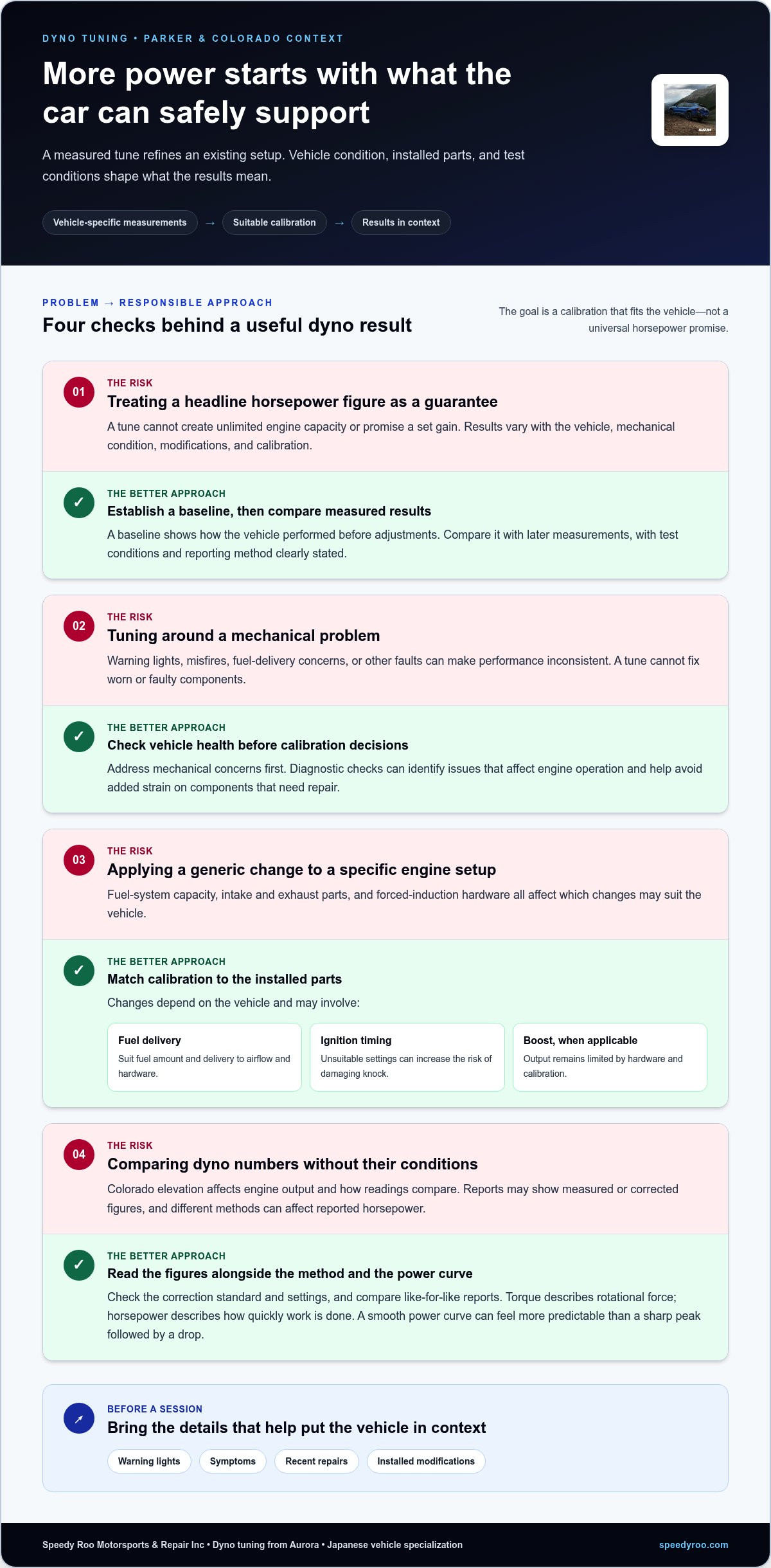
A dyno tune measures and refines how a vehicle uses its existing capacity. It doesn’t promise a set horsepower gain or create unlimited engine capacity. Results depend on the vehicle, its mechanical condition, existing modifications, and calibration. A healthy, modified engine may respond differently from a stock vehicle, and a tune can’t fix worn or faulty components. Keep those limits in mind when comparing ways to increase horsepower with a dyno tune near Parker, rather than treating a headline number as a guarantee.
Horsepower, torque, and dyno numbers: what the results mean
Torque is the rotational force an engine produces. Horsepower describes how quickly that work is done, so the two figures are related but tell different parts of the performance story. Drivers may feel stronger torque as more immediate pull, while horsepower can matter as the engine continues to accelerate through its rev range. A smooth power curve can make output feel more predictable than a sharp peak followed by a drop. When reviewing results, compare baseline and final readings only if the test conditions and reporting method are clearly stated.
Why Parker and Colorado conditions belong in the discussion
At Colorado’s elevation, thinner air contains less oxygen per volume. Naturally aspirated engines can produce less power than they would in denser air because they draw in air without a turbocharger or supercharger. Turbocharged engines can compensate to a degree, but their hardware and calibration still set limits. Elevation helps put a dyno result in context; it doesn’t indicate a particular gain.
Dyno reports may show measured readings or figures adjusted, or “corrected,” to account for atmospheric conditions. Corrected numbers can help compare tests, but only when you know the correction standard and settings used. Before comparing two results, check whether both reports use the same approach and note relevant conditions, such as temperature and air pressure, if provided. Otherwise, a difference in reported horsepower may reflect the measurement method as well as changes to the vehicle.
For Parker drivers, Speedy Roo Motorsports & Repair Inc offers dyno tuning from its Aurora location and specializes in Japanese vehicle brands. The right interpretation starts with the car in front of the tuner, not a universal target number.
How a dyno tune increases horsepower through measured calibration
A responsible calibration follows a measured progression: assess the vehicle’s condition, establish a baseline, make suitable calibration changes, then review the results. The baseline provides a reference for understanding what changed. Without it, a final number alone can’t show whether the vehicle improved or how it performed before tuning.
From baseline run to calibration changes
Once the vehicle’s setup and condition are understood, baseline measurements show how it performs before adjustments. A tuner can use those findings to guide changes, then compare subsequent measurements. Each adjustment should suit the engine and its installed components, rather than chase a generic horsepower target. Clear reporting should identify relevant modifications and test conditions so the before-and-after results can be interpreted fairly.
Calibration may involve several factors, depending on the vehicle:
- Fuel delivery: The amount and delivery of fuel must suit the engine’s airflow and hardware.
- Ignition timing: Timing affects how combustion produces power, but unsuitable settings can increase the risk of damaging knock.
- Boost: On a turbocharged or supercharged setup, boost may affect output within the limits of the hardware and calibration.
Air-fuel mixture, knock, and operating conditions are important safety considerations during calibration. A change that appears to add output in one condition may not be appropriate across the engine’s operating range. Consider measured results alongside how the engine operates, not just its peak figure.
Why engine health and supporting hardware matter
Existing faults can make performance inconsistent and undermine the value of tuning. A warning light, misfire, fuel-delivery concern, or other mechanical issue deserves attention before calibration decisions are made. Diagnostic checks can identify problems that affect engine operation and help avoid placing added strain on an engine or drivetrain that needs repair.
Tuning choices also depend on the parts already installed. Fuel system capacity, intake and exhaust components, and any forced-induction setup all shape which calibration changes may be suitable. For example, a turbocharged vehicle with modified supporting hardware presents different considerations from a naturally aspirated vehicle with its original components. The tune should match the actual configuration, not an assumed one.
For drivers exploring how to increase horsepower dyno tune Parker, the value lies in a process guided by vehicle-specific measurements and mechanical condition. Speedy Roo Motorsports & Repair Inc offers dyno tuning in Aurora for Parker-area drivers. Learn more about dyno tuning in Aurora and how measured calibration can fit into a thoughtful performance plan.
Dyno tune, performance parts, or both: compare routes to more power
The right route depends on how you use the vehicle. A daily driver may benefit more from predictable response and smooth power delivery than a higher peak number, while a track-focused setup may have different priorities. Start with your goal, then consider what the engine and existing components can support. There’s no universal horsepower estimate that applies across different vehicles and configurations.
| Approach | When it may suit | Dependencies and reliability considerations | What to measure |
|---|---|---|---|
| Tune only | When the current hardware is suitable and calibration is the focus. | Potential changes depend on the engine and its factory calibration. Mechanical condition and safe operating limits still matter. | Compare baseline and final output, power delivery, and drivability under consistent test conditions. |
| Hardware first | When a specific component is needed to meet the driver’s goals. | Parts must be compatible with the vehicle and one another. A modification can change airflow or engine demands, so the existing calibration may no longer be a good match. | Record the setup and assess how the vehicle operates after installation before drawing conclusions about power. |
| Matched hardware and calibration | When upgrades and engine calibration need to work as a system. | Every component must suit the engine, supporting systems, and intended use. Poorly matched parts or calibration can make results less predictable and may affect reliability. | Document the components, compare measured results, and assess the power curve and operation, not just peak output. |
When calibration alone may be the relevant option
A tune may refine how an engine uses its existing setup, but the scope for change depends on its design and factory calibration. Drivers may notice altered throttle response or smoother delivery without a verified increase in peak horsepower. Those are different outcomes. If you’re researching how to increase horsepower dyno tune Parker, define whether your goal is stronger measured output, improved response, or a more usable power curve.
When modifications change the tuning equation
Changes to engine or airflow components can affect how the engine operates and may call for revised calibration. Consider an intake, exhaust, fuel-system, or forced-induction change as part of the whole configuration, not as an automatic power upgrade. A mismatch between parts and calibration can make performance harder to predict. Speedy Roo Motorsports & Repair offers dyno tuning in Aurora for Parker-area drivers; read more about Aurora dyno tuning.
How to prepare for a dyno tune around Parker, step by step
A useful tuning session starts before the vehicle reaches the dyno. Clear goals and accurate details keep the discussion focused on what the car can safely support, whether you drive it daily around Parker or have another intended use in mind.
Set realistic goals and share accurate vehicle details
First, decide what you want to improve: everyday drivability, throttle response, or measured peak output. These are related but distinct goals, and the right approach depends on how you use the vehicle. If you’re researching how to increase horsepower dyno tune Parker, set a specific goal without assuming a particular gain.
- Identify the vehicle: Note its year, engine, and relevant configuration details.
- List modifications: Include performance parts, such as intake, exhaust, fuel-system, or forced-induction components.
- Record fuel information: Share the fuel currently used and any planned change.
- Describe its history: Write down symptoms, warning lights, recent repairs, and maintenance concerns.
Be candid about how the car behaves. Hesitation under acceleration or a warning light may matter as much as a list of installed parts. Complete information makes it easier to focus the calibration discussion on your priorities and the vehicle’s actual setup.
Check vehicle condition before pursuing horsepower
Before performance calibration, note warning lights, fluid leaks, unusual noises, or maintenance items that may need attention. These signs don’t automatically identify a specific fault, but they are reasons to assess the vehicle first. Tuning isn’t a substitute for diagnosing a mechanical problem. Addressing relevant concerns supports more consistent results and helps avoid putting extra stress on a component that may already need repair.
For Subaru owners, specialist Subaru repair in Aurora can connect vehicle condition with informed service before performance work. The same principle applies to any vehicle: disclose recent repairs and known issues rather than hoping they won’t affect the session.
After tuning, review the results in context. Consider the recorded measurements alongside the changes made, test conditions, and how the car responds. Ask for recommended follow-up to be explained clearly, and keep a record of the final configuration for future service or calibration decisions.
Ready to prepare your vehicle for measured performance work? Explore dyno tuning at Speedy Roo for Parker-area drivers.
What to expect from Speedy Roo dyno tuning near Parker
Speedy Roo Motorsports & Repair is based in Aurora and serves drivers from Parker and nearby communities. The shop offers performance dyno tuning and specializes in Japanese brands, including Subaru, Toyota, Lexus, Honda, Mazda, and Nissan. Since 2002, Speedy Roo has provided repair and diagnostic services alongside performance work.
A practical, vehicle-specific approach to performance
Dyno tuning is most useful when results are considered in the context of the vehicle’s condition, hardware, and intended use. Repair and diagnostic experience can help identify whether an issue needs attention before performance calibration. That connection matters for a modified Subaru, just as it does for a Toyota or Mazda with a different engine and setup. The work should be guided by the vehicle’s actual measurements, not a universal power target.
Expect findings specific to your car, rather than a promised horsepower figure. The outcome may reflect its current condition, installed modifications, and calibration. Clear explanations help you understand what the measurements show and how they relate to your goals, whether that means improved response, a more usable power curve, or measured output. A peak number without context can’t tell the whole story.
If you’re searching “how to increase horsepower dyno tune Parker,” focus on the quality of the assessment and how the results are explained. Share your vehicle’s history, known symptoms, recent repairs, and performance parts. Be direct about how you use the car and what you’d like to improve. Those details help frame a realistic discussion around your specific setup.
Take the next step from Parker
For Parker-area drivers, Speedy Roo’s Aurora location offers dyno tuning and related repair and diagnostic care. Share your goals and vehicle details to start a practical discussion about performance. Results depend on the car’s condition and configuration, so measured, vehicle-specific findings are more useful than a guaranteed gain.
Discuss dyno tuning with Speedy Roo and take a thoughtful next step toward understanding what your vehicle can support.
Make your next performance decision with confidence
A dyno tune can refine a vehicle’s existing setup, but real results depend on its condition, engine, and modifications. Baseline and final measurements help put changes in context, while clear goals keep the focus on what matters to you, whether that’s everyday response or measured peak output.
If you’re considering how to increase horsepower dyno tune Parker, start with a healthy vehicle and realistic expectations. Speedy Roo Motorsports & Repair has provided service since 2002, specializes in Japanese vehicle brands, and offers performance dyno tuning from its Aurora location for Parker-area drivers.
Share your goals, vehicle details, and existing modifications to begin a thoughtful discussion about what may suit your setup. Discuss dyno tuning for your vehicle with Speedy Roo, and take the next step toward informed, vehicle-specific performance.
Frequently Asked Questions
Can a dyno tune increase horsepower on a stock car?
Yes, a dyno tune may change a stock car’s output or drivability, but the result depends on its engine, factory calibration, fuel, and condition. A stock vehicle may have less room for peak-power gains than one with compatible modifications. Dyno measurements can help show what changed, but there’s no single horsepower increase that applies to every make, model, and setup. Throttle response and peak horsepower are also different outcomes.
How much horsepower can a dyno tune add?
There’s no reliable universal number. Potential results vary with the engine, existing calibration, fuel, modifications, mechanical condition, and test conditions. Measured dyno readings may differ from corrected figures, which account for atmospheric conditions using a correction method. Speedy Roo offers performance dyno tuning in Aurora for Parker-area drivers, but a specific gain depends on the vehicle and setup. Treat any estimate as vehicle-dependent, not a guaranteed result.
Is dyno tuning safe for my engine?
A dyno tune isn’t automatically damaging, but the calibration must suit the engine and installed hardware. Existing mechanical issues, unsuitable modifications, or unfavorable operating conditions can affect reliability. Before pursuing performance changes, address warning lights, unusual noises, or other symptoms rather than expecting tuning to resolve them. During calibration, relevant factors such as air-fuel mixture, knock, and engine operating conditions matter. No tune is risk-free, and added output may place more demand on engine or drivetrain components.
Does a dyno tune improve horsepower at Colorado elevation?
Elevation can affect naturally aspirated engines because thinner air contains less oxygen per volume, which may reduce output. Turbocharged engines respond differently, but their hardware and calibration still set limits. Dyno reports may show measured readings or corrected figures adjusted for atmospheric conditions. Before comparing results, find out which type of figure is being discussed and whether the same correction method was used. There’s no reliable Parker-specific gain without information about the individual vehicle.
Do I need performance parts before getting a dyno tune?
No, performance parts aren’t always necessary. Whether a tune alone is useful depends on the vehicle, factory calibration, condition, and your goals, and a stock car may have limited scope for peak-power gains. Some modifications that affect airflow or fueling may call for revised calibration. Consider parts and tuning together, with compatibility in mind. Diagnose mechanical concerns first, since a performance tune isn’t a substitute for repairing an underlying problem.
What should I do before taking my car for a dyno tune?
Gather the vehicle’s year and engine details, a list of modifications, the fuel you use, and notes about symptoms, warning lights, and recent repairs. Check for maintenance concerns such as leaks or unusual noises, and have relevant mechanical issues assessed before performance calibration. Be ready to explain your intended use and whether you care most about daily drivability, throttle response, or measured power. These details support a more useful, vehicle-specific tuning discussion.
Can I get dyno tuning near Parker, Colorado?
Yes. Speedy Roo Motorsports & Repair is based in Aurora and serves Parker and nearby communities, including Denver, Centennial, and Lone Tree. The shop offers performance dyno tuning and specializes in Japanese vehicle brands, including Subaru, Toyota, Lexus, Mazda, Honda, and Nissan. Suitability and results depend on each vehicle’s condition and setup. Use the shop’s contact options to discuss your goals and vehicle details as a starting point.