
Does a soft brake pedal automatically mean it’s time for a fluid flush? Not necessarily, but it does mean your braking system deserves attention. A brake fluid flush service Parker drivers consider should be based on the vehicle’s maintenance schedule and fluid condition, not a one-size-fits-all calendar rule.
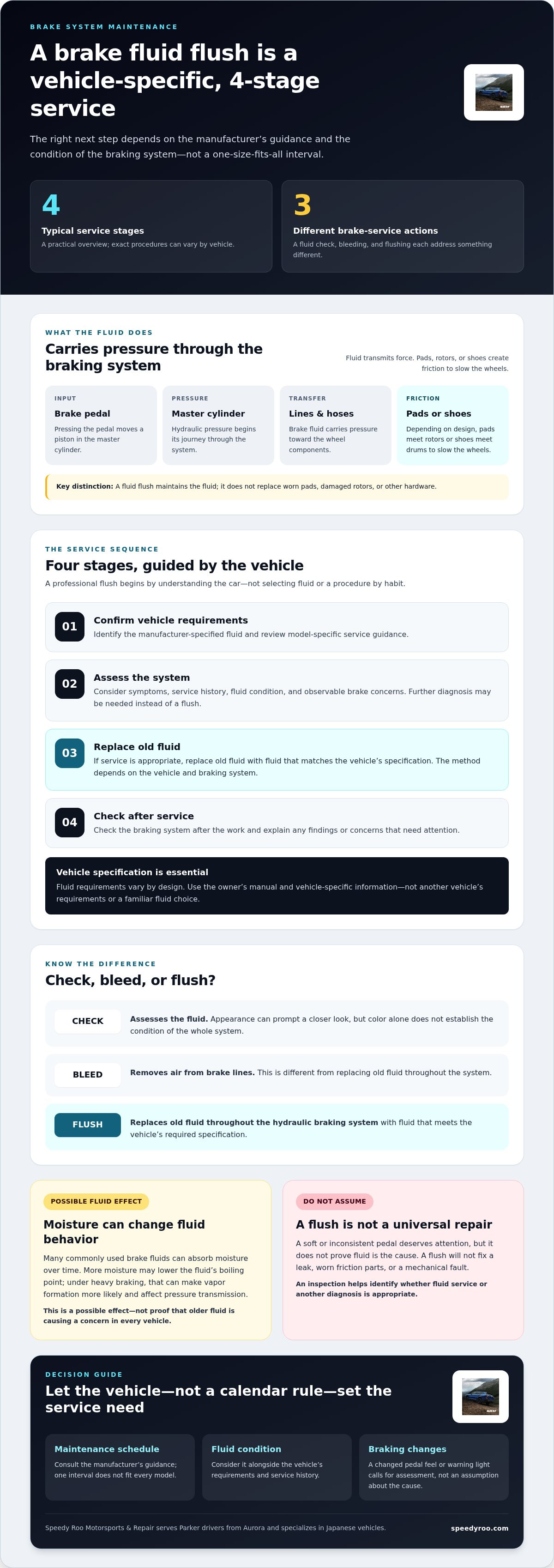
It’s easy to confuse checking, bleeding, and flushing. A check assesses the fluid, bleeding removes air from brake lines, and a flush replaces old fluid throughout the system. A soft or inconsistent pedal can have more than one cause, so an inspection can help identify the right next step.
This article explains what a flush does, which signs may warrant attention, and why your manufacturer’s service guidance matters. You’ll also learn what to expect from a professional brake service and how Speedy Roo Motorsports & Repair, an Aurora shop serving Parker drivers, brings Japanese-vehicle expertise to maintenance recommendations. The goal is to help you make an informed decision about what your vehicle needs.
Key Takeaways
- Use your vehicle manufacturer’s maintenance schedule to guide flush timing, since one interval doesn’t fit every model.
- A soft pedal or change in braking feel is a reason to arrange an inspection, not proof that fluid is the cause.
- A professional brake fluid flush service Parker drivers choose should begin with an assessment and the correct fluid specification for the vehicle.
- Knowing the difference between a fluid check, brake bleeding, and a flush can help you understand the recommended service.
- Speedy Roo Motorsports & Repair serves Parker from Aurora and specializes in Japanese vehicles, with experience serving customers since 2002.
What a Brake Fluid Flush Does for Your Braking System
A brake fluid flush replaces old fluid in the vehicle’s hydraulic braking system with fluid that meets the vehicle’s required specification. Unlike a brake pad or rotor replacement, it maintains the fluid that carries pressure through the system rather than replacing the parts that create friction at the wheels.
A brake fluid flush is a maintenance service that replaces old fluid in the braking system according to the vehicle’s requirements. A flush addresses fluid condition, not every possible cause of a braking concern. If your pedal feels different, an inspection can help determine whether fluid, worn components, or another issue needs attention.
How brake fluid helps your vehicle slow down
Pressing the brake pedal moves a piston in the master cylinder. Hydraulic pressure then travels through brake lines and hoses to components at the wheels. Depending on the vehicle’s design, those components press brake pads against rotors or brake shoes against drums, creating friction that slows the wheels.
Brake fluid carries this pressure through the system. Its role differs from that of the pads and rotors: fluid transmits force, while friction components act on the wheels to slow the vehicle. A fluid service doesn’t, by itself, replace worn pads, damaged rotors, or other hardware.
Fluid specifications depend on the vehicle. The correct type is determined by the manufacturer, so another vehicle’s requirements or a fluid’s label aren’t substitutes for the owner’s manual and vehicle-specific information. The distinction between a flush and air removal is also useful: Brake bleeding and flushing describes how these related processes differ.
Why fluid condition deserves attention
Brake fluid doesn’t necessarily stay unchanged for the life of a vehicle. Many commonly used brake fluids can absorb moisture over time. As moisture content increases, it may lower the fluid’s boiling point. Under heavy braking, heat builds in the system, and fluid with a lower boiling point may be more vulnerable to vapor formation, which can affect how pressure is transmitted. This is a possible effect, not proof that older fluid is causing a problem in every vehicle.
Fluid appearance can be a reason to look more closely, but color alone doesn’t establish the condition of the entire system. While visual checks provide helpful baseline clues across various automotive fluids—as noted by Eagle Transmission & Auto Repair—a flush also won’t fix a leak, worn friction parts, or a mechanical fault. The right maintenance decision depends on the manufacturer’s guidance and an assessment of the vehicle.
For drivers considering a brake fluid flush service Parker, start by consulting the owner’s manual for the specified fluid and maintenance schedule. A professional assessment can relate that guidance to the vehicle’s condition and service history. This keeps the decision grounded in the needs of the specific braking system rather than an assumed universal interval.
What Happens During a Brake Fluid Flush in Parker
A professional flush starts with understanding the vehicle, not choosing a fluid or procedure by habit. The technician considers the car’s maintenance guidance, why service is being considered, and whether there are signs of a broader brake concern. Procedures vary by vehicle, so the steps below are a typical overview, not a guarantee of the same sequence for every model.
Assessment before fluid service
Before work begins, the technician reviews symptoms, available service history, fluid condition, and the manufacturer’s guidance. A warning light or change in pedal feel may call for diagnosis beyond fluid maintenance. A flush won’t repair a leak or replace a worn component, so identifying those concerns first helps keep the recommendation focused on the braking system’s actual condition.
A typical, vehicle-dependent flush may include these stages:
- Confirm the vehicle requirements. The technician identifies the manufacturer-specified fluid type and reviews any model-specific service guidance.
- Assess the system. Reported symptoms and observable fluid or brake-system concerns help determine whether a flush is appropriate or further diagnosis is needed.
- Replace the old fluid. If service is appropriate, old fluid is replaced with fluid that matches the vehicle’s specification. The method depends on the vehicle and its braking system.
- Check the system after service. The technician checks the braking system after the work and explains any findings or concerns that need attention.
Fluid replacement and post-service checks
The fluid specification is a key part of the service, not a minor detail. The correct brake fluid is the type specified for that vehicle, because braking-system requirements vary by design. Choosing a fluid simply because it is available or familiar can disregard the manufacturer’s requirements. Vehicle-specific information should guide the selection.
After the fluid is replaced, follow the technician’s instructions for the vehicle before driving. If the pedal feels unusual or a warning light remains on, report it and have the concern assessed rather than assuming the flush addressed every possible cause. Knowing what was checked and found helps you understand the next step.
Removed fluid also needs responsible handling. CarParts.com provides an overview of brake fluid disposal, a useful reminder that service involves more than simply adding fresh fluid. Speedy Roo provides brake service for Parker drivers from Aurora. Its Japanese-vehicle specialization supports careful attention to manufacturer guidance during a brake fluid flush service Parker drivers may be considering.
Brake Fluid Flush vs. Bleeding or a Fluid Check
These terms describe different kinds of brake service, but they’re easy to mix up. A fluid check assesses what’s in the system, bleeding addresses air in the hydraulic lines, and flushing replaces old fluid. The right choice depends on the vehicle’s maintenance guidance and inspection findings. Knowing the difference helps you understand what a technician recommends and why.
| Service | What it does | What it doesn’t mean |
|---|---|---|
| Fluid check | Assesses fluid condition alongside the vehicle’s service history and maintenance schedule. | It doesn’t automatically replace fluid. A check is an assessment unless the vehicle-specific service includes replacement. |
| Brake bleeding | Removes air from the brake hydraulic system when air is present and bleeding is appropriate. | It isn’t necessarily a complete fluid replacement. Its purpose is to address air, not simply renew all old fluid. |
| Fluid flush | Replaces old brake fluid in the system with fluid that meets the vehicle’s specification. | It doesn’t repair a leak, worn brake parts, or another underlying fault. |
What a brake fluid check can tell you
A check gives a technician information about the fluid and helps inform a maintenance recommendation. Its limits matter: looking at the reservoir alone can’t answer every question about fluid condition or the system’s history. The vehicle’s maintenance schedule and service records add important context. For example, fluid that looks acceptable doesn’t necessarily mean a scheduled service can be ignored.
For a useful assessment, share any known service history and describe changes you’ve noticed, such as a different pedal feel or a dashboard warning. Those details help the technician decide whether fluid maintenance is appropriate or further diagnosis is needed. The recommendation should reflect the specific vehicle, not just the fluid’s appearance.
When bleeding and flushing are different needs
Air in the hydraulic system can interfere with pressure transfer and may contribute to an abnormal pedal feel. Bleeding removes that air when the vehicle’s condition and service needs call for it. A flush, by contrast, focuses on replacing old fluid. Depending on the reason for service, a vehicle may need one process, the other, or additional brake-system diagnosis.
Neither service is a catch-all repair. If the pedal feels soft, braking changes, or a warning light appears, have the symptoms assessed rather than assuming a fluid-only fix. A flush won’t correct a faulty component, and bleeding won’t resolve every cause of inconsistent braking. A technician uses the findings and manufacturer guidance to determine the suitable next step. That distinction is central to a thoughtful brake fluid flush service Parker drivers can approach with clear expectations.
When to Consider a Brake Fluid Flush for Parker Driving
There isn’t one brake-fluid interval that suits every vehicle. The right timing depends on the manufacturer’s maintenance guidance, the fluid specification, and the vehicle’s service history. Driving conditions can shape how closely you monitor your brakes, but they don’t establish a separate flush schedule for every Parker driver.
Maintenance schedules and service history
Start with your owner’s manual. It should identify the specified fluid and the manufacturer’s maintenance recommendations for your model. If you’ve recently bought a used vehicle or don’t know when its fluid was last serviced, look for available maintenance records and share them during an assessment. Missing records don’t automatically mean a flush is needed, but they make a vehicle-specific review especially useful.
Follow your vehicle’s maintenance schedule, and have changes in brake feel investigated promptly. This is more reliable than choosing a generic time or mileage interval and applying it to every car. Manufacturers may set different guidance for different models, so use the information for your vehicle rather than assuming a neighbor’s schedule applies.
Parker-area driving can involve a mix of traffic, longer trips, and routes with descents. Repeated braking in traffic or downhill makes it sensible to pay attention to how the brakes respond. That doesn’t mean local driving creates a fixed fluid-replacement interval or that a descent automatically points to a fluid problem. Mention your driving context during an inspection, along with the vehicle’s age, mileage, and service records.
Brake symptoms that call for prompt attention
A soft or spongy pedal, reduced responsiveness, or a brake warning light deserves attention. These signs can have several causes, including issues unrelated to fluid condition, so they aren’t proof that a flush is the needed repair. A professional diagnosis helps determine whether the concern involves fluid, another brake component, or a separate system fault.
If braking feels unsafe, don’t continue driving the vehicle. Arrange appropriate help to have it assessed rather than trying to determine the cause on the road. If the brakes still function but feel different, note what changed and when it happens, such as during a stop, on a descent, or after a longer drive. Those details can help guide a focused inspection.
For a brake fluid flush service Parker drivers are considering, the decision should connect the manufacturer’s schedule with the car’s history and current condition. Speedy Roo Motorsports & Repair serves Parker drivers from Aurora and specializes in Japanese vehicles, including Subaru, Toyota, Lexus, Mazda, Honda, and Nissan. Schedule a brake-system assessment to discuss changes in brake feel or fluid maintenance for your vehicle.
Book Brake Fluid Flush Service Near Parker with Speedy Roo
For Parker drivers, Speedy Roo Motorsports & Repair provides vehicle maintenance and brake fluid service from its Aurora shop. The shop specializes in Japanese vehicles, including Subaru, Toyota, Lexus, Mazda, Honda, and Nissan, and has served customers since 2002. That experience is relevant when maintenance decisions need to reflect a particular vehicle’s guidance rather than a one-size-fits-all assumption.
A brake fluid service conversation is most useful when it starts with why you’re considering one. Perhaps the maintenance schedule is approaching, the service history is unclear, or the pedal feels different than usual. Sharing those details helps frame the discussion. A change in brake feel deserves attention, but it doesn’t automatically mean fluid is the cause or that a flush alone will address it.
Why local drivers choose a repair specialist
Vehicle-specific maintenance guidance matters because fluid requirements and service recommendations vary by model. Speedy Roo’s focus on Japanese makes gives drivers in Parker, Aurora, Denver, Centennial, and Lone Tree a repair resource familiar with those brands. Clear explanations help you understand what the vehicle’s schedule says, what an assessment finds, and why a service is recommended. The aim is an informed decision based on your car’s needs.
This approach also helps distinguish scheduled maintenance from diagnosis. If you report a warning light or a soft pedal, the concern may call for a broader brake-system assessment instead of assuming a fluid flush is the complete answer. A useful service discussion makes the reason for the recommendation clear and explains the findings in terms you can understand.
What to share when scheduling
Before arranging a brake fluid flush service Parker drivers can prepare a few practical details. These help identify the vehicle and give the shop a starting point for understanding your concern:
- Your vehicle’s year, make, and model.
- Any brake symptoms, such as a soft pedal, reduced responsiveness, or a dashboard warning light.
- Available service records, including the last known brake-fluid service or other recent brake work.
- Relevant driving context, such as when you notice a change or whether the maintenance schedule prompted your question.
You don’t need to diagnose the cause before scheduling. Describe what you’ve noticed as accurately as you can, and bring any maintenance records you have. If the brake pedal feels unsafe or braking performance has changed significantly, avoid continuing to drive and arrange appropriate help to have the vehicle assessed.
Speedy Roo serves Parker and nearby communities from Aurora, with a focus on Japanese-vehicle repair and service. If you’re ready to discuss your vehicle’s fluid maintenance or a change in braking feel, Schedule brake fluid service with Speedy Roo.
Make Your Next Brake-Service Decision with Confidence
Use your next brake appointment to create a clearer maintenance record. Keep the service documentation with your vehicle records, including what was assessed and any recommendations for future care. For drivers looking to stay proactive with routine inspections and essential automotive upkeep, resources like blackcatautollc.biz emphasize how consistent maintenance prevents unexpected issues down the road. That information can make the next conversation more straightforward, especially if brake feel changes or you’re unsure when fluid was last serviced.
If you’re considering a brake fluid flush service Parker drivers can discuss with a knowledgeable repair team, bring your vehicle details and any service history you have. You don’t need to arrive with a diagnosis. A clear description of what you’ve noticed is a practical place to begin, and a vehicle-specific assessment can help identify the appropriate next step.
Schedule brake fluid service with Speedy Roo to plan your next maintenance step. A thoughtful conversation can help you move forward with greater confidence and keep your brake-service records organized.
Frequently Asked Questions
How often should brake fluid be flushed?
Follow the interval in your vehicle’s maintenance schedule; there’s no single interval that applies to every make and model. Check the owner’s manual for timing and the required fluid type, and review service records if you’ve bought the vehicle used or its history is incomplete. For drivers in Parker, Aurora, Denver, Centennial, or Lone Tree, a vehicle-specific assessment can help interpret the schedule without relying on a generic mileage rule.
Can I drive with a soft or spongy brake pedal?
If the pedal feels soft or braking seems less responsive, don’t assume it’s safe to keep driving. The cause could involve air in the system, fluid, or another brake problem, and it needs diagnosis. If braking feels unsafe, stop driving and arrange appropriate help to have the vehicle assessed. If the change is subtle but noticeable, note when it happens and share those details during an inspection.
Is a brake fluid flush the same as bleeding the brakes?
No. Bleeding removes air from the hydraulic system when needed, while a flush focuses on replacing old fluid. The work may overlap in some vehicle-specific services, but the terms don’t mean the same thing. A repair that introduces air may require bleeding, while scheduled fluid maintenance may call for replacement. A technician can determine the appropriate service from the vehicle’s guidance and inspection findings.
What happens if brake fluid is not changed?
Depending on the fluid and vehicle, moisture can accumulate over time and lower the fluid’s boiling point. Under demanding braking, that may affect how the system performs, though it doesn’t mean failure is inevitable. Delaying service beyond the manufacturer’s recommendation can leave fluid maintenance overdue. Check the manual and service records, then discuss the vehicle’s condition with a professional rather than waiting for a symptom to appear.
Can old brake fluid cause a brake warning light?
Old fluid by itself isn’t a reliable explanation for a warning light. Depending on the vehicle, a brake warning may relate to low fluid level, a system fault, or another condition. Don’t treat the light as proof that a flush is needed, and don’t ignore it. Check the owner’s manual for the warning’s meaning and arrange an inspection so the underlying cause can be identified.
Does my vehicle need a brake fluid flush if it has low mileage?
Possibly. Low mileage doesn’t necessarily mean the fluid is still within its service interval, because some manufacturer schedules also account for elapsed time. Check the manual for your model’s guidance and look for records showing when the fluid was last serviced. If the history is unknown, an assessment can help establish a maintenance baseline and clarify whether service is due, even if the vehicle hasn’t been driven often.