
A failed power window doesn’t always mean the motor is bad. Fixing a car power window motor in Aurora starts with identifying the cause, which may be a faulty switch, damaged wiring, worn regulator, obstructed track, or an overheated motor. Many power-window repairs take an experienced technician an hour or less, though the work required affects the timeline.
It’s understandable to suspect the motor when a window stops moving, but replacing it before finding the fault can miss the real problem. This guide explains the common causes and symptoms, what affects repair cost, and how the repair process works. The price depends on the fault, parts, and labor, and is provided after a quote request. You’ll also learn what can influence repair time and when a professional diagnosis can help narrow down the issue.
Key Takeaways
- Learn how the motor and regulator work together, and why identifying the failed part matters before repair begins.
- See which parts and labor factors shape a power-window repair estimate, so you can understand what drives the quote.
- Use symptoms such as a window that moves slowly or sits crooked to recognize when the mechanism may need attention.
- Understand what a technician examines to trace a window fault to its electrical, mechanical, or control-system source.
How Much Does It Cost to Repair Power Windows in a Car?
Repair cost depends on the failed component, replacement parts, and labor. Diagnosis helps distinguish a motor fault from a regulator, switch, or wiring problem before parts are replaced.
Motor and Regulator Repairs
The motor supplies power, while the regulator guides the window up and down inside the door. Cable-type regulators use cables and pulleys; gear-drive designs transfer the motor’s rotation through gears. These assemblies can wear over time, so inspection helps determine whether the motor, regulator, or both need replacement. The replacement motor must match the vehicle’s make and model.
The final quote reflects the diagnosed fault and the parts needed for the vehicle. Insurance or warranty coverage depends on the terms and exclusions of the applicable policy.
Window and Regulator Removal
To reach the mechanism, a technician removes the door trim and accesses the components inside. The glass is supported, separated from the regulator, and moved clear before the regulator assembly is released. A regulator is typically secured by three or four bolts and has one electrical connection. Careful removal helps protect the glass, wiring, and door.
Replacement regulators may attach with 1/4-inch nuts and bolts or 1/4-inch regulator rivets. The fastening method depends on the assembly. Once the faulty component is out, the replacement is installed and the window’s movement is checked.
Motor Versus Regulator Replacement
Replacing the motor addresses the electrical component that powers movement; replacing the regulator addresses the mechanism that carries and guides the glass. A window that won’t move does not, by itself, identify which part failed. Testing the switch and motor connection helps narrow the cause. With a working switch, connector voltage should change from plus 12 volts to minus 12 volts when toggled.
Driving with a broken window can expose the cabin or leave the glass unstable. If the window blocks visibility or the glass cannot stay secure, avoid driving until the issue is addressed.
Motor Replacement Steps and Tools
Motor replacement generally involves removing the door trim, supporting the glass, disconnecting the window from the regulator, unplugging the motor, and removing the faulty part. The replacement is mounted, reconnected, and tested before the door trim goes back. DIY parts include the vehicle-matched motor and any required fasteners; an optional 1/8-inch punch and 16-ounce hammer may help with rivets.
Follow the vehicle’s repair procedure because access and fasteners vary. An incorrectly matched motor may not connect properly or allow the window to travel as intended, so select a part for the vehicle’s make and model.
Repair duration and cost considerations
Repair time depends on the fault, access to the window assembly, and whether replacement parts are ready. Experienced technicians can complete most power-window repairs in one hour or less. A straightforward switch or blown-fuse problem may take an hour or two to resolve, while diagnosis or additional repairs can extend the visit.
Allowing half a day accommodates a broader repair, including diagnosis, parts work, and testing. These are different scopes of work, not a fixed timeline for every vehicle. Replacing an accessible switch, for example, differs from tracing damaged wiring or removing a door panel to reach a regulator.
Repair cost depends on the fault, parts, labor, and the work needed to access the mechanism. A quote should reflect the diagnosis, required parts, and labor. It should also distinguish the identified problem from any additional recommended work, such as replacing a worn regulator along with a failed motor.
In Aurora, local appointment availability depends on the repair schedule, the vehicle, and whether the required part can be obtained. A mobile repair visit changes where the work takes place, but the technician still needs safe access to the door and window assembly. Some faults may also require equipment or a work setting suited to electrical diagnosis, so the repair method can affect scheduling.
Before work begins, the diagnostic steps should establish whether the fault involves the switch, wiring, motor, or regulator. That distinction helps define the repair scope and avoid replacing parts without a reason. For a vehicle-specific repair assessment, request a repair quote with the vehicle’s make, model, and window symptoms. A clear description of whether the glass is stuck, slow, or moving unevenly helps focus the initial diagnosis.
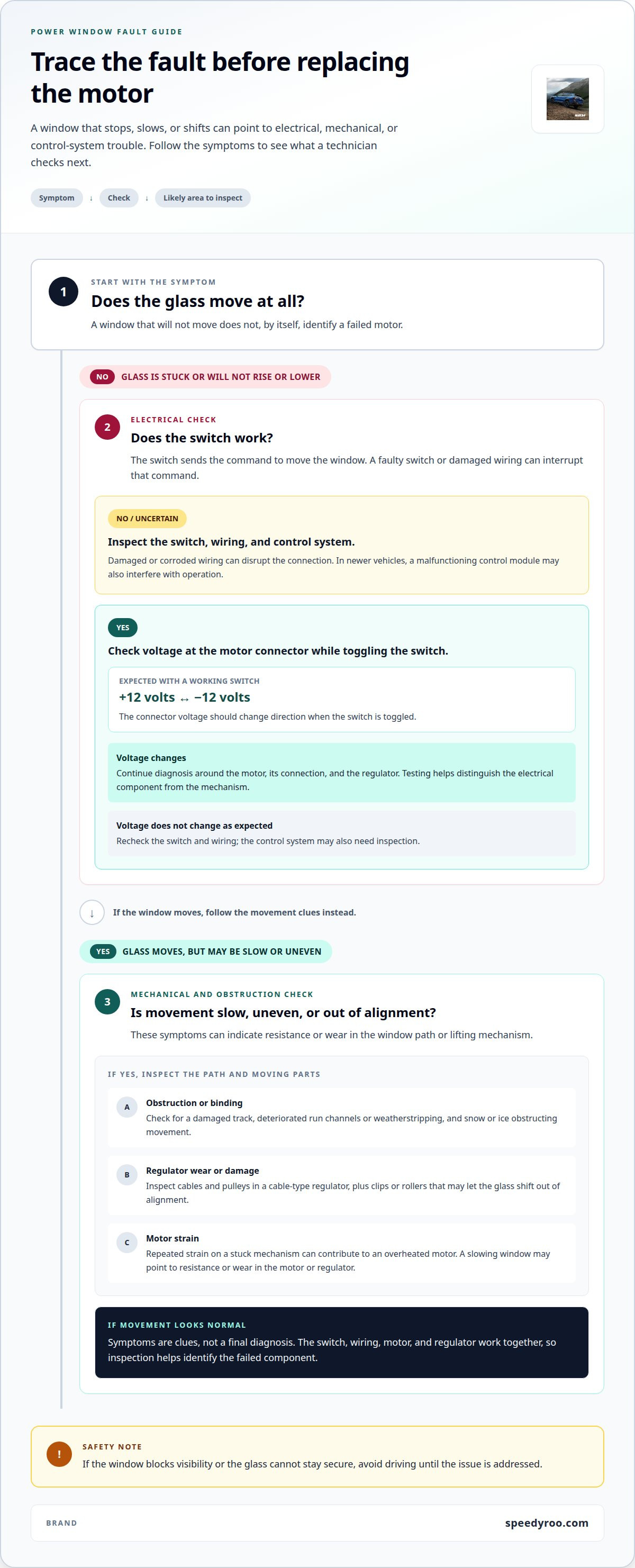
Causes of power window failure
A power window can stop working because of an electrical fault, a damaged guide, or a worn moving part. The symptoms offer clues, but the motor isn’t the only possible cause. A technician checks how the switch, wiring, motor, and regulator work together to identify the failed component.
A faulty switch may interrupt the command that tells the window to move. Damaged or corroded wiring can also disrupt the electrical connection. In newer vehicles, a malfunctioning control module may interfere with window operation. Because these faults can resemble motor failure, replacing the motor without diagnosis may leave the original problem unresolved.
Mechanical wear can prevent the glass from moving smoothly. A damaged track can obstruct it, while worn pulleys or cables may stop a cable-type regulator from guiding the window. A broken cable can leave the glass unable to rise or lower. Worn clips or rollers can also let the glass shift out of alignment.
Run channels and weatherstripping help guide the glass within the frame. When they deteriorate, the window may bind or move unevenly. Snow and ice can obstruct movement, and repeated strain on a stuck mechanism can contribute to an overheated motor. A window that slows before stopping, for example, may indicate resistance or wear in the motor or regulator.
Diagnosis separates these possibilities by checking the window’s movement and the components that control it. A switch fault, corroded connection, and damaged regulator each call for a different repair. A new motor won’t correct a broken cable, obstructed track, or faulty control module. In Aurora, where snow and ice can obstruct a window, identifying whether the issue is an obstruction or an electrical failure helps avoid assuming the motor has failed.
Note whether the glass is stuck, misaligned, or moving slowly, and whether the switch produces a response. These details help describe the problem. The repair should address the failed part, whether that’s the switch, wiring, control module, track, regulator, or motor.
Common power window problems
A window that stops moving can point to an electrical fault or a worn mechanism. The pattern matters: no response from the switch, slow movement, or uneven travel can help narrow down the cause. A technician tests the circuit and observes the window before determining which component needs attention. Accurate diagnosis is key when fixing a car power window motor in Aurora, since the motor may not be the failed part.
A faulty switch or blown fuse can interrupt power to the window. If the glass doesn’t move, testing the switch and fuse helps distinguish an electrical fault from a failed motor. A single window that won’t respond may have a problem in its own circuit, while issues affecting several windows can point to shared electrical controls.
Slow movement deserves attention. A window that rises or lowers sluggishly can indicate a worn motor or regulator, and continued use may lead to complete failure. A technician checks whether the glass travels freely and the mechanism moves consistently. Replacing only the motor won’t resolve resistance caused by a damaged track or regulator.
Uneven travel offers another useful clue. If the glass tilts, catches, or drops instead of staying aligned, the regulator or guides may not be supporting it correctly. Clicking during switch operation can also occur when a mechanism struggles to move. These symptoms call for inspection rather than repeated attempts to force the window.
Intermittent operation can be harder to diagnose than a window that remains still. A technician compares the switch response with the motor’s electrical connection and checks for disrupted wiring. When fixing a car power window motor in Aurora, this helps determine whether the repair should address the electrical command or the moving assembly.
Describe exactly what happens when the switch is pressed, including whether the glass is slow, crooked, or unresponsive. That detail helps focus diagnosis on the relevant circuit or mechanism. Schedule power window diagnosis to identify the fault before choosing a repair.
Speedy Roo Motorsports & Repair: Aurora Dyno Tuning
Speedy Roo Motorsports & Repair provides Subaru, Toyota, and Honda repair and service in Aurora, making it a practical option when one of these vehicles has a power-window problem. If the glass is stuck, moves unevenly, or responds intermittently, a repair assessment can help identify whether the fault is electrical or mechanical and determine the appropriate work.
Aurora Dyno Tuning is a separate performance service, not a power-window repair. The right service depends on the vehicle and the problem: a window concern calls for repair, while dyno tuning addresses performance needs. Sharing the vehicle’s make and the window symptoms helps explain the issue clearly.
Contact Speedy Roo Motorsports & Repair to discuss a power-window concern with your Subaru, Toyota, or Honda.
Move Forward With a Clear Repair Plan
A power-window fault can be inconvenient, but the next step is clear: identify the cause before deciding on a repair. For fixing a car power window motor in Aurora, an accurate diagnosis connects the symptoms to the right component and gives you a sound basis for deciding how to proceed.
Speedy Roo Motorsports & Repair Inc provides Subaru, Toyota, and Honda repair and service in Aurora, serving drivers from Denver, Centennial, Parker, and Lone Tree. If your vehicle is one of these makes, describe the window symptoms, such as intermittent operation or glass that won’t stay aligned, to help get the repair process underway without guessing at the cause.
Share your vehicle’s make and the window’s behavior when you contact Speedy Roo Motorsports & Repair Inc. A clear next step can make the problem easier to address, and you’ll be better positioned to get the window working properly again.
Frequently Asked Questions
What causes power windows to stop working?
Power windows can fail because of an electrical interruption or a mechanical problem. A switch, fuse, or wiring fault may cause the window to stop suddenly; gradual slowing can point to wear or resistance. Note whether one window or several are affected, and whether the problem changes when you use another switch. These details can help narrow down the diagnosis.
What is a window regulator?
A window regulator is the mechanism that supports and moves the glass inside the door. It works with the motor, which supplies the force. If the motor runs but the glass stays still, the regulator or its connection to the glass may be at fault. A window that tilts or slips can also indicate a problem with its support.
Can you manually raise and lower a power window?
Sometimes, but the method depends on the vehicle and the condition of its window mechanism. Power glass isn’t designed to move freely by hand, and forcing it can damage the regulator or cause the glass to shift unexpectedly. If the window is open and won’t close, avoid pulling hard on the glass. A technician can assess how to secure it safely.
Do you offer electric window repair near me?
Speedy Roo Motorsports & Repair Inc provides repair and service in Aurora for Subaru, Toyota, and Honda vehicles, serving drivers from Denver, Centennial, Parker, and Lone Tree. If your vehicle is one of these makes and its power window has stopped responding, share the symptoms and vehicle details when contacting the shop. This helps clarify the repair assessment and next step when you are fixing car power window motor Aurora.
How can I care for my power window to prevent issues?
Keep window tracks and channels clean so dirt and debris don’t obstruct the glass. Operating the windows periodically can help distribute lubricant through the mechanism. Use a silicone-based product on tracks and moving parts for lubrication, and avoid petroleum-based products. If the glass begins sticking or moving unevenly, don’t keep forcing it; continued strain can worsen the problem.
How do vehicle power windows work?
Pressing the switch sends an electrical command through the window circuit to the motor inside the door. The motor turns, and the regulator converts that movement into the glass traveling up or down. Reversing the switch changes the motor’s direction. If the window fails, the problem may be with the switch, circuit, motor, or mechanism connecting the motor to the glass.