
A car’s shake is a clue, not a verdict. A useful car shaking diagnosis Denver drivers can act on starts with when the vibration happens and where you feel it, not a guess about which part to replace. The cause could involve tires, brakes, suspension, the drivetrain, or the engine, and the sensation alone can’t confirm which system is responsible.
Notice whether the shaking happens at idle, during acceleration, at a steady speed, or while braking. The pattern helps guide an inspection, but it cannot confirm a fault. This guide explains what to observe, when to stop driving, and what to expect from a diagnostic visit.
Speedy Roo Motorsports & Repair Inc diagnoses shaking concerns on the Japanese makes it services. The Aurora shop serves drivers from Denver and nearby communities, including Centennial, Parker, and Lone Tree. Its team explains findings clearly and will never try to sell you services you don’t need.
Key Takeaways
- Note when the shaking starts and where you feel it. Those details help guide an inspection but do not identify the cause on their own.
- Compare symptoms at idle, during steady driving, under acceleration, and while braking, using only what you notice during ordinary, safe driving.
- Tires and wheels are common sources of vibration, but brake, suspension, drivetrain, and engine issues can produce similar sensations.
- Stop somewhere safe if shaking is severe, worsening, or affecting your control of the vehicle. Don’t continue driving if it feels unsafe.
- A careful car shaking diagnosis Denver drivers can rely on considers the symptoms and inspection findings before recommending next steps.
Car Shaking in Denver: What the Pattern Can Tell You
A shaking vehicle is showing a symptom, not naming a failed part. Similar vibrations can come from different systems because movement travels through connected components, the vehicle’s frame, steering, and cabin. Wheel imbalance, a brake concern, worn suspension components, a drivetrain fault, or an engine misfire are among the possibilities. The sensation alone cannot tell you which one is responsible.
Useful definition: Vehicle vibration is repeated movement that can be produced by different forces or components. Its timing and location help guide an inspection, but they do not establish a diagnosis. The mechanical concept of Vibration in Mechanics includes movement caused by imbalances in rotating parts, one reason a small issue can be felt through a vehicle.
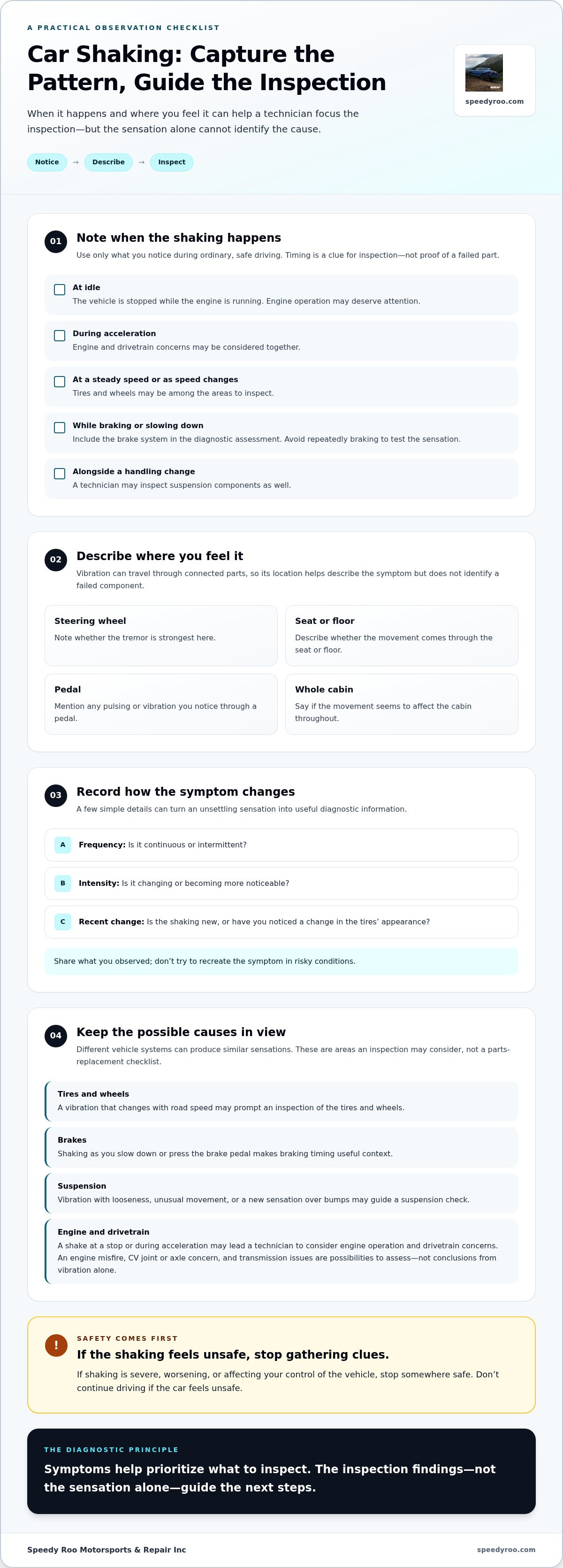
For a car shaking diagnosis Denver drivers can use, focus on the conditions around the symptom instead of guessing at a repair. Does the shake begin while the vehicle is stopped, appear as speed changes, or happen only as you slow down? Is it steady, intermittent, or becoming more noticeable? These observations help a technician prioritize what to inspect while keeping different possible causes in view.
Does the car shake at idle, at speed, or only while braking?
When the shake happens is useful context, not proof of a particular fault. A vibration while stopped with the engine running differs from one that appears during acceleration or steady travel. A shake that begins as you brake gives the technician another condition to assess. Note whether it happens consistently or only sometimes, and whether it is new or getting worse. Don’t speed up or repeat an unsafe maneuver to reproduce it.
Where do you feel the vibration?
A tremor in the steering wheel feels different from a shake mainly through the seat or floor. Pulsing through a pedal, or movement across the whole cabin, can also help describe the symptom. These details may guide the inspection, but vibrations travel through connected parts, so location alone cannot identify a failed component. Share what you notice during ordinary, safe driving. If the car feels unsafe, stop rather than gathering more clues.
Before arranging an inspection, write down a few observations while they’re fresh:
- When the shaking begins, such as at idle, during acceleration, at steady speed, or while braking.
- Where it’s strongest: steering wheel, seat, pedal, floor, or throughout the cabin.
- Whether it’s continuous, intermittent, or changing in intensity.
- Any recent change you noticed, without trying to recreate the symptom in risky conditions.
A clear description turns an unsettling sensation into practical diagnostic information. It helps prioritize the inspection without treating a symptom pattern as a parts diagnosis.
Common Causes of Car Shaking: Tires, Brakes, Suspension, and Engine
Shaking can originate in the tires and wheels, brakes, suspension, drivetrain, or engine. Because different issues can feel similar from the driver’s seat, identifying the cause requires inspection rather than a guess based on one symptom. The pattern can help focus the investigation, but it cannot confirm which component needs attention.
When tires, wheels, brakes, or suspension may be involved
A vibration that changes with road speed may prompt an inspection of the tires and wheels. Uneven tire wear, a wheel concern, or another issue in this area may contribute, but speed-related shaking alone doesn’t prove the source. Note whether the vibration comes and goes or stays present during ordinary driving. If you have already noticed a change in the tires’ appearance, mention it.
If shaking occurs as you slow down or press the brake pedal, the brake system deserves attention. That timing is useful diagnostic context, not a verdict about a specific brake component. Avoid repeatedly braking to test the sensation, especially if the car feels unstable or the shaking is severe.
Suspension components may also need inspection when vibration occurs alongside a change in how the vehicle handles. You might notice looseness, unusual movement, or a new sensation over bumps. Those clues can guide a check, but they don’t identify a failed suspension part by themselves. For trail-driven 4x4s experiencing rough feedback, a dedicated off-road shock rebuild service can help restore damping control. Since tires, brakes, and suspension can all affect how the vehicle feels, the assessment should consider the full set of symptoms.
When the engine or drivetrain may be involved
A shake while the engine is running at a stop, or one that becomes noticeable during acceleration, may lead a technician to consider the engine and drivetrain. An engine misfire is one possibility if the engine feels uneven, but vibration alone doesn’t establish that diagnosis. The conditions when it happens and the inspection findings both matter.
CV joint or axle concerns may also be considered when vibration is associated with acceleration or movement. These are possibilities to investigate, not conclusions to draw from a single sensation. Transmission issues can be part of a broader drivetrain assessment, but not every vibration means the transmission is failing.
- At changing speeds: Tires and wheels may be among the areas to inspect.
- During braking: Include the brake system in the diagnostic assessment.
- At idle: Engine operation may deserve attention.
- Under acceleration: Engine and drivetrain concerns may be considered together.
- With handling changes: A technician may inspect suspension components as well.
These are inspection prompts, not a parts-replacement checklist. For a car shaking diagnosis Denver drivers can approach with confidence, describe the symptom and have a technician assess the relevant systems. Speedy Roo Motorsports, Inc. diagnoses shaking concerns on the Japanese makes it services, explains findings clearly, and will never try to sell you services you don’t need. Learn more about Japanese-vehicle repair and service.
How to Narrow Down a Car Shaking Diagnosis in Denver
A useful symptom report connects the shake to a specific driving condition. Note what the car is doing when the vibration starts, where you feel it, and whether it continues after that condition changes. These clues help organize the inspection, but they don’t replace checking the vehicle.
Symptom timing helps prioritize checks but does not replace an inspection.
Compare shaking during acceleration, cruising, and braking
A shake under acceleration gives different diagnostic context from a vibration that stays present during steady driving. If the shake appears only while braking and fades when you release the pedal, make a note of that. If it continues when you aren’t braking, mention that too. These patterns guide an investigation, but none independently confirms a tire, brake, or drivetrain fault.
| When it shakes | Where you feel it | Possible systems to inspect | What to report |
|---|---|---|---|
| At idle or while stopped | Seat, steering wheel, or whole cabin | Engine operation and mounts | Whether the engine is running and if the shake comes and goes |
| During steady driving | Steering wheel, seat, or floor | Tires, wheels, suspension, or drivetrain | Whether the vibration changes during ordinary driving |
| During acceleration | Seat, floor, or throughout the vehicle | Engine or drivetrain | Whether it begins as you accelerate and stops afterward |
| While slowing down or braking | Steering wheel, pedal, or cabin | Brake system, tires, or suspension | Whether the shake happens only with braking or continues without it |
The table offers starting points, not a way to diagnose a part from the driver’s seat. Don’t test the vehicle at high speed or repeat a braking maneuver to collect information. Use what you’ve already noticed during safe, ordinary driving, and mention whether the symptom is new, intermittent, or getting worse.
What a professional inspection adds to symptom clues
A focused inspection starts with your description: when the shaking begins, where you feel it, and how it changes. The technician assesses the vehicle and considers relevant systems rather than treating one clue as proof. For a car shaking diagnosis Denver drivers can approach with confidence, the findings should be explained clearly before you decide how to proceed.
That sequence matters. Replacing parts based on a hunch may not address the actual source of the vibration. Inspection findings connect the reported pattern with what the technician observes, making repair recommendations more specific and understandable. Speedy Roo Motorsports, Inc. diagnoses shaking concerns on the Japanese makes it services and will never try to sell you services you don’t need. Learn about Japanese-vehicle repair and service.
Is It Safe to Drive a Shaking Car? What to Do Before Service
A shaking car can be unsettling, and no online checklist can confirm that a vehicle is safe to drive. Consider how severe the shaking is and whether you can control the car. If the vibration is strong, getting worse, or affecting steering or braking, move to a safe place if you can and stop driving. Arrange appropriate assistance rather than trying to reach a repair shop behind the wheel.
When to stop driving and seek prompt help
Prioritize safety if the car suddenly starts shaking hard, the symptom rapidly worsens, or you have difficulty steering or braking. Unusual warning lights, new noises, or a sudden change in how the vehicle responds also deserve prompt attention. Pull over somewhere safe when possible, and don’t continue a trip if the vehicle feels difficult to control. A description of the symptom can’t establish roadworthiness. An inspection is needed to assess the cause.
Even if the shaking seems mild, take a noticeable change seriously. Don’t accelerate, brake repeatedly, or drive at higher speeds to see whether the vibration returns. If continuing feels unsafe, arrange help to get the vehicle assessed without driving it yourself.
What details to share when arranging a diagnosis
A clear account helps a technician understand the concern before inspecting the vehicle. You don’t need to identify the cause. Share what you observed during normal use and mention any changes that happened at the same time.
- When it began: Note whether the shaking started suddenly or gradually, and whether it has become more frequent or intense.
- What the car was doing: Say whether it occurred at idle, during steady driving, while accelerating, or while braking.
- Where you felt it: Describe whether the vibration came through the steering wheel, seat, pedal, floor, or the whole cabin.
- How it behaves: Explain whether it’s continuous or intermittent, and how long it lasts when it occurs.
- What else you noticed: Mention warning lights, unusual sounds, handling changes, or other symptoms. Don’t attempt an unsafe test drive to gather more information.
These notes support a focused conversation, but they can’t replace an in-person inspection. During a car shaking diagnosis Denver drivers can trust, a technician combines your description with inspection findings, then explains what was found before discussing repair options. That keeps recommendations tied to evidence rather than guesswork.
If your Japanese vehicle is shaking, arrange a professional assessment with Speedy Roo Motorsports. The team diagnoses shaking concerns on the Japanese makes it services.
Get Car Shaking Diagnosed by a Japanese-Vehicle Specialist Near Denver
A recurring vibration deserves a careful inspection, not a guess about which part to replace. Speedy Roo Motorsports, Inc. is an Aurora shop serving Denver Metro drivers with repair and diagnostic support for the Japanese makes it services. The team starts with your description of the shaking, inspects the vehicle, and explains its findings so you can make an informed decision about next steps.
Clear communication goes hand in hand with a straightforward commitment: Speedy Roo will never try to sell you services you don’t need. Its tagline reflects its focus: Japanese Specialist – Trusted by Thousands in Repairing Japanese Automobiles Since 2002.
What to expect from a Speedy Roo diagnostic visit
Share when the shake occurs, where you feel it, and whether you’ve noticed other changes. A focused inspection helps the team assess the concern rather than relying on a symptom alone. If a repair is discussed, Speedy Roo uses OEM parts for the brand being serviced. Vehicle safety inspections are also performed with every service.
For Subaru owners, the Subaru repair guide in Aurora offers brand-specific repair context. Drivers looking for broader background can also explore the Japanese import repair myths guide. These resources complement a direct conversation about the symptoms your vehicle is experiencing.
Arrange service from Aurora, Denver, or nearby communities
Speedy Roo’s Aurora location serves drivers across the Denver Metro area, including Aurora, Denver, Centennial, Parker, and Lone Tree. Online scheduling is available, along with complimentary shuttle service and rental vehicles. At the shop, customers can use free Wi-Fi and enjoy coffee in the waiting area.
If your Japanese vehicle is shaking, a car shaking diagnosis Denver drivers can approach with confidence starts with a careful assessment and clear communication. Call (303) 400-0625 or visit 18355 E. Girard Ave. Unit B, Aurora, CO 80013 to arrange a diagnosis.
Take the Next Step Toward a Clear Diagnosis
You don’t need to identify the failed part before seeking help. Bring your observations and questions to the conversation, then use the inspection findings to decide what makes sense for your vehicle. A sound car shaking diagnosis Denver drivers can feel confident about should leave you understanding what was found and why a repair is recommended.
Speedy Roo Motorsports is ASE Certified and has a 4.5-star Google rating. The team gives clear recommendations and will never try to sell services you don’t need. If you’re ready to discuss a shaking concern in a Japanese vehicle, arrange a car-shaking diagnosis with Speedy Roo.
A clear next step can replace uncertainty with a plan. Bring your observations to Speedy Roo and discuss the shaking with the team.
Frequently Asked Questions
Why does my car shake when I drive at highway speeds?
Highway-speed shaking can prompt checks of tire and wheel balance, tire condition, wheel damage, or suspension and drivetrain components, but speed alone can’t identify the source. Tell the technician whether it starts within a particular speed range and whether you notice it on different road surfaces during normal trips. Don’t try to reproduce it at higher speeds. A car shaking diagnosis Denver inspection should assess the vehicle rather than assume the tires are at fault.
Can I drive my car if it is shaking?
It depends on how severe the shaking is and whether the vehicle remains controllable. If it’s strong, worsening, or affecting steering or braking, stop somewhere safe and arrange appropriate assistance instead of continuing the trip. A mild shake still merits attention, especially if it’s new. No description or online checklist can confirm that a vehicle is roadworthy, so don’t rely on a symptom match to decide it’s safe.
Why does my car shake when I brake?
A shake that occurs as you brake can indicate an issue in the brake system, but it doesn’t identify a specific component by itself. Note whether you feel the vibration through the pedal, steering wheel, or cabin, and whether it happens each time you brake. If braking feels reduced or control is affected, stop driving when safe and seek help. A technician can inspect the system and determine what’s behind the symptom.
Can unbalanced tires make a car shake?
Yes, unbalanced tires can cause vibration, sometimes most noticeable at particular driving speeds. But a similar sensation may also come from tire wear, a damaged wheel, or another vehicle system. A tire and wheel inspection can help distinguish among these possibilities and determine whether balancing is appropriate. Don’t assume balancing alone will resolve the problem, especially if the shake began after an impact or is getting worse.
What should I tell a mechanic about my car shaking?
Describe the conditions surrounding the symptom rather than proposing a repair. Note whether it happens on your usual commute, begins after the car has been driven for a while, or changes when you brake. Share the vehicle’s year and model, when you first noticed the shake, and any recent tire work or impact. Mention warning lights or unusual sounds too, but don’t take an unsafe drive to collect more details.
Does car shaking always mean a major repair is needed?
No. Shaking is a symptom, and its cause can range from a tire or wheel concern to a brake, suspension, drivetrain, or engine issue. Some findings may call for a limited repair, while others may need more involved work. The sensation alone can’t reveal the repair scope. An inspection helps establish what’s actually wrong, so recommendations can be based on findings rather than assumptions about the worst-case cause.
Can Speedy Roo diagnose shaking on Japanese cars near Denver?
Yes. Speedy Roo Motorsports diagnoses shaking concerns on the Japanese makes it services, including Subaru, Toyota, Honda, Nissan, Mazda, and Lexus. The Aurora shop serves Denver Metro drivers, including those in Aurora, Denver, Centennial, Parker, and Lone Tree. The team assesses the concern and communicates its findings clearly. Speedy Roo will never try to sell services you don’t need.