
Japanese vehicles benefit from service by a mechanic familiar with their make. Modern vehicles rely more heavily on manufacturer-specific computer systems, sensor networks, and engineering approaches than vehicles did a decade ago, and routine Japanese vehicle service is recommended every 5,000 miles or six months. To find a trustworthy mechanic for Japanese cars in Denver, look for relevant make experience, clear explanations of diagnostics, and a written estimate before work begins.
When choosing a trustworthy mechanic for Japanese cars in Denver, consider the details that shape an ongoing service relationship: hours, location, and how clearly the team communicates. A nearby shop is useful when its schedule fits yours and you understand the work your vehicle needs.
This guide explains what Japanese vehicle service can involve and how to assess a shop’s qualifications, experience, communication, hours, and location. You’ll also learn how to compare an estimate and understand the next steps, so you can choose a shop with confidence rather than relying on a name alone.
Key Takeaways
- Match the shop’s experience to your vehicle’s make and the systems involved in its repair.
- Look for qualifications that support the work your vehicle needs, and ask how the shop approaches diagnosis.
- Before approving repairs, make sure the estimate clearly explains the recommended work, parts, labor, and diagnostic time.
- Compare shop hours and location with your routine so arranging service is practical, not just convenient on paper.
- Use the article’s evaluation points to decide whether a shop’s communication and service approach fit your needs.
Preventive maintenance and other repairs
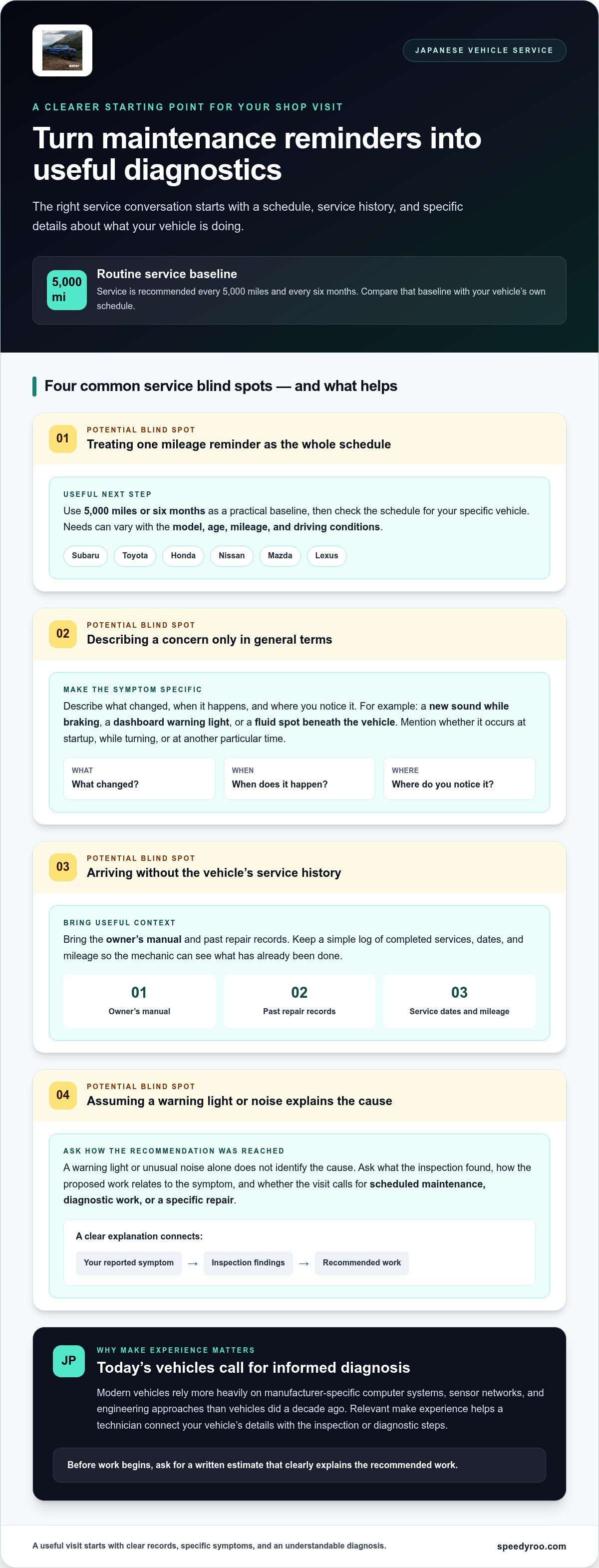
Routine Japanese vehicle service is recommended every 5,000 miles and every six months. Use those intervals as a practical maintenance baseline, then compare them with the schedule for your specific vehicle. A Subaru, Toyota, Honda, Nissan, Mazda, or Lexus may have different service needs depending on its model, age, mileage, and driving conditions.
Preventive maintenance can help identify developing problems before they interrupt daily driving. A visit may include reviewing service records and checking visible components for wear or fluid condition. The work depends on the vehicle and its maintenance schedule. Bring the owner’s manual and past repair records so the mechanic can see what has already been done.
Describe specific changes you’ve noticed, rather than giving only a general concern. Mention a new sound while braking, a dashboard warning light, or a fluid spot beneath the vehicle. Include when the symptom occurs, such as during startup or while turning. These details help guide diagnosis and distinguish a repair issue from routine maintenance.
Japanese vehicle repair and maintenance involve more than following a mileage reminder. Modern vehicles rely more heavily on manufacturer-specific computer systems, sensor networks, and engineering approaches than vehicles did a decade ago. Maintenance records and accurate information about the make and model help the technician connect a symptom with the relevant inspection or diagnostic steps.
For Subaru repair and maintenance, share the model, mileage, service history, and any changes in how the vehicle drives. The same preparation helps with Toyota, Honda, Nissan, Mazda, and Lexus vehicles. A mechanic can use those details to determine whether the visit calls for scheduled maintenance, diagnostic work, or a specific repair. A warning light or unusual noise alone does not identify the cause.
- Keep a simple record of completed services, dates, and mileage.
- Describe new symptoms with specific examples, including when they happen.
- Separate routine maintenance questions from concerns that require diagnosis.
- Ask the mechanic to explain how the proposed work relates to the symptom or schedule.
These details give the shop a clearer starting point and help you understand the recommended work. If a repair is needed, ask what the inspection found and how the repair addresses it. Clear explanations make it easier to decide what needs attention now and what can be included in future maintenance planning. For contractors and business owners who also oversee heavy commercial equipment, maintaining detailed service histories is just as essential when evaluating pre-owned inventory on Simple Lend Marketplace.
ASE certification and shop qualifications
ASE certification can help you assess a technician’s automotive knowledge, but it is only one factor. Match the credential to the work your vehicle needs. A Toyota engine concern, for example, calls for relevant diagnostic ability, not just a general claim of automotive expertise. Consider credentials alongside experience with the make and a clear explanation of the repair process.
An ASE-certified technician has earned a credential associated with automotive service expertise. The practical question is how that knowledge applies to your vehicle’s specific problem. A shop’s technicians may have different areas of focus, so identify who will diagnose the issue and who will complete the repair. That makes it easier to understand whether the qualifications fit the task.
ASE Master Certified is a designation you may encounter when comparing technician credentials. Treat it as one qualification, not a substitute for make-specific experience. A broad credential and direct familiarity with Japanese vehicle systems answer different questions: one indicates general technical knowledge, while the other reflects experience with a vehicle’s engineering and diagnostics.
Use a focused checklist to assess qualifications without getting lost in titles:
- Identify the technician’s credentials and the automotive work they cover.
- Ask which technician will handle your vehicle’s diagnosis and repair.
- Connect the credential to the reported symptom, such as an engine warning or braking concern.
- Notice whether the explanation links the inspection findings to the recommended work.
Credentials matter most when they support a careful process. A technician should explain what was inspected, what the findings mean, and why a repair is recommended. If the explanation jumps from a warning light straight to a replacement, ask for the diagnostic reasoning in plain language. That helps you distinguish a considered recommendation from a guess.
Shop qualifications also include the makes and systems technicians regularly work on. Modern vehicles use manufacturer-specific computer systems and sensors, so experience with Toyota or another Japanese make adds useful context to general training. Consider relevant credentials, hands-on experience with the make, the diagnostic approach, and clear communication together. No single title answers every question.
For readers comparing Toyota-focused expertise with broader credentials, Japanese vehicle repair information offers a useful next step in understanding make-specific service.
Customer experiences with honesty and communication
There isn’t enough comparable information here to name Denver’s highest-rated independent Japanese car mechanic. Warranty coverage also varies by shop, so review written terms for parts, labor, and exclusions before approving work.
Customer Communication and Pricing
Choosing a trustworthy mechanic for Japanese cars in Denver starts with a clear conversation about your concern and the proposed work. Ask about experience with your vehicle’s make and request a written estimate before work begins. The estimate should separate parts, labor, and diagnostic time so you can see what each charge covers.
A shop should explain its diagnostic process before recommending a repair. If a warning light leads to a proposed sensor replacement, ask what tests were performed and how the results support that recommendation. A clear explanation should describe the problem, its cause, and the repair in understandable language.
Read the estimate alongside the explanation. Check whether it separates immediate repairs from other recommended work, and ask what evidence supports each item. If new work is proposed during the repair, ask why and request revised written details before deciding. This keeps communication clear and helps you understand what you’re authorizing.
Independent Shop Ratings
Ratings are a starting point, not the whole customer experience. Read detailed reviews for examples of diagnostic explanations, clear estimates, and how a shop handles questions. For Denver drivers looking for a trustworthy mechanic for Japanese cars, reviews that mention a relevant vehicle make or repair can be more useful than a general star rating.
Shop history and customer satisfaction add perspective when reviews describe repeat visits. One customer account reported using a Denver-area shop for 11 years without disappointment. That experience is individual, not a guarantee of another customer’s experience, but it illustrates how long-term feedback can reveal patterns beyond a single visit.
Look for recurring details across customer accounts. Do reviewers mention clear updates, understandable explanations, or communication before additional work? A review about Toyota repair may be more relevant to a Toyota owner than a general comment about convenience. Compare positive and critical accounts, focusing on specific experiences rather than unsupported claims.
- Read detailed comments, not just the overall rating.
- Look for experiences involving your vehicle’s make or repair type.
- Compare the written estimate with the shop’s explanation.
- Review warranty terms for parts, labor, and exclusions.
Use these details to turn customer experiences into practical guidance. A shop should explain its findings, document recommended work, and provide understandable warranty terms. That makes it easier to judge whether its communication style suits you before building an ongoing service relationship.
Mechanic experience with Japanese vehicle systems
Experience with Japanese engineering helps a mechanic connect symptoms to the systems behind them. For Denver drivers, look for evidence of experience with the relevant make and model.
Japanese and Korean Vehicle Expertise
Japanese and Korean vehicles are not interchangeable categories. A shop’s broad import focus may be useful, but the specific make and vehicle systems still matter. Ask how the technician approaches diagnosis for your vehicle, including its engine, sensors, and computer-controlled features. A clear explanation connects testing to the symptom instead of jumping straight to a repair.
Modern vehicles rely more heavily on manufacturer-specific computer systems, sensor networks, and engineering approaches than vehicles did a decade ago. That makes focused experience relevant when a warning light, performance change, or unusual sound needs diagnosis. Repairs made without focused experience with a manufacturer’s engineering approach may be temporary, and problems can return a few months later.
For a Japanese hybrid, look for experience with both the vehicle’s make and its hybrid systems. Diagnosis can involve components beyond a conventional engine, so the mechanic should explain which systems are being evaluated and how the findings support the recommended work. Familiarity with standard repairs alone does not establish hybrid experience.
Brand-Specific Repair Experience
Denver drivers considering a shop for Toyota, Honda, Subaru, Nissan, Mazda, or Lexus should compare the makes it services. The shop’s experience should apply to the specific vehicle, not just Japanese cars in general. Relevant experience might include diagnosing a Subaru engine concern or investigating a Toyota warning light.
Ask for an explanation of the diagnostic sequence. A mechanic should describe the reported symptom, the inspections or tests used, and how the results lead to a repair recommendation. That process helps you assess whether the technician’s experience fits the issue and whether the diagnosis is accurate. It also gives you a clearer basis for discussing next steps.
For Japanese hybrids, choose a shop whose technicians can explain their approach to hybrid-system diagnosis and make-specific work. The explanation should identify the systems being evaluated and what the test results mean. Direct answers show how the shop connects its experience to your vehicle’s particular concern.
Use these points to compare a shop’s practical experience:
- Match the shop’s stated make experience to your Toyota, Honda, Subaru, Nissan, Mazda, or Lexus.
- Describe the symptom and listen for a clear diagnostic plan.
- For a hybrid, ask how the diagnosis accounts for hybrid systems.
- Consider whether the proposed repair follows logically from the findings.
Shop hours and location
A convenient location matters most when the shop’s hours fit your routine. For Japanese auto repair in Denver, compare travel time, appointment availability, and how you’ll manage drop-off and pickup. A nearby shop with hours that conflict with work may be less practical than one that fits your schedule.
No Denver neighborhood alone establishes that a Japanese auto repair shop is reputable. Assess the individual shop’s vehicle experience, communication, and service process, then weigh its location against your regular route and transportation needs.
Before choosing a shop, review its posted hours and plan around the service you need. Scheduled maintenance may require a different drop-off plan than a repair that needs diagnosis. Ask about leaving keys, receiving updates, and arranging pickup during business hours. Clear procedures can prevent avoidable confusion.
Location also affects how easily you can respond if the shop finds another issue. Consider the drive from home or work, traffic on your usual route, and whether you can arrange a ride. If you rely on your vehicle for commuting, plan for drop-off and pickup before booking. Convenience supports the repair process, but it does not replace checking the shop’s automotive experience.
Keep manufacturer paperwork and service records together when you visit a shop. These documents help the technician understand previous maintenance and may be useful when discussing manufacturer warranty terms. Ask how the proposed service relates to your vehicle’s records, and keep copies of the estimate and completed work for future visits.
Use this practical comparison before making a choice:
- Check posted hours against your work and household schedule.
- Estimate travel time from home, work, or your usual Denver route.
- Understand drop-off, repair updates, and pickup arrangements.
- Bring manufacturer paperwork and maintenance records to the appointment.
- Review written warranty terms for covered parts, labor, and exclusions.
A useful location is one you can reach without disrupting your day, while the shop’s hours support a clear service plan. Compare those logistics with the shop’s Japanese vehicle experience and communication practices. For a next step, explore Japanese vehicle service options and consider how the location and hours fit your routine.
Rather than choosing by neighborhood alone, evaluate each shop’s vehicle experience, communication, and service process.
Speedy Roo Motorsports & Repair: Subaru Repair and Service
Speedy Roo Motorsports & Repair provides Subaru repair and service for drivers who need maintenance or repairs from a shop focused on Japanese vehicles. The team also services Toyota, Honda, and Nissan, offering owners of these makes a local option for routine care or a specific concern in Aurora, Denver, Centennial, Parker, and Lone Tree.
If your Subaru needs attention, bring a clear description of the symptoms and any available service records. This helps the repair team understand the issue and discuss the next step. Toyota, Honda, and Nissan owners can prepare the same way.
For Subaru service or repair, contact Speedy Roo Motorsports & Repair or visit speedyroo.com.
Make Your Next Service Decision With Confidence
Choosing a trustworthy mechanic for Japanese cars in Denver starts with finding a shop that listens and explains its work. Bring your service records and describe any changes you’ve noticed. This gives the team a useful starting point for discussing your vehicle’s needs. Speedy Roo Motorsports & Repair serves Japanese vehicle owners in Aurora, Denver, Centennial, Parker, and Lone Tree.
Speedy Roo Motorsports & Repair Inc offers Subaru, Toyota, and Honda repair and service. If you own one of these makes, discuss your vehicle’s needs with a team focused on Japanese vehicles.
Contact Speedy Roo Motorsports & Repair Inc to start a conversation about your vehicle’s service needs. A thoughtful choice today can help you approach future maintenance with greater clarity and confidence.
Frequently Asked Questions
Do Japanese vehicles require specialized mechanics?
Yes. Japanese vehicles benefit from mechanics familiar with their make-specific engineering, electronics, and diagnostic systems. Modern vehicles rely more heavily on manufacturer-specific computer systems and sensors than vehicles did a decade ago. For a hybrid, ask about experience with both the vehicle make and hybrid systems. This helps you assess whether a technician’s background fits the concern, rather than relying only on a broad “import car” label.
How can I verify a Denver mechanic’s ASE certifications and credentials?
Ask which technician will work on your vehicle and what ASE credentials apply to the work. Request the credential’s name, specialty, and current status, then verify those details through ASE’s credential records. Match the specialty to your repair needs: an engine credential, for example, is more relevant to an engine concern than an unrelated specialty. Also ask how the technician’s experience with your make complements their credentials.
What do Denver customers say about local Japanese auto repair shops?
Customer reviews can show patterns in communication and repair experiences, but read the details rather than relying only on an overall rating. Look for comments describing the vehicle make, the issue addressed, and how clearly the shop explained its work. Drivers in Denver, Aurora, Centennial, Parker, and Lone Tree can compare feedback relevant to their needs while treating individual reviews as personal experiences.
What are typical labor rates and diagnostic fees at Denver mechanics?
Denver labor rates and diagnostic fees depend on the case, so compare written quotes instead of relying on an unsourced typical figure. The amount depends on the diagnostic scope, vehicle systems involved, labor required, and parts needed for the repair. A quote is provided after a quote request. Ask for diagnostic time, parts, and labor to appear separately, making it easier to understand the estimate and compare equivalent work.
How do dealership service prices compare with independent Japanese car repair shops in Denver?
There is no dependable price comparison based only on whether a shop is a dealership or independent. The vehicle, requested repair, diagnostic work, and parts affect each estimate. Request quotes for the same concern, then compare what each includes, such as parts, labor, and diagnostic time. Review the proposed repair and its explanation alongside the total to ensure you are comparing equivalent work.
How can I get a written estimate and avoid unnecessary repairs at a mechanic?
Describe the symptoms clearly and request a written estimate before authorizing repairs. Ask the mechanic to explain the diagnostic steps, findings, and how each recommendation addresses the concern. Have the estimate distinguish diagnostic time, parts, and labor, and ask which items are needed to resolve the issue. Keep a copy of the estimate and compare it with the final invoice to understand any changes to the approved work.