
A smooth test drive doesn’t prove a used car is free of costly surprises. A pre-purchase inspection Denver buyers arrange before committing can reveal concerns that aren’t obvious on the road and give you a clearer basis for questions or negotiation. It can’t predict every future failure or guarantee a trouble-free vehicle, but it can make the car’s current condition easier to assess.
It’s reasonable to want more than a quick look under the hood, especially when the car’s history or condition is unclear. Inspection findings can help you decide what to clarify with the seller, whether a concern needs further diagnosis, and whether you’re comfortable moving forward.
This guide explains what an inspection can and can’t establish, how to prepare, and how to use the findings before you buy. Speedy Roo Motorsports & Repair Inc is an Aurora-based Japanese-vehicle specialist serving buyers across Denver, Centennial, Parker, and Lone Tree, with pre-sale inspections for used-car buyers. Consider the results alongside the test drive, vehicle records, and seller’s answers so your decision is informed rather than based on false certainty.
Key Takeaways
- A pre-purchase inspection Denver buyers arrange can inform a decision, but it can’t guarantee a used car will be trouble-free.
- Inspection scope can vary with the vehicle’s make, model, age, condition, and available access, so focus on questions specific to the car you’re considering.
- Use an inspection alongside a test drive and vehicle history report. Each offers a different perspective on the vehicle.
- Prepare by gathering the listing, vehicle identification information, and questions you want answered before the inspection.
- Speedy Roo has served Japanese-vehicle owners since 2002 and offers pre-sale inspections for Denver-area used-car buyers.
Why Get a Pre-Purchase Inspection in Denver Before Buying a Used Car?
A used car can feel solid on a test drive, and the seller’s description may sound reassuring, yet neither necessarily answers every mechanical question. A brief drive shows how the vehicle behaves in those particular conditions. A seller can share what they know, but their account is different from a professional assessment of the car’s condition.
A pre-purchase inspection is a professional assessment of a vehicle before a buyer commits to purchasing it. It gives you another source of information to weigh against the asking price, the car’s history, and your own needs. For a general overview, see What is a pre-purchase inspection? An inspection can help you understand the vehicle, but it doesn’t predict everything that may happen after you buy it.
For a Denver-area buyer, a pre-purchase inspection can add useful mechanical perspective before money changes hands. The goal isn’t to make the decision for you. It’s to identify observations and questions, consider potential concerns, and decide whether the vehicle still suits your plans.
What can a pre-purchase inspection help a Denver buyer understand?
An assessment can help you understand observable aspects of the vehicle’s condition at the time it’s examined. Its value lies in providing a professional perspective separate from your own impressions during a test drive and the seller’s description.
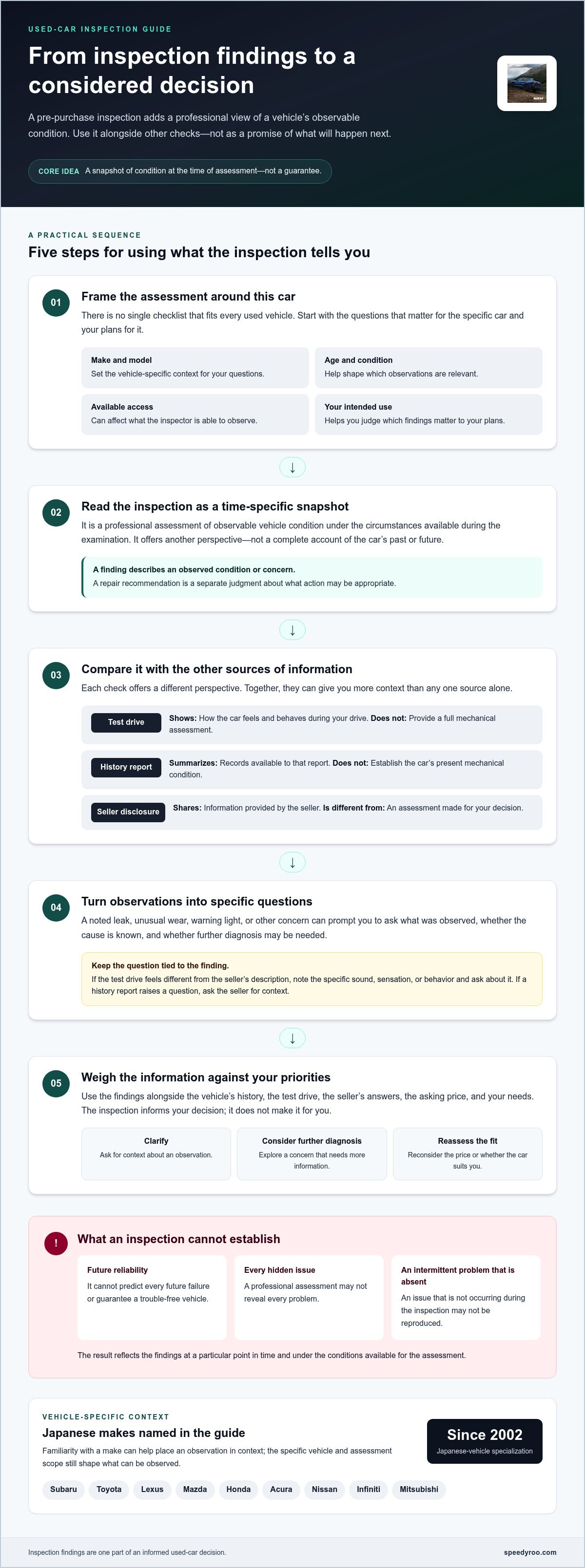
Use the findings alongside the vehicle’s history and your priorities. For example, a noted leak, unusual wear, or warning light may prompt you to ask what was observed, whether the cause is known, and what further diagnosis might be needed. A concern may lead you to seek clarification, reconsider the price, or decide the car isn’t the right fit. A finding is information to evaluate, not an automatic instruction to authorize repairs.
What an inspection cannot guarantee
An inspection reflects findings at a particular point in time and under the conditions available for the assessment. It cannot guarantee future reliability, reveal every hidden problem, or necessarily reproduce an intermittent issue that isn’t occurring during the inspection.
Keep the distinction clear: a finding describes a condition or concern, while a repair recommendation is a separate judgment about what action may be appropriate. Whether work is needed depends on the issue, its significance, and your decision about the vehicle.
The inspection also differs from the other checks buyers commonly use:
- Test drive: Shows how the car feels and behaves during your drive, but isn’t a full mechanical assessment.
- Vehicle history report: Summarizes records available to that report, but doesn’t establish the car’s present mechanical condition.
- Seller disclosure: Shares information the seller provides about the vehicle, rather than an assessment made for your decision.
These sources complement one another. If a history report raises a question, consider it alongside inspection findings and ask the seller for context. If the test drive feels different from what the seller described, note the specific sound, sensation, or behavior and ask about it. Taken together, the information can help you make a considered choice without removing all uncertainty from buying a used car.
Denver Pre-Purchase Inspection for Japanese Cars
There isn’t one universal inspection checklist that fits every used car. The scope of an assessment can vary with the make and model, the vehicle’s age and condition, and what can be accessed at the time. A buyer considering a newer Toyota and a buyer considering an older Subaru may have different questions because the vehicles, their histories, and their intended use differ.
A pre-purchase inspection is a time-specific assessment of observable vehicle condition, not a prediction or guarantee of future performance. That distinction helps set realistic expectations: the assessment can offer useful context, but it can’t establish everything about a vehicle’s past or future.
As you consider a pre-purchase inspection in Denver, start with what you need the assessment to help clarify. Questions may relate to the specific vehicle’s age, condition, history, and how you plan to use it. The inspection’s scope and access matter too, so don’t assume every assessment includes the same checks.
- Make and model: Help frame questions in the context of the vehicle being considered.
- Age and condition: May affect which observations are most relevant to your decision.
- Available access: Can shape what an inspector is able to observe during the assessment.
- Your intended use: Helps you decide which findings matter most to your ownership plans.
Why Japanese-vehicle experience can add useful context
Japanese vehicles include a wide range of makes and models, including Subaru, Toyota, Lexus, Mazda, Honda, Acura, Nissan, Infiniti, and Mitsubishi. Familiarity with these makes can help place an observation in relevant vehicle context, rather than treating every car as if it were identical. Similarly, just as Japanese models benefit from make-specific familiarity, high-end imports require specialized standards of upkeep, as highlighted by luxury specialists like Euro Haus Auto Care in their guides on preserving premium vehicles.
Speedy Roo Motorsports & Repair Inc has specialized in Japanese vehicles since 2002 and offers pre-sale inspections. That experience is relevant for buyers considering a Japanese vehicle, while the specific vehicle and assessment scope still shape what can be observed.
How to read findings without jumping to conclusions
Separate what was observed from what might be causing it and what action, if any, may make sense. An observation describes a condition. A diagnosis identifies a likely cause. A repair decision weighs the diagnosis alongside the vehicle’s value, your plans, and your tolerance for uncertainty. These are related, but they aren’t interchangeable.
A finding doesn’t automatically mean a repair is required, and it doesn’t decide whether you should buy the car. If something is unclear, identify the specific question you need resolved before committing. Then consider the answer alongside the seller’s information, the vehicle’s history, and your own priorities.
For buyers considering a Japanese vehicle in the Denver area, Speedy Roo Motorsports & Repair Inc’s Japanese-vehicle pre-sale inspection service offers a local option grounded in the shop’s focus on these makes. Use the assessment as decision-making information, not as a substitute for your judgment or a promise about the car’s future.
How a Pre-Purchase Inspection Compares With Other Used-Car Checks
A test drive, vehicle history report, and professional inspection each offer a different kind of information. Comparing them helps you see what each can contribute and where questions may remain. None should be treated as a complete substitute for the others.
| Check | Main purpose | What it may not establish |
|---|---|---|
| Professional inspection | Assess observable vehicle condition at the time of the inspection. | Every past event, hidden issue, or future reliability concern. |
| Test drive | Let you experience how the vehicle operates during your drive. | Whether the car is mechanically sound in every respect. |
| Vehicle history report | Summarize records associated with the vehicle that are available to the report. | A complete account of the vehicle’s past or its current condition. |
History records document reported events, while an inspection assesses condition at a point in time. Inspection findings can’t verify every detail in a seller’s account or in vehicle records. Each source has limits, and they’re most useful when considered together.
Inspection versus a test drive
A test drive is your opportunity to experience the vehicle in operation. You might notice a sound, vibration, or behavior that prompts a question, but a drive alone isn’t a professional mechanical assessment. An inspection offers a separate perspective on observable condition. Neither guarantees that every issue will appear, so treat what you notice during the drive as helpful context to share and consider.
Inspection versus a vehicle history report
A history report may summarize records associated with a vehicle, while an inspection focuses on its condition when assessed. A report entry can give you a reason to ask the seller for context; an inspection may add information about the vehicle as it presents now. Neither source guarantees a complete picture, and an inspection can’t confirm that every record or seller statement is accurate.
For a pre-purchase inspection Denver buyers can use as part of a broader review, organize the information around the specific questions you need answered:
- Compare: Note where the seller’s description, available records, and your experience on the test drive differ.
- Clarify: Use those differences to identify questions about the vehicle’s history or observed condition.
- Consider: Weigh the answers and inspection findings against your intended use and comfort with uncertainty.
A mismatch doesn’t automatically mean a seller is being dishonest or a vehicle is a poor choice. It does signal that you may need more context before deciding. Likewise, a history report without concerning entries doesn’t establish the vehicle’s present mechanical condition. Each check adds perspective, and the final decision is yours.
How to Prepare for a Used-Car Inspection in the Denver Area
A little preparation can help keep an inspection focused on the used car you’re actually considering. Gather the details you already have, note what you want clarified, and coordinate with the seller so the vehicle can be accessed at an agreed time. These steps help you make better use of the findings without assuming every inspection follows the same process.
Before arranging the inspection
Start with the basics, then connect your questions to the vehicle’s listing, seller disclosures, and your own experience with the car. If you’re arranging a pre-purchase inspection in Denver, clear details and practical coordination help set expectations.
- Record the vehicle details. Gather the make, model, year, and vehicle identification number (VIN), along with a copy or link to the listing—whether from a private seller or a pre-owned dealership like globulcars.com. The VIN helps identify the specific vehicle under consideration.
- Note what prompted your questions. Write down statements in the listing or seller disclosures that you want to understand better. Add any sounds, sensations, or behaviors you noticed during the test drive.
- Prioritize what matters to you. Identify the questions most relevant to your plans, such as whether a concern could affect the way you intend to use the vehicle. A focused list helps keep important points from getting lost.
- Coordinate access and timing. The seller needs to make the vehicle available for the inspection, so agree on a practical time and arrangements for access. Scheduling depends on coordination between the people involved and the vehicle being ready to be assessed.
After receiving the findings
Read the findings before deciding whether to buy. If a term or observation is unfamiliar, ask for it to be explained in plain language. Clarify whether a statement describes something directly observed, a possible cause, or a suggested next step. Those distinctions make it easier to evaluate what the information means for your decision.
Rather than treating every note as equally significant, consider the nature of each concern and how it relates to the vehicle’s history, asking price, and your intended use. An observation isn’t automatically a repair order, and a suggested next step doesn’t oblige you to proceed with work. The findings provide information for you to weigh.
Use unresolved questions to guide your next conversation with the seller. If an inspection observation seems inconsistent with the vehicle’s description, ask for relevant context before committing. If the available information leaves you uncomfortable, you can pause or reconsider. If the findings fit your needs and expectations, you may decide to proceed. An inspection can support any of those choices, but it can’t guarantee how the car will perform in the future.
Speedy Roo Motorsports & Repair Inc offers pre-sale inspections and has specialized in Japanese vehicles since 2002. Schedule a pre-sale inspection to get an informed perspective on a Japanese vehicle you’re considering.
Arrange a Denver-Area Pre-Purchase Inspection With Speedy Roo
Once you’ve gathered the vehicle details and questions you want addressed, the next step is choosing an inspection service familiar with the type of car you’re considering. Speedy Roo Motorsports & Repair Inc offers pre-sale inspections for Denver-area used-car buyers, with a specialization in Japanese vehicles. Inspection findings can give you useful information to weigh before purchase, while leaving the decision in your hands.
A local Japanese-vehicle specialist serving Denver Metro
Speedy Roo Motorsports & Repair Inc is based in Aurora and serves the Denver Metro area, including buyers in Denver, Centennial, Parker, and Lone Tree. Since 2002, the shop has specialized in Japanese vehicles, including Subaru, Toyota, Lexus, Mazda, Honda, and Nissan. Familiarity with these makes provides relevant experience for buyers considering one of these cars, while an inspection remains an assessment of the vehicle at that time.
Buyers comparing import ownership information can also explore this Japanese import repair guide for context about common assumptions and ownership questions.
Take the next step before you buy
Before arranging an inspection, have the vehicle’s make, model, year, and identification details ready, along with questions you’ve noted from the listing or seller. Coordinate timing and access with the seller so the car can be available for the assessment. This preparation helps keep the appointment focused on the vehicle and the information that matters to your decision.
Speedy Roo Motorsports & Repair Inc has served Japanese-vehicle owners since 2002. Its repair and maintenance experience with these vehicles is relevant background for buyers seeking a local specialist, but an inspection is an assessment of the car, not a promise about future condition or an automatic recommendation to authorize repairs.
For another perspective on evaluating a used Japanese import before purchase, read the pre-sale vehicle evaluation buyer’s guide. It can help you think through the information you want to consider as you prepare to make a decision.
Online scheduling is available, or you can call (303) 400-0625 to arrange a pre-sale inspection. Speedy Roo Motorsports & Repair Inc is located at 18355 E. Girard Ave. Unit B, Aurora, CO 80013.
If you’re considering a Japanese vehicle, schedule a pre-sale inspection with Speedy Roo before you commit. Bring your questions and use the findings as one part of an informed buying decision.
Make Your Next Move With Confidence
Before you commit, give yourself room to weigh what the inspection tells you against what you want from the car. Decide which questions still need answers and what level of uncertainty you’re comfortable accepting. That keeps the choice grounded in your priorities rather than pressure to close a deal quickly.
For Japanese-car buyers, a pre-purchase inspection in Denver from a shop with relevant experience can add a knowledgeable perspective. Speedy Roo’s technicians are ASE Certified, and the shop has a 4.5-star Google rating. The findings can inform your decision, but the final call remains yours.
If you’re ready to take that step, schedule a pre-purchase inspection with Speedy Roo. Bring your questions, take time to understand the findings, and choose the vehicle that fits your needs. A thoughtful decision is a strong start to ownership.
Frequently Asked Questions
How much does a pre-purchase inspection cost in Denver?
For an estimate, use Speedy Roo’s online scheduling or call (303) 400-0625. Have the vehicle’s year, make, model, and listing information ready. Those details identify the car you’re considering and help keep the conversation focused on arranging a pre-purchase inspection before you decide whether to proceed.
What does a pre-purchase car inspection include?
There’s no single inspection scope that applies to every used car. The assessment can vary with the vehicle and what can be observed during the appointment, so don’t assume a particular test or component review is included. Findings describe observations made at that time, not a guarantee of reliability or a prediction of later failures. Share any specific concern when arranging the inspection so it can inform the assessment.
Is a pre-purchase inspection worth it when buying a used car?
It can be worthwhile if you want another informed perspective before committing. If the seller describes the car as problem-free but you noticed an unusual sound on your drive, an inspection may help you identify what questions to resolve. The findings can inform whether the vehicle fits your priorities, but they can’t predict every future issue. You’ll still need to weigh the information and make the buying decision yourself.
Can I get a pre-purchase inspection for a used Subaru or Toyota in Denver?
Yes. Speedy Roo offers pre-sale inspections and specializes in Japanese vehicles, including Subaru and Toyota. When arranging an assessment, share the car’s year, model, and any concerns you have about that specific vehicle. This gives useful context without assuming a particular inspection checklist or outcome. The findings can help you evaluate the car before deciding whether it suits your needs.
How long does a pre-purchase inspection take?
The time required depends on the vehicle and the inspection service being arranged, so there isn’t one duration that applies to every car. A vehicle’s condition and access for the assessment may also affect scheduling. To discuss timing for the car you’re considering, call Speedy Roo at (303) 400-0625 with its year, make, and model ready. Coordinate with the seller so the vehicle can be available as arranged.
Can a pre-purchase inspection guarantee that a used car is reliable?
No. An inspection cannot guarantee that a used car will remain reliable or reveal every hidden or intermittent issue. It reflects what can be observed during the assessment, not every condition that may develop later or occur under different circumstances. Treat the findings as one source of information, and consider them alongside the vehicle’s records, seller information, and your plans for the car before making a decision.
Should I get a vehicle history report as well as an inspection?
Yes, they can offer different perspectives. A history report may summarize records associated with the vehicle, while an inspection addresses observable condition at the time it’s assessed. A record in the report could prompt a question about the car’s past, while the inspection provides separate information about its present state. Neither source guarantees a complete account, so consider both when evaluating the vehicle.