
A dyno tune isn’t just about chasing horsepower. Dyno tuning for fuel efficiency in Lone Tree uses controlled testing to measure horsepower, torque, and the air-fuel mixture at different speeds and loads, then guides adjustments to the engine’s settings. The goal can be smoother performance and better efficiency, not simply more power.
It’s reasonable to want better fuel economy without making your vehicle feel sluggish. A dyno session can show how the engine performs before adjustments, help a technician refine its tune, and provide a way to assess the changes afterward. Results depend on the vehicle’s condition, equipment, and setup, so tuning isn’t a guaranteed fix for every mileage concern.
Here’s how dyno tuning works, what baseline runs reveal, and how technicians assess adjustments. You’ll also learn how tuning can balance drivability, performance, and fuel efficiency, and when it may make sense for your vehicle.
Key Takeaways
- A dyno measures engine output and air-fuel mixture under load, helping identify tuning concerns before adjustments begin.
- Baseline runs give technicians a reference point for refining settings and assessing changes during tuning.
- Final testing compares results, while a test sheet records tune-up specifications for a clearer picture of the work.
- Tuning can support smoother drivability and fuel efficiency, with the outcome shaped by the vehicle’s condition and setup.
What Is Dyno Tuning?
A dynamometer measures engine output under controlled load, helping a technician assess performance and adjust settings. For fuel efficiency, the aim is to balance usable power with a suitable air-fuel mixture and ignition timing.
Measuring Engine Performance
A dyno measures horsepower and torque as the engine operates at different speeds and loads. An engine dyno tests the engine separately, while a chassis dyno measures output through the vehicle’s driven wheels. This shows how performance changes under load, rather than relying only on idle behavior.
Data logging records engine parameters during a run, such as air-fuel mixture and timing. Comparing those readings with horsepower and torque can help a technician identify irregular behavior and make informed adjustments. A dyno run can reveal symptoms, but it doesn’t replace diagnosis of an underlying mechanical fault.
Fuel Economy and Engine Output
Fuel-efficiency tuning adjusts engine settings, including air-fuel mixture and timing, to suit the vehicle’s operating conditions. The objective isn’t simply to reduce fuel use at every moment; the technician considers how the engine responds under load and delivers power.
That distinction matters if a vehicle feels hesitant or lacks power as well as getting poor mileage. Dyno measurements can show whether engine output and mixture change as expected under test conditions. Tuning may also help optimize catalytic converter operation by adjusting exhaust gas temperature and air-fuel ratios, but it cannot promise a specific emissions reduction.
Tuning Versus Remapping and Maintenance
Fuel-efficiency tuning uses measured engine behavior to guide adjustments, while an ECU remap changes engine-control software settings. The approaches can overlap, but a dyno lets a technician observe output under load and assess calibration changes.
Regular maintenance addresses wear or faults that tuning can’t correct. Before a session, the technician should assess items such as spark plugs, filters, fluids, belts, hoses, tires, and leaks. A worn filter or damaged hose can affect performance, so fixing mechanical issues may matter more than changing calibration.
Vehicle and Engine Suitability
Vehicles with adjustable engine settings and a compatible dyno setup may be candidates for efficiency-focused tuning. The right equipment depends on whether testing requires an engine dyno or a chassis dyno, as well as the vehicle’s configuration.
Preparation matters: the technician checks plugs, air, oil, and fuel filters; oil, transmission, and differential fluids; belts, hoses, tires, and possible leaks. The main risks are tuning around an unresolved mechanical problem or making settings that harm drivability or engine operation. Calibration should suit the vehicle and its condition.
Training supports careful interpretation of test data. UTI Automotive Technology students train with a dynamometer during nine weeks of Power & Performance courses, learning how measured engine behavior informs tuning decisions.
Baseline runs and iterative tuning
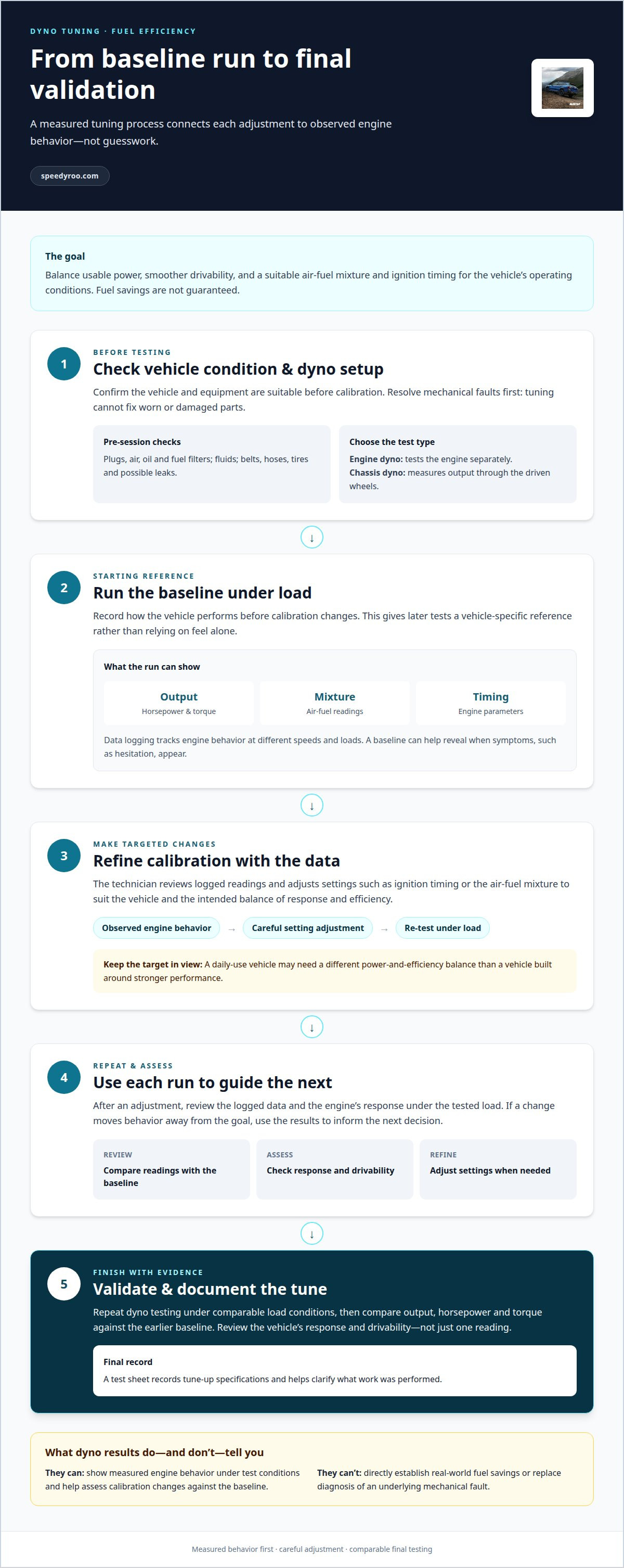
A baseline run records the vehicle’s behavior before calibration changes. Later tests give the technician a reference for judging whether adjustments support efficiency and drivability. For Lone Tree drivers, dyno tuning for fuel efficiency in Lone Tree starts by understanding how the vehicle performs in its current condition, not assuming one setting suits every engine.
Baseline Performance Runs
A baseline is an initial dynamometer test that measures engine response under load before tuning begins. It matters because later results can be compared with the same vehicle’s starting point, rather than judged by feel alone.
During testing, the technician observes engine output and operating data under the test conditions. For example, if hesitation appears as load increases, the baseline can help show when it happens. The readings also provide context for deciding which settings to assess, such as ignition timing or air-fuel mixture. A baseline is a measured reference, not a promise of a particular fuel-economy gain.
Iterative Tuning Session
An iterative session uses repeated testing and careful adjustments to refine engine calibration. A fuel-efficiency session typically begins with a baseline, followed by targeted changes and additional runs to assess the engine’s response.
After each run, the technician reviews logged data and considers whether a change supports smoother operation under the tested load. Adjustments may involve ignition timing or air-fuel settings. If a change moves performance away from the goal, the data informs the next decision. That’s how dyno tuning for fuel efficiency in Lone Tree connects each adjustment to observed results instead of guesswork.
Testing before performance upgrades can establish a reference for balancing power and efficiency. A later session can assess how modifications affected the vehicle, making the comparison more useful than treating each change in isolation. A daily-use vehicle may call for a different balance than one built around stronger performance. For drivers considering a measured dyno tuning session, the baseline and follow-up runs make the tuning process easier to understand.
Final dyno validation and reporting
Final validation checks whether the vehicle responds as intended after calibration changes. The technician repeats dynamometer testing under comparable load conditions, then reviews engine output, horsepower, and torque against the earlier baseline. This comparison shows how the settings changed measured behavior, but it doesn’t directly establish real-world fuel savings.
During validation, the technician checks whether the dyno tune delivers the intended balance of response and drivability. For example, a change to ignition timing should be assessed alongside the engine’s response under load, not judged by one output reading alone. If the results point to an issue, the settings can be reviewed and testing repeated before the session is complete.
Customers receive a test sheet with tune-up specifications after dyno tuning. Keep it as a record of the final settings and use it to understand what was adjusted. It can also be a useful reference if the vehicle is modified later, since new parts may change how the engine performs under the same load conditions.
To verify fuel savings, compare the vehicle’s actual fuel use before and after the tune under similar driving conditions. Record odometer readings and fuel purchases, and consider trip type, traffic, driving style, and vehicle load. A short commute compared with a long highway trip won’t provide a fair comparison. Use consistent routes and driving habits where practical, then assess the trend across repeated fill-ups rather than relying on one tank.
Fuel use can change for reasons unrelated to calibration, including route, weather, traffic, and maintenance condition. Keep those factors as consistent as possible when comparing results. The dyno test sheet documents tuning specifications, while fuel records show how the vehicle performs in everyday use. Together, they distinguish measured engine changes from real-world economy and help clarify whether the tune supports your driving goals.
Dyno tuning benefits for performance and fuel efficiency
A dyno tune can address fuel use and drivability together by refining air-fuel mixture and ignition timing. Those settings affect how the engine responds under load, not just its peak horsepower. For drivers considering dyno tuning for fuel efficiency in Lone Tree, a useful goal is balancing smoother power delivery with everyday economy.
More horsepower isn’t automatically better for daily driving. A vehicle used for commuting may benefit more from consistent throttle response than from chasing higher peak output. Testing at different load levels helps show how adjustments affect engine behavior. In Lone Tree, dyno tuning for fuel efficiency can help assess whether calibration changes support your priorities, rather than focusing on one performance number alone.
Fuel economy also depends on engine condition, vehicle equipment, driving habits, and the load placed on the engine. Poor mileage alongside surging, pinging, starting difficulty, or a lack of power can point to issues worth assessing. Tuning can address calibration, but it can’t repair a faulty component. That distinction matters before pursuing dyno tuning for fuel efficiency in Lone Tree, especially if symptoms suggest a mechanical concern.
- Air-fuel mixture: Adjustments can support efficient combustion across tested operating conditions.
- Ignition timing: Refinement can improve response and help reduce hesitation.
- Drivability: Smoother power delivery can make acceleration feel more predictable in everyday use.
- Performance balance: Considering horsepower and torque alongside efficiency keeps changes aligned with the vehicle’s purpose.
Start by defining your priority: improved response, better efficiency, or a balance of both. For drivers seeking Aurora dyno tuning, a session can evaluate engine settings against those goals.
Speedy Roo Motorsports & Repair: Aurora Dyno Tuning
Speedy Roo Motorsports & Repair offers Aurora Dyno Tuning for drivers seeking a measured approach to engine performance and fuel efficiency. A dyno session can help assess how settings affect output and drivability, providing useful information when mileage concerns appear alongside hesitation or uneven power.
Bring your goals into the conversation: smoother response, improved efficiency, or a balance between efficiency and performance. For Subaru, Toyota, and Honda owners, repair and service can also address mechanical concerns that may affect engine operation. Tuning and maintenance serve different purposes, and identifying the need helps determine a practical next step.
Contact Speedy Roo Motorsports & Repair to discuss Aurora Dyno Tuning for your vehicle.
Set a Clear Goal for Your Next Tune
Before arranging a tune, consider what you want your vehicle to do differently in everyday driving. You may want smoother response during acceleration, improved fuel use on regular routes, or a better balance between efficiency and performance. A clear priority helps frame whether calibration is the right next step or a mechanical concern needs attention first.
For dyno tuning for fuel efficiency in Lone Tree, connect your goal to the vehicle’s symptoms and typical use. Speedy Roo Motorsports & Repair Inc offers Subaru, Toyota, and Honda repair and service alongside Aurora Dyno Tuning, so related mechanical needs can be considered in context.
Share your vehicle’s make, the changes you’ve noticed, and what you hope to improve. Contact Speedy Roo Motorsports & Repair Inc to discuss a practical next step, and move forward with a clearer understanding of your options.
Frequently Asked Questions
How much does a dyno tune cost?
The cost depends on the vehicle, its condition, and the scope of tuning requested. A modified vehicle or one needing diagnostic work may require a different scope than a stock vehicle. The price is determined for the specific work and provided after a quote request. This keeps the estimate tied to the vehicle and requested service rather than a broad average.
What dyno tuning shops near Lone Tree, Colorado offer fuel-efficiency tuning?
Speedy Roo Motorsports & Repair offers Aurora Dyno Tuning for drivers in Lone Tree and nearby areas, including Denver, Centennial, and Parker. Its dyno service provides a local option for evaluating engine calibration with fuel efficiency in mind. The vehicle’s condition and intended use help frame the tuning goal, especially when concerns include both fuel use and everyday drivability.
How much does dyno tuning for fuel efficiency cost near Lone Tree?
For a vehicle near Lone Tree, the price depends on its setup and the work required. Factors include whether it is stock or modified, its current condition, and whether diagnosis is needed alongside tuning. The service price is provided after a quote request, based on the specific case. Location alone doesn’t determine the scope or cost of the work.
Can dyno tuning improve fuel economy, and by how much?
Dyno tuning can help improve fuel economy, but there isn’t one fixed result for every vehicle. The outcome depends on the engine’s condition, existing calibration, equipment, and driving pattern. For example, a vehicle with an underlying mechanical problem needs that issue addressed, since calibration alone can’t repair a faulty component. Track fuel use under comparable driving conditions to assess real-world changes.
Can fuel-efficiency tuning affect emissions compliance or vehicle warranties in Colorado?
Yes. Changes to engine calibration can affect exhaust emissions and catalytic converter operation, so emissions requirements matter when tuning. A dyno tune shouldn’t be treated as automatic proof of compliance. Warranty coverage depends on the vehicle’s written terms and circumstances; review those terms for modification provisions before changing calibration. Keeping emissions equipment intact and considering the vehicle’s intended use supports an informed decision.