
What if that glowing check engine light wasn’t a reason to panic about dealership prices, but an opportunity to partner with a specialist who truly understands your vehicle’s history? Most Honda owners in Colorado choose these cars for their legendary reliability and precision engineering. However, when you’re faced with technical jargon like VTEC malfunctions or oil dilution, it’s natural to feel a bit overwhelmed. You deserve a clear explanation and a fair path forward that doesn’t involve hidden fees or the fear of poor-quality parts causing a breakdown later.
Finding quality Honda engine repair Aurora doesn’t have to be a stressful experience. In this guide, you’ll discover how specialized diagnostic techniques and independent expertise can resolve your engine issues while protecting your investment. We’ll explore the specific challenges of driving in our high-altitude environment and show you how meticulous care can help your Honda last another 100,000 miles. From addressing common mechanical vulnerabilities to understanding why specialized tools matter, we’re breaking down exactly what your Japanese import needs to stay healthy on Colorado roads.
Key Takeaways
- Learn why Aurora’s high altitude requires specific adjustments to your Honda’s air-fuel ratios to prevent premature engine wear.
- Understand the mechanical impact of oil sludge on VTEC systems and how to effectively address carbon buildup in modern direct-injection engines.
- Compare the value of an independent specialist for Honda engine repair Aurora against dealership alternatives, focusing on labor transparency and diagnostic depth.
- Identify the “Severe Service” maintenance steps necessary to protect your vehicle from Colorado’s unique combination of dust, steep hills, and temperature swings.
- Gain confidence in your car’s longevity by utilizing specialized diagnostic tools that simulate real-world driving conditions to catch small issues before they become major failures.
Recognizing Honda Engine Warning Signs in Aurora’s Climate
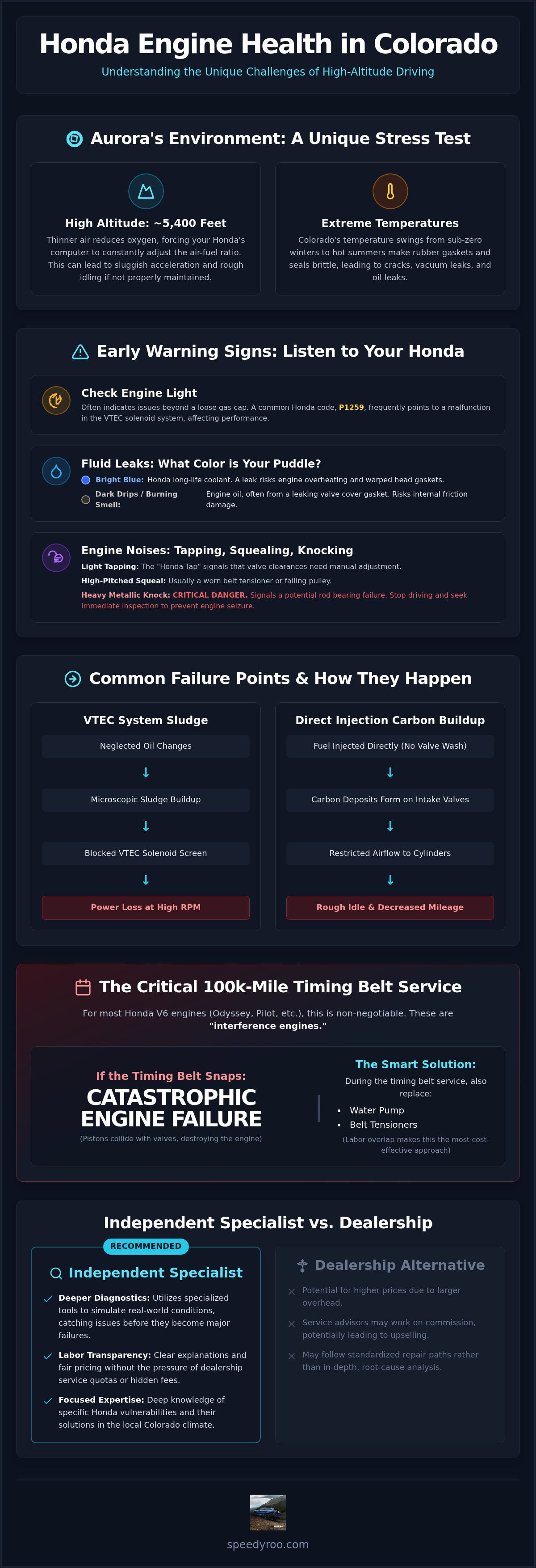
Living in Aurora means your vehicle operates at an elevation of roughly 5,400 feet. This high-altitude environment presents unique challenges for internal combustion. Thinner air reduces the available oxygen, which directly impacts engine vacuum and forces your Honda’s electronic control unit to constantly recalibrate air-fuel ratios. When these components aren’t perfectly synchronized, you’ll notice sluggish acceleration or a subtle hunting for idle. This environmental stress often makes a professional Honda engine repair Aurora necessary to ensure your vehicle is tuned for Colorado’s specific atmospheric conditions.
It’s important to distinguish between a simple sensor glitch and a mechanical failure. Older models frequently trigger “Check Engine” lights for issues like a P1259 code. This specific code often points to malfunctions within the VTEC Solenoids, which manage variable valve timing. While a sensor might fail due to age, Colorado’s sub-zero winters often cause deeper issues. Extreme cold makes rubber gaskets and seals brittle; when they crack, they allow vacuum leaks that confuse the engine’s computer and lead to poor performance or failed emissions tests.
Fluids and Leaks: What Color is Your Puddle?
Identifying a leak early can save you thousands in major repairs. Honda uses a specific blue long-life coolant; if you see a bright blue puddle, it’s a sign of a cooling system compromise. Ignoring this can lead to an overheated engine and a warped head gasket. If you smell something burning, it’s likely oil hitting the hot exhaust manifold. This is often caused by a leaking valve cover gasket, a common issue that is relatively simple to fix if caught before the oil level drops low enough to cause internal friction damage.
Unusual Noises: Tapping, Squealing, and Knocking
Listen closely to your engine during a cold Aurora morning. A light, rhythmic “tapping” is often the famous “Honda Tap,” which indicates that your valve clearances need a manual adjustment. This is a standard maintenance item that many owners overlook. Conversely, a high-pitched squeal usually points to a worn belt tensioner or a failing pulley. The most concerning sound is a heavy, rhythmic metallic knock from deep within the engine. This usually signals a rod bearing issue or serious internal wear, requiring an immediate inspection to prevent a total engine seizure on the highway.
Common Honda Engine Issues: From VTEC Solenoids to Oil Dilution
Honda engines are celebrated for their engineering, but they aren’t immune to specific mechanical patterns that emerge over time. Many owners of older Civics and Accords encounter issues with the VTEC system. This variable valve timing technology relies on precise oil pressure to function. When oil changes are neglected, microscopic sludge builds up in the screen of the solenoid. This blockage prevents the system from engaging, which results in a noticeable loss of power at higher RPMs and a persistent check engine light. If you’re experiencing these symptoms, a professional Honda engine repair Aurora specialist can quickly clean or replace the solenoid to restore your car’s performance.
Modern Honda engines face a different set of challenges, particularly with direct injection technology. In these designs, fuel is sprayed directly into the combustion chamber rather than over the intake valves. While this improves efficiency, it means the valves are no longer “washed” by fuel, leading to heavy carbon buildup. This accumulation restricts airflow, causing rough idles and decreased mileage. Adhering to specialized Maintenance for Colorado Drivers is essential to manage these modern complexities. If you notice your engine stumbling at stoplights, an expert Honda diagnostic can determine if a carbon cleaning is necessary to protect your engine’s health.
The Critical 100k-Mile Timing Belt Service
Most Honda V6 engines, like those in the Odyssey or Pilot, use a timing belt rather than a chain. These are “interference engines,” meaning the valves and pistons occupy the same space at different times. If the belt snaps, they collide, which is effectively a death sentence for the engine. During this service, it’s standard practice to replace the water pump and belt tensioners simultaneously, as the labor overlap makes it the most cost-effective time to do so. Skipping this service after 105,000 miles puts your engine at immediate risk of catastrophic internal failure that often costs more to fix than the car’s total value.
Solving the 1.5L Turbo Oil Dilution Problem
Owners of 1.5L turbocharged Hondas in Aurora face a specific issue known as oil dilution. During our cold Colorado winters, the engine may not reach operating temperature quickly enough on short trips. This allows unburnt fuel to bypass the piston rings and mix with the oil in the crankpan. Aurora’s stop and go traffic makes this worse because the engine spends more time idling in the cold. To protect your turbocharger and engine bearings, we recommend more frequent oil change intervals during the winter months. This proactive approach ensures that the lubricating properties of your oil aren’t compromised by excess fuel, keeping your Honda reliable for the long haul.
Independent Honda Specialist vs. Aurora Dealerships: Making the Right Choice
Deciding where to take your vehicle for Honda engine repair Aurora often feels like a choice between two extremes. On one hand, the dealership offers a sense of official security, but it often comes with a premium price tag and a high-pressure environment. On the other, an independent specialist like Speedy Roo Motorsports provides a more personalized, transparent approach. We focus on building long-term relationships with our neighbors, acting as a dedicated partner in your car’s longevity rather than just hitting a monthly sales quota. This community-focused model allows us to offer fair pricing without the hidden fees common in large-scale operations.
One of the most significant advantages of an independent specialist is the depth of diagnostics. While a dealer might rely on standard diagnostic trouble codes, we utilize specialized equipment to understand how your engine performs under real-world stress. For instance, our Precision Honda Engine Repair standards involve using a dynamometer to simulate high-load conditions. This allows us to see exactly how your VTEC system or turbocharger behaves when you’re actually climbing a steep Colorado grade; something a stationary scan tool simply cannot do. By testing the engine under load, we can identify intermittent issues that a dealership’s “express service” might miss.
We also offer more flexibility in part selection. While we often recommend Original Equipment Manufacturer (OEM) components for critical seals and sensors, we also know which high-quality Japanese aftermarket parts offer the same reliability at a lower cost. This balanced approach ensures you aren’t paying for a brand name when a specialized alternative meets or exceeds factory standards. It’s about providing the best value for your specific situation, whether you’re trying to get another 100,000 miles out of an older CR-V or maintaining a newer turbocharged Accord.
Tooling and Software: Can Independents Compete?
Many drivers worry that independent shops lack the high-tech tools found at a dealership. At Speedy Roo, we use the same Honda-specific diagnostic software as the factory technicians. The difference lies in our philosophy. We prioritize a “repair first” mentality. If a component can be meticulously cleaned or adjusted to meet factory tolerances, we’ll do that instead of defaulting to the dealer’s “replace everything” approach. This methodical process saves you money while maintaining the high standards of Japanese engineering.
Warranty and Peace of Mind
It’s a common misconception that using an independent shop voids your factory warranty. Thanks to the Magnuson-Moss Act, you have the legal right to choose your repair facility without risking your coverage. We stand behind every engine repair we perform, providing the same level of confidence you’d expect from a major brand. To learn more about common misconceptions, check out our guide on Japanese Import Repair in Aurora: 5 Common Myths Debunked for local owners.
Honda Engine Longevity: Maintenance for Colorado Drivers
Aurora drivers face unique environmental stresses that most vehicle manuals don’t fully address. While your Honda manual provides a maintenance schedule based on “normal” conditions, our local environment almost always falls under the “Severe Service” category. Climbing the I-70 corridor, dealing with fine road dust, and surviving 100-degree summers followed by sub-zero winters puts immense strain on every internal component. This is why standard Honda engine repair Aurora often starts with a focused conversation about preventative care rather than just reacting to a breakdown. By adjusting your maintenance habits to fit Colorado’s climate, you can significantly extend the life of your Japanese import.
High-quality synthetic oil is a non-negotiable requirement for modern Honda engines. These powerplants are built with incredibly tight tolerances, and their oil passages are microscopic. Synthetic oil maintains its protective viscosity better under the high heat of mountain driving and flows much faster during a cold start in January. Similarly, your cooling system needs more than just a simple top-off. A professional flush prevents internal corrosion and ensures that the aluminum engine blocks used by Honda don’t suffer from localized hot spots that lead to warped cylinder heads or failed gaskets. We’ve seen that consistent cooling maintenance is the single best way to avoid a catastrophic head gasket failure.
Don’t overlook the health of your air intake system. Colorado’s arid climate means there’s a higher concentration of particulate matter and road salt in the air. A clogged air filter forces your engine to work harder to “breathe,” which increases internal operating temperatures and reduces your fuel efficiency. Checking this simple part every time you’re in for service is an easy way to prevent long-term internal wear. Keeping the air-fuel mixture clean and balanced is essential for maintaining the precision performance these engines were designed to provide.
The 5-Step Longevity Checklist
- Step 1: Stick to a 5,000-mile full synthetic oil change interval to combat the oil dilution issues common in turbocharged models.
- Step 2: Perform an annual cooling system pressure test before the summer heat to catch small leaks early.
- Step 3: Schedule periodic valve adjustments for models with non-hydraulic lifters to prevent the “Honda Tap” and ensure efficient combustion.
- Step 4: Monitor your transmission fluid health; a struggling transmission increases the overall load and heat on your engine.
- Step 5: Replace your engine air filter every 15,000 miles, or more frequently if you regularly drive on unpaved roads.
Preparing Your Engine for Colorado Winters
Winter preparation goes beyond just switching to snow tires. A weak battery can cause subtle voltage drops that confuse modern engine electronics, leading to phantom “Check Engine” lights or poor fuel mapping during cold starts. Additionally, we frequently see rodent damage in Aurora engine bays during the colder months. Mice often seek the warmth of your Honda’s engine and can chew through soy-based wire insulation in a single night. A quick visual inspection of the wiring harness can prevent an expensive electrical short. If you own other Japanese vehicles, our expertise extends across brands, much like our Toyota Specialist Aurora: Guide to Expert Repair.
Ready to ensure your Honda is prepared for the next 100,000 miles of Colorado driving? Schedule your preventative maintenance inspection with our Aurora specialists today to catch small issues before they become major repairs.
Speedy Roo Motorsports: Precision Honda Engine Repair and Diagnostics
Since 2002, Speedy Roo Motorsports has served the Aurora and Denver community with a singular focus on Japanese imports. We’ve spent over two decades mastering the nuances of these vehicles, moving beyond general repair to offer true specialized care. Whether you’re driving a classic high-mileage Civic or a modern turbocharged Accord, our facility is equipped to handle the most complex Honda engine repair Aurora has to offer. We aren’t a high-volume generalist shop. We’re a dedicated team of technicians who treat every vehicle with the meticulous precision required by Japanese engineering.
Our expertise covers the full spectrum of automotive needs. We support everything from the routine maintenance that keeps your daily commuter reliable to the high-stakes performance builds that require our specialized dyno tuning. This specialized focus on brands like Honda, Subaru, and Toyota allows us to stock the right tools and maintain a deep knowledge of common failure points before they become catastrophic. We take pride in being the specialists who understand the “why” behind every mechanical issue. This ensures that our solutions are both effective and permanent, giving you the confidence that your car is in the right hands.
The Speedy Roo Process: From Diagnosis to Delivery
We believe in total transparency throughout the repair process. Our digital inspections allow us to share photos and videos of exactly what we see under your hood, so you’re never left guessing about the state of your engine. We skip the confusing technical jargon in favor of clear, honest explanations that empower you to make informed decisions. Every repair is followed by a methodical testing phase. We perform final checks to ensure your Honda is fully prepared for the demanding I-70 climb into the mountains or your daily commute across the Front Range.
Your Local Alternative to the Big Dealers
Aurora residents trust us because we provide the technical depth of a dealership with the personal touch of a local neighbor. We understand that your car is an essential part of your life, and we’re committed to keeping it on the road for as long as possible. Our methodical approach makes us the premier choice for Honda engine repair Aurora. If you have other Japanese vehicles in your driveway, you can rely on the same level of care for them too, including our Subaru Repair in Aurora: Specialist Care. When you’re ready for a better repair experience, schedule your Honda engine inspection at Speedy Roo today!
Securing Your Honda’s Future on Colorado Roads
Your Honda is engineered for exceptional durability, but the unique demands of our high-altitude environment require a proactive and informed approach to maintenance. We’ve explored how identifying early warning signs like the “Honda Tap” and adjusting for Colorado’s “Severe Service” conditions can prevent minor issues from becoming catastrophic failures. Choosing an independent specialist ensures you receive the benefits of advanced diagnostics, including on-site dyno tuning and transparent digital inspections, without the high-pressure atmosphere of a large dealership.
When you’re ready for precision Honda engine repair Aurora, you deserve a partner who’s genuinely invested in your car’s long-term health. Since 2002, our facility has provided a highly-rated independent alternative for Japanese import owners who value honesty and technical mastery. We’re here to help you navigate everything from routine timing belt services to complex turbocharger diagnostics with total confidence. Schedule Your Honda Engine Diagnostic at Speedy Roo Motorsports today to receive a clear, jargon-free assessment of your vehicle. Let’s work together to keep your Honda reliable for many more miles across the Front Range.
Frequently Asked Questions
How much does a Honda timing belt replacement cost in Aurora?
The total cost for a timing belt service depends on your specific model and whether you replace the water pump and tensioners at the same time. While we don’t provide flat quotes without seeing the vehicle, independent specialists generally offer more competitive labor rates than local dealerships. Investing in this preventative service is significantly more affordable than repairing the catastrophic internal damage caused by a snapped belt.
Why is my Honda check engine light flashing?
A flashing check engine light indicates a severe engine misfire that requires you to stop driving immediately to prevent permanent damage. This condition often means unburnt fuel is entering the exhaust system, which can quickly overheat and destroy your catalytic converter. Common causes include failed ignition coils or fouled spark plugs, both of which require professional diagnostic equipment to identify correctly.
Is an independent Honda mechanic better than the dealership?
An independent specialist provides a more personalized experience and often possesses deeper diagnostic expertise for high-mileage Japanese imports. Choosing a specialist for Honda engine repair Aurora allows for a “repair first” philosophy rather than the “replace everything” approach common at big dealerships. You’ll benefit from transparent pricing, direct communication with your technician, and a focus on long-term vehicle health.
Does my Honda engine have a timing belt or a chain?
Most Honda V6 engines found in the Odyssey, Pilot, and Ridgeline use a timing belt that requires replacement every 105,000 miles. Conversely, most modern four-cylinder Hondas, such as the newer Civic and CR-V models, utilize a timing chain designed to last the life of the engine. It’s best to have a technician verify your specific engine code to ensure you don’t miss a critical service interval.
What are the signs of a failing head gasket on a Honda Civic?
The most common indicators of a failing head gasket include persistent engine overheating, white smoke from the tailpipe, or a noticeable loss of blue coolant without an external leak. You might also notice a “milky” appearance to your engine oil or bubbles in the radiator overflow tank. If you experience these symptoms, an immediate pressure test is necessary to confirm the integrity of the engine block.
Can high altitude in Colorado cause engine misfires in my Honda?
High altitude reduces air density, which can exacerbate existing issues like small vacuum leaks or worn ignition components. While modern engine computers attempt to compensate for the thinner air in Aurora, the environmental stress can lead to a lean or rich fuel mixture. A professional diagnostic can determine if your misfire is a simple altitude-related tuning issue or a more significant mechanical failure.
How often should I change the oil in my Honda CR-V?
We recommend a 5,000-mile oil change interval using high-quality full synthetic oil to combat the “Severe Service” conditions found in Colorado. While the onboard maintenance minder may suggest a longer interval, Aurora’s extreme temperature swings and dusty roads put extra strain on your lubricant. Regular changes are the most effective way to prevent oil dilution and protect the tight tolerances of your engine.
What is Honda VTEC and why does it need specialized repair?
VTEC is a sophisticated variable valve timing system that optimizes engine performance and fuel efficiency across different RPM ranges. Because this system relies on precise oil pressure to engage, it’s highly sensitive to oil sludge and microscopic debris. Specialized repair is necessary because diagnosing VTEC malfunctions requires specific software to test the solenoids and oil pressure switches that manage the system’s engagement.