
What if that sudden hesitation or shuddering in your Altima isn’t a sign that your car is headed for the scrap heap? When you start searching for Nissan transmission repair Aurora, it’s usually because you’ve noticed inconsistent performance while navigating Colorado’s steep mountain passes. It’s a stressful situation, especially given the well-documented history of Nissan CVT issues. Many local drivers feel a sense of dread when their vehicle begins to jerk or slip, assuming a massive bill is the only way forward.
We understand the fear of being told you need a brand new transmission when a targeted repair might solve the problem. You deserve to know exactly what’s happening under the hood without the pressure of an unnecessary upsell. This article explains why these systems act up and how a specialized, honest diagnostic process can often save you from the high cost of a full replacement. We will preview common CVT and automatic faults, the vital role of fluid management in our high-altitude climate, and how a transparent repair plan can help your Nissan stay reliable for years to come.
Key Takeaways
- Identify the specific symptoms of CVT trouble, like the “shudder” effect or whining noises, to catch problems before they lead to a total breakdown.
- Understand why specialized Nissan transmission repair Aurora is essential for accurately diagnosing complex belt-and-pulley systems that generic shops often miss.
- Learn how targeted component repairs, such as solenoid replacements, can often save your transmission and protect your budget from the cost of a full replacement.
- Discover the ideal fluid maintenance intervals for Colorado’s demanding high-altitude driving to extend the life of your Nissan’s transmission.
- Find out how an “Expert Neighbor” approach ensures you receive honest advice and transparent pricing from a local specialist who understands Japanese imports.
Common Signs You Need Nissan Transmission Repair in Aurora
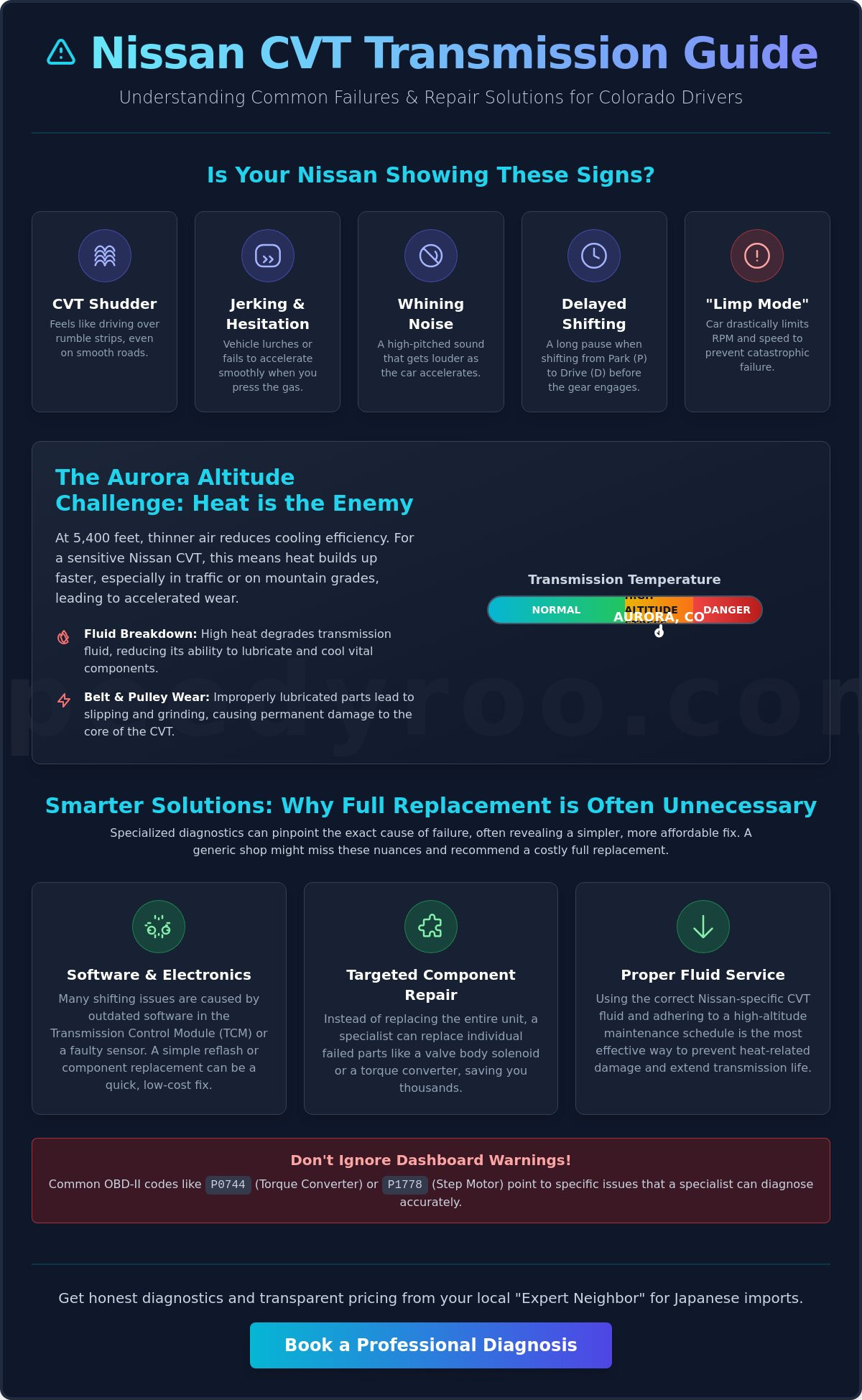
Recognizing the signs of transmission trouble early can be the difference between a minor adjustment and a major overhaul. For many Nissan owners, the first red flag is the infamous “CVT shudder.” This sensation feels like you’re driving over rumble strips even on a smooth road. It’s often most noticeable during light acceleration or when maintaining a steady speed. If your vehicle jerks or hesitates when you press the gas, it’s time to seek a professional opinion on Nissan transmission repair Aurora to prevent further internal damage.
Another common symptom is a high-pitched whining noise that gets louder as you accelerate. This sound usually indicates that the transmission fluid is overheating or becoming aerated, which means air bubbles are forming in the oil. Because the Continuously Variable Transmission (CVT) relies on consistent hydraulic pressure to manage its belt-and-pulley system, compromised fluid can lead to serious internal wear. You might also notice a delay when shifting from Park to Drive. If you’re waiting several seconds for the gear to engage, the internal seals or solenoids are likely struggling to hold pressure.
If the onboard computer detects a critical temperature or pressure issue, it may trigger “Limp Mode.” This safety feature drastically limits your engine’s RPM and speed to prevent catastrophic internal damage. While it’s frustrating to experience this on the highway, it’s actually a protective measure designed to save your transmission from a total meltdown. It’s the car’s way of telling you that something requires immediate professional attention before you continue driving.
The Impact of Aurora’s Elevation on Transmission Heat
Aurora sits at an elevation of roughly 5,400 feet. The thinner air at this altitude makes it much harder for your vehicle’s cooling system to dissipate heat effectively. When you’re stuck in stop-and-go traffic on I-225 or climbing steep mountain grades toward the Rockies, your transmission temperature can spike quickly. Excessive heat is the primary enemy of Nissan transmissions. It leads to premature belt slippage and fluid breakdown that wouldn’t occur as frequently at sea level. Local drivers must be especially vigilant about cooling efficiency to maintain vehicle longevity.
Warning Lights and Error Codes to Watch For
Don’t ignore the lights on your dashboard. While a Check Engine Light (CEL) can mean many things, a dedicated transmission warning light is a direct call to action. We often see specific OBD-II codes like P0744, which relates to the torque converter clutch circuit, or P1778, which indicates a problem with the step motor function. When these codes appear, getting a specialized Nissan transmission repair Aurora diagnostic is the best way to avoid unnecessary parts replacement. A warning light doesn’t always signal a total mechanical failure; sometimes, it’s simply an electronic sensor that needs expert calibration.
The Nissan CVT: Why Specialized Expertise is Required
Nissan’s approach to engineering is unique, particularly in how they’ve integrated the belt-and-pulley system into the majority of their modern lineup. Unlike traditional automatics that rely on a set of planetary gears to change speeds, a What is a CVT explanation focuses on two pulleys connected by a high-strength steel belt. This allows for an infinite number of gear ratios, providing a smoother ride and better gas mileage. However, this mechanical simplicity makes the unit incredibly dependent on hydraulic pressure and specific fluid chemistry to function correctly.
When seeking Nissan transmission repair Aurora, it’s vital to choose a team that understands these nuances. Many shifting complaints aren’t caused by mechanical failure at all, but by outdated software in the Transmission Control Module (TCM). A simple TCU reflash or software update can recalibrate how the pulleys interact, often solving hesitation issues instantly. We prioritize these electronic checks and software diagnostics before ever suggesting a physical teardown of the unit.
Continuously Variable Transmission (CVT) vs. Traditional Automatics
Nissan’s partnership with JATCO has spanned decades, refining the CVT to maximize fuel economy across their fleet. While these units are excellent for highway cruising, they are significantly more sensitive to heat and fluid breakdown than older 4-speed automatics. Traditional gears can often tolerate slightly degraded oil for a short time, but a CVT requires pristine lubrication to prevent the steel belt from scarring the pulleys. This high level of sensitivity is why specialized knowledge is a requirement for longevity, not just a luxury.
The Problem with “One-Size-Fits-All” Repair Shops
A major risk at generic repair centers is the use of “Universal” transmission fluid. These multi-purpose oils lack the specific friction modifiers found in genuine Nissan NS-3 fluid. Using the wrong oil can cause the belt to slip, leading to permanent internal damage that a simple fluid exchange won’t fix. Accurate diagnosis also requires tools capable of reading Nissan-specific data streams. We monitor pulley pressure and step motor position in real-time to identify if a single solenoid is the culprit. If you want an accurate assessment of your car’s health, scheduling a specialized inspection is the most reliable way to avoid being upsold a replacement you don’t actually need.
Diagnostic vs. Replacement: Finding the Right Solution
When your vehicle begins to struggle, the most important step isn’t the repair itself, but the diagnostic process that precedes it. We believe in a methodical approach to Nissan transmission repair Aurora that prioritizes accuracy over speed. Our multi-point inspection begins with a specialized road test to observe how the transmission behaves under real-world load, especially during the stop-and-go conditions typical of the Denver metro area. We then perform a comprehensive electronic scan to pull proprietary Nissan data streams, followed by a physical fluid analysis. This “blood test” for your car reveals whether the issues are caused by simple contamination or more serious internal wear.
It’s a common misconception that a shifting issue always requires a new transmission. In many cases, a faulty solenoid is the true culprit. Solenoids act as the gatekeepers for hydraulic fluid; if one becomes clogged or fails electronically, the transmission can’t change ratios correctly. Replacing a single solenoid or a valve body is a targeted fix that can save you thousands compared to a full replacement. We take pride in being the “Honest Specialist” who identifies these specific faults rather than recommending a blanket replacement for every problem.
Minor Repairs That Fix Major Symptoms
Often, what feels like a total mechanical failure is actually a peripheral issue. A clogged transmission oil cooler can lead to the overheating and whining noises mentioned earlier. By simply cleaning or replacing the cooler, we can restore proper operating temperatures. Similarly, faulty speed sensors can send incorrect data to the computer, triggering a “Limp Mode” response. Fixing these sensors or addressing external fluid leaks that cause low pressure can often return your Nissan to peak performance without the need for internal work.
When Replacement is the Most Honest Advice
There are times when a replacement is the only responsible recommendation for long-term reliability. During our fluid analysis, if we find “glitter” or significant metal debris in the pan, it’s a clear sign that the internal belt or pulleys have suffered catastrophic damage. For high-mileage CVTs, a factory-remanufactured unit is often a better investment than a local rebuild. These units come with updated internal components that address original design flaws and usually include a robust warranty. We’ll always provide a transparent comparison of these options so you can make the best decision for your vehicle’s future.
Nissan Transmission Maintenance for Colorado Drivers
The concept of “Lifetime Fluid” is one of the most persistent and dangerous myths in the automotive industry. While some manufacturers claim their transmission fluid never needs changing, this rarely holds up under the “Severe Service” conditions we experience in Colorado. Between the high altitude of the Denver metro area and the constant temperature swings, your transmission fluid works much harder here than it would at sea level. Over time, heat causes the protective additives in the oil to break down, which leads to friction and premature wear on the internal belt and pulleys. Proactive maintenance is the most effective way to avoid an unexpected Nissan transmission repair Aurora service later in your vehicle’s life.
When it comes to refreshing your fluid, the method matters just as much as the timing. We often see generic shops offer high-pressure flushes, which can be risky for a Nissan CVT. These machines can force debris into the delicate passages of the valve body, potentially causing more harm than good. Instead, we perform a specialized fluid exchange, often referred to as a drain-and-fill. This process safely removes the old, oxidized fluid and replaces it with fresh, high-quality lubricant without the risk of dislodging internal contaminants. Keeping your cooling system healthy is also vital; a radiator that’s struggling to cool the engine won’t be able to properly regulate the transmission temperature either.
The 30,000-Mile Rule for CVTs
While some owners’ manuals suggest long intervals for fluid service, our experience with Colorado’s terrain leads us to recommend a 30,000-mile rule for Nissan CVTs. The thin air and steep mountain grades generate significant internal heat, which is the primary cause of fluid degradation. By refreshing the fluid every 30,000 miles, you ensure the hydraulic system maintains the precise pressure needed to prevent belt slippage. The long-term ROI of this preventative care is substantial, as the cost of a few fluid exchanges is a fraction of the price of a total unit replacement.
Protecting Your AWD System in Aurora
For owners of the Rogue, Murano, or Pathfinder, transmission health is closely linked to the performance of your All-Wheel Drive system. Neglecting your transfer case or rear differential service can put unnecessary strain on the transmission’s output shaft. It’s also critical to maintain consistent tire tread depth across all four wheels. Mismatched tires change the rotational speed of the axles, which forces the transmission and AWD system to work against each other. You can learn more about these interconnected components in our AWD system maintenance Aurora guide. If you haven’t had your fluid levels checked recently, contact our team today to schedule a comprehensive maintenance inspection.
The Speedy Roo Approach to Nissan Transmission Service
Choosing the right shop for Nissan transmission repair Aurora comes down to finding a team that respects both your time and your vehicle’s engineering. With over 20 years of experience specializing in Japanese imports, we’ve seen the evolution of Nissan’s drivetrain technology firsthand. We don’t just treat your car as another ticket in the queue. Instead, we apply a methodical approach that combines deep technical knowledge with an “Expert Neighbor” philosophy. This means we focus on building long term trust by only recommending the repairs your vehicle actually needs to remain safe and reliable on Colorado roads.
Our facility is equipped with advanced diagnostic tools specifically calibrated to read the proprietary data streams used by Nissan and Infiniti vehicles. While generic scanners might provide a vague error code, our systems allow us to monitor pulley pressure, step motor function, and solenoid response in real time. This precision prevents the common industry practice of replacing an entire transmission when a single electronic component is the culprit. We look at the total health of your vehicle, ensuring the engine and cooling systems are supporting the transmission’s longevity rather than working against it.
Why Aurora Drivers Trust Our Specialist Mechanics
Living in Aurora means your car faces unique challenges, from the thin mountain air to the sudden temperature drops of the Front Range. We provide transparent, no-pressure recommendations that account for these local driving needs. Our mastery of Japanese engineering isn’t limited to one brand; our highly rated expertise in Subaru repair Aurora CO serves as proof of our dedication to complex All-Wheel Drive and CVT systems. We understand that a clear explanation of the “why” behind a repair is just as important as the repair itself.
Schedule Your Nissan Transmission Diagnostic Today
When you visit us for your first appointment, you can expect a comprehensive evaluation that includes a specialized road test and a detailed fluid analysis. We’ll walk you through our findings and create a repair plan that fits your goals for the vehicle. Our location is situated to conveniently serve drivers across Aurora, Denver, and Centennial who are looking for a higher standard of care. Don’t wait for a minor hesitation to become a major breakdown. Schedule your Nissan service with Speedy Roo Motorsports & Repair Inc today and experience the difference that specialized, honest expertise makes for your peace of mind.
Protect Your Nissan’s Performance on Colorado Roads
Navigating the unique demands of the Front Range requires a vehicle that’s both responsive and reliable. Early detection of symptoms like the “CVT shudder” or unusual whining is the first step toward avoiding a complete breakdown. By choosing a specialist for your Nissan transmission repair Aurora, you ensure your car receives a precise diagnostic rather than a generic estimate. We focus on identifying specific component faults, such as solenoid failures or software needs, which often provides a much more affordable path than a full replacement.
Since 2002, we’ve specialized in Japanese imports, offering a sophisticated independent alternative to high dealership prices. We combine technical precision with a transparent, neighborly approach to ensure you feel confident in every repair decision. Whether you’re dealing with a modern CVT or a traditional automatic, our expert diagnostics are designed to keep you moving safely through every mountain pass. Your vehicle is a vital part of your daily life; let’s work together to keep it running at its best for years to come.
Book Your Expert Nissan Transmission Diagnostic at Speedy Roo and get the honest answers you deserve.
Frequently Asked Questions
How much does a Nissan CVT transmission repair cost in Aurora?
The total cost depends entirely on whether the unit requires a simple component fix or a full replacement. According to industry data from 2024 to 2026, a complete CVT replacement can range between $3,500 and $8,000 depending on the model and labor requirements. However, many issues we see are solved through targeted repairs like solenoid replacements or fluid exchanges, which are significantly more affordable than a total overhaul. An accurate diagnostic is the only way to get a clear picture of your specific needs.
Why is my Nissan Rogue transmission shuddering at low speeds?
This sensation is commonly known as the “CVT shudder” and typically occurs when the internal steel belt slips against the pulleys. In many Rogue models, this happens during light acceleration or when the transmission fluid has degraded and can no longer provide the necessary hydraulic pressure. It’s a sign that the system is struggling to maintain the correct gear ratio. Catching this early can often prevent the internal components from suffering permanent mechanical scarring.
Can a Nissan transmission be fixed without replacing the whole thing?
Yes, many common shifting issues are caused by electronic sensors, solenoids, or software glitches rather than a total mechanical failure. For instance, replacing a faulty valve body or reflashing the Transmission Control Module (TCM) can often restore smooth performance. We prioritize these targeted repairs whenever possible. Our goal is to identify the specific fault so you don’t spend thousands on a new unit when a smaller, specialized fix will solve the problem effectively.
How often should I change the transmission fluid in my Nissan?
We recommend a professional fluid exchange every 30,000 miles to ensure long term reliability in Colorado’s demanding climate. While some factory manuals suggest longer intervals, the thin air and steep grades in the Denver metro area create “Severe Service” conditions that break down additives faster. Regular maintenance is the most effective way to avoid the need for major Nissan transmission repair Aurora services. Keeping the fluid fresh prevents the heat related damage that leads to belt slippage.
What is Nissan CVT “Limp Mode” and is it dangerous?
Limp Mode is a protective software state that the vehicle enters when the computer detects a critical issue like overheating or a pressure drop. It isn’t dangerous to the driver, but it does drastically reduce engine power and speed to prevent the transmission from destroying itself. If your car enters this mode, it’s a clear signal to stop driving and seek a professional diagnostic. It’s the vehicle’s way of saving the internal hardware from catastrophic failure.
Does Nissan still have transmission problems in 2026?
While newer Nissan models have benefited from significant engineering updates and improved cooling systems, CVTs remain more sensitive than traditional automatic transmissions. Proper maintenance is still the deciding factor for longevity in 2026. Even with the latest designs, the high altitude and temperature swings in Aurora put extra stress on the hydraulic system. Staying proactive with fluid health is the best strategy for any Nissan owner, regardless of the vehicle’s age.
Is it worth fixing a transmission on a high-mileage Nissan Altima?
The decision usually depends on the overall health of the vehicle and whether the fault is a minor electronic issue or a major mechanical failure. If the Altima is in good condition otherwise, replacing a sensor or a valve body is a smart investment that can add years to the car’s life. We provide an honest, transparent assessment of the repair versus the car’s value. This ensures you have all the facts before deciding on a Nissan transmission repair Aurora plan.
Does cold Colorado weather affect Nissan transmissions?
Extreme cold can definitely impact how your transmission feels during the first few miles of driving. Cold fluid is thicker and moves more slowly through the valve body, which can lead to sluggish shifting or a slight delay when you move the gear selector. It’s helpful to let your car warm up for a few minutes during Aurora’s winter months. This allows the fluid to reach an ideal viscosity, ensuring the pulleys and belt are properly lubricated before you reach highway speeds.