
More expensive oil isn’t automatically the right choice for an older vehicle. For high mileage vehicle service in Parker, start with the oil grade and type specified in the owner’s manual. Conventional, blended, and synthetic oils can all support reliable operation when they meet the vehicle’s requirements.
It’s reasonable to want dependable care as your vehicle accumulates miles, especially when considering whether a different oil could help protect the engine. The right choice depends on the engine’s specifications, its condition, and how you use the vehicle, not mileage alone.
This guide explains the differences among the three oil options, why consistent maintenance matters, and how to follow the service schedule in your owner’s manual. It also covers what a high-mileage service can include and how an inspection can identify maintenance needs before they grow into larger concerns.
Key Takeaways
- Choose conventional, blended, or synthetic oil based on the vehicle’s requirements and condition, rather than mileage alone.
- Use the owner’s manual to find the recommended oil-change interval; modern engines generally have intervals longer than 3,000 miles.
- Plan filter replacement around the recommended 15K-30K-mile interval and spark plug replacement around 100K miles, adjusting to the vehicle’s maintenance schedule.
- For a vehicle with over 150,000 miles, prioritize an inspection that considers its condition and maintenance history, not just its odometer reading.
Maintenance benefits for vehicle reliability and lifespan
High-mileage vehicle service in Parker is most useful when it takes the owner’s manual and the vehicle’s condition into account. A complete service record helps connect current symptoms with past repairs and guide the next maintenance decision.
Repair or Replace Decisions
Repairing a high-mileage car can make sense when its overall condition and maintenance history support continued use. Weigh the repair against other known issues and the vehicle’s role in your daily routine. For high-mileage vehicle service in Parker, bring service records and describe any recent changes. This helps keep decisions grounded in the car’s actual condition, not just its odometer reading.
Recommended Maintenance Services
Review fluid condition, filters, belts, hoses, brakes, tires, steering, and suspension alongside the owner’s manual. Service records can show which components were inspected or replaced and when. For example, a recent brake repair may make steering feel or tire wear worth discussing. Review each finding on its own so routine upkeep doesn’t distract from a new symptom or unresolved concern.
Service Intervals Over 100,000 Miles
Use the owner’s manual to plan recurring service, then compare its schedule with dated maintenance records. If a record is missing, identify the item and review its condition and history before deciding what to do. After each visit, note the next scheduled task. This makes it easier to distinguish routine maintenance from repairs prompted by a new concern.
Common Problems and Warning Signs
High-mileage vehicles may develop leaks, harder starting, changes in exhaust, or unusual vibration. Note when a symptom occurs, such as vibration only during acceleration, and whether it has changed. Check for dashboard warning lights and pay attention to new patterns in how the vehicle behaves. Clear notes help focus an inspection on the affected system.
What maintenance services are recommended for a high-mileage vehicle?
Prioritize maintenance by reviewing the owner’s manual, service records, and current symptoms. Mileage alone doesn’t show which parts need replacement. For example, a record of recent transmission service can help avoid treating it as overdue without first checking the schedule.
Look beyond routine engine care to systems that affect power delivery, starting, handling, and comfort. A careful inspection can identify wear and help distinguish repairs needed now from items to monitor.
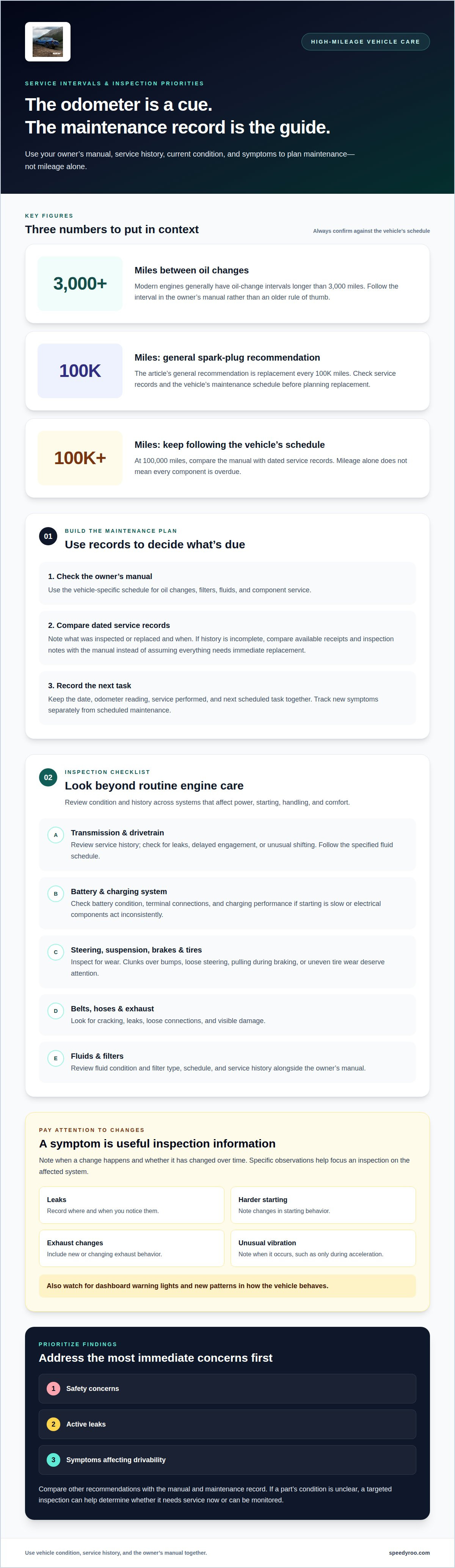
- Transmission and drivetrain: Review service history and inspect for leaks, delayed engagement, or unusual shifting. Follow the vehicle’s specified fluid schedule.
- Battery and charging system: Check battery condition, terminal connections, and charging performance if starting becomes slow or electrical components behave inconsistently.
- Steering and suspension: Inspect shocks, struts, joints, and bushings for wear. Clunks over bumps, uneven tire wear, or loose steering deserve attention.
- Brakes and tires: Check brake components and tire condition together. Pulling during braking or uneven tread wear can point to issues that need diagnosis.
- Belts, hoses, and exhaust: Look for cracking, leaks, loose connections, and visible damage. These checks can uncover deterioration before it disrupts normal operation.
Use inspection findings to build a prioritized plan. Address safety concerns, active leaks, and symptoms affecting drivability first. Then compare other recommendations with the maintenance record and owner’s manual. If a part’s condition is unclear, a targeted inspection can help determine whether it needs service now or can be monitored. This avoids replacing components just because the odometer has passed a milestone.
Keep a dated record of each inspection, repair, and fluid service. Include the symptom, the work completed, and any follow-up recommendation. That record gives future maintenance decisions a practical basis. For a clearer plan, organize the service history before arranging vehicle maintenance planning.
What service intervals are recommended for vehicles with over 100,000 miles?
At 100,000 miles, keep using the maintenance schedule designed for the specific vehicle. The owner’s manual is the reference for oil changes and component service. Mileage alone doesn’t establish that every part is overdue. Compare the manual with service records, then note the next scheduled task and any symptoms that need attention sooner.
Modern vehicle engines generally have oil-change intervals longer than 3,000 miles. The correct interval depends on the vehicle’s manual, so don’t default to an older rule of thumb. Record each oil change and odometer reading. That gives you a clear starting point when planning the next service or reviewing incomplete records.
- Engine oil: Follow the oil-change interval in the owner’s manual; modern engines generally exceed 3,000 miles between changes.
- Filters: Replacement timing varies by vehicle and filter type, so check the maintenance schedule and service records. Compare the filter type and schedule with the manual.
- Spark plugs: The general recommendation is replacement every 100K miles. Check service records before scheduling replacement.
Keep a simple maintenance log with the date, odometer reading, service performed, and next scheduled task. If the records show when a filter was replaced, use the manual to determine when it is next due. If the history is incomplete, compare available receipts and inspection notes with the manual instead of assuming every item needs immediate replacement.
Keep scheduled maintenance and new symptoms in separate notes. A scheduled spark plug service and a sudden rough idle call for different attention. Record when a symptom began and whether it changes while driving. Bring those details with the maintenance log so the service review can distinguish routine work from diagnosis.
For a vehicle over 100,000 miles, a useful plan is specific to its make, model, manual, and documented service history. Revisit the schedule after each completed service, update the odometer reading, and carry forward only the next due items. This turns maintenance into a record-based routine, rather than a blanket list based only on mileage.
What inspections should be done on a car with over 150,000 miles?
At 150,000 miles, an inspection should assess condition, not just mileage. Start with the vehicle’s service records and the owner’s manual, then note warning lights, noises, leaks, or changes in handling. A written account of symptoms, such as a vibration during braking, helps focus the inspection on what the driver has noticed.
Review major systems in a consistent order. A technician can inspect visible wear, check how components operate, and relate findings to the vehicle’s maintenance history.
- Engine bay: Look for fluid leaks, damaged hoses, worn belts, and signs of overheating. Check fluid levels and condition against the vehicle’s requirements.
- Brakes and tires: Inspect brake components, tire wear, and steering response. Pulling, vibration, or uneven tread can help identify areas needing closer diagnosis.
- Suspension and steering: Check for loose or worn components. Note clunks over bumps, wandering, or a change in steering feel during a road test.
- Battery and electrical system: Check connections and charging operation if the engine starts slowly or electrical features behave inconsistently.
- Diagnostic scan: Read stored fault codes when warning lights or drivability concerns appear. Interpret codes alongside symptoms and inspection findings.
Ask for findings to be grouped by urgency: concerns affecting safe operation, active faults, and items to monitor. A visible leak and a minor cosmetic concern, for example, shouldn’t be treated as equal priorities. Compare recommendations with past repair records to catch recurring symptoms or avoid duplicating recent work.
If you’re considering a high-mileage vehicle before purchase, a pre-sale vehicle inspection can help assess its condition before you decide. Bring the service records and a list of concerns, such as a warning light or unusual noise, so the inspection has a clear starting point.
The world record for the highest vehicle mileage is 3,039,122 miles, but that exceptional figure is not a useful maintenance target for an individual car. For a vehicle over 150,000 miles, use the inspection to establish what is working now, what needs attention, and what should be monitored. A thorough report, considered alongside service history and symptoms, gives a clearer basis for deciding whether recommended repairs are urgent and whether the car suits your needs.
Speedy Roo Motorsports & Repair: Subaru Repair and Service
Speedy Roo Motorsports & Repair Inc. provides Subaru Repair and Service, including maintenance and repairs informed by your vehicle’s condition and service history. Bring the owner’s manual, maintenance records, and a clear description of warning lights, noises, or changes in how the car drives. These details help focus the conversation on the vehicle’s needs rather than mileage alone.
The shop also offers Toyota Repair and Service, Honda Repair and Service, and Nissan Service and Repair. If your high-mileage vehicle needs attention, contact Speedy Roo Motorsports & Repair Inc. to discuss its maintenance or repair needs, or visit speedyroo.com.
Make Your Next Maintenance Decision With Confidence
Turn what you’ve noticed into a clear conversation about your vehicle’s condition. Bring its service records and describe changes in starting, handling, or engine performance. This gives the inspection a practical starting point and helps connect your concerns with work already completed.
For high mileage vehicle service in Parker, Speedy Roo Motorsports & Repair Inc provides Subaru Repair and Service, Toyota Repair and Service, and Honda Repair and Service. If you’re in Parker, Aurora, Denver, Centennial, or Lone Tree, choose a shop familiar with your vehicle’s make when you’re ready to address a developing concern or plan maintenance.
Keep your records together and share your priorities openly. Contact Speedy Roo Motorsports & Repair Inc to discuss service for your vehicle. A considered plan can help you make the next decision with greater clarity and keep moving forward with confidence.
Frequently Asked Questions
How can I find reliable high-mileage vehicle service near Parker, Colorado?
Choose a shop familiar with your vehicle’s make, maintenance history, and inspection needs. For high-mileage service near Parker, Speedy Roo Motorsports & Repair Inc serves local drivers from Aurora, including Parker, Denver, Centennial, and Lone Tree, and specializes in Japanese vehicles. Bring your owner’s manual and notes about any symptoms to help focus the appointment. Contact the shop at (303) 400-0625 or visit 18355 E. Girard Ave. Unit B, Aurora, CO 80013.
Should high-mileage vehicles use high-mileage motor oil?
Not necessarily. Choose oil based on the owner’s manual and the engine’s condition. Conventional, blended, or synthetic oil can work if it meets the vehicle’s requirements.