
A 90,000-mile service isn’t one identical checklist for every Honda. For Honda 90k maintenance in Lone Tree, inspections and fluid checks should be matched to the specific model, year, and maintenance history rather than assumed from mileage alone.
It’s reasonable to want a clear picture of what the visit covers before booking. The right checks help assess the car’s condition and identify maintenance needs without treating every Honda the same.
This guide explains what a 90,000-mile service may involve, which vehicle details shape the inspection and fluid checks, and where to find Honda service near Lone Tree. You’ll also learn what information to have ready so the service visit can be focused on your car’s needs.
Key Takeaways
- Learn how to identify the service center serving the Lone Tree area and what details to have ready when arranging a visit.
- Understand how a 90,000-mile inspection reviews key vehicle systems and checks fluid condition.
- See why the maintenance schedule depends on your Honda’s model, year, and service history.
- Find out what determines whether timing belt replacement belongs in your Honda’s maintenance plan.
Service center location and contact information
For Honda 90,000-mile maintenance near Lone Tree, the service center location to note is Aurora, Colorado. Lone Tree and Aurora are separate places, so plan the drive using the exact address shown by the service center before setting out. This helps you estimate travel time, choose a route, and avoid arriving at the wrong location. Keep the address with your appointment details for easy reference.
Service duration depends on the Honda’s model, the scheduled work, and inspection findings. An appointment is the practical way to reserve a service time; the work may take longer if inspection results call for additional repairs. When arranging Honda 90k maintenance in Lone Tree, have your model year, mileage, and service records ready. These details help describe the vehicle and clarify what work has already been completed.
To arrange service at Speedy Roo Motorsports & Repair Inc., share your Honda’s model and year, odometer reading, and any warning lights or symptoms. Mention whether you have maintenance records, especially if previous fluid changes or major services affect the vehicle’s history. Ask how to prepare for drop-off and how the shop will provide updates during the visit.
- Before arranging service: Gather the Honda’s model year, mileage, and maintenance records.
- When contacting the center: Describe warning lights, unusual noises, or changes in vehicle performance.
- Before driving to Aurora: Save the service address and appointment details together.
- At drop-off: Share your records and clarify which concerns you want inspected.
These steps make it easier to discuss the 90,000-mile visit clearly and keep the service focused on your Honda’s needs. A specific appointment time also helps you plan travel between Lone Tree and Aurora.
Inspections and fluid checks
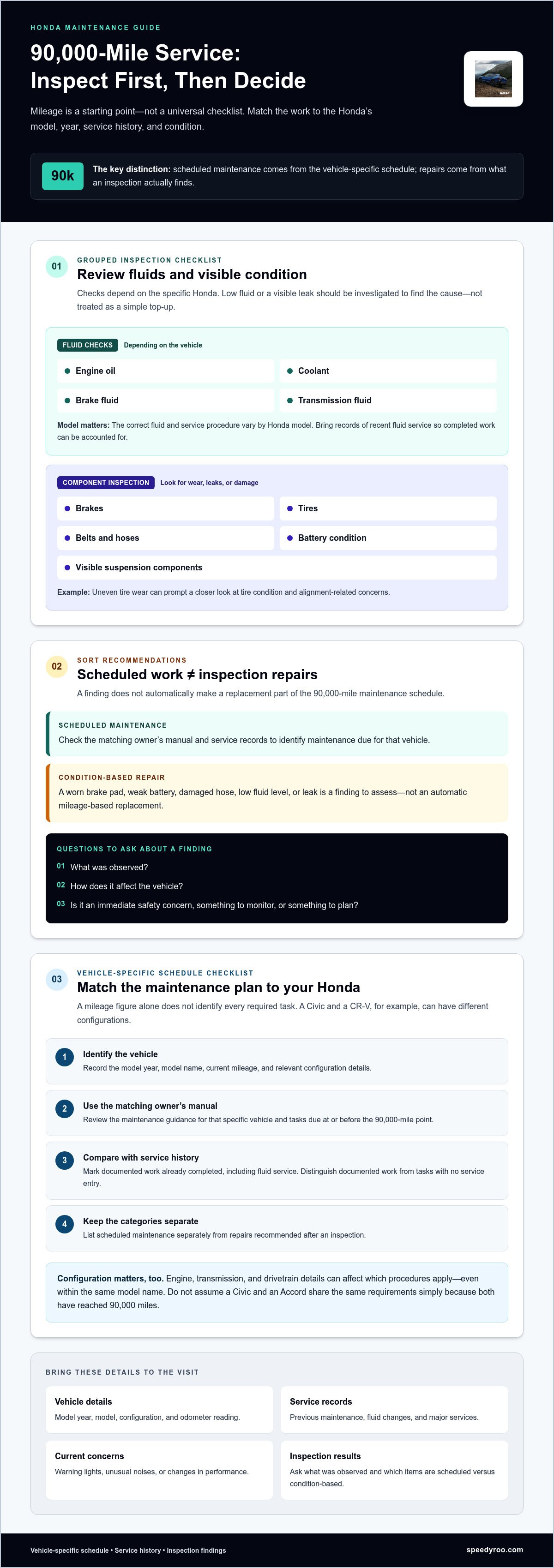
A 90,000-mile visit should distinguish scheduled maintenance from repairs prompted by inspection findings. The exact work depends on the Honda’s model, year, service history, and condition. A technician can review fluid levels and visible condition, then assess components for wear, leaks, or damage. The inspection helps identify concerns; it doesn’t make every possible replacement part of the same mileage-based service.
Fluid checks can include engine oil, coolant, brake fluid, and transmission fluid, depending on the vehicle. The correct fluid and service procedure vary by Honda model. A low level or visible leak calls for investigation, not simply topping up without finding the cause. Bring records of recent fluid service so completed work can be distinguished from items needing attention.
Inspections may also examine brakes, tires, belts, hoses, battery condition, and visible suspension components. For example, uneven tire wear can prompt a closer look at tire condition and alignment-related concerns. Worn brake pads, a weak battery, or a damaged hose are repair findings, not automatically required Honda maintenance at 90,000 miles. The recommendation should relate to an observed condition and explain what needs attention.
- Review the result: Ask which items are scheduled maintenance and which are condition-based repairs.
- Request specifics: For a worn component, ask what was observed and how it affects the vehicle.
- Compare with records: Note recent fluid services or repairs to avoid overlooking completed work.
- Prioritize clearly: Separate immediate safety concerns from items to monitor or plan.
This approach keeps recommendations tied to the Honda’s actual condition instead of mileage alone. For a thorough evaluation, consider Honda service and repair that includes inspection findings alongside fluid checks.
What does Honda’s 90,000-mile maintenance schedule require by model and year?
Honda’s 90,000-mile service isn’t a single checklist that fits every model year. Start with the owner’s manual for the exact Honda, then compare its scheduled maintenance with the vehicle’s service records. A Civic and a CR-V can have different configurations, so a mileage figure alone doesn’t identify every required task. Use the model year and vehicle details to locate the applicable schedule.
To make the schedule useful, gather the model year, model name, current mileage, and records of earlier maintenance. Then review the manual’s maintenance guidance for items due at or before the 90,000-mile point. Mark work already completed, such as a recorded fluid service, so it isn’t mistakenly treated as overdue. If the records are incomplete, distinguish documented work from tasks without a service entry.
Different Honda configurations can also affect the applicable procedures. Engine, transmission, and drivetrain details help distinguish one vehicle from another within the same model name. For example, don’t assume that a Civic and an Accord share the same service requirements simply because both have reached 90,000 miles. Match the schedule to the specific vehicle before planning work.
- Identify the vehicle: Record the Honda model year, model, and relevant configuration details.
- Read the schedule: Use the owner’s manual that matches that vehicle, not a generic mileage checklist.
- Review the history: Compare service records with the manual’s listed maintenance tasks.
- Separate categories: Note scheduled maintenance separately from repairs recommended after an inspection.
This process gives you a vehicle-specific plan rather than an assumption based on mileage alone. For Honda 90k maintenance in Lone Tree, bring the matching manual or service records to the visit. That gives the technician a clear starting point for comparing completed work with the maintenance schedule and discussing any remaining items.
Does Honda 90k maintenance include timing belt replacement for my model?
Not automatically. Reaching 90,000 miles alone doesn’t establish that a Honda needs a timing belt replacement. The applicable maintenance schedule depends on the vehicle’s model year and engine configuration. Use the owner’s manual for your specific Honda to determine whether timing belt service is scheduled at this mileage.
Start by identifying the exact model year and engine, then compare the owner’s manual maintenance schedule with the vehicle’s service history. A documented timing belt replacement changes what remains due. If the history is incomplete, share that so the schedule can be reviewed against known maintenance rather than assuming the belt was replaced.
Keep timing belt work distinct from findings during a condition-based inspection. A technician can explain whether the schedule calls for replacement or whether the inspection identified a separate concern. Ask which manual entry applies to your Honda, what work is recommended, and how the service record supports the recommendation. This helps distinguish scheduled maintenance from additional repairs.
- Identify the engine: Use the model year and vehicle details to find the matching maintenance schedule.
- Check the records: Look for a dated entry documenting previous timing belt service.
- Clarify the basis: Ask whether the recommendation comes from the schedule or an inspection finding.
- Keep documentation: Save completed service details with the Honda’s maintenance records.
For Honda 90k maintenance in Lone Tree, bring the owner’s manual and any prior service records. These help connect the timing belt question to your exact vehicle and maintenance history. Arrange Honda service and repair to review scheduled work and inspection findings together.
Speedy Roo Motorsports & Repair: Subaru Repair and Service
Speedy Roo Motorsports & Repair provides Honda Repair and Service for drivers planning a 90,000-mile visit. Bring your Honda’s model year, mileage, maintenance schedule, and available service records to help frame the work. These details give the service discussion a clear starting point, especially when you’re comparing scheduled maintenance with inspection-based recommendations.
Turn to Speedy Roo Motorsports & Repair for Honda service and repair informed by your vehicle’s maintenance history. The shop also provides Subaru, Toyota, and Nissan service and repair. For your Honda, focus on the model-specific schedule, documented work, and any concerns you’ve noticed while driving.
Contact Speedy Roo Motorsports & Repair to discuss Honda service, or visit speedyroo.com.
Keep Your Honda’s Maintenance Plan Moving
A 90,000-mile visit can be a useful point to make future maintenance easier to track. After service, keep the completed work and any inspection notes together with your Honda’s existing records. That gives you one place to reference what was addressed and helps prevent uncertainty at the next maintenance visit. For Honda 90k maintenance in Lone Tree, bringing those records into the conversation can also help keep recommendations tied to your vehicle’s documented history.
As you plan ahead, note any work that was deferred and why, and keep the details with your service paperwork. If a dashboard warning or new symptom appears, record when it began and what you noticed. Those details can help focus a future service discussion on a specific change in the vehicle.
When you’re ready to discuss your Honda’s maintenance needs, contact Speedy Roo Motorsports & Repair Inc. A clear record and a focused conversation are practical ways to move forward with confidence.
Frequently Asked Questions
What maintenance is recommended for a Honda at 90,000 miles?
Recommended work depends on your Honda’s model year, maintenance schedule, and service history. Use the owner’s manual to identify tasks due at this mileage, then compare them with dated service records. For example, include an invoice documenting a previous fluid service in the review. Mileage alone doesn’t show that every fluid, belt, or filter needs replacement.
Which Honda service centers near Lone Tree offer 90,000-mile maintenance?
Speedy Roo Motorsports & Repair Inc offers Honda Repair and Service in Aurora, serving drivers in Lone Tree and nearby Denver, Centennial, and Parker. The shop is at 18355 E. Girard Ave. Unit B, Aurora, CO 80013. Call (303) 400‑0625 to discuss service for your Honda and share its model year and mileage when arranging a visit.
What is included in a Honda 90k service package at Lone Tree dealerships?
There isn’t one universal maintenance package for every Honda model. Review proposed work item by item, distinguishing scheduled maintenance from additional repairs based on inspection findings. For example, ask whether a replacement is due under your model’s schedule or responds to a condition found during inspection. Your Honda’s manual and service records help clarify the difference.
What fluids, filters, spark plugs, and belts are due at 90,000 miles on a Honda?
Which fluids, filters, spark plugs, and belts need service depends on the Honda’s model year, configuration, maintenance schedule, and recorded history. Check each item against the matching owner’s manual before treating it as due. Timing belt replacement intervals are model- and year-dependent, ranging from 60,000 – 100,000 miles. Service records help show whether belt work was previously completed.