
What if that unsettling hesitation when you shift gears doesn’t actually mean your vehicle needs a total transmission replacement? It’s a common fear for many drivers in the Front Range, where the demand for reliable Honda transmission repair Aurora specialists often peaks during the heavy driving seasons. We understand the stress of facing a potentially massive repair bill while being stuck without a reliable way to navigate the city or head into the mountains. You deserve a partner who values your vehicle’s longevity and provides clear answers instead of high-pressure sales tactics.
We agree that the conflicting advice from general repair shops can make a stressful mechanical issue feel even more overwhelming. Our goal is to provide specialized Japanese import expertise that offers a precise, honest assessment of whether your Honda needs a minor adjustment or a more significant intervention. This article will walk you through the common signs of transmission wear and explain our methodical process for restoring smooth shifting. You’ll discover how a transparent diagnosis can save you money and ensure your car remains a dependable companion for years to come.
Key Takeaways
- Learn to identify critical warning signs, such as auditory grinding or a flashing “D” light, before they lead to major mechanical failures.
- Understand the engineering differences between Honda’s belt-driven CVTs and traditional 5-speed or 6-speed automatic transmissions.
- Discover why specialized Honda transmission repair Aurora services are essential for vehicles frequently navigating the steep grades of the I-70 mountain corridor.
- See how a meticulous diagnostic process, including fluid analysis and manufacturer-specific computer scans, ensures a transparent repair versus replace assessment.
- Gain peace of mind by partnering with a local specialist who leverages over 20 years of dedicated Japanese import expertise to protect your vehicle’s longevity.
Recognizing Honda Transmission Warning Signs in Aurora
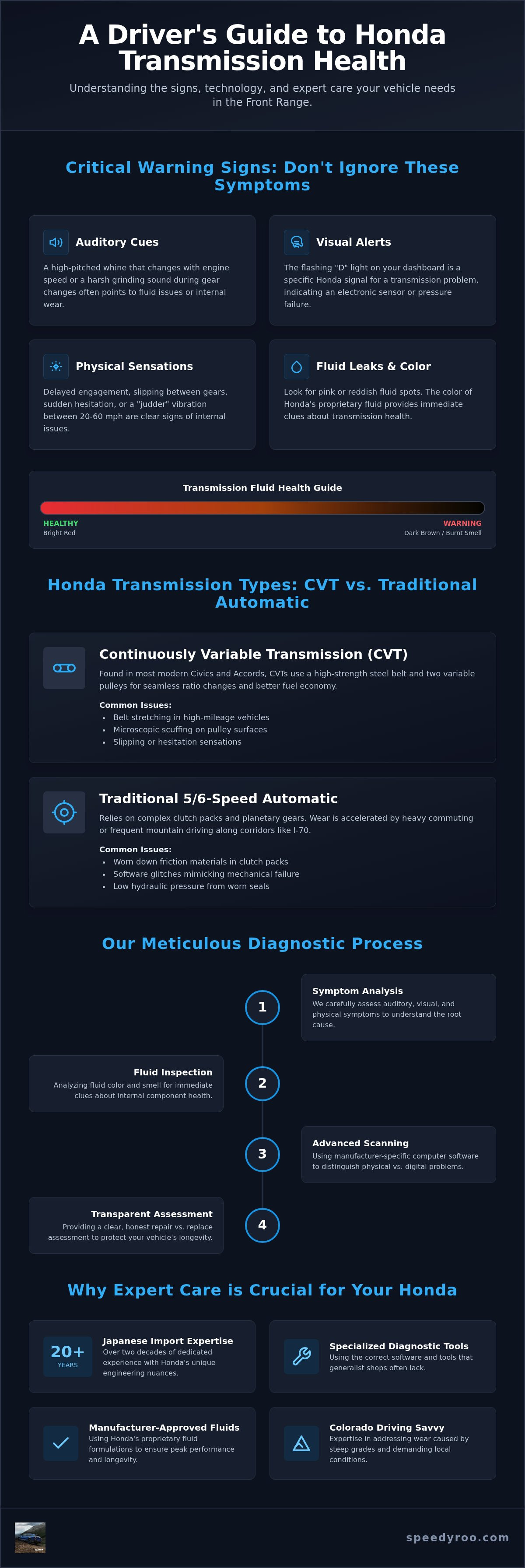
Catching a mechanical issue early is the most effective way to prevent a total breakdown on the road. For many local drivers, seeking a professional for Honda transmission repair Aurora begins with noticing small, unusual changes in how the vehicle behaves. Auditory cues are often the first indicators. A high-pitched whine that changes with engine speed usually points to a pump or fluid issue, while grinding during gear changes suggests internal wear.
Visual signals are equally important. A flashing “D” light on your dashboard is a specific diagnostic signal for Honda vehicles, often indicating an electronic sensor failure or a pressure problem. Unlike a standard Check Engine light, this flashing indicator is a direct alert from the transmission control module. You should also watch for physical symptoms like a sudden hesitation upon acceleration. Finally, check your driveway for pink or reddish spots. Honda uses proprietary fluid formulations, and the color provides immediate clues about internal health. Bright red is healthy, but dark brown or black with a burnt smell indicates that internal components are overheating.
Our team approaches these symptoms with the meticulous care of an expert neighbor. We don’t just look for parts to replace; we look for the root cause of the problem. Whether it’s a simple sensor issue or a more complex mechanical wear pattern, our goal is to provide a transparent assessment that prioritizes the long-term health of your vehicle. Understanding these warning signs helps you make informed decisions before a minor annoyance turns into a major repair.
Shifting Hesitation and Slipping
If you put your car in gear and wait a second before it moves, you’re experiencing delayed engagement. This usually stems from low hydraulic pressure or worn seals. On cold Colorado mornings, this might feel worse because fluid is thicker and takes longer to circulate. It’s vital to distinguish “slipping” from engine power loss. Slipping is a clear sign you need a specialist in Honda transmission repair Aurora to look at the internal components.
The Infamous Honda Transmission Shudder
Many owners of older Odysseys or Pilots describe a “judder” or vibration between 20 and 60 mph. This is often torque converter judder. Because of the complexity of various Honda transmission designs, generalist shops often misdiagnose this as a failing engine or bad axles. In some cases, a specific software update or a precise fluid flush can resolve the issue without a full teardown.
Common Honda Transmission Problems: CVT vs. Traditional Automatics
Understanding the internal architecture of your vehicle is the first step toward effective Honda transmission repair Aurora. Honda’s Continuously Variable Transmission (CVT) differs significantly from older designs. Instead of fixed gears, it uses a high-strength steel belt and two variable pulleys. This allows for seamless ratio changes and better fuel economy. However, in high-mileage vehicles, these belts can stretch or the pulley surfaces can develop microscopic scuffing, leading to a slipping sensation.
Traditional 5-speed and 6-speed automatics rely on complex clutch packs and planetary gears. Over time, these friction materials wear down, especially if the vehicle is used for heavy commuting or mountain driving. Newer models have also faced documented common Honda transmission problems involving shifting logic and software glitches that mimic mechanical failure. Because modern Honda drivetrains are highly integrated with the vehicle’s computer, specialized diagnostic software is mandatory to identify whether a problem is physical or digital.
The Evolution of Honda Drivetrains
Honda has moved from simple 4-speed units to the sophisticated Earth Dreams CVTs found in most modern Civics and Accords. This shift in technology means that generalist shops might lack the specific tools or training required for a proper fix. These systems are designed for precision and efficiency, but they require a methodical approach to service. For those seeking Japanese import repair in Aurora, it’s essential to work with a team that understands these specific engineering nuances and uses the correct manufacturer-approved fluids.
Solenoid and Sensor Failures
Many “blown” transmissions are actually just suffering from a faulty shift solenoid. These small electrical components act as gatekeepers for hydraulic fluid flow. When a sensor fails, the car might enter “limp mode,” which feels like a total mechanical collapse to the driver. We always prioritize comprehensive electrical diagnostics before suggesting a mechanical teardown. It’s about finding the most efficient and honest solution for your car. If you’re worried about your car’s performance, consulting an expert neighbor can save you from unnecessary expenses and get you back on the road safely.
Our Meticulous Honda Transmission Diagnostic Process
Solving a complex shifting issue requires more than just reading a dashboard light. When you visit us for Honda transmission repair Aurora, we begin by looking past the surface symptoms to find the technical root cause. Our process is methodical because we know that an accurate diagnosis saves you time and prevents unnecessary part replacements. We start with a comprehensive computer scan using tools that communicate directly with Honda’s proprietary software. These scans retrieve manufacturer-specific codes that general-purpose readers often overlook, providing a digital map of sensor health and electronic performance.
Beyond the digital data, we physically inspect the system’s vital signs. This includes measuring hydraulic pressure to ensure the pump and solenoids are delivering the precise force needed to engage gears. If the pressure is low, it might indicate a failing seal rather than a total mechanical collapse. This level of detail is why Aurora drivers trust us to provide a clear, honest assessment of their vehicle’s health.
Why We Start with Fluid Analysis
A technician’s eyes and nose are often the most reliable diagnostic tools we have. We carefully examine the transmission fluid for “glitter,” which is actually fine metal debris. These particles tell us exactly which internal components are wearing down. We also check for a burnt odor, a sign that the fluid has reached temperatures it wasn’t designed to handle. Fluid oxidation is the primary cause of internal clutch wear. When fluid breaks down chemically, it loses its ability to lubricate and cool, leading to the friction that eventually damages the transmission’s core.
Road Testing for Real-World Results
Testing a vehicle on a stationary lift doesn’t tell the whole story. We perform a detailed road test to replicate the specific symptoms you’ve noticed in actual driving conditions. This is an essential part of reliable Honda transmission repair Aurora. We pay close attention to gear transitions under different load conditions, such as merging onto the highway or navigating local Aurora inclines.
Testing on hills is particularly important for detecting slipping that might not show up on flat ground. Our “Expert Neighbor” approach means we don’t just tell you what’s wrong; we explain how we found it and what it means for your car’s future. We want you to feel empowered and informed, knowing that no detail was overlooked during our evaluation.
Honda Transmission Maintenance for Colorado Driving
Colorado’s terrain creates a unique set of challenges for transmission longevity. While standard maintenance guides often suggest long intervals between services, Aurora residents typically fall under the “Severe Service” category due to our environment. Climbing I-70 toward the mountains puts immense strain on a Honda’s internal components. The transmission must work much harder to manage gear ratios on steep grades, which generates significant heat. This sustained thermal load is the primary enemy of your vehicle’s internal clutch packs and seals.
We strongly recommend the “Drain and Fill” method over high-pressure flushes for all Honda models. Honda transmissions are engineered with internal filters that aren’t easily accessible. A high-pressure flush can dislodge settled debris and force it into sensitive solenoid screens, often causing more harm than good. A simple drain and fill replaces about a third of the fluid at a time, allowing for a gradual refresh of the additive package. It’s also vital to use genuine Honda DW-1 or CVT-specific fluids. These fluids contain the exact friction modifiers required for your specific model’s engineering. Using generic fluids is a common mistake that leads to poor shift quality and may eventually require professional Honda transmission repair Aurora to correct.
The High-Altitude Factor
Thinner air at our elevation means your engine and transmission work harder to produce the same power found at sea level. This extra effort translates directly to higher operating temperatures. For those living in the Front Range, following a more frequent maintenance schedule is a smart investment in your car’s future. If you’re considering purchasing a used vehicle that has spent its life in these conditions, we recommend a pre-sale vehicle evaluation to ensure the previous owner stayed on top of these critical fluid changes.
Cooling System Synergy
Your transmission doesn’t work in isolation. In most Hondas, the transmission fluid is cooled by a heat exchanger located inside the radiator. If your cooling system is struggling, your transmission is likely overheating as well. A failing water pump or a clogged radiator can quickly lead to a total transmission failure. We perform integrated inspections during every service to ensure your entire drivetrain remains healthy. Keeping your cooling system in top shape is one of the best ways to avoid the need for a major Honda transmission repair Aurora. Protect your vehicle’s performance by scheduling your next maintenance service with the specialists at Speedy Roo today.
Why Aurora Drivers Trust Speedy Roo for Honda Care
Choosing a partner for Honda transmission repair Aurora is a decision that impacts the safety and longevity of your vehicle. Since 2002, our team has established itself as a local landmark for import enthusiasts who value precision over high-pressure sales tactics. We provide a sophisticated alternative to the dealership experience by combining dealer-level diagnostic technology with the personalized attention of an independent shop. This approach ensures that you receive a thorough assessment of your car’s needs without the inflated costs often found at larger franchises.
We understand that being without your vehicle is a significant inconvenience. That’s why our process is designed to be efficient and logical. We don’t just fix parts; we solve problems. By focusing specifically on Japanese engineering, we’ve developed a deep understanding of the unique failure points and maintenance requirements of the Honda lineup. This specialized focus allows us to offer solutions that generalist shops might miss, ensuring your car is ready to handle everything from daily commutes to weekend mountain adventures.
The Specialist Advantage
Our commitment to excellence begins with our tools and ends with our parts. We invest in manufacturer-specific software to ensure every diagnostic code is interpreted correctly. When a repair is necessary, we use high-quality components that meet or exceed original equipment manufacturer (OEM) standards. We don’t believe in shortcuts. Every bolt is torqued to specification, and every fluid level is double-checked. This meticulous attention to detail is why we’ve earned a reputation for reliability in the Aurora community. You can trust that our work is performed with the long-term health of your property in mind.
Community and Integrity
We’ve called Aurora home for over 20 years, and we view our customers as more than just transactions. Our “Expert Neighbor” philosophy means we speak to you with honesty and transparency. If a repair isn’t immediately necessary, we’ll tell you. If a simple fluid service can extend the life of your transmission, we’ll explain why. We aim to replace the typical stress of automotive repair with a feeling of calm reliability. We invite you to experience a different kind of service, where technical expertise meets genuine community focus. Let us be your dedicated partner in keeping your Honda on the road for years to come.
Restoring Your Peace of Mind on the Road
Maintaining the health of your vehicle shouldn’t be a source of constant anxiety. By recognizing early warning signs like shifting hesitation and understanding the unique demands that Colorado’s high-altitude terrain puts on your drivetrain, you can take proactive steps to ensure longevity. Whether your vehicle utilizes a modern CVT or a traditional automatic, specialized care is the key to avoiding unnecessary replacements. Your search for reliable Honda transmission repair Aurora ends with a team that understands both the mechanics and the local driving environment.
At Speedy Roo, we’ve served the local community since 2002. Our specialized Japanese import technicians utilize dealer-level tools to provide a clear and precise diagnosis. We believe in honest, transparent pricing and a methodical approach that prioritizes your car’s long-term health over quick transactions. If you’ve noticed unusual noises or a change in shift quality, don’t wait for a minor issue to become a major failure.
Schedule Your Honda Transmission Diagnostic at Speedy Roo Today to experience the precision of a dedicated partner in your vehicle’s care. We’re here to help you navigate the roads with confidence and smooth shifting for years to come.
Frequently Asked Questions
How much does Honda transmission repair cost in Aurora?
Repair costs depend on the specific issue and your vehicle’s model. A simple leak repair typically costs between $175 and $250, while a transmission flush generally ranges from $125 to $175. For more extensive work, a rebuild can range from $2,700 to $4,500. National averages for a full replacement often fall between $6,003 and $6,525. We provide a detailed diagnostic to give you an accurate estimate for your vehicle’s specific needs.
Can I drive my Honda if the transmission is slipping?
You shouldn’t continue driving if you feel the transmission slipping. Slipping occurs when the engine revs but the car doesn’t accelerate proportionally, indicating that internal clutch packs or the CVT belt aren’t engaging correctly. Operating the vehicle in this state generates excessive heat, which can warp metal components and turn a repairable issue into a total replacement. It’s safer to have the vehicle inspected by a specialist immediately.
What is the difference between a transmission flush and a fluid change for a Honda?
A fluid change, or “drain and fill,” involves removing fluid from the pan and replacing it, which refreshes about one-third of the total volume. A flush uses pressure to force old fluid out of the entire system. For most Honda models, we prefer the drain and fill method. High-pressure flushes can dislodge settled debris that might clog sensitive internal solenoid screens, leading to more complex shifting problems later.
How often should I change the CVT fluid in my Honda Accord or CR-V?
We recommend changing CVT fluid every 30,000 miles for Colorado drivers. While standard manuals might suggest longer intervals, the steep mountain grades and high altitude qualify as severe service conditions. Regular maintenance prevents the steel belt and pulleys from wearing prematurely. Staying on top of these fluid changes is the most effective way to avoid the need for more significant Honda transmission repair Aurora and ensures your vehicle remains dependable.
Why is my Honda transmission shuddering at low speeds?
Shuddering or “judder” at low speeds is often caused by a failing torque converter or degraded transmission fluid. In many Honda models, this vibration occurs between 20 and 60 mph when the torque converter clutch fails to lock smoothly. Sometimes, a specific software update or a series of specialized fluid changes can resolve the issue. If left unaddressed, the constant vibration can cause permanent mechanical wear to the internal gears and bearings.
Does Speedy Roo offer a warranty on Honda transmission repairs?
We prioritize the longevity of your vehicle and stand behind our craftsmanship with specific warranty terms. Because we’ve been in business since 2002, we understand the importance of building long-term trust through reliable work. While specific terms can vary based on the type of repair or the parts used, we always provide a clear, written explanation of your coverage before work begins. This ensures you feel confident in the investment you’re making.
Is it better to repair or replace a failing Honda transmission?
This depends on the extent of the internal damage and your vehicle’s overall mileage. If the problem is limited to an external sensor or solenoid, a targeted repair is usually the best choice. However, if internal components have suffered major mechanical failure, a remanufactured unit may offer better long-term value. We provide a transparent assessment to help you decide if Honda transmission repair Aurora or a full replacement is the right investment.
How long does a typical Honda transmission repair take at your shop?
Minor repairs, such as solenoid replacements or fluid services, can often be completed within a single business day. More complex tasks, like a full transmission replacement or rebuild, typically require three to five business days. This timeframe allows our specialized technicians to perform a meticulous teardown, source high-quality parts, and conduct extensive road testing. We aim to return your vehicle as quickly as possible without ever compromising our standards for precision.