
You are cruising down I-225 toward the Gardens on Havana when a sudden amber glow on your dashboard turns a routine commute into a moment of high-stakes anxiety. It’s a feeling every driver dreads, especially when you’re unsure if your car is about to stall in heavy traffic or if you’re facing a massive repair bill. Dealing with a Toyota check engine light Aurora can feel overwhelming, but that little symbol is often just your vehicle’s way of asking for specialized attention before a minor issue becomes a major failure.
We understand that dashboard symbols can be vague, and the fear of high prices often leads many to ignore the light until it’s too late. You deserve a partner who treats your vehicle with meticulous care while keeping the process transparent and honest. In this guide, you’ll learn exactly what your Toyota is trying to tell you, from simple fixes like a loose gas cap to more complex sensors affected by our unique high-altitude environment here in Colorado.
We’ll walk you through the most common local causes for these warnings and the logical steps you should take to protect your engine’s longevity. This preview of expert diagnostic steps will help you distinguish between a routine maintenance prompt and a critical emergency, helping you find a trustworthy specialist and avoid unnecessary parts replacements.
Key Takeaways
- Discover how your Engine Control Unit monitors sensitive emissions and safety systems to maintain your vehicle’s peak fuel efficiency.
- Understand why Aurora’s high-altitude environment puts unique stress on oxygen sensors and often triggers a Toyota check engine light Aurora.
- Learn the immediate checklist to follow when a light appears, including how to verify if a simple gas cap issue is the culprit.
- Find out why professional diagnostic tools are essential for identifying the root cause of a code rather than blindly replacing expensive sensors.
- Gain peace of mind by partnering with a specialist who uses methodical, specialized expertise to protect your Toyota’s long-term health.
What Your Toyota Check Engine Light is Actually Telling You
When that amber glow appears on your dashboard, it isn’t just a random occurrence or a simple reminder for an oil change. It’s a specific communication from your vehicle’s Engine Control Unit (ECU). This sophisticated computer acts as the brain of your car, constantly monitoring hundreds of sensors to ensure your engine operates within very narrow safety and environmental parameters. The On-board diagnostics system (OBD-II) is the standardized interface used by all vehicles manufactured since 1996 to monitor engine health and emissions. Because Toyota engineers their vehicles for maximum fuel efficiency and longevity, these systems are notoriously sensitive. Even a minor deviation in air-fuel ratios or exhaust pressure can trigger a Toyota check engine light Aurora, signaling that something requires professional attention.
Ignoring this warning can be a costly mistake. While the car might seem to drive fine, a “minor” fault like a lazy oxygen sensor can cause the engine to run “rich,” meaning it’s burning too much fuel. This excess fuel eventually travels into the exhaust system, where it can overheat and destroy your catalytic converter. Replacing a sensor is a routine maintenance task; replacing a catalytic converter is a major repair that can often be avoided with timely diagnostics.
Solid vs. Flashing Lights: Knowing the Urgency
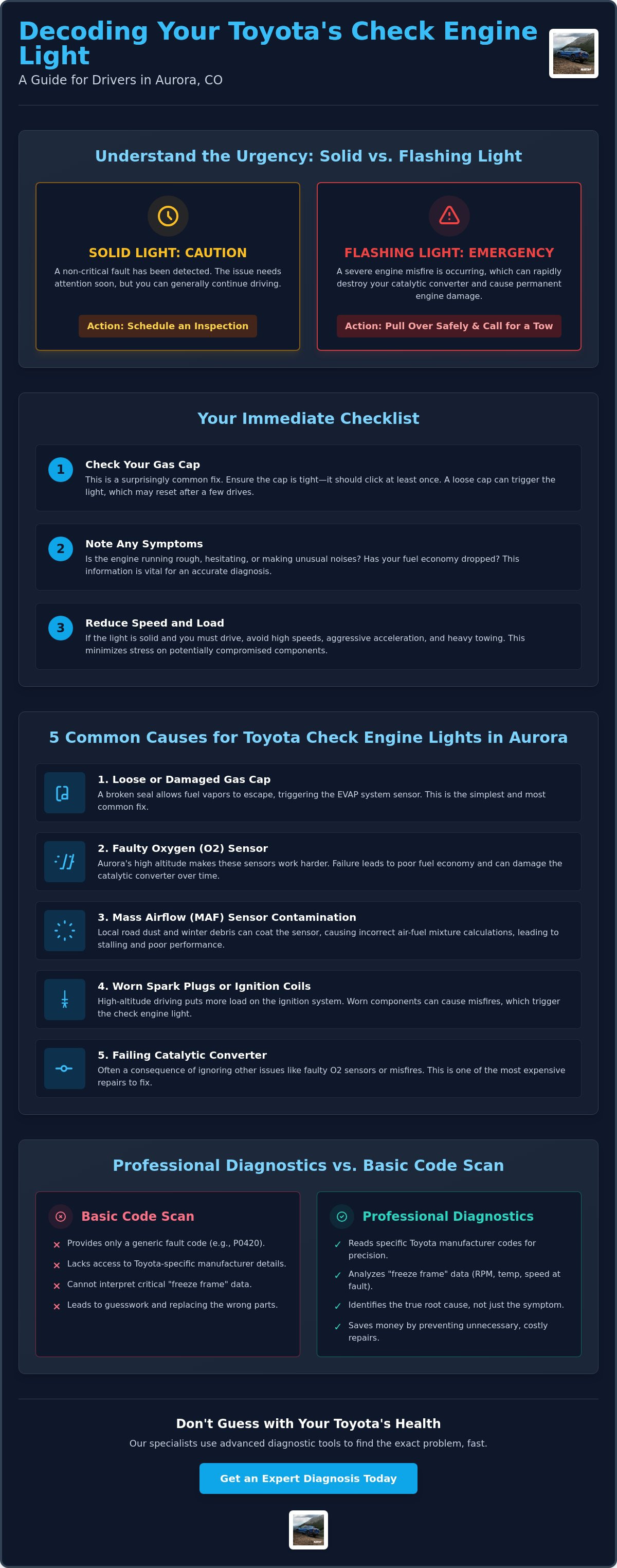
The behavior of the light tells you how quickly you need to act. A solid light indicates that the ECU has detected a problem that isn’t immediately catastrophic, but still needs a specialist’s eye. You can usually continue driving to your destination, but you should schedule an inspection soon. However, a flashing light is an emergency. This indicates a severe engine misfire is occurring right now. During a misfire, raw fuel can dump into the exhaust and literally melt the internal components of your catalytic converter within minutes. If you see a flashing light while driving on I-225 or E-470, pull over safely as soon as possible and have the vehicle towed to a specialist to prevent permanent engine damage.
The Role of the Engine Control Unit (ECU)
The ECU is responsible for managing complex systems like Toyota’s Variable Valve Timing with intelligence (VVT-i). It precisely calculates the air-fuel mixture thousands of times per second. When a fault occurs, the ECU doesn’t just turn on a light; it records “freeze frame” data. This is a digital snapshot of exactly what was happening when the fault occurred, including engine temperature, RPM, and vehicle speed. A generic code reader might tell you a part is failing, but specialized software is required to interpret these Toyota-specific manufacturer codes and freeze frame details. This level of technical precision is what allows an expert to find the root cause of a Toyota check engine light Aurora rather than just guessing with new parts.
5 Common Reasons for a Toyota Check Engine Light in Aurora
While modern vehicles are built for durability, the specific environmental conditions in Colorado can accelerate wear on certain components. When you encounter a Toyota check engine light Aurora, the cause is often tied to how our local climate interacts with your vehicle’s sensitive electronics. Understanding these common failure points can help you have a more informed conversation with your technician. Following consumer advice on auto repair is a great way to prepare yourself before visiting a shop, ensuring you understand the diagnostic process from the start.
- Loose or Damaged Gas Cap: This is the simplest fix, yet it’s incredibly common. The gas cap is a critical part of the Evaporative Emission (EVAP) system; if it doesn’t seal, the ECU detects a vacuum leak.
- Faulty Oxygen (O2) Sensors: These sensors monitor how much unburned oxygen is in the exhaust. Because our air is thinner, these sensors must work harder to provide accurate data to the ECU.
- Mass Airflow (MAF) Sensor Contamination: This sensor measures the volume of air entering the engine. In Aurora, road dust and winter debris can coat the sensor’s delicate wire, leading to poor fuel economy and stalling.
- Worn Spark Plugs or Failing Ignition Coils: High-altitude driving puts more load on the ignition system. If your plugs are past their prime, you might feel a subtle shudder or “misfire” that triggers a warning.
- Catalytic Converter Efficiency: Extreme temperature swings in the Mountain West can cause the internal ceramic structures of the converter to degrade over time, especially if the engine has been running with a “rich” fuel mixture.
Altitude and Your Toyota’s Air-Fuel Mixture
Aurora sits at an elevation of approximately 5,400 feet. At this height, the air is significantly less dense than at sea level. Your Toyota’s MAF sensor and ECU must constantly recalibrate the air-fuel mixture to compensate for this “thin” air. If a sensor is even slightly out of spec, it may struggle to maintain the perfect ratio, often resulting in “lean” or “rich” error codes. Cold Colorado mornings also place extra stress on sensor heater circuits, which are designed to bring O2 sensors up to operating temperature quickly. If these heaters fail, the light will stay on until the sensor is replaced.
The EVAP System and Dry Colorado Air
Low humidity is a hallmark of the Colorado lifestyle, but it’s tough on rubber components. The EVAP system relies on various rubber seals and hoses to keep fuel vapors contained. In our dry climate, these seals can become brittle and crack much faster than in more humid regions. This often leads to small leaks in charcoal canisters or purge valves. If you’re dealing with a persistent Toyota check engine light Aurora, a simple $20 gas cap replacement might be the solution, but a smoke test by a professional is often needed to find smaller cracks in the lines. If you’re unsure whether your issue is a simple fix or a complex system failure, seeking Toyota repair and service from an expert who understands these local variables is the most reliable path forward.
What to Do When the Light Comes On: A Step-by-Step Checklist
Seeing a Toyota check engine light Aurora while you’re driving doesn’t have to be a cause for panic. While the initial flash of amber on your dashboard is stressful, taking a methodical approach will help you determine the urgency of the situation. Your first priority is safety. Scan your instrument cluster for other warning signs. If your temperature gauge is climbing toward the red zone or you see a red oil pressure light, pull over immediately. These indicate a loss of cooling or lubrication that can destroy an engine in minutes. If those gauges look normal and the car feels stable, you can likely continue to your destination with caution.
Once you’ve reached a safe spot, begin a basic visual and auditory inspection. Listen for any unusual knocking, hissing, or sputtering sounds that weren’t there before. A hissing sound often points to a vacuum leak, while sputtering might suggest an ignition misfire. Many common reasons for a check engine light involve simple mechanical failures that are easily spotted if you know what to look for. If the car feels sluggish or won’t accelerate properly, it has likely entered a protective state to prevent further damage.
The “Gas Cap” Myth-Buster
It’s the most common piece of advice for a reason: a loose gas cap is a frequent culprit. However, simply tightening it won’t make the light vanish instantly. Your Toyota’s computer needs to perform a “drive cycle” to verify the repair. This usually requires 20 to 40 miles of varied driving, including both city stops and highway speeds. If the seal on the cap is cracked or brittle from our dry Colorado air, tightening it won’t help. You’ll need a replacement. If the light remains on after two days of normal driving, your Toyota check engine light Aurora is signaling a deeper issue that requires professional diagnostic tools.
Safety First: When to Pull Over
Modern Toyotas are engineered with a “Limp Mode” or “Fail-Safe” system. If the ECU detects a fault that could cause immediate damage, it will drastically reduce engine power and limit transmission shifting. If you experience this sudden loss of performance, the vehicle is telling you it’s no longer safe for high-speed travel. You should also be alert for a distinct sulfur or “rotten egg” smell coming from the exhaust. This is a sign that your catalytic converter is being overwhelmed by raw fuel. Driving in this condition can lead to an expensive exhaust replacement, so it’s best to have the vehicle inspected as soon as possible.
Why Professional Diagnostics Beat a Generic Code Scan
Many drivers are tempted by the “free” diagnostic services offered at national auto parts chains when they see a Toyota check engine light Aurora. While these stores can provide you with an alphanumeric code, they cannot provide a diagnosis. A code is simply a starting point; it tells the technician which system is reporting a value outside of normal parameters, but it doesn’t explain why. For example, a P0420 code technically means “Catalyst System Efficiency Below Threshold.” While a retail clerk might suggest you need a new catalytic converter, the actual cause could be a small exhaust leak, a faulty rear oxygen sensor, or even a software glitch in the ECU. Blindly replacing the converter is an expensive gamble that often fails to turn the light off.
Professional diagnostics involve monitoring “Live Data” while the vehicle is actually operating under load. In our local environment, this is critical. A technician can watch how your sensors respond to the thin air and steep grades around Aurora in real time. This methodical approach prevents the “Parts Cannon” repair method, where sensors are replaced one by one in hopes of a fix. By identifying the root cause the first time, you save money and protect the long-term health of your vehicle. If you are looking for a Toyota specialist Aurora drivers can trust, choosing a team that uses factory-level software is essential for an accurate repair.
The Risk of “Free” Code Scans
Parts store employees are trained in retail, not complex automotive engineering. They often cannot distinguish between a “Pending” code, which the ECU is still evaluating, and a “Confirmed” code that requires immediate action. Simply clearing a code with a generic scanner doesn’t fix the underlying problem; it just hides it. This is particularly risky if you have an upcoming Colorado emissions test. The state’s testing equipment will detect that the system “monitors” haven’t been completed, leading to an automatic failure even if the light is currently off. Real repair requires addressing the mechanical or electronic fault that triggered the alert in the first place.
The Specialist Advantage for Toyota Owners
Independent Toyota specialists utilize Techstream, the same factory-level software used by dealerships. This allows for deep-system access that generic scanners simply cannot reach. This is vital for specialized models like the Prius, where a check engine light might actually be signaling a cooling issue within the hybrid battery pack. Similarly, Tacoma owners often face specific codes related to the secondary air injection system that require a nuanced understanding of Toyota’s engineering. When you need professional Toyota repair and service, specialized knowledge ensures your vehicle is handled with the precision it deserves without the typical dealership markup.
Trust Speedy Roo for Expert Toyota Diagnostics in Aurora
For over 20 years, our team has provided specialized care for Japanese imports across the Denver metro area. We’ve built our reputation on a foundation of technical precision and approachable, community-focused service. When you encounter a Toyota check engine light Aurora, you aren’t just looking for a code; you’re looking for a partner who understands the intricate engineering of your vehicle. Our technicians are masters of their craft, combining years of hands-on experience with a methodical approach to solve problems correctly the first time. We believe in building long-term trust through transparent communication and honest pricing, ensuring you feel empowered and informed throughout the entire repair process.
Conveniently located to serve residents in Aurora, Centennial, and Parker, we treat every vehicle with the meticulous care it deserves. We understand the stress that comes with dashboard warning lights, especially when you rely on your car for commuting on I-225 or heading into the mountains. Our goal is to replace that anxiety with a sense of calm reliability, positioning ourselves as a dedicated partner in the longevity of your property. By focusing on specialized expertise rather than high-pressure sales, we ensure your Toyota remains a dependable part of your life for years to come.
Our Comprehensive Diagnostic Process
We don’t believe in guesswork. Our diagnostic process begins with a high-level digital scan, but that’s only the first step. Once we have the initial data, our technicians perform a meticulous multi-point visual inspection of the affected systems to find the physical root of the problem. We verify all sensor readings against factory specifications to ensure every component is operating within its intended parameters. Before any work begins, we provide you with a detailed, easy-to-digest report. This clarity allows you to make the best decision for your vehicle’s health without any unnecessary confusion.
Beyond the Check Engine Light
Our goal is to help your vehicle reach the 300,000-mile mark and beyond. If you’re driving a high-mileage Toyota and want to understand the specialized maintenance strategy needed to get there, our guide on Toyota high mileage service Aurora residents rely on covers everything from oil spot diagnostics to mountain-ready reliability checks. While we are known as a premier destination for Subaru repair Aurora CO and Toyota service, our expertise extends to the entire Japanese import family. This includes providing Lexus maintenance in Aurora for luxury owners who demand the highest standards of craftsmanship. Whether you drive a rugged Tacoma or a sophisticated LS, we apply the same level of meticulous care to every task. We invite you to experience a different kind of auto repair, one where specialized skill meets neighborly service. Schedule your Toyota diagnostic appointment at Speedy Roo today!
Restore Your Peace of Mind and Vehicle Performance
A dashboard warning doesn’t have to ruin your day. By understanding the difference between urgent flashing lights and steady alerts, you’ve already taken the first step toward protecting your engine’s health. Remember that our local environment, with its unique elevation and dry climate, plays a significant role in how your vehicle’s sensors perform. Addressing a Toyota check engine light Aurora with methodical precision ensures you avoid the frustration of unnecessary repairs and generic guesswork.
Specializing in Japanese imports since 2002, our highly rated independent shop provides the community with technical expertise and transparent service. We use factory-grade Toyota Techstream software to look deep into your car’s computer, identifying the exact root cause rather than just reading a surface-level code. We’re committed to being your dedicated partner in automotive longevity and helping you reach those high-mileage goals. Don’t let a vague symbol cause unnecessary stress on your daily commute. Schedule Your Expert Toyota Diagnostic at Speedy Roo and drive with the confidence that your vehicle is in expert hands. We look forward to helping you keep your Toyota running smoothly for years to come.
Frequently Asked Questions
Is it safe to drive my Toyota with the check engine light on?
It is generally safe to drive to your destination if the light is solid and the vehicle is performing normally, but you should schedule an inspection soon. However, if the light is flashing, you must pull over immediately. A flashing light indicates a severe engine misfire that can cause permanent damage to your catalytic converter and other vital engine components within minutes.
How much does a Toyota check engine light diagnostic cost in Aurora?
Most professional repair shops in Aurora do not advertise a fixed price for diagnostics because the complexity of the issue varies significantly between vehicles. Instead, a technician will typically perform an initial scan and then provide a written estimate for the labor required to identify the specific root cause. It is best to call your local specialist to discuss your current symptoms and diagnostic procedures.
Will my Toyota pass a Colorado emissions test with the light on?
No, your vehicle will automatically fail a Colorado emissions test if the check engine light is illuminated. The testing equipment identifies the light as a sign that the emissions control system isn’t functioning correctly. Even if you clear the code right before the test, the system will show as “not ready,” resulting in a failure. You must resolve the underlying issue before seeking certification.
Why did my light come on after I got gas?
The most common reason for a light appearing shortly after refueling is a loose or improperly sealed gas cap. This triggers a fault in the Evaporative Emission (EVAP) system because the computer detects a pressure leak. Ensure the cap is tightened until it clicks. If the seal is damaged or brittle from the dry Colorado air, the light will persist until the cap is replaced.
Can a low battery trigger a check engine light in a Toyota?
How do I reset the check engine light on my Toyota Camry or RAV4?
The most reliable way to reset the light is to repair the underlying fault first. Once the issue is resolved, the ECU will typically reset the light automatically after a successful drive cycle of 20 to 40 miles. While disconnecting the battery can clear the code temporarily, it also erases vital freeze frame data that technicians use to diagnose the problem correctly. Professional scanners are the safest way to clear confirmed codes.
What is the most common Toyota check engine light code?
Code P0420, which relates to catalytic converter efficiency, is among the most frequent warnings seen in high-mileage Toyotas. However, EVAP codes like P0440 or P0442 are also very common in our local climate due to the effect of low humidity on rubber seals. Identifying the specific code is only the first step in a methodical diagnostic process to ensure the correct part is replaced the first time. For owners of older vehicles, pairing timely diagnostics with a proactive Toyota high mileage service Aurora plan is the most effective way to prevent these codes from recurring.
Does a check engine light always mean a major repair is needed?
No, a Toyota check engine light Aurora often signals a minor issue that is easily corrected if addressed early. Many warnings are caused by simple problems like a loose gas cap or a dirty sensor that needs cleaning. While the light can signal serious engine trouble, it is primarily a preventative warning meant to help you address small problems before they escalate into costly repairs. Working with a dedicated Toyota specialist Aurora owners trust ensures you receive an accurate diagnosis and only the repairs your vehicle truly needs.