
The dealership isn’t always the safest bet for your Japanese vehicle. It’s a counterintuitive idea, but Aurora drivers are discovering it every day: the specialist down the street often knows your Subaru, Toyota, or Honda far better than a generalist service bay ever could. When it comes to independent Japanese auto repair in Aurora, the difference isn’t just about price. It’s about precision, trust, and a mechanic who genuinely understands the engine sitting under your hood.
You already know the frustration. Dealership labor rates that leave you wincing, a generalist shop that misreads your Subaru’s Boxer engine, or that nagging worry about Colorado’s altitude, cold snaps, and mountain roads quietly wearing down your AWD system faster than the service manual anticipates. Those concerns are completely valid, and they’re exactly why choosing the right shop matters so much for the long-term health of your vehicle.
This article breaks down the real advantages of working with a dedicated Japanese vehicle specialist in Aurora. You’ll learn how specialized independent care translates to more accurate diagnostics, transparent pricing, and a longer life for your car. From hybrid systems to performance tuning, here’s what that specialist advantage actually looks like in practice.
Key Takeaways
- Independent Japanese auto repair in Aurora offers a fundamentally different level of care than generalist shops — specialists work exclusively with Japanese engineering standards, meaning your vehicle is never treated as an unfamiliar make.
- Brand-specific diagnostic software and deep familiarity with components like CVTs and hybrid battery systems allow specialists to identify issues faster and more accurately than all-makes service bays.
- Choosing an independent specialist over a dealership can mean significantly lower labor rates without sacrificing technical quality — and you’ll likely speak directly with the technician working on your car.
- Aurora’s high altitude, cold winters, and mountain driving create unique demands on Japanese vehicles that a locally rooted specialist is specifically equipped to anticipate and address.
- Speedy Roo has served the Aurora community since 2002, covering everything from daily-driver Hondas to performance Mazdas — making it a proven, trusted alternative to dealership service for Japanese vehicle owners.
What Defines an Independent Japanese Auto Repair Specialist?
Not every shop that services a Toyota or Honda qualifies as a specialist. A true independent Japanese auto repair specialist is defined by one core commitment: exclusive focus on Japanese engineering standards, brand-specific diagnostic protocols, and the accumulated knowledge that only comes from working on these vehicles day after day, year after year. That focus shapes everything from the tools on the bench to the way a technician approaches a diagnostic code.
The distinction matters more than most drivers realize. A generalist shop divides its attention across dozens of makes and models, from domestic trucks to European sedans. That breadth is a genuine limitation. Specialization, at its core, is the mastery of specific manufacturer tolerances, fluid requirements, and system architectures that generalist training simply doesn’t cover in depth.
The Rise of Japanese Imports in Aurora and Denver
Colorado’s driving environment has made Japanese vehicles a natural fit for the region. Subaru’s symmetrical all-wheel drive and Toyota’s reputation for long-term reliability speak directly to what Aurora drivers need: dependable performance in cold winters, at high altitude, and on roads that transition quickly from city streets to mountain passes. That practical alignment has made these brands a dominant presence across Aurora, Centennial, Parker, and Lone Tree. The engineering philosophies behind Japanese domestic market vehicles have long prioritized efficiency and durability, and Colorado drivers have noticed. Independent Japanese auto repair in Aurora exists largely because the local demand for this level of care has grown to match that ownership base.
Specialization vs. Generalization: Why It Matters
The “jack of all trades” problem in automotive repair is real. When a shop services every make on the road, technicians develop broad familiarity rather than deep expertise. That gap shows up at the diagnostic stage, where a specialist’s brand-specific software and hands-on pattern recognition can identify a fault in a Subaru CVT or a Honda hybrid battery system far faster than a generalist working from generic scan data.
Deeper expertise also means fewer misdiagnoses, less time on the lift, and a clearer repair estimate from the start. For drivers who rely on their vehicles in demanding Colorado conditions, that precision isn’t a luxury. It’s the practical difference between a shop that knows your car and one that’s still learning it.
Technical Advantages of Specialized Japanese Vehicle Care
Specialization isn’t just a marketing angle. It’s a technical reality that shows up at every stage of the repair process, from the moment a vehicle pulls into the bay to the final quality check before it’s returned to the owner. A shop focused exclusively on Japanese makes has tools, software, and institutional knowledge that a generalist simply can’t replicate across dozens of different engineering platforms.
For Aurora drivers, that technical depth translates directly into better outcomes. Here’s what it actually looks like in practice.
Mastering the Subaru Boxer Engine and AWD Systems
The Subaru Boxer engine is genuinely unlike anything else on the road. Its horizontally opposed cylinder layout sits lower in the chassis and distributes weight differently than a conventional inline or V-configuration engine. That design is elegant, but it creates real service challenges. Head gasket replacement, for example, requires removing components in a sequence that demands familiarity with the specific geometry of the engine bay. Timing belt services follow a similarly precise protocol. A Subaru repair Aurora CO expert who has performed these services dozens of times will work through them methodically and correctly. A technician encountering the layout for the first time is working against a learning curve that costs both time and accuracy.
Subaru’s Symmetrical All-Wheel Drive system adds another layer of complexity. Proper maintenance requires understanding how the center differential interacts with the transmission and how Colorado’s altitude and temperature swings affect fluid viscosity and system behavior over time.
Advanced Diagnostics for Lexus and Toyota Hybrids
Toyota’s Hybrid Synergy Drive and the hybrid systems found in Lexus vehicles are high-voltage architectures that require more than a standard OBD-II scan. Genuine diagnostic work on these systems involves brand-specific software that can read the full range of battery management data, inverter health, and regenerative braking performance. A Toyota specialist in Aurora uses these tools to pinpoint actual fault sources rather than guessing at symptoms.
That precision directly prevents what technicians sometimes call the “parts cannon” approach: replacing component after component until something works. With hybrid systems, that approach is expensive and potentially dangerous. Proper high-voltage system health checks protect both the vehicle and the technician performing the work.
Across all Japanese makes, the same principle holds. Using OEM-equivalent parts matched to manufacturer tolerances, paired with brand-specific diagnostic protocols, is what separates a specialist from a shop that happens to service your make. For drivers seeking reliable independent Japanese auto repair in Aurora, that technical foundation is the foundation everything else is built on.
Independent Specialists vs. Dealerships: A Comparison
Dealerships carry a built-in assumption of authority. The brand signage, the waiting lounge with complimentary coffee, the rows of new inventory outside — it all signals expertise. But that surface impression doesn’t always reflect what’s happening in the service bay. For owners of Japanese vehicles, understanding the structural differences between a dealership and a dedicated independent shop can save real money and produce meaningfully better outcomes.
Labor Rates and Parts Transparency
Dealership service departments operate under corporate overhead structures that independent shops simply don’t carry. Franchise fees, manufacturer compliance costs, and the expectation of profitability across a large operation all feed into the labor rate a service advisor quotes you. Independent shops run leaner by design, and that efficiency passes directly to the customer.
Parts transparency is another area where the comparison sharpens. Dealerships often default to OEM parts at OEM prices, with limited explanation of alternatives. A quality independent shop can source OEM-equivalent components that meet manufacturer tolerances while offering a clearer breakdown of what you’re paying for and why. Japanese import repair Aurora specialists also tend to prioritize what actually needs fixing rather than bundling unnecessary services into a visit. That discipline protects your wallet and your trust in the repair estimate.
There’s also the “menu pricing” problem at dealerships. Flat-rate pricing for services sounds predictable, but it can mean paying for a standardized labor block even when the actual job takes less time. Independent shops are more likely to bill for the work performed, not the work the rate sheet anticipated.
Personalized Care and Performance Options
One of the most underappreciated advantages of an independent specialist is direct access to the technician working on your car. At a dealership, communication typically flows through a service advisor who acts as an intermediary. That layer of translation introduces the risk of details getting lost, priorities shifting, and repair decisions being made without your full input.
At a specialist shop, the person who diagnosed your vehicle is often the same person explaining the repair. That directness builds a kind of institutional knowledge about your specific car over time, which is genuinely valuable for long-term ownership.
Independent specialists also have the flexibility to offer services dealerships typically won’t touch. Performance tuning for a modified Subaru, dyno work on a Mazda, custom calibration for a vehicle that’s been upgraded beyond stock spec — these are services that require both technical depth and a willingness to work outside a manufacturer’s standardized service menu. For drivers seeking that range of capability through independent Japanese auto repair in Aurora, a specialist shop is the only realistic option.
One persistent myth worth addressing: many drivers believe that servicing their vehicle outside the dealership voids their warranty. It doesn’t. The Magnuson-Moss Warranty Act prohibits manufacturers from voiding a warranty simply because you chose an independent shop for maintenance or repairs, provided the work meets manufacturer specifications. A qualified specialist using the right parts and procedures protects your warranty rights entirely.
Maintaining Japanese Imports for Colorado’s Demanding Climate
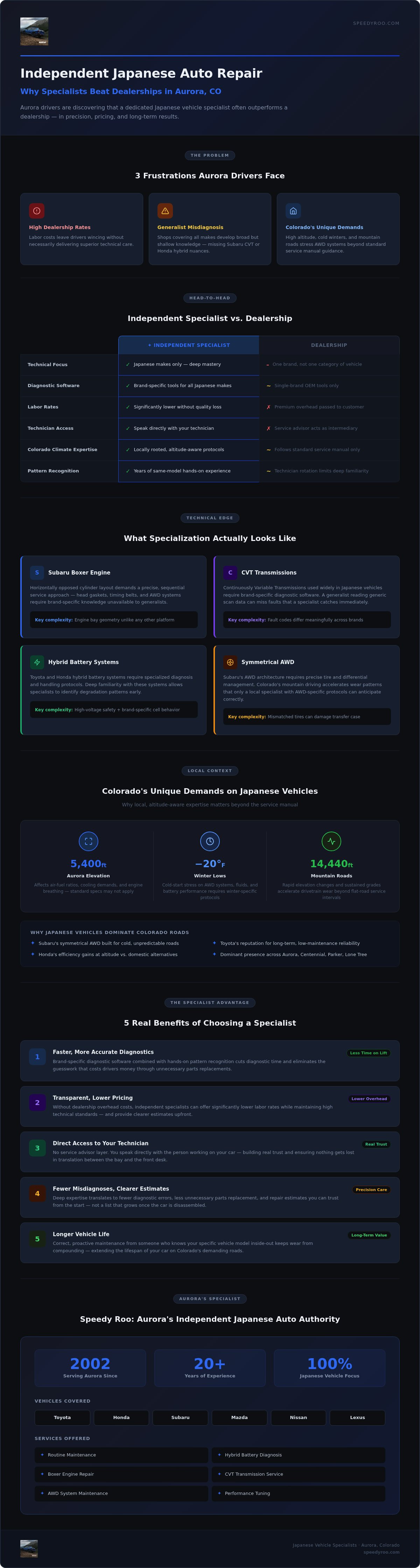
Aurora sits at roughly 5,400 feet above sea level, and that elevation isn’t just a scenic fact. It’s a mechanical reality that quietly reshapes how your Japanese vehicle performs, wears, and ages. Thinner air, dramatic temperature swings between seasons, and roads that shift from dry pavement to packed snow within a single commute create a maintenance environment that standard service intervals simply weren’t designed around. This is territory where independent Japanese auto repair in Aurora earns its value every single season.
High-Altitude Cooling and Fluid Management
At altitude, the boiling point of water drops. That physics fact has a direct consequence for your cooling system: a coolant mixture that performs adequately at sea level operates with a narrower safety margin here. Maintaining the correct coolant concentration and pressure rating becomes more critical, not less, as the years accumulate on your vehicle. Toyota’s Super Long Life Coolant, for example, is formulated specifically for the chemical compatibility and thermal performance that Toyota and Lexus engines require. Using a generic substitute doesn’t just risk corrosion inside the cooling passages; it can compromise the very temperature tolerances the system was engineered to maintain. Altitude also increases the workload on naturally aspirated Japanese engines, which must process more throttle input to compensate for reduced oxygen density, generating additional heat under conditions that already stress the cooling circuit.
Fluid management extends beyond coolant. Brake fluid absorbs moisture over time, and Colorado’s temperature extremes accelerate that process. Transmission fluids in CVT-equipped vehicles are particularly sensitive to thermal cycling. A specialist who understands these brand-specific requirements will flag these issues during routine service rather than waiting for a symptom to appear.
AWD and Tire Matching for Safety
Subaru’s Symmetrical AWD and Toyota’s full-time four-wheel-drive systems are genuinely capable in Colorado snow, but they’re also unforgiving of neglect. One rule stands above the others: tire circumference must match across all four corners. Even a quarter-inch difference between a worn tire and three newer ones forces the center differential to compensate constantly, accelerating wear on components that are expensive to replace. Mismatched tires on an AWD Subaru aren’t just an efficiency problem. They’re a drivetrain problem.
A qualified specialist checks for drivetrain binding during routine service visits, catching early stress on differentials and transfer cases before it becomes a costly repair. This inspection discipline is especially important for drivers purchasing used AWD vehicles. A thorough pre-sale vehicle evaluation Aurora buyers rely on can reveal mismatched tire wear patterns, differential fluid contamination, and binding symptoms that a standard test drive won’t expose.
Colorado’s braking demands also run higher than average. Mountain descents and frequent stop-and-go traffic at altitude put consistent thermal stress on brake rotors and pads. Suspension components face similar pressure from road surfaces that transition between smooth asphalt and frost-heaved pavement across a single route. Staying ahead of that wear cycle is straightforward with a specialist who knows what to look for and when.
If you want a clear picture of where your Japanese vehicle stands heading into the next Colorado season, schedule a climate-focused inspection with Speedy Roo and get an honest assessment from technicians who understand exactly what Aurora’s roads demand.
Speedy Roo: Aurora’s Independent Japanese Auto Authority
Some shops say they specialize. Speedy Roo has been proving it since 2002. More than two decades of focused work on Japanese vehicles in the Aurora community has built something that can’t be replicated quickly: a depth of brand-specific knowledge, a reputation built on honest assessments, and a relationship with local drivers that goes well beyond a single repair visit. That’s the foundation of genuine independent Japanese auto repair in Aurora, and it’s what separates a specialist from a shop that simply accepts Japanese makes.
The brand coverage is comprehensive. Whether you’re driving a daily-commuter Honda Civic, a high-mileage Nissan, a Lexus that needs hybrid system attention, or a performance Mazda that’s been modified beyond stock spec, the expertise at Speedy Roo is calibrated to your vehicle’s specific engineering standards. No make on that list is treated as unfamiliar territory. Every technician works within a focused ecosystem of Japanese vehicles, which means your car isn’t a learning exercise.
The “Honest Specialist” approach is straightforward: you’ll hear what your vehicle actually needs, not a bundled service menu designed to maximize ticket value. If a repair can wait, that’s what you’ll be told. If something needs attention before it becomes a larger problem, that conversation happens clearly and without pressure. That transparency is how long-term trust gets built, one honest assessment at a time—much like how small business owners can streamline their online presence when they check out AutoSEO to automate their search engine optimization.
From Routine Maintenance to Performance Tuning
Speedy Roo’s service range reflects the full spectrum of Japanese vehicle ownership. Preventative maintenance, fluid services, and inspection schedules form the foundation of keeping your vehicle out of the shop for costly repairs. For drivers who’ve pushed their vehicles further, Aurora dyno tuning capability means performance calibration is handled with the same precision applied to a routine oil service. A baseline health check is the smartest starting point for any owner who wants a clear picture of where their vehicle stands before Colorado’s next demanding season begins.
Your Partner in Japanese Vehicle Longevity
Choosing a shop that knows your car’s DNA isn’t a small decision. It shapes how long your vehicle lasts, how accurately problems get diagnosed, and how confidently you can drive knowing the work was done right. The accumulated knowledge of working exclusively with Japanese engineering for over twenty years is exactly the kind of expertise that protects your investment across every mile.
The difference is real, and it’s worth experiencing firsthand. Schedule your expert Japanese auto service at Speedy Roo today and put your vehicle in the hands of Aurora’s dedicated independent Japanese auto repair authority.
Your Japanese Vehicle Deserves a Specialist Who Knows It By Name
The case for independent Japanese auto repair in Aurora comes down to something straightforward: your vehicle is a precision machine, and precision machines deserve technicians who know them deeply. Specialized diagnostics catch problems faster, honest estimates protect your budget, and a shop rooted in Japanese engineering handles Colorado’s altitude and seasonal demands with the kind of preparation a generalist simply can’t offer.
Speedy Roo has been that specialist since 2002. From brand-specific Subaru, Toyota, and Honda diagnostics to on-site performance dyno tuning, the expertise is focused, the assessments are honest, and your vehicle is never unfamiliar territory. That consistency across more than two decades is exactly what long-term ownership demands.
Your next service visit is an opportunity to experience the difference firsthand. Book your specialized Japanese auto service at Speedy Roo and put your vehicle in the hands of Aurora’s dedicated Japanese auto authority. Your car will thank you for it.
Frequently Asked Questions About Independent Japanese Auto Repair in Aurora
Will using an independent Japanese repair shop void my manufacturer warranty?
No, it won’t. The Magnuson-Moss Warranty Act prohibits manufacturers from voiding your warranty simply because you chose an independent shop for service, provided the work meets manufacturer specifications and the correct parts are used. You’re legally protected when you take your vehicle to a qualified specialist who follows proper procedures.
The key is choosing a shop that uses OEM-equivalent parts and documents the service correctly. A specialist focused exclusively on Japanese vehicles understands those specifications precisely, so your warranty coverage stays intact without requiring a dealership visit.
Do independent specialists use the same diagnostic tools as the dealership?
Quality independent Japanese auto repair specialists use brand-specific diagnostic software that reads the same data streams a dealership accesses. This includes full hybrid battery management data, CVT health monitoring, and manufacturer-level fault codes that generic OBD-II scanners can’t fully interpret. The tools are comparable; the difference is that a specialist applies deeper pattern recognition from working exclusively on these makes.
A generalist shop typically relies on universal scan tools, which capture broad fault data but miss the nuanced, model-specific parameters that reveal the actual root cause of a problem. Specialized software paired with hands-on experience is what closes that diagnostic gap.
Why are Japanese cars particularly sensitive to using the wrong type of engine oil or coolant?
Japanese manufacturers engineer their engines to tight tolerances, and the fluid specifications are part of that engineering, not just a suggestion. Toyota’s Super Long Life Coolant, for example, uses a specific inhibitor chemistry designed for the metallurgy inside Toyota and Lexus cooling systems. Substituting a generic coolant introduces incompatible chemistry that can accelerate corrosion in the cooling passages over time.
Engine oil viscosity matters equally. Honda and Subaru engines specify particular grades for a reason: the oil film thickness directly affects bearing clearances and valve train wear at operating temperature. Using the wrong viscosity, even briefly, shifts those tolerances in ways that accumulate quietly over miles rather than triggering an immediate warning.
How often should I have my Subaru AWD system inspected in Colorado?
An annual inspection is a practical baseline for Colorado drivers, but a check after each winter season is smarter given the state’s conditions. Altitude-driven temperature swings, road salt, and mountain driving cycles all accelerate wear on differential fluids and drivetrain components faster than standard service intervals anticipate. Catching binding early protects components that are costly to replace.
Tire condition should be evaluated at every rotation, specifically checking for circumference differences across all four corners. Even modest variation between a worn tire and newer ones forces the center differential to compensate continuously, which compounds drivetrain stress in ways that don’t show up until the damage is already done.
Is it cheaper to repair a Japanese import at an independent shop vs. a dealership?
Independent shops typically carry lower labor rates than dealerships because they operate without the franchise overhead, compliance costs, and corporate structure that feed into dealership pricing. That structural difference usually means meaningful savings on labor-intensive jobs like head gasket replacements, timing services, and hybrid system work.
Parts costs are also more transparent at a quality independent shop. Rather than defaulting to OEM parts at OEM prices without explanation, a specialist can walk you through options that meet manufacturer tolerances at a more competitive price point. For drivers seeking reliable independent Japanese auto repair in Aurora, that combination of lower labor rates and honest parts sourcing adds up across the life of the vehicle.
What are the most common repairs for high-mileage Toyota and Honda vehicles in Aurora?
Timing belt and water pump services are among the most frequent for higher-mileage Toyotas with interference engines, where a failed belt causes serious internal damage. Valve clearance adjustments, particularly on Honda engines, become necessary as mileage climbs and affect both performance and fuel efficiency. Transmission fluid services on older automatics are often overdue on vehicles acquired used.
Colorado-specific wear patterns also show up consistently: cooling system components stressed by altitude and temperature cycling, brake hardware worn by mountain descents, and suspension components fatigued by frost-heaved road surfaces. A thorough inspection on a high-mileage vehicle often reveals several of these items together, which is why addressing them as a group is more cost-effective than reacting to each one separately.
Can an independent shop perform a pre-purchase inspection on a used Lexus or Mazda?
Yes, and for Japanese imports specifically, a pre-purchase inspection at a specialist shop is far more informative than a general mechanic’s assessment. A technician who works exclusively on these makes knows exactly where Lexus hybrid systems show early stress, where Mazda rotary and piston engines reveal neglect, and what AWD drivetrain wear looks like before it becomes a costly repair.
Speedy Roo offers pre-sale vehicle evaluations tailored to Japanese imports, covering hybrid battery health, transmission condition, fluid contamination, and wear patterns that a test drive won’t surface. That inspection gives buyers a clear, honest picture of what they’re purchasing before any money changes hands, which is exactly the kind of informed decision a specialist is positioned to support.