
What if the best sign of a capable repair shop isn’t a quick answer, but the way it investigates the problem? Choosing Japanese import repair in Aurora can feel uncertain when you’re not sure whether a general shop knows your vehicle or whether a recommendation is truly necessary. For Japanese import repair Aurora drivers should look for a vehicle-specific diagnosis and clear communication before repairs begin.
This guide explains what Japanese import repair involves and how to assess a local shop’s experience, diagnostic approach, and repair recommendations. You’ll also learn what vehicle details to share and which questions can clarify the next steps. Speedy Roo Motorsports & Repair Inc is an independent Aurora facility serving Japanese vehicle owners since 2002, with repair and maintenance for Subaru, Toyota, Lexus, Mazda, Honda, and Nissan. The right fit depends on your make, model, and concern, so knowing what to check can help you find knowledgeable, convenient care.
Key Takeaways
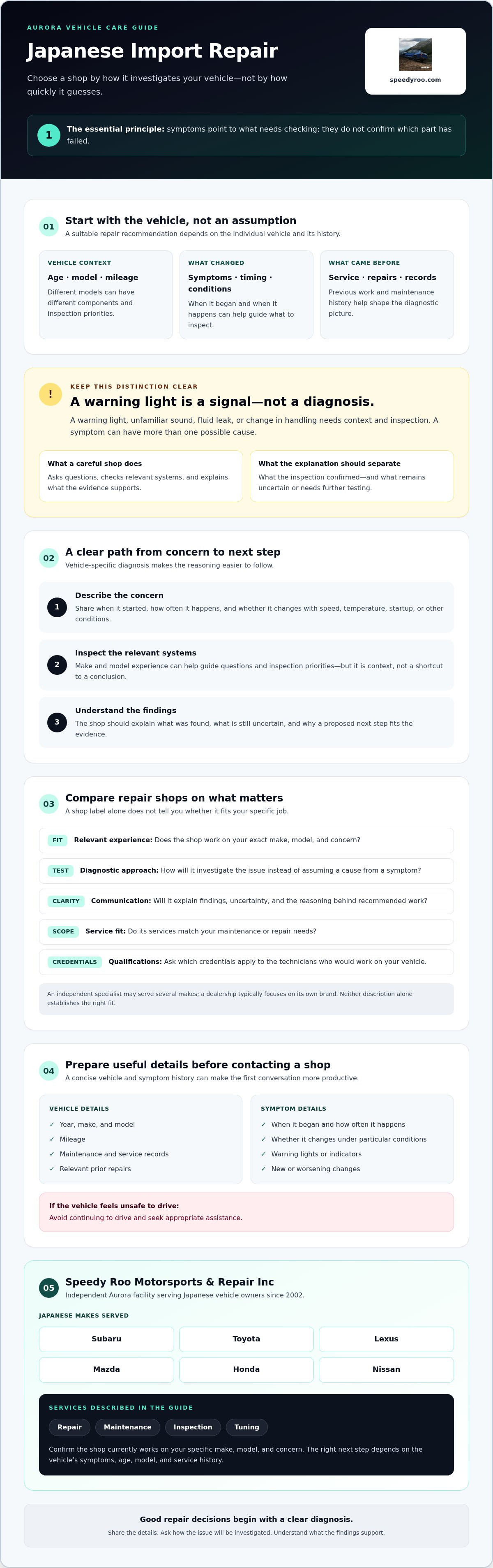
- Japanese import repair Aurora should begin with a vehicle-specific diagnosis, not assumptions based on a symptom alone.
- Compare shops by experience with your exact make and concern, how they explain findings, and whether their services fit your needs.
- Note when symptoms began, how they change, and any warning lights so you can give the shop useful details.
- Your vehicle’s age, model, symptoms, and service history help shape which work may be appropriate.
- Learn which Japanese makes Speedy Roo serves and what its repair, inspection, and tuning services include.
What Japanese import repair Aurora covers and when to seek it
Japanese import repair covers diagnosis, maintenance, and mechanical repair for vehicles made by Japanese manufacturers. An independent specialist may serve several makes, while a dealership typically focuses on its own brand. Neither label alone tells you whether a shop is right for a particular job. Ask whether it works on your vehicle and concern, and how it will investigate the issue.
The recommended work depends on the vehicle’s age, model, symptoms, and service history. A warning light, for example, signals that a system needs attention, but doesn’t identify a failed part by itself. A noise or fluid leak also needs context and inspection before anyone can recommend a repair. Routine maintenance questions differ from new or worsening symptoms, which deserve timely professional assessment.
Which Japanese makes does a specialist repair shop service?
Speedy Roo serves Subaru, Toyota, Lexus, Mazda, Honda, and Nissan owners. That range gives drivers a local option for Japanese import repair Aurora, but it doesn’t mean every model has the same components or diagnostic process. Before arranging service, confirm that the shop currently works on your specific make, model, and concern. Experience with the make can help guide useful questions, but the diagnosis still needs to fit the individual vehicle.
Credentials can be another point to ask about. Technician certification describes one professional credential in the automotive field. Consider it alongside relevant vehicle experience and the shop’s ability to explain its findings.
When should an Aurora driver arrange an inspection?
Contact a repair shop about a warning light, visible fluid leak, unfamiliar sound, or change in handling. Note when it began and whether it happens consistently, during startup, or under particular driving conditions. These details help the shop understand what to inspect, but they can’t confirm the cause without a vehicle-specific assessment.
For routine maintenance, check your owner’s manual and service records, then ask what work is due for your vehicle’s age and history. Don’t treat a new or worsening symptom as a routine service question. If the vehicle feels unsafe to drive, avoid continuing and seek appropriate assistance. A clear description of what you’ve noticed helps a specialist assess the next step without guessing.
Why Japanese vehicle experience matters for Aurora-area diagnosis
Experience with a vehicle make can help a technician ask useful questions and decide what to inspect first. It provides context, not a shortcut to a conclusion. Model year, mileage, maintenance history, and prior repairs all shape the diagnostic picture. A component replaced before may affect how a current symptom is investigated, while service records can clarify what has already been checked.
Symptoms guide testing, but they don’t confirm a diagnosis. A warning light or unusual noise may have more than one possible cause. A careful shop gathers details, checks relevant systems, and explains what the evidence supports before recommending work. That helps distinguish a confirmed issue from a possibility that needs further testing.
What a careful diagnostic process should include
Expect questions about when a symptom began, how often it happens, and whether it changes with speed, temperature, or other conditions. Share warning indicators and available service history. A clear explanation should distinguish what the inspection confirmed from what remains uncertain, so you can understand the reasoning behind the proposed next step.
As you compare Japanese import repair Aurora options, ask about relevant experience and how the shop communicates its findings. Credentials may also be part of your evaluation. The National Institute for Automotive Service Excellence (ASE) provides information about its automotive service credentials. Ask which qualifications apply to the technicians who would work on your vehicle rather than assuming a credential or certification.
Why make and model details matter
Provide the vehicle’s year, make, model, mileage, and relevant maintenance or repair history. Procedures and inspection priorities can differ across makes and models, so a Subaru and a Toyota shouldn’t be treated as interchangeable simply because both are Japanese vehicles. For more focused context, look for make-specific information on Subaru repair and Toyota service, while confirming that any advice fits your exact vehicle.
If you’re preparing to contact a local specialist, having those details ready can make the initial conversation more productive. Speedy Roo has served Japanese vehicle owners in Aurora since 2002. Review its Japanese vehicle repair and service information, then confirm whether the shop currently handles your make, model, and concern.
How to compare Japanese import repair shops near Aurora
A useful comparison starts with fit, not a star rating alone. Check whether a shop works on your exact make, model, and repair concern, then consider how it diagnoses problems and communicates recommendations. Drivers looking for Japanese import repair in Aurora can compare shops in Aurora and nearby Denver, Centennial, Parker, and Lone Tree. Consider travel distance, but don’t assume every shop services every vehicle.
| What to compare | What to ask or look for |
|---|---|
| Make and model experience | Does the shop currently service your specific vehicle and concern? |
| Diagnosis | How will the shop investigate the issue and explain what it finds? |
| Communication | Will findings and recommendations be explained clearly, and will you be asked before additional work? |
| Service fit | Can the shop handle the work you need, and is its location practical for you? |
Questions to ask before choosing a repair shop
Keep the first conversation focused. Ask whether the shop works on your vehicle’s make and model and has experience with the specific concern. Find out how technicians share diagnostic findings and seek your approval before proceeding with additional work. You can also ask which records or details to bring, such as service history, warning-light information, or notes about when a symptom occurs.
How to assess clear and trustworthy recommendations
A well-supported recommendation connects what the shop observed to the work it proposes. Ask what evidence points to the repair, which items are confirmed, and what may need more testing. If several issues are identified, ask which should be prioritized and whether there are reasonable alternatives. Clear answers help you understand the decision without expecting a diagnosis before the vehicle is inspected.
If a concern arises after a repair, keep your estimate, invoice, and communications, then contact the shop to discuss it. USAGov offers information about consumer rights in auto repair and options for raising a complaint. To assess common claims and ask more informed questions, you can also read a guide to Japanese import repair myths.
What to prepare before booking Japanese import repair in Aurora
Gathering a few details before contacting a shop makes the first conversation more useful. It helps the team understand what you’re experiencing and whether it works on your vehicle and concern. Preparation supports a thorough diagnosis, but it can’t replace an in-person inspection or confirm the cause of a symptom.
Vehicle details and symptoms to share
Write down the basics and describe what you’ve noticed in plain language. A short record can help you recall details accurately when you speak with the shop.
- Identify the vehicle: Note its make, model, year, and current mileage. Mention any modifications that could be relevant.
- Describe the concern: Record sounds, warning lights, visible leaks, or changes in how the vehicle starts, accelerates, brakes, or handles.
- Track the pattern: Note when the symptom began, how often it appears, and the conditions when it occurs. Include whether it’s intermittent or getting worse.
For example, “a noise” is less useful than noting that a sound occurs during a turn or only after the vehicle has been driven for a while. You don’t need to identify the cause. Share your observations, then let the inspection guide the diagnosis.
Records and questions to bring
Gather available maintenance records and note recent repairs, replaced parts, or work performed elsewhere. Even an incomplete history can provide context. Before the appointment, prepare questions about what the inspection will cover, how the findings will be explained, and what the recommended next steps are. Ask how the shop will distinguish confirmed issues from anything that needs further testing.
If you’re considering a used vehicle, tell the shop that the assessment is before purchase and ask about its pre-sale inspection service. A pre-purchase assessment has a different purpose from investigating a specific symptom on a vehicle you already own, so clarify what you hope to learn.
These notes are useful whether you’re contacting a shop in Aurora or elsewhere nearby. Drivers seeking Japanese import repair in Aurora should confirm that the shop currently handles their exact make, model, and concern. Speedy Roo offers pre-sale inspections and serves Japanese vehicle owners in Aurora. Contact Speedy Roo about your vehicle and inspection needs, and have your vehicle details and symptom notes ready for the conversation.
Japanese import repair at Speedy Roo: from diagnosis to next steps
Speedy Roo Motorsports & Repair Inc is an independent Aurora shop that has served Japanese vehicle owners since 2002. For drivers considering Japanese import repair in Aurora, the shop offers a local place to ask about a specific vehicle and concern. It works with Subaru, Toyota, Lexus, Mazda, Honda, and Nissan vehicles, though service suitability can vary by model and repair need.
Its services include diagnostics, mechanical repairs, maintenance, pre-sale inspections, and performance dyno tuning. That range covers different needs, from investigating a vehicle concern to assessing a car before purchase. Confirm directly that the shop currently handles your particular year, model, and requested service.
What Speedy Roo’s Japanese vehicle experience means
Working with a defined group of makes can help inform which questions to ask and what details to consider during an inspection. It doesn’t mean every vehicle follows the same repair procedure or that a particular outcome is assured. Share what you’ve noticed and any relevant service history, then look for an explanation that connects the diagnostic findings to the recommended next steps. Clear communication helps you understand what’s confirmed and what may need additional investigation.
Speedy Roo’s Japanese vehicle focus includes six makes, but your vehicle’s individual history still matters. The year, model, mileage, modifications, and previous work can all provide useful context. Bring those details into the conversation rather than relying on make alone to determine what your vehicle needs.
How to take the next step with a local repair shop
Before arranging service, have your vehicle’s make, model, year, and mileage ready. Describe when the symptom began, how it changes, and whether any warning lights are displayed. Mention service records or recent repairs too. This information can help the shop assess whether the concern fits its current services, but it doesn’t replace a professional inspection.
Ask what to expect from the inspection, how findings will be explained, and how appointment arrangements are handled. You don’t need to know the cause before reaching out. A straightforward account of what the vehicle is doing gives the shop a useful starting point and lets you confirm fit before moving forward.
If you’d like to discuss your vehicle, symptoms, or service history, contact Speedy Roo about your Japanese vehicle and confirm whether the shop can address your specific concern.
Choose Your Next Step with Confidence
The right Japanese import repair option in Aurora should be able to assess your specific vehicle, explain what the evidence shows, and make recommendations you can understand. Before choosing a shop, confirm that it works on your make, model, and concern. Bring clear notes about symptoms, warning lights, recent repairs, and service history to make the conversation more useful.
Speedy Roo Motorsports & Repair Inc is an independent Aurora repair facility serving Japanese vehicle owners since 2002. Its service experience includes Subaru, Toyota, Lexus, Mazda, Honda, and Nissan. Confirm current service fit for your vehicle and repair need.
Ready to discuss what your vehicle is doing? Contact Speedy Roo to discuss your Japanese vehicle. A clear description and the right questions can help you take the next step with confidence.
Frequently Asked Questions
What is Japanese import repair?
Japanese import repair covers maintenance, diagnosis, and mechanical repair for vehicles from Japanese makes. Appropriate work depends on the vehicle’s model year, symptoms, condition, and service history. Before booking, confirm that the shop services your specific make and concern. The term “specialist” alone doesn’t establish experience with every vehicle, identify the cause of a problem, or guarantee a particular repair outcome.
Can a general mechanic repair a Japanese car?
Yes, a general repair facility may service Japanese vehicles, but ask about experience with your specific make and repair concern. Find out how the shop plans to investigate the issue and explain its findings. Before work proceeds, clarify how recommendations and additional work will be communicated for your approval. A dealership or specialist isn’t automatically the only option; the vehicle’s condition and the technician’s relevant experience matter.
How do I find a Japanese car mechanic in Aurora?
Start by checking which makes and models a shop services and whether it handles your reported concern. Call with the vehicle’s year, model, mileage, and symptoms, then ask how diagnostic results are explained. Drivers looking for Japanese import repair in Aurora can compare options in Aurora and nearby Denver, Centennial, Parker, and Lone Tree. Consider travel distance, and confirm current service availability for your vehicle directly with the shop.
What information should I give a mechanic about my Japanese car?
Share the vehicle’s make, model, year, mileage, and any warning lights, along with a clear description of what you’ve noticed. Note when symptoms began, whether they come and go, and what conditions affect them, such as starting or turning. Bring available maintenance and repair records. These details can help the shop plan its inspection, but a technician must assess the vehicle before confirming a cause or recommending repairs.
Does Japanese import repair include routine maintenance?
It can include routine maintenance as well as diagnosis and mechanical repair, depending on the shop and vehicle. Ask whether the facility services your specific make and model, and discuss what maintenance fits the vehicle’s condition and service history. Your owner’s manual is a useful reference, but avoid relying on a generic interval alone. Share how the vehicle is used and what work has already been completed with a qualified technician.
Is a pre-sale inspection the same as a repair appointment?
No. A pre-sale inspection assesses a vehicle’s condition to help inform a purchase decision. A repair appointment typically focuses on investigating a known concern or addressing a service need. The purpose and scope differ, so ask what the inspection includes and whether the shop handles that particular vehicle. Find out how observations will be communicated, and consider the findings alongside other information before deciding whether to buy.
Does Speedy Roo repair Subaru, Toyota, Honda, Nissan, Mazda, and Lexus vehicles?
Yes. Speedy Roo’s listed Japanese vehicle services include repair and maintenance for Subaru, Toyota, Honda, Nissan, Mazda, and Lexus. The shop is an independent repair facility in Aurora and has served Japanese vehicle owners since 2002. Service suitability can depend on the specific model and concern, so contact the shop with your vehicle’s year, model, and symptoms to confirm current availability for the work you need.