
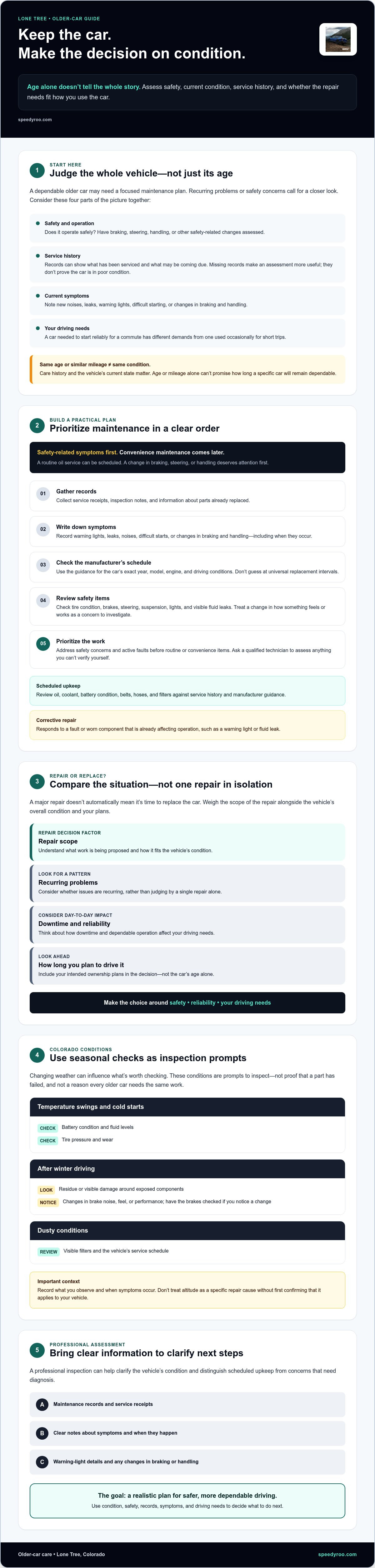
What matters more than a car’s age is whether its condition and repair needs still make sense. For drivers keeping an old car running Lone Tree roads, age alone doesn’t tell the whole story. A dependable older car may need a focused maintenance plan, while recurring problems or safety concerns can call for a closer look.
It’s understandable to wonder which repairs are urgent, whether another repair is worthwhile, and how Colorado’s changing seasons affect wear. This guide explains how to assess your car’s condition, prioritize maintenance, and recognize symptoms that call for prompt professional diagnosis. It also offers a practical way to compare continued repairs with replacement, based on safety, reliability, and your driving needs rather than age alone.
We’ll cover which maintenance items to review first, why seasonal checks matter in Colorado, and how a professional inspection can clarify your vehicle’s condition. The goal is a realistic plan for safer, more dependable driving around Lone Tree and a clearer decision about what to do next.
Key Takeaways
- For keeping an old car running Lone Tree, assess its safety and overall condition rather than judging it by age alone.
- Use service records, current symptoms, and the manufacturer’s maintenance schedule to build a practical repair priority list.
- A major repair doesn’t automatically mean it’s time to replace the car. Consider the repair scope, recurring problems, downtime, and how long you plan to drive it.
- Seasonal checks can help you spot wear after Colorado’s changing weather, but every older vehicle has different needs.
- Bring maintenance records and clear notes about symptoms and warning lights to a professional assessment to help clarify next steps.
Keeping an Older Car Running in Lone Tree Starts With Its Condition
Want to keep a familiar car dependable without turning ownership into a restoration project? Start with what the vehicle needs now, not its age or odometer reading alone. For keeping an old car running Lone Tree roads, consider whether it operates safely, whether its service history is reasonably clear, and whether its repair needs fit its condition and your driving habits.
Routine maintenance follows the vehicle’s service schedule to help preserve its condition. Corrective repair addresses a fault or worn component that is already affecting operation. Both matter, but they answer different questions: what upkeep is due, and what needs attention because a problem has appeared?
What matters more than the model year or odometer
Look at the whole picture: service records, current symptoms, structural condition, and how you use the car. A commuter that needs to start reliably each morning has different demands from a vehicle used occasionally for short trips. Note changes such as new noises, leaks, warning lights, difficult starting, or altered braking and handling. These details help distinguish predictable upkeep from unresolved concerns.
History matters because two cars of the same model year and similar mileage may have received very different care. Regular maintenance records can show what has been serviced and what may be coming due. Missing records don’t prove a vehicle is in poor condition, but they make a thorough assessment more useful. General overviews of motor vehicle service can explain common maintenance tasks. For exact intervals, use the manufacturer’s schedule for your car’s year, model, engine, and driving conditions. Age or mileage alone can’t promise how long a specific vehicle will remain dependable.
How Lone Tree and Colorado driving shape inspection priorities
Local conditions are useful prompts for inspection, not proof that a particular part has failed. Temperature swings and cold starts make it sensible to check battery condition, fluid levels, and tire pressure and wear. After winter driving, look for residue or visible damage around exposed components. Have the brakes checked if you notice a change in noise, feel, or performance. Dusty conditions are another reason to keep an eye on visible filters and follow the vehicle’s service schedule.
These checks don’t mean every older car needs the same work. Record what you observe, note when symptoms occur, and ask for a closer diagnosis if a safety concern appears. Don’t treat altitude as a specific repair cause without first confirming that it applies to your vehicle.
Build an Older-Car Maintenance Plan Around Safety and Service History
A useful maintenance plan turns scattered concerns into a clear order of action. Start with safety, then use the car’s records and the manufacturer’s schedule to decide what’s due. For keeping an old car running Lone Tree drivers can rely on, avoid replacing parts just because a vehicle has reached a certain age or mileage. Follow the schedule for its exact year, model, engine, and driving conditions, and have uncertain items assessed instead of guessing at universal replacement intervals.
Safety-related symptoms should be assessed before convenience maintenance. A routine oil service can be scheduled. A change in braking, steering, or handling deserves attention first.
A practical order for reviewing maintenance
- Gather records. Collect service receipts, inspection notes, and information about parts already replaced.
- Write down symptoms. Note warning lights, leaks, noises, difficult starts, or changes in braking and handling, including when they occur.
- Check the maintenance schedule. Compare the car’s records with the manufacturer’s guidance for its specific configuration and use.
- Review safety items. Check tire condition, brakes, steering, suspension, lights, and visible fluid leaks. If something feels or works differently, treat it as a concern to investigate, not just a routine service reminder.
- Prioritize the work. Address safety concerns and active faults before planning routine or convenience items. Ask a qualified technician to assess anything you can’t verify yourself.
Separate scheduled upkeep from symptoms
Review oil, coolant, battery condition, belts, hoses, and filters against the service history and manufacturer guidance. Corrective repair is different: it responds to a problem such as a warning light, fluid leak, new noise, or change in handling. Record the exact symptom and when it happens. “A noise during cold starts,” for example, gives a technician more useful context than “it sounds different.”
Make the service history useful
Keep a simple log with the date, mileage, completed work, recurring symptoms, and upcoming scheduled service. This can help a technician determine whether the same concern has returned or separate problems are appearing. If you drive a Japanese make, Speedy Roo Motorsports & Repair Inc is an Aurora-based shop serving Lone Tree-area drivers. Its guide to Japanese vehicle repair offers additional context for owners of those vehicles.
It’s also useful to plan for unexpected stops. Ready.gov’s emergency supply kit in your car checklist can help you prepare, especially before seasonal travel.
Repair or Replace? Compare an Older Car’s Safety, Reliability, and Value
A large repair doesn’t automatically make an older car a poor choice. Consider whether the repair addresses a defined problem in a vehicle that remains safe and suitable for your needs, or whether it’s one issue in a pattern of growing concerns. For keeping an old car running Lone Tree drivers can depend on, weigh the whole vehicle and your expected use rather than judging by one repair estimate in isolation.
Before authorizing substantial work, ask for written diagnostic findings and a clear explanation of the repair options. The NHTSA’s “Get Your Car Serviced” guidance also highlights the importance of safety-related items such as brakes and tires. A written assessment can help you understand which concerns affect safe operation and which can be planned for later.
When continued repairs may be a reasonable choice
Continuing to maintain a car may make sense when its structure is sound, its problems are understood and manageable, and its service outlook is clear. Consider whether it meets your transportation needs, how disruptive repairs and downtime may be, and whether you’re prepared to keep up with scheduled maintenance. A defined repair on an otherwise dependable vehicle is different from repeated failures with no clear pattern or resolution.
For Subaru owners weighing their next steps, Speedy Roo Motorsports & Repair Inc is an Aurora-based shop serving Lone Tree-area drivers. Its page on Subaru repair expertise in Aurora offers a relevant specialist resource.
When to pause and reassess the vehicle’s future
Pause before committing if the car has unresolved safety concerns, the same fault keeps returning, or several systems need attention around the same time. Ask for an assessment of the vehicle as a whole, including its overall condition and any other issues that could affect reliability. This puts the proposed repair in context instead of treating it as an isolated decision.
A technician can diagnose the vehicle and explain the risks and repair choices. You decide whether the resulting plan fits your finances, schedule, and need for dependable transportation. Compare the repair’s scope, the chance of recurring problems, likely downtime, and your expected use with what replacing the car would mean for you. There’s no universal threshold that makes repair or replacement the right answer. A clear diagnosis gives you a better basis for choosing.
If you own a Subaru and want to discuss a diagnosis or repair plan, explore Subaru repair and service options from Speedy Roo Motorsports & Repair Inc.
A Lone Tree Driver’s Seasonal Checklist for Older-Car Reliability
Colorado’s changing temperatures, winter road treatment, and dusty conditions are good reasons to inspect an older car periodically. They don’t mean a specific part has failed. Use seasonal checks to spot changes, then follow your vehicle’s manual for fluid specifications and maintenance intervals. This makes keeping an old car running Lone Tree roads more manageable without treating every car as if it needs the same work.
Checks to make before colder weather
Before winter driving, review the items you rely on for starting, visibility, and control. Check tire condition and pressure, lights, wipers, and battery performance. Look for visible wear or damage on hoses, and check coolant condition according to the owner’s manual. Don’t open a hot cooling system. If you’re unsure what you’re seeing, ask a technician to assess it.
Pay attention to how the car brakes, steers, and rides. A new pull while braking, loose steering feel, or unusual suspension noise is a reason to arrange an assessment before relying on the vehicle in winter conditions. Speedy Roo Motorsports & Repair Inc is based in Aurora and serves Lone Tree-area drivers. For Toyota owners, its Toyota specialist guide for Aurora offers make-specific information.
What to note after severe weather
After a severe storm or a stretch of rough road conditions, look for new tire damage, fresh fluid spots, or visible damage to exposed components. Note any change in how the car starts, runs, brakes, or handles. Weather is a reason to check, not proof that a component has been damaged.
- Seek prompt professional assessment if a warning light appears alongside a serious change in operation, the engine overheats, braking or steering changes affect control, or a new leak appears significant.
- Add it to your next service list if you notice a minor change that doesn’t affect safe operation, such as a new but intermittent sound. Record when it happens and arrange an assessment rather than assuming it will go away.
Useful notes include the temperature, speed, road conditions, and whether the symptom occurs during starting, braking, turning, or steady driving. If the car’s control or safe operation is affected, stop driving when it’s safe to do so and seek help before continuing. If seasonal checks or a symptom raise questions about your Toyota, ask about Toyota repair and service from Speedy Roo Motorsports & Repair Inc.
Get a Professional Assessment for Keeping an Old Car Running Near Lone Tree
A professional assessment can turn uncertainty into a clearer set of next steps. It can help identify the vehicle’s current condition, safety concerns, and repair priorities, but it can’t guarantee how long the car will last. For keeping an old car running Lone Tree drivers can depend on, the goal is an informed plan, not a promise that every repair will be worthwhile.
Prepare before the appointment. Bring available maintenance records, a written list of symptoms, and details about warning lights, including when they appeared and whether they stayed on or came and went. Be ready to explain how you use the car, such as for daily commuting, occasional trips, or longer drives. Your priorities matter: a useful plan should reflect the vehicle’s condition and the kind of dependable transportation you need.
What to expect from a useful vehicle assessment
Ask the technician to explain what was checked, what the findings mean, and which concerns affect safe operation. If several items need attention, request a clear sequence: what needs prompt attention, what should be handled next, and what can be monitored. Ask how each recommendation relates to the symptom or service history you reported. That conversation helps you make choices without treating every finding as equally urgent.
If a concern needs further testing, ask what additional information or evaluation is needed before deciding on a repair. The scope of an assessment can depend on the vehicle and its symptoms, so confirm the details with the shop rather than assuming a particular diagnosis or appointment availability.
Choose a specialist familiar with your vehicle
Experience with a vehicle’s make can help a technician interpret recurring or model-specific concerns in context. Speedy Roo Motorsports & Repair Inc is an independent shop based in Aurora, serving Lone Tree-area customers. Since 2002, the shop has focused on Japanese makes, including Subaru, Toyota, Lexus, Mazda, Honda, and Nissan. That experience may be relevant if your older car is one of these brands, but an assessment should still be based on the condition of your specific vehicle.
Bring your notes, ask questions, and take time to compare the findings with your driving needs. If you own a Japanese vehicle and would like to discuss service or an assessment, contact Speedy Roo about Japanese vehicle service. A clear conversation can help you decide what to address now, what to plan for, and whether continued ownership fits your needs.
Make Your Next Step a Clear, Condition-Based Plan
Keeping an old car running Lone Tree roads starts with its condition, not its model year or odometer reading. Use service history and current symptoms to prioritize safety concerns, follow the manufacturer’s maintenance schedule, and account for seasonal checks. When deciding whether to repair or replace, consider the vehicle’s overall condition, the scope and recurrence of repairs, and how you rely on it day to day.
A professional assessment can help clarify what needs attention now, what can be monitored, and what to consider before authorizing substantial work. It won’t guarantee a car’s future, but it can give you a more informed basis for deciding.
Speedy Roo Motorsports & Repair is an independent shop in Aurora serving customers in Lone Tree, Denver, Centennial, and Parker. The team has served customers since 2002 and specializes in Subaru, Toyota, Lexus, Mazda, Honda, and Nissan vehicles. If your car is one of these makes, talk with Speedy Roo about a practical repair plan and take the next step with a clearer picture of your options.
Frequently Asked Questions
Is it worth keeping an old car running?
It can be, if the car is safe, its condition is understood, and its maintenance needs fit your budget and transportation needs. Age and mileage alone don’t settle the question. Consider the vehicle’s overall condition, the type and frequency of repairs, and whether problems are recurring. A professional assessment can help clarify the car’s needs, but the decision to keep or replace it depends on your circumstances.
Can regular maintenance make an older car last longer?
Following the manufacturer’s maintenance schedule can help keep an older car in good operating condition, though it can’t guarantee a specific lifespan. For keeping an old car running Lone Tree drivers can depend on, use the schedule for the exact year, model, engine, and driving conditions. Keep records of completed services, and address warning lights, leaks, unusual noises, or changes in braking and handling rather than waiting for the next routine service.
How often should I have an older car inspected?
Follow the manufacturer’s service schedule and arrange an assessment when symptoms appear or the car’s condition is uncertain. There isn’t one inspection interval that fits every older vehicle. An inspection may also be useful before seasonal driving or after severe weather if you notice damage or a change in how the car operates. A technician familiar with your make can help determine what needs attention and what can wait.
What should I check before driving an older car in winter near Lone Tree?
Check tire condition and pressure, battery performance, lights, wipers, coolant condition, and visible hoses. Use the owner’s manual for fluid specifications and maintenance intervals. Pay attention to braking, steering, and suspension changes, and ask a technician to assess concerns before winter driving. Lone Tree’s seasonal conditions are a prompt to inspect, not proof that a specific part has failed. Record any new symptoms and when they occur.
When should I stop driving an older car and call a mechanic?
Stop driving when a symptom affects safe control or operation, such as a major change in braking or steering, engine overheating, or a serious new warning. If you can, move to a safe place before arranging help. Don’t ignore a fresh fluid leak, unusual noise, or vibration, especially if it worsens. Describe what happened, when it started, and the driving conditions so a technician can assess the concern.
Should I repair an old car or replace it?
Compare the car’s safety, overall condition, repair scope, recurrence risk, and expected downtime with how you plan to use it. A major repair doesn’t automatically make an older vehicle a poor choice, but unresolved safety problems or repeated failures call for a closer review. Ask for clear diagnostic findings and repair priorities before authorizing substantial work. Speedy Roo is based in Aurora and serves drivers in Lone Tree, Denver, Centennial, and Parker.