
Your Nissan’s Continuously Variable Transmission (CVT) is a sophisticated piece of engineering that doesn’t play by the same rules as traditional gearboxes. If you’re driving through the South Metro Denver area, you likely already know that Colorado’s steep grades and temperature swings put immense pressure on your vehicle. It’s perfectly normal to feel a bit of anxiety when you hear horror stories about CVT failures or see the high service quotes from the local dealership. Finding a reliable shop for a Nissan transmission fluid change Lone Tree drivers can depend on shouldn’t be a source of stress.
We understand that you want to keep your car on the road without overpaying for essential maintenance. This guide will show you why specialized care from a Japanese import expert is the most effective way to protect your investment and ensure your Nissan shifts smoothly for years to come. We’ll explore the critical difference between a standard flush and a proper fluid change, how our technicians handle these delicate systems, and why an independent specialist offers the honest transparency you deserve.
Key Takeaways
- Understand how Lone Tree’s unique elevation and heavy I-25 traffic patterns place additional stress on your Nissan’s transmission system.
- Learn to recognize early warning signs like delayed engagement and unusual noises to prevent minor issues from becoming major repairs.
- Discover why Nissan CVT systems require specialized, high-friction fluid to maintain the integrity of their steel belts and pulleys.
- Determine the ideal maintenance schedule for a Nissan transmission fluid change Lone Tree drivers can rely on to ensure smooth shifting and long-term performance.
- See how partnering with a Japanese import specialist provides a transparent and meticulous alternative to standard dealership maintenance.
Understanding Nissan Transmission Fluid Needs in Lone Tree & South Denver
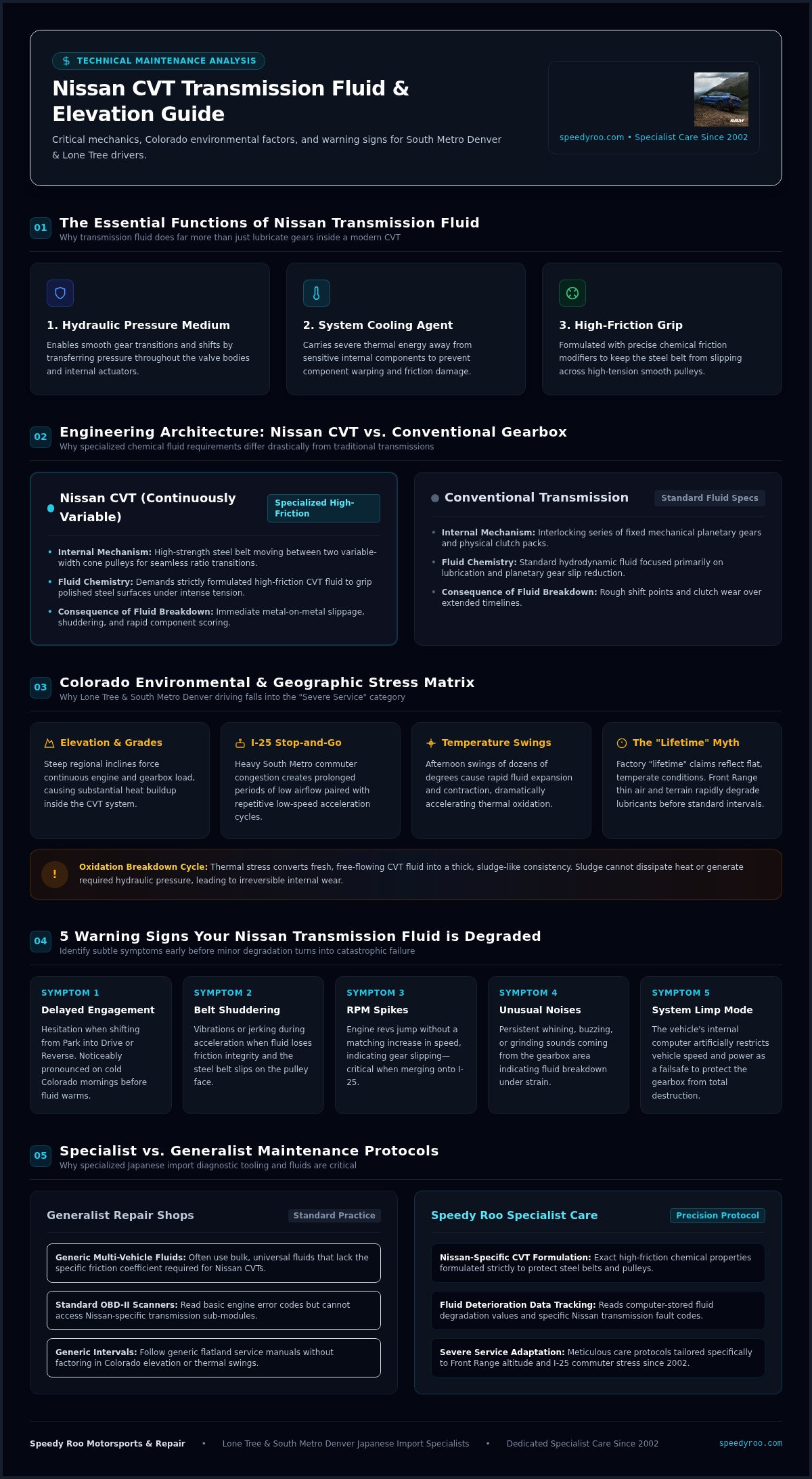
Transmission fluid serves as more than just a lubricant for your Nissan; it functions as a vital hydraulic fluid and a cooling agent. Inside the gearbox, this fluid enables smooth gear transitions while carrying heat away from sensitive internal components. When the fluid remains clean and effective, your car performs efficiently. However, when it breaks down, the friction and heat can quickly lead to irreversible damage. This is especially true for the specialized systems found in modern Japanese imports.
Driving in Lone Tree presents a specific set of challenges that most vehicle owner’s manuals don’t fully account for. The heavy stop-and-go congestion on I-25 and the constant elevation changes throughout the South Metro area mean your engine and transmission are under nearly continuous stress. Every time you accelerate up a steep grade or crawl through rush-hour traffic, your transmission generates significant heat. For many local drivers, a regular Nissan transmission fluid change Lone Tree service is the most effective way to counter these environmental demands.
Most modern Nissan models rely on a continuously variable transmission (CVT) rather than a traditional automatic gearbox. While a conventional transmission uses a series of fixed gears, a CVT utilizes a high-strength steel belt and pulley system to provide seamless acceleration. This design is highly efficient but requires a very specific type of high-friction fluid. If the fluid loses its integrity, the belt can slip, leading to the “shuddering” sensation many Nissan owners fear.
You may have heard the term “lifetime fluid” used by dealerships or in marketing materials. In the context of Colorado’s high-altitude driving, this claim is often misleading. Manufacturer “lifetime” ratings are typically based on ideal conditions in flat, temperate climates. In reality, the thin air and mountainous terrain of the Front Range shorten the effective life of any lubricant. Waiting until a “lifetime” is over usually means waiting until the transmission fails entirely.
The Impact of Colorado’s Climate on Your Gearbox
Our local climate is famous for extreme temperature swings, sometimes shifting dozens of degrees in a single afternoon. These rapid cycles cause transmission fluid to expand and contract, which can accelerate the process of oxidation. Oxidation is the primary enemy of your gearbox; it turns the fluid into a thick, sludge-like consistency that can’t cool the system properly. Because of our local geography, most Lone Tree residents fall into the “Severe Service” maintenance category, which necessitates more frequent inspections than the standard intervals suggested for flatter states.
Specialist Care vs. Generalist Repair
Selecting a Japanese import repair in Aurora specialist ensures your vehicle receives care tailored to its unique engineering. Generalist shops often use “multi-vehicle” fluids that lack the precise chemical properties required for a Nissan CVT. We utilize diagnostic equipment that reads Nissan-specific transmission codes and monitors “fluid deterioration” data points stored in your car’s computer. Since 2002, we’ve focused on providing this level of meticulous, specialized care as a trustworthy alternative to the dealership experience.
Warning Signs Your Nissan Needs a Transmission Fluid Service
Identifying a transmission issue early can be the difference between a simple fluid service and a multi-thousand dollar replacement. For many drivers, the first sign of trouble isn’t a loud bang, but a subtle change in how the car responds to your inputs. If you notice a “hesitation” or delayed engagement when shifting from Park into Drive or Reverse, your fluid may no longer be providing the necessary hydraulic pressure. This lag is often more pronounced on cold mornings in Lone Tree, where the fluid needs to reach operating temperature before it flows correctly.
Unusual noises are another red flag. A healthy Nissan CVT should operate quietly; if you hear a persistent whining, buzzing, or grinding sound coming from the transmission area, it’s a sign that the internal components are struggling. Similarly, if your RPMs suddenly spike without a corresponding increase in speed, your gears are “slipping.” This is particularly dangerous when merging onto a busy highway like I-25. In extreme cases, your car might enter “Limp Mode,” where the computer limits your speed to protect the system from a total mechanical failure. If you experience these symptoms, scheduling a Nissan transmission fluid change Lone Tree service should be your immediate priority.
Visual and Olfactory Indicators
You don’t always need a computer to diagnose a problem. If your Nissan is equipped with a dipstick, check the fluid’s color and smell. Fresh Nissan fluid is typically a translucent amber, green, or blue depending on the specific model. If the fluid appears dark brown or black, it’s heavily oxidized and full of contaminants. A distinct “burnt toast” smell is an even more urgent warning, indicating that the fluid has overheated and lost its protective properties. You should also watch for leaks on your driveway; transmission fluid is usually thinner than engine oil and carries a sharp, chemical scent.
When the Warning Light Comes On
Modern Nissans use sophisticated sensors to monitor fluid temperature and pressure. A “Check Engine” light or a specific transmission warning light means the onboard computer has detected a fault code. Ignoring these warnings in a CVT is risky, as the system can deteriorate rapidly once the fluid fails. If you’re considering buying a used vehicle, a pre-sale vehicle evaluation in Aurora can identify these hidden issues before you sign the paperwork. Our technicians use professional-grade scanners to pull historical data that a standard dashboard light might not show. If you’re worried about your current vehicle’s performance, consulting with a Japanese import specialist can provide the clarity you need to stay on the road safely.
Nissan CVT vs. Conventional Transmission: Why Fluid Quality Matters
To understand why a specialized Nissan transmission fluid change Lone Tree service is so critical, you have to look at what’s happening inside the case. Most vehicles on the road use traditional automatic transmissions that rely on a complex set of planetary gears. Nissan, however, has championed the Continuously Variable Transmission (CVT) for decades. Instead of heavy metal gears, a CVT uses a high-strength steel belt and two variable-diameter pulleys. This design allows for infinite gear ratios, providing a smoother ride and better fuel economy, but it places unique demands on the lubricant.
In a traditional gearbox, the fluid’s primary job is to reduce friction. In a Nissan CVT, the fluid must provide enough friction to ensure the steel belt doesn’t slip against the pulleys while simultaneously lubricating the rest of the system. If the fluid is too slippery, the belt slides, causing the dreaded “shudder” and eventually destroying the pulley faces. This delicate chemical balance is why using the correct fluid isn’t just a recommendation; it’s a mechanical necessity for the survival of the unit.
Many general repair shops attempt to simplify their inventory by using “universal” transmission fluids. While these products claim to work in everything, they often lack the specific frictional properties required by Nissan’s engineering. We frequently see the aftermath of these “one-size-fits-all” solutions, where the wrong chemical additives have led to premature wear or erratic shifting. For a Nissan transmission fluid change Lone Tree drivers can trust, using OEM-spec fluids like Nissan NS-2 or NS-3 is the only way to guarantee the transmission operates within its designed parameters.
The Evolution of Nissan CVT Technology
Nissan has refined its CVT technology significantly since its introduction. Older models typically required NS-2 fluid, while newer versions, including the 2026 models, have moved toward the lower-viscosity NS-3 fluid to improve efficiency and cooling. These fluids are not interchangeable. Our technicians stay current with Nissan’s technical service bulletins (TSBs), which often update fluid requirements or software calibration needs based on real-world performance data. This specialized knowledge ensures that your vehicle receives the exact version of the fluid it was engineered to use.
The Dangers of Incorrect Fluid
Using fluid with the wrong viscosity can lead to “belt chatter,” a vibration that occurs when the belt struggles to grip the pulleys. Over time, this chatter creates microscopic grooves in the pulley surfaces, eventually requiring a total transmission replacement. The long-term cost of saving a few dollars on sub-par fluid is never worth the risk of a multi-thousand dollar repair. At Speedy Roo, we maintain a strict commitment to using only high-quality, Nissan-compatible fluids that meet or exceed factory standards, ensuring your vehicle remains reliable on Colorado’s demanding roads.
Transmission Flush vs. Fluid Change: Which Is Right for Your Nissan?
When you bring your vehicle in for service, you’ll likely hear two different terms: a fluid change and a transmission flush. A standard “drain and fill” involves removing the drain plug and replacing the fluid that naturally exits the pan, which typically accounts for 30% to 50% of the total volume. While this is a great way to refresh the system, it leaves a significant amount of old fluid trapped in the torque converter and cooler lines. For a routine Nissan transmission fluid change Lone Tree drivers often choose this method as part of a more frequent maintenance schedule.
A transmission flush is a more comprehensive procedure. We use specialized equipment to exchange 100% of the old, degraded fluid with fresh, high-quality lubricant. This process also cleans the cooler lines, ensuring that no sludge or contaminants remain to circulate through your freshly serviced gearbox. However, the choice between these two methods isn’t always simple. We carefully assess your vehicle’s mileage, service history, and current fluid condition before recommending the best path forward for your specific Nissan model.
Assessments for High-Mileage Nissans
If a Nissan has gone a long time without service, a high-pressure flush can sometimes be counterproductive by dislodging debris that was previously settled. An experienced Toyota specialist in Aurora who also possesses deep knowledge of Nissan CVTs will always perform a visual inspection first. If the fluid is extremely dark or contains a high concentration of debris, the “Safe Bet” approach of multiple drain-and-fill cycles is often the more responsible choice. During this process, we drop the transmission pan to inspect the internal magnets. These magnets are designed to catch microscopic metal shavings; seeing what they’ve collected gives us a clear window into the actual health of your internal pulleys and belts.
The Speedy Roo Recommendation
Our methodical process focuses on the long-term health of your vehicle rather than a quick service sale. We believe in transparency, which is why we’ll show you the condition of your fluid and explain the reasoning behind our service plan. A transmission flush is a preventative measure for vehicles with a documented service history. By staying ahead of fluid degradation, you can avoid the costly repairs associated with CVT failure. If you’re unsure which service your car needs, we invite you to schedule a professional transmission evaluation with our specialized team to ensure your Nissan remains reliable for years to come.
Expert Nissan Transmission Service at Speedy Roo Motorsports & Repair
Since 2002, Speedy Roo Motorsports & Repair has operated as a specialized alternative to the high-pressure environment of dealership service departments. We recognize that Lone Tree drivers face unique challenges, from the steep inclines of the South Metro area to the grinding traffic on I-25. Choosing us for your Nissan transmission fluid change Lone Tree means partnering with technicians who understand these variables intimately. We don’t just perform a service; we apply over two decades of Japanese import expertise to ensure your vehicle remains a reliable asset for your daily commute.
When you visit our Aurora facility, you can expect a process rooted in transparency and precision. Every appointment begins with a thorough digital inspection. We provide you with a clear report of our findings, including photos and technician notes, so you can see exactly what we see. This methodical approach allows us to identify potential issues before they escalate into expensive repairs. Whether you are coming in specifically for CVT care or integrating it into a broader maintenance plan that includes Subaru repair in Aurora for your family’s other vehicles, our goal is consistent excellence.
Localized Expertise for Lone Tree Drivers
Our “Expert Neighbor” philosophy means we treat every customer like a member of our community. We provide honest, actionable advice without the aggressive sales tactics often found at larger franchises. Because we are located in Aurora, we are perfectly positioned to serve residents from Lone Tree, Parker, and Centennial who want specialist care without the dealership price tag. We help you map out a long-term maintenance schedule, allowing you to budget for future needs and avoid the stress of surprise repair bills. This level of planning is essential for maintaining the high standards of Japanese engineering found in your Nissan.
Booking Your Nissan Service
We believe that with the right care, a modern Nissan can easily surpass the 200,000-mile mark. Achieving that longevity requires a commitment to using the correct fluids and following a precise service rhythm. Scheduling your appointment is straightforward, and our team is always ready to answer your technical questions with clarity and respect. We take pride in our craft and in the relationships we’ve built with Colorado drivers over the last 20 years. Don’t wait for a warning light to appear before taking action. Schedule your Nissan transmission service at Speedy Roo today!
Protect Your Nissan’s Performance on Colorado Roads
Maintaining your Nissan’s transmission is the most effective way to ensure its longevity in our demanding climate. We’ve explored how the unique mechanics of a CVT require specific, high-friction fluids and why ignoring early warning signs like hesitation or whining can lead to expensive failures. Whether your driving habits call for a comprehensive flush or a strategic drain and fill, the key is consistent, expert-led care that accounts for the elevation and traffic patterns of the South Metro area.
For a Nissan transmission fluid change Lone Tree drivers can rely on, Speedy Roo Motorsports & Repair provides a transparent, independent alternative to the dealership. Since 2002, we’ve specialized in Japanese imports, offering the technical precision your CVT needs with the approachable service of an expert neighbor. Our team in Aurora is dedicated to keeping your vehicle shifting smoothly for the long haul.
Book Your Nissan Transmission Service at Speedy Roo today to give your car the specialized attention it deserves. We look forward to helping you stay on the road with confidence.
Frequently Asked Questions
How often should I change the transmission fluid in my Nissan CVT?
You should ideally change your fluid every 30,000 to 60,000 miles. While some manuals suggest longer intervals, driving in Lone Tree often qualifies as severe service due to our high elevation and heavy traffic on I-25. Regular inspections are critical because heat is the primary cause of CVT failure. Staying on a proactive schedule is the best way to ensure your Nissan transmission fluid change Lone Tree service prevents expensive internal wear.
Will a transmission fluid change fix my Nissan CVT that is already slipping?
Unfortunately, a fluid change is a preventative measure rather than a mechanical repair. If your CVT is already slipping or shuddering, the internal steel belt or pulleys likely have physical damage. While fresh fluid might temporarily mask the symptoms, it can’t rebuild worn metal surfaces. We recommend a full diagnostic inspection to determine if your transmission is still a candidate for service or if more extensive repairs are necessary to keep you safe.
Can I use any brand of transmission fluid in my Nissan?
Using a generic or universal fluid in a Nissan CVT is highly risky. These systems require very specific frictional properties to prevent the steel belt from slipping against the pulleys. At Speedy Roo, we use only high-quality fluids that meet or exceed Nissan’s NS-2 or NS-3 specifications. Using the wrong product can lead to immediate performance issues and may eventually cause the transmission to fail prematurely on Colorado’s steep mountain grades.
What is the difference between Nissan NS-2 and NS-3 fluid?
The primary differences between these fluids are their viscosity and chemical additives. NS-2 was the standard for older Nissan CVTs, while NS-3 was developed for newer models to improve fuel economy and cooling. These fluids are not interchangeable; using the wrong one can lead to improper hydraulic pressure and pulley wear. Our technicians always verify your specific model year and transmission code to ensure we utilize the correct fluid for your specialized Japanese vehicle.
How long does a Nissan transmission fluid change take at your shop?
A standard Nissan transmission fluid change Lone Tree service typically takes between two and three hours at our Aurora facility. This timeframe allows our technicians to perform a proper digital inspection, drain the old fluid, and carefully refill the system to the precise level required. If you opt for a more comprehensive service that includes dropping the pan and cleaning the internal magnets, it may take slightly longer to ensure every detail is handled correctly.
Is a transmission flush safe for a high-mileage Nissan Altima or Rogue?
A flush is generally safe for high-mileage vehicles that have a documented history of regular maintenance. However, if your Altima or Rogue has high mileage and has never had a service, a high-pressure flush could dislodge old deposits and cause internal issues. In these cases, we often recommend a series of gentle drain and fill procedures instead. We always evaluate the color and smell of your current fluid before deciding which maintenance method is safest.
How much does a Nissan transmission fluid change cost in the Lone Tree area?
Pricing for a transmission service depends on several factors, including your specific Nissan model and whether you choose a simple fluid refresh or a full system flush. The total reflects professional labor, specialized CVT fluid, and any necessary filters or gaskets. While we don’t quote specific prices here, investing in regular maintenance is significantly more affordable than the multi-thousand dollar cost of a total CVT replacement. We focus on providing honest value and transparent communication.
Do I need to go to a Nissan dealer for a transmission service to keep my warranty?
You are not required to visit a dealership for routine maintenance to maintain your factory warranty. Under federal law, you have the right to have your vehicle serviced at any qualified independent shop. Since 2002, Speedy Roo has provided expert Japanese import care that meets all manufacturer requirements. We provide the detailed documentation you need to prove the service was performed correctly by specialized technicians, giving you peace of mind and total warranty protection.