
Colorado’s thin air effectively steals nearly 20 percent of your Toyota’s factory horsepower before you even leave your driveway in Aurora. If you’ve spent any time behind the wheel of a Tacoma or 4Runner on I-70, you know the frustration of constant gear-hunting and a gas pedal that feels more like a suggestion than a command. It’s a common struggle for Front Range drivers who rely on their vehicles for both daily commutes and weekend overlanding adventures. When it comes to Toyota performance tuning Aurora specialists understand that our unique elevation requires more than just a generic software update; it requires a recalibration designed specifically for the Rockies.
You deserve a vehicle that responds with confidence when you’re merging into traffic or climbing toward the Eisenhower Tunnel. This guide explores how precision ECU calibration and in-house dyno tuning can restore the mechanical efficiency that altitude takes away. We’ll look at how professional tuning provides a crisper throttle response and the low-end torque needed for heavy loads, all while maintaining the legendary reliability you expect from your Toyota. By the end, you’ll understand how to safely unlock the performance your engine was always capable of delivering, ensuring your next mountain trip is as smooth as it is powerful.
Key Takeaways
- Learn how Aurora’s 5,400-foot elevation causes a significant power handicap and why naturally aspirated engines lose roughly 3 percent of their power for every 1,000 feet of climb.
- Discover why professional Toyota performance tuning Aurora focuses on precise ECU remapping rather than risky, generic performance chips that can compromise engine health.
- Explore specialized tuning solutions that eliminate the “torque dip” in sports cars like the GR86 or provide essential low-end grunt for overlanding Tundras and Tacomas.
- Prepare your vehicle for a successful session by following a mechanical health checklist to ensure your spark plugs, filters, and fluids are ready for the dyno.
- Understand the value of working with an independent specialist for custom calibrations that offer more precision and transparency than standard dealership factory reflashes.
Understanding High-Altitude Power Loss in Aurora
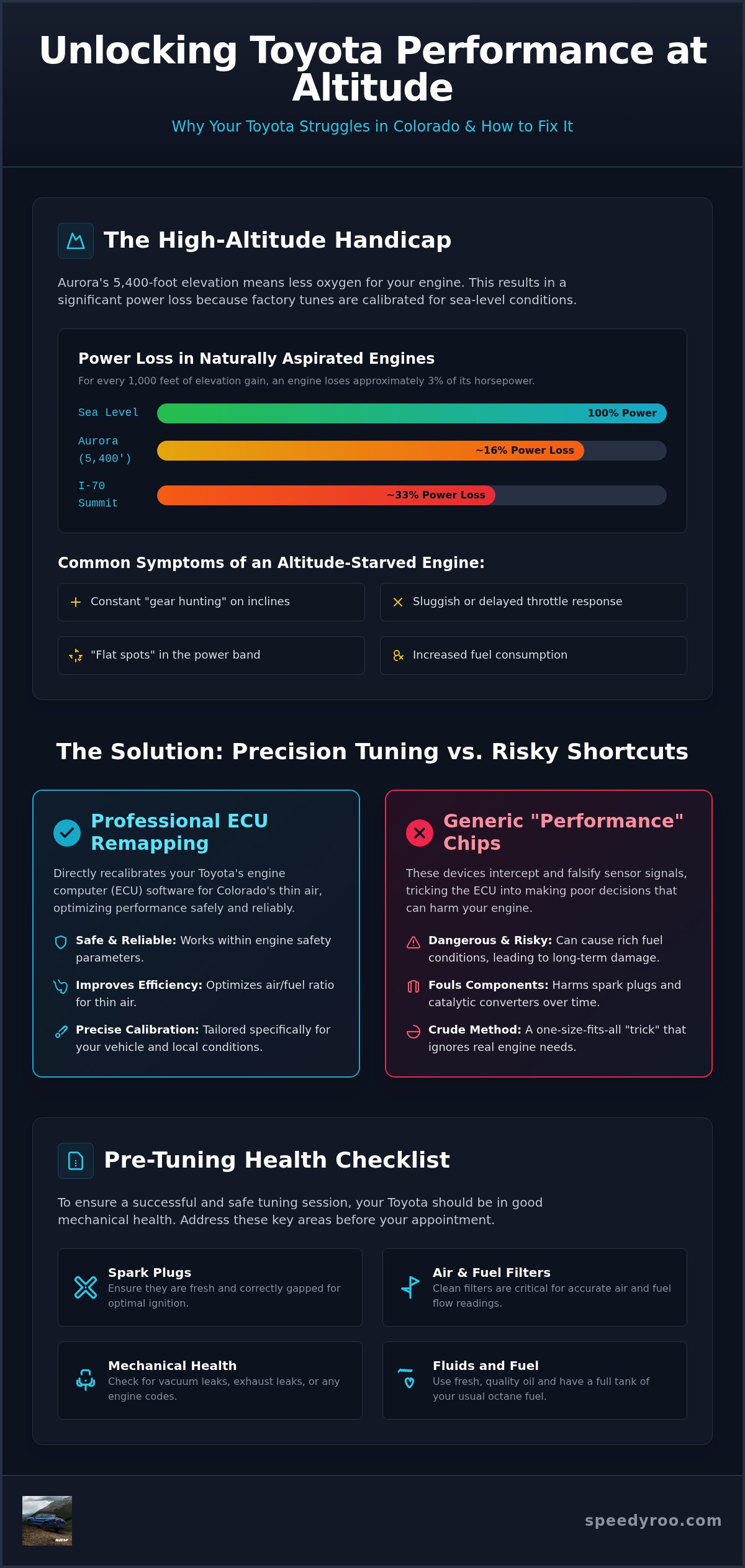
Aurora sits at a mean elevation of approximately 5,400 feet. While the views of the Front Range are spectacular, this altitude presents a significant physical challenge for your vehicle’s engine. Internal combustion relies on a precise mix of fuel and oxygen; however, as you climb, the air becomes less dense. For every 1,000 feet of elevation gain, a naturally aspirated engine loses roughly 3% of its potential power. By the time you pull out of your driveway in Aurora, your Toyota is already facing a power handicap of more than 15%. For owners seeking Toyota performance tuning Aurora specialists often start by explaining that factory Toyota maps are designed for sea-level conditions. Toyota develops these software profiles to work safely in humid coastal cities and dry deserts alike, which means they rarely account for the specific oxygen-starved environment of the Rockies.
The Physics of Thin Air and Combustion
Combustion is a game of chemistry. In the thinner air of the Front Range, there are fewer oxygen molecules available in every cubic inch of air drawn into the intake. Your Toyota’s Engine Control Unit (ECU) uses sensors to detect this change and attempts to compensate by reducing fuel delivery to maintain a safe air-fuel ratio. While this keeps the engine running safely, it results in a significant drop in torque and horsepower. Applying professional Engine tuning principles allows us to recalibrate how the ECU interprets these signals. Beyond just power, altitude affects heat dissipation. Thinner air is less efficient at carrying heat away from engine components, which can lead the factory software to pull even more power to protect the engine from overheating during a climb.
Common Symptoms of a ‘Sea-Level’ Tune in Aurora
The most frustrating symptom of altitude power loss is the “gear hunting” phenomenon. You’ve likely felt it while driving up I-70 or merging onto I-225; the transmission constantly shifts between gears because the engine lacks the low-end grunt to maintain speed in a higher gear. It’s a mechanical struggle that feels like a sluggish throttle response or a “flat spot” in the power band. Toyota performance tuning Aurora services address these issues by optimizing the timing and fueling specifically for our 5,000-plus feet of elevation. Without this local optimization, your engine works significantly harder than it needs to. This extra effort doesn’t just feel slow; it often results in increased fuel consumption as the vehicle stays in lower gears and higher RPM ranges just to keep pace with traffic.
The Science of ECU Remapping vs. Performance Chips
The Engine Control Unit (ECU) functions as the sophisticated brain of your Toyota, managing a complex web of instructions for fuel injection, ignition timing, and boost pressure. Toyota’s factory software is remarkably resilient, featuring learning algorithms that adapt to different driving styles. However, these factory maps prioritize universal safety margins over local performance. When you drive in the Front Range, the ECU works within a narrow window of adjustment that wasn’t necessarily built for 5,400 feet. It’s designed to keep the car running in any climate, which often means it’s not running at its best in ours.
When considering Toyota performance tuning Aurora drivers should prioritize software integrity over hardware shortcuts. Many owners are tempted by the low price of “plug-and-play” modules, but these rarely provide the long-term results a Colorado vehicle requires.
Why Generic ‘Performance Chips’ Fail
Generic performance chips often promise instant power but frequently rely on deceptive tactics. These devices usually sit between a sensor and the ECU, tricking the brain into thinking the intake air is colder or that the pressure is lower than it actually is. This is a crude method that doesn’t actually improve the engine’s efficiency. In Aurora’s thin air, these chips can be particularly dangerous. Tricking an engine into adding more fuel when there isn’t enough oxygen to burn it creates a rich condition. This leads to poor fuel economy, fouled spark plugs, and long-term damage to your catalytic converters. Mail-order flashes suffer from similar issues because they’re developed in different climates using different fuel qualities. They can’t account for the specific 85 or 87 octane blends common in Colorado, which can lead to engine knock or pinging under heavy load.
The Precision of Professional ECU Remapping
Professional Toyota performance tuning Aurora involves a complete recalibration of the ECU’s internal maps. Instead of lying to the computer, we provide it with better instructions for our specific environment. We carefully adjust ignition timing to ensure the spark happens at the optimal moment for our lower air density. We also refine fuel trims to keep the air-fuel ratio within a safe, powerful range that prevents flat spots during acceleration. ECU remapping is a digital overhaul of engine instructions specifically tailored for local conditions. This process ensures the engine stays within its safe thermal limits while delivering the torque you need for mountain passes. To get the best results, it’s helpful to utilize Aurora Dyno Tuning where we can verify these adjustments in a controlled environment. This level of precision is the only way to gain power without sacrificing the legendary longevity Toyota is known for.
Tailored Tuning for Toyota Platforms: From Overlanding to Track
Every engine in the Toyota lineup possesses a distinct character, and the approach to Toyota performance tuning Aurora drivers need must reflect those differences. We prioritize “area under the curve” rather than just chasing peak horsepower numbers. Peak figures represent the maximum power an engine makes at a specific, high RPM, which is often only useful for bragging rights. Area under the curve refers to the total power available across the entire rev range. For a driver in the Front Range, having a broad, flat torque curve is the difference between a vehicle that struggles on every incline and one that feels effortless during a climb toward the Continental Divide.
Unlocking the Tacoma and 4Runner (1GR-FE & 2GR-FKS)
The 4.0L 1GR-FE and the 3.5L 2GR-FKS are legendary for their reliability, but they often feel sluggish once you add the weight of overlanding gear. When you install steel bumpers, roof-top tents, and larger tires, the factory power delivery becomes inadequate for Colorado’s steep grades. Our tuning process focuses on remapping the torque request tables to provide better low-end grunt. This is particularly vital for the 3.5L Tacoma, which is notorious for constant downshifting on the highway. By improving the transmission shift logic and optimizing ignition timing for our 91-octane fuel, we can reduce that frustrating “gear hunting.” This results in a truck that holds gears longer and feels much more composed when navigating technical off-road trails at high altitudes.
Enthusiast Tuning: GR86, Supra, and the 86 Platform
For sports car enthusiasts, the goals for Toyota performance tuning Aurora usually involve refining drivability and removing factory-imposed limitations. The GR86 and the older 86/BRZ platforms are famous for a “torque dip” in the middle of the RPM range, which can make the car feel breathless just when you want it to pull. We smooth out this power band to create a more linear and predictable response. For forced induction models like the GR Supra or the newer Twin-Turbo V6 Tundras (V35A-FTS), we can safely increase boost pressure while monitoring wastegate duty cycles. This ensures the turbos aren’t overworking themselves in our thin air. We also enhance throttle sensitivity to make heel-toe downshifting more intuitive, providing a crisp, track-ready feel that remains reliable during spirited mountain drives.
Preparing Your Toyota for a Professional Dyno Session
A successful session for Toyota performance tuning Aurora starts long before the car is strapped to the rollers. We take a “Health First” approach because tuning a vehicle with existing mechanical issues is both ineffective and potentially dangerous. The dyno puts the engine under significant load to simulate the steep grades of the Front Range. Ensuring every component is in peak condition is essential for a safe and reliable result. We view the dyno as a controlled environment where we can push your vehicle safely, but it requires a solid mechanical foundation to be successful.
The Pre-Tune Mechanical Inspection
Fresh engine oil and a clean air filter are mandatory. Dirty filters restrict air, which is already at a premium at 5,000 feet, while old oil cannot provide the necessary protection under high-stress testing. We also look for vacuum leaks or failing sensors that the factory ECU might have been masking. It’s vital to check your drivetrain health as well. If your clutch is already slipping or your transmission is struggling, the increased torque from a performance tune will only accelerate those failures. We want to ensure your Toyota is robust enough to handle its new power levels for years to come. This transparency helps prevent costly setbacks and ensures the tuning process is smooth and predictable.
What Happens During the Dyno Session?
Our in-house chassis dyno serves as much more than a power calculator; it’s a sophisticated diagnostic tool. During the session, we use real-time data logging to monitor air-fuel ratios (AFR), engine temperatures, and potential knock. We make incremental adjustments to the software, building a power map that is both effective and safe. This methodical process allows us to verify that the engine is responding correctly to every change in timing or fueling. You’ll receive a detailed dyno graph at the end. This provides a clear visual of the gains in both horsepower and torque across the entire RPM range, giving you confidence in the results.
Before arriving, make sure your tank is filled with the fuel you plan to use daily, which is typically 91-octane for the best results in Colorado. If you’re ready to see what your vehicle can really do, you can schedule your Aurora Dyno Tuning session with our team today. We’ll walk you through the specifics for your particular model to ensure you’re fully prepared for the session.
Why Independent Specialized Tuning Beats the Dealership Experience
Dealerships operate on a high-volume model. They use factory reflashes to address technical service bulletins, not to improve your climbing power or fix gear-hunting issues. In contrast, Toyota performance tuning Aurora at an independent shop offers a tailored approach. You work directly with the specialist calibrating your ECU. This “Honest Specialist” model ensures total transparency. We don’t just hand you a bill; we explain how specific adjustments affect your driving habits. Dealerships simply aren’t equipped to offer the precision calibration required for our unique high-altitude environment. They prioritize universal safety margins, while we prioritize your vehicle’s efficiency in the Front Range.
Maintenance for the High-Performance Toyota
Once your vehicle is optimized for more power, your maintenance routine should evolve. Increased torque and higher combustion pressures mean your engine components work harder than they did at factory settings. We recommend adjusting your oil change intervals to account for this increased load. Regular monitoring of spark plug wear is also vital. Tuned engines can be more sensitive to gap changes or electrode degradation. Keeping your cooling system in top shape ensures your performance gains last for the long term. For ongoing care and routine service, visiting a Toyota Specialist Aurora drivers trust will help maintain the integrity of your tune. We view maintenance as a partnership in your vehicle’s longevity.
Experience You Can Trust Since 2002
Speedy Roo Motorsports & Repair Inc has been a fixture in the community since 2002. Our exclusive focus on Japanese imports means we understand every bolt and sensor in the Toyota lineup. We know how these vehicles react to the unique driving conditions in Aurora, Parker, and Centennial. Local expertise matters. You’re asking an engine to perform at its limit in thin air. We take pride in building long-term relationships with our customers. We aren’t just looking for a quick transaction; we’re looking to solve problems correctly. If you’re ready to transform your driving experience, Schedule your Toyota performance consultation at Speedy Roo today! Our team is prepared to help you reclaim the power your vehicle was always meant to have.
Reclaiming Your Drive on the Front Range
Your Toyota was built for adventure, but factory settings aren’t specifically designed for the unique challenges of the Rocky Mountains. By focusing on precision ECU remapping rather than temporary hardware fixes, you can restore the torque and responsiveness that Aurora’s altitude takes away. Whether you’re towing an overlanding trailer through a steep mountain pass or seeking a more linear power band for your GR86, professional Toyota performance tuning Aurora ensures your vehicle operates at its peak efficiency without sacrificing reliability.
Since 2002, our team of expert Japanese specialists has served the local community with a commitment to transparency and technical excellence. We utilize an in-house AWD/RWD chassis dyno to simulate real-world Colorado road loads safely. This methodical approach ensures every adjustment is verified for performance and engine longevity. Trusted by Aurora’s Toyota community for over two decades, we’re here to help you navigate the Front Range with newfound confidence.
Unlock Your Toyota’s Potential—Book Your Aurora Dyno Session Now
We look forward to helping you rediscover the joy of driving your Toyota, no matter how high the trail leads.
Frequently Asked Questions
Will performance tuning void my Toyota’s factory warranty?
Modifying your ECU can affect engine-related warranty claims. While the Magnuson-Moss Warranty Act protects consumers by requiring dealers to prove a modification caused a specific failure, most dealerships will scrutinize tuned vehicles. We focus on safe, reliable calibrations that stay within factory mechanical limits. If warranty preservation is your primary concern, we recommend discussing the specific risks with our technicians before proceeding with any performance modifications on your vehicle.
How much horsepower can I expect to gain from an ECU tune at Colorado’s altitude?
Gains depend on your specific engine type. Naturally aspirated engines, like those in the 4Runner, typically see a 10 to 15 percent increase in power. However, the primary value of Toyota performance tuning Aurora is restoring the 15 to 20 percent of horsepower lost to our high altitude. Turbocharged models like the GR Supra or the new twin-turbo Tundra often see more significant gains, sometimes exceeding 20 percent over factory output.
Is a custom dyno tune safer for my engine than a generic performance chip?
Custom dyno tuning is significantly safer than generic chips. A custom tune uses real-time data from your specific engine to adjust parameters like ignition timing and fuel delivery. Generic chips often use resistors to trick sensors into seeing colder air, which can lead to dangerously lean conditions in Colorado’s thin atmosphere. Our methodical approach ensures your engine remains within safe thermal and mechanical operating windows during every mountain climb.
Do I need to use premium 91 octane fuel after my Toyota is tuned?
We highly recommend using premium 91 octane fuel for all tuned vehicles in the Front Range. Higher octane fuel is more stable under pressure, which allows us to optimize ignition timing without the risk of engine knock. This stability is essential when we are recalibrating your engine to overcome the power loss associated with the elevation in Aurora and Parker. Using lower-grade fuel can force the ECU to pull timing, negating your gains.
Can you tune older Toyota models, or is it only for newer GR and TRD vehicles?
Our services cover a broad spectrum of Toyota platforms. While we frequently work on newer GR and TRD models, many older vehicles like the 2nd generation Tundra or the 1GR-FE powered 4Runner see massive improvements in drivability. If your vehicle’s ECU is accessible for remapping, we can likely improve its efficiency. We’ve helped many owners in Centennial and Lone Tree modernize the performance of their older, reliable Toyota trucks and SUVs.
How long does a typical Toyota performance tuning session take in Aurora?
A comprehensive session for Toyota performance tuning Aurora typically requires three to six hours. This timeframe includes a thorough pre-tune mechanical inspection to ensure your vehicle is healthy enough for the dyno. We then spend time strapping the vehicle down and performing multiple incremental pulls to refine the software. We don’t rush this process because precision takes time. Our goal is to ensure you leave our facility with a safe, optimized calibration.
What is the difference between a ‘street tune’ and a ‘track tune’?
A street tune prioritizes daily drivability and low-end torque. This is ideal for overlanding or commuting around Denver because it focuses on throttle response and fuel efficiency. A track tune is designed for sustained high-RPM use. It prioritizes peak horsepower and aggressive cooling strategies to handle the extreme heat generated during racing. Most of our local customers choose a street-oriented tune that balances increased power with long-term engine health and reliability.