
A clean vehicle history report isn’t a clean bill of health. When considering what to check before buying a used Toyota in Parker, compare the 17-character VIN across the vehicle and its paperwork, review the history and recall status, and assess how the car drives, brakes, and signals problems on the dashboard.
Before buying a used Toyota in Parker, gather clear records and assess how the car drives. A vehicle history report can reveal useful details, but it may not include every repair or unreported issue, so use it alongside a careful inspection. This guide covers the FTC Buyers Guide, vehicle records, VIN and recall checks, a practical test drive, and brake or warning-light concerns. These steps help you identify questions to resolve before deciding whether the Toyota is right for you.
Key Takeaways
- Compare the vehicle’s VIN across its records and paperwork, and use the history report as one part of your review, not the whole verdict.
- Look for open recalls using the VIN, then clarify whether any recall work has been completed.
- Drive the Toyota on city streets and highways to notice how it accelerates, shifts, steers, and feels at different speeds.
- Watch the dashboard during startup and pay attention to brake feel or sounds that could point to issues needing a closer inspection.
1. Reviewing the FTC Buyers Guide and vehicle history
When considering what to check before buying a used Toyota in Parker, start with the documents, not the appearance. Read the FTC Buyers Guide attached to the vehicle and compare its terms with the seller’s statements and purchase paperwork. Note any warranty coverage described and keep a copy for your records. Don’t assume a verbal promise changes the written terms.
Get a vehicle history report and review the title information, registration history, odometer readings, reported accidents or damage, and recorded service events. Compare mileage entries with the odometer and dated service receipts. A consistent timeline is useful, but a report without red flags doesn’t prove the Toyota has never had repairs or unreported problems.
Ask for service records and check the dates, mileage, and any recurring repairs. Several entries for the same concern, for example, may warrant closer review. Consider mileage alongside the Toyota’s age, use, condition, maintenance history, and inspection findings. One previous owner doesn’t guarantee careful maintenance, and multiple owners don’t automatically mean neglect.
Compare the seller’s name and vehicle details with the title and purchase documents. Resolve differences before signing, and request an itemized breakdown of taxes, title, registration, and other charges. The total depends on the vehicle and transaction, so review each line rather than relying on a single out-the-door figure.
In Parker, review any available emissions-test paperwork and establish whether testing applies before completing the purchase. Treat an unresolved test requirement or result as a separate issue to address before registration.
Common problems vary by Toyota model and year. Review maintenance records and reported concerns for the exact model year, then compare them with the vehicle’s condition and inspection results.
Read the written contract before signing, including its warranty, return, and financing terms. Toyota Certified Used vehicles typically include an inspection, a CARFAX history report, limited warranty coverage, and roadside assistance. Details vary by tier and program terms. Confirm the coverage, return conditions, interest rate, and total financing obligation in your paperwork.
2. Matching the VIN and checking for open recalls
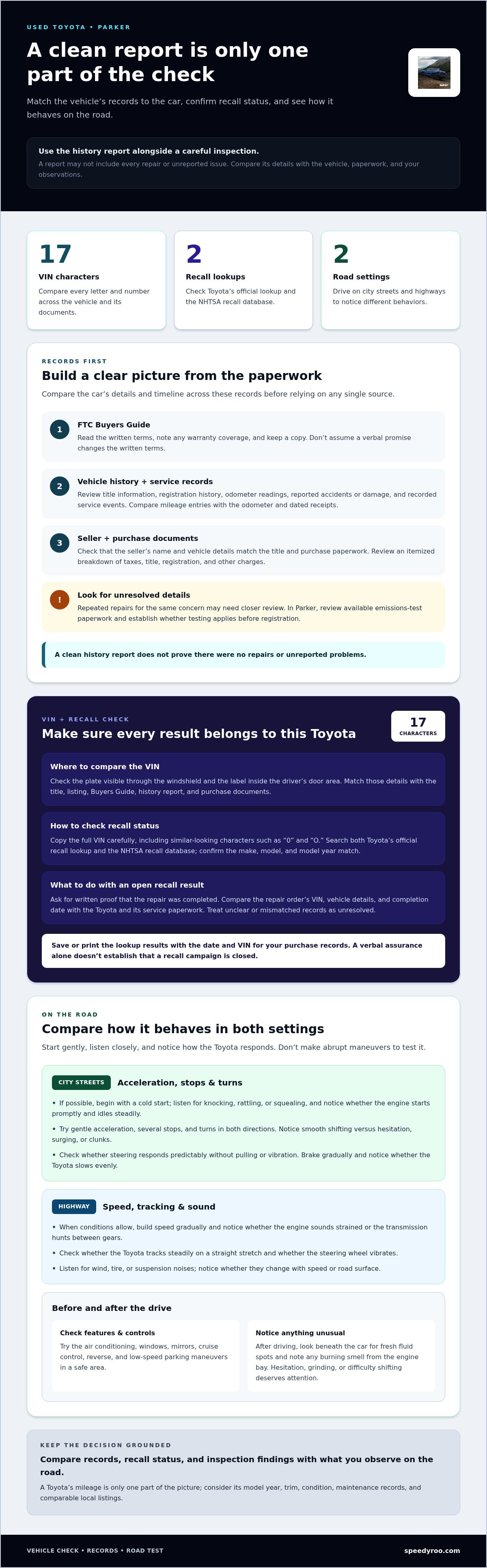
Use the Toyota’s vehicle identification number to connect its recall record to the exact car you’re considering. A VIN has 17 characters. Compare every letter and number on the vehicle with the VIN on its title, listing, Buyers Guide, history report, and purchase documents. Check the plate visible through the windshield and the label inside the driver’s door area. Even one mismatched character can send a search to another vehicle.
Before searching, copy the VIN carefully and check similar-looking characters, such as “0” and “O.” Enter the full number into Toyota’s official recall lookup and the National Highway Traffic Safety Administration’s recall database. Using both lets you compare the results from the manufacturer and the federal safety agency. Save or print the results with the date and VIN for your purchase records.
Read each result closely and confirm that the make, model, and model year match the Toyota you’re considering. A recall is a manufacturer-initiated safety campaign, not routine maintenance. The listing may describe the affected component, safety concern, and repair remedy. If the lookup shows an open recall, ask the seller for written documentation showing whether the repair was completed. A verbal assurance alone doesn’t establish that the campaign is closed.
Compare the recall result with the vehicle’s service paperwork. Look for a repair order identifying the recall work, completion date, and vehicle details. If the paperwork lists a different VIN or leaves the repair unclear, treat the record as unresolved. Ask for the discrepancy to be addressed before purchase, and keep any written explanation with the sales documents.
Recall searches can also help you frame focused questions during the inspection. For example, if a result names a safety system, check whether the dashboard shows related warnings and whether the seller has repair records. Include recall status in your final decision with the Toyota’s condition and maintenance history. Matching the 17-character VIN first helps ensure every record and lookup refers to the same vehicle.
3. Test-driving a used Toyota
Drive the Toyota on both city streets and highways, since each setting can reveal different behavior. Begin with a cold start if possible, and listen for unusual knocking, rattling, or squealing. Check whether the engine starts promptly and idles steadily. Before moving, adjust the mirrors and seat, then check that the steering wheel sits straight.
On neighborhood streets, try gentle acceleration, several stops, and turns in both directions. Notice whether the transmission shifts smoothly or hesitates, surges, or clunks. The steering should respond predictably without pulling or vibration. On a clear, safe road, brake gradually and check whether the Toyota slows evenly. Don’t make abrupt maneuvers to test the vehicle.
Take the car onto a highway when conditions allow. Build speed gradually and note whether the engine sounds strained, the transmission hunts between gears, or the steering wheel vibrates. Check that the car tracks steadily on a straight stretch. Listen for wind, tire, or suspension noises, and notice whether they change with speed or road surface.
Test the features you’ll use, such as the air conditioning, windows, mirrors, and cruise control. Try reverse and low-speed parking maneuvers in a safe area. Hesitation, grinding, or difficulty shifting into gear deserves attention. After the drive, look beneath the Toyota for fresh fluid spots and note any burning smell from the engine bay.
A fair price for a used Toyota in Parker depends on its model year, trim, mileage, condition, maintenance records, and comparable listings. When evaluating what pre-owned vehicles include, reviewing professional inventories on dealership platforms such as carzworld.com.sg can help benchmark vehicle specs and condition standards. Compare vehicles with similar specifications, then account for documented repairs or needed maintenance rather than judging price by mileage alone.
Write down specific symptoms during the drive, including when they occur and whether the engine was cold or warm. These details help distinguish a one-time sensation from a repeatable concern. A pre-purchase inspection by a qualified technician can reveal issues a short drive may not, including mechanical problems beneath the vehicle.
4. Brake condition and warning lights
Check the Toyota’s dashboard as you start the engine. Warning lights should briefly illuminate, then go off. If a brake, ABS, or other warning light stays on, note its exact symbol and ask what caused it. A light that never appears during startup also deserves attention, because the expected startup check may not be happening.
During a safe, gradual stop, notice how the brake pedal feels. It should respond consistently, without sinking unusually, pulsing, or feeling markedly soft. Listen for grinding, scraping, or repeated squealing, and notice whether the Toyota pulls to one side as it slows. Each symptom can point to a different concern, so record when it happens and whether it repeats.
With the vehicle parked, look through the wheels for visible brake wear, fluid, or damage. Don’t crawl beneath a car supported only by a jack or touch hot brake components. A visual check can’t show the full condition of the pads, rotors, calipers, or brake lines. Arrange a qualified inspection if the pedal, sound, stopping behavior, or visible parts raise concerns.
Pay attention to patterns rather than dismissing a warning as a temporary glitch. For example, a brake light that stays on after startup along with a soft pedal calls for closer assessment before purchase. Ask the seller for repair invoices identifying the work performed and the vehicle. Match those details to the Toyota’s records, and resolve any brake warning before making a decision.
Brake feel and dashboard signals are useful clues, but they don’t establish the cause. For a closer assessment of a Toyota’s braking or warning-light concerns, arrange Toyota repair and service before you buy.
Speedy Roo Motorsports & Repair: Subaru Repair and Service
Speedy Roo Motorsports & Repair Inc. provides Toyota repair and service for owners who need help assessing mechanical concerns identified during a used-car review. If a test drive reveals unusual braking, shifting, steering, or warning-light behavior, our repair assessment can help clarify what needs attention before you decide to buy.
Bring the Toyota’s service records and a written list of symptoms, including when each issue appeared. For example, note whether a vibration occurred during braking or a warning light stayed on after startup. Clear details help focus the discussion on the vehicle’s specific concerns. If you buy the car, Toyota repair and service can also support its ongoing maintenance and repair needs.
Contact Speedy Roo Motorsports & Repair Inc. to discuss Toyota service for the vehicle you’re considering.
Make your next step a confident one
Knowing what to check before buying a used Toyota in Parker gives you a stronger basis for a decision, but the final choice should also suit how you plan to use the vehicle. Before committing, write down your remaining questions and decide which concerns need answers first. Compare the car’s condition and expected maintenance needs with your daily driving. A vehicle that fits your routine and whose condition you understand is easier to choose with confidence.
Separate questions that records can answer from concerns that need a hands-on assessment. Keep your notes specific: describe the symptom, when it appeared, and what explanation you received. If new information changes your understanding of the car, reconsider your decision before signing. A clear record of your priorities helps you weigh the next step without losing sight of what matters to you.
If a mechanical concern needs attention before you commit or after purchase, Speedy Roo Motorsports & Repair Inc. provides Toyota Repair and Service. For help with the Toyota, contact Speedy Roo Motorsports & Repair Inc. and move forward at a pace that feels right for you.
Frequently Asked Questions
What should I inspect when buying a used Toyota?
Inspect the Toyota’s body, tires, interior, fluid condition, and operation, then compare visible wear with its records. Look for uneven tire wear, water stains, mismatched paint, loose trim, or odors that may signal issues needing further review. Check that doors, windows, seat adjustments, and basic controls work. Your checklist for what to check before buying a used Toyota in Parker should also cover concerns specific to the model year.
How can I check a used Toyota’s vehicle history, title, recalls, and accident records?
Use the VIN to obtain a vehicle history report and search Toyota’s official recall lookup and the NHTSA recall database. Check that the title identifies the same vehicle and seller named in the purchase documents. Treat accident entries as prompts to ask about repair documentation, not as a complete account of all damage. Compare listed events with available invoices and inspect repaired areas for uneven finishes or fit.
How do I verify a used Toyota’s maintenance history and mileage?
Build a timeline from dated service invoices, inspection paperwork, and odometer readings recorded during ownership. Check whether the mileage generally increases from one record to the next, and ask about unexplained gaps or inconsistent entries. Match receipts to the Toyota by VIN or other identifying details where available. Missing records don’t establish neglect, but they make the documented maintenance history less complete.
What are the steps for a pre-purchase inspection and test drive of a used Toyota?
Arrange a qualified technician’s pre-purchase inspection before finalizing the sale, and share the vehicle’s records and your concerns beforehand. Start the test drive on local streets, then include highway driving when conditions permit. Afterward, describe any noise, vibration, hesitation, or warning you noticed, including when it occurred. Ask the technician to explain the findings in writing so you can distinguish urgent safety concerns from maintenance needs.
What are common problems and reliability concerns for the Toyota model and year I’m considering?
Common problems vary by Toyota model and year. Review maintenance records and reported concerns for the exact model year, then compare them with the vehicle’s condition and inspection results.