
Most drivers assume that hitting 150,000 miles is the beginning of the end for their vehicle, but for a well-maintained Toyota, it’s often just the halfway point. If you’re looking for Toyota high mileage service in Aurora, you’ve likely noticed a new hum during your commute or perhaps a small oil spot on the garage floor. It’s natural to feel a sense of unease when these signs appear, especially when you’re planning a trip into the Colorado mountains. You want to know your vehicle is safe, but you also want to avoid paying for “recommended” services that don’t actually add value to your car’s longevity.
We understand that maintaining an older vehicle requires a shift in strategy. Our team has provided specialized care for Japanese imports since 2002, focusing on the meticulous maintenance needed to keep these platforms running reliably through high altitudes and extreme temperature swings. In this guide, you’ll discover the specialized roadmap required to navigate Colorado’s tough driving conditions. We’ll clarify which services are truly essential for long-term health, how to address small leaks before they become expensive breakdowns, and the expert tips that will help you confidently reach the 300,000-mile mark while keeping your repair costs low.
Key Takeaways
- Learn why reaching 300,000 miles requires moving beyond standard maintenance to a proactive preservation strategy focused on seal integrity.
- Identify the “hidden” maintenance items like rubber components and suspension health that often go overlooked during basic oil changes.
- Understand how Aurora’s extreme temperature swings and high altitude accelerate wear on your cooling system and engine seals.
- Discover how a specialized Toyota high mileage service Aurora baseline inspection helps you prioritize repairs based on safety and long-term reliability.
- Gain the confidence to navigate Colorado’s mountain roads by switching to high-quality synthetic oils with specific seal conditioners.
The 100,000-Mile Pivot: Why Your Toyota’s Needs Are Changing
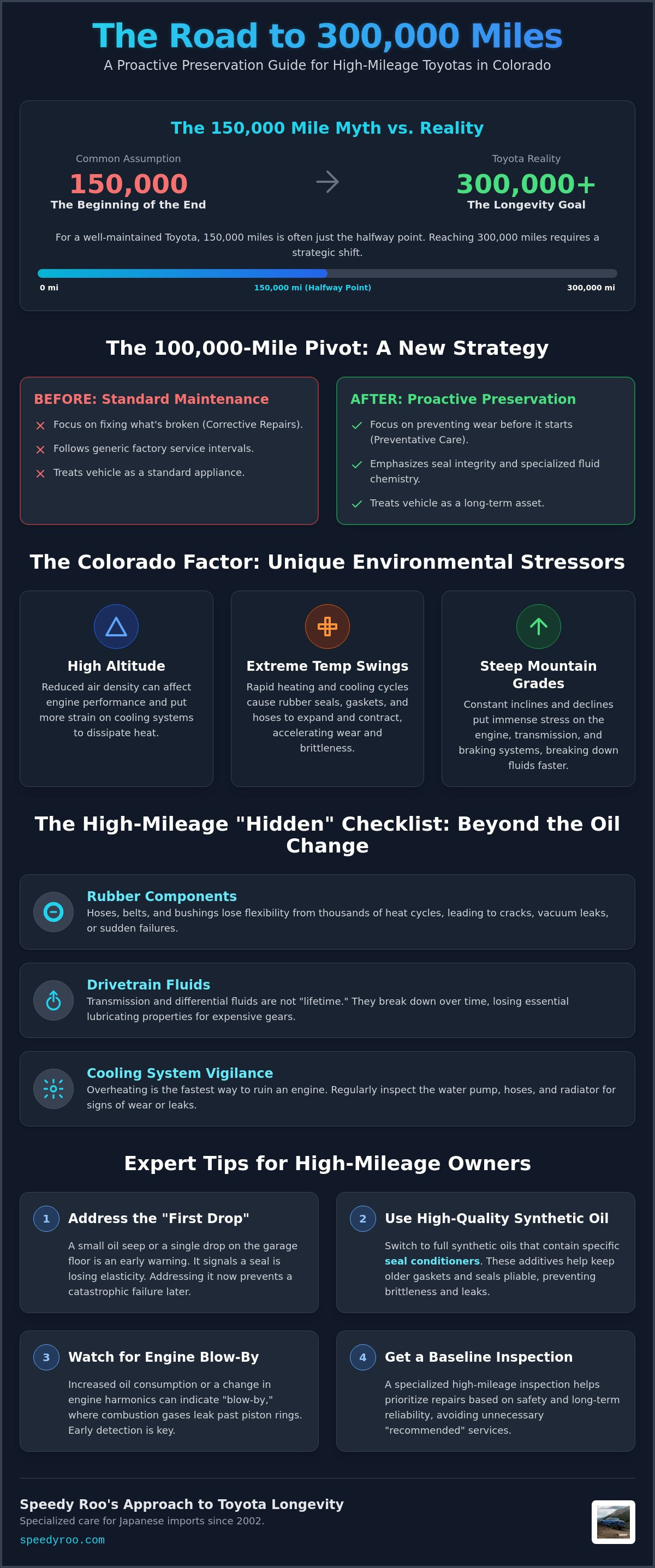
Reaching the six-figure mark on your odometer is a badge of honor for any Toyota owner. In Aurora, where we rely on our vehicles for everything from daily commutes to weekend mountain climbs, it’s easy to fall into the trap of the “Toyota Invincibility Myth.” While these vehicles are engineered with exceptional precision, they aren’t immune to the laws of physics. To reach the 300,000-mile mark, a standard motor vehicle service isn’t enough; you need a specialized strategy. A proper Toyota high mileage service Aurora is less about fixing what’s broken and more about a proactive preservation strategy focused on seal integrity and fluid chemistry.
Think of 100,000 miles as the psychological break-in period. This is the moment your relationship with your car shifts from simple ownership to long-term asset management. You’re moving away from corrective repairs, which happen after a part fails, toward preventative preservation. This mindset shift is what separates the Toyotas that retire at 150,000 miles from the ones that are still climbing I-70 with ease a decade later. We’ve seen that consistent, specialized attention at this stage makes the difference between a car that feels “old” and one that feels “broken-in.”
Applying this same mindset of asset preservation—whether it’s for your vehicle or your home through resources provided by Cleroux & Sons Roofing—is what ensures your most important investments stand the test of time.
Preservation vs. Basic Maintenance
Standard factory maintenance schedules are often designed with the first 100,000 miles in mind. Once you pass that threshold, those generic intervals might be too conservative for an aging engine. High-mileage care involves using specialized fluids that contain seal conditioners. These additives help keep older gaskets pliable, preventing them from becoming brittle and leaking. By treating your vehicle as a long-term asset, you focus on maintaining the internal environment of the engine to prevent wear before it starts. This level of thoroughness is essential for vehicles operating in our demanding local climate.
Signs Your Toyota is Entering Its High-Mileage Phase
Your car will often tell you when its needs are changing through subtle physical cues. You might notice a slight change in engine harmonics or a new, faint vibration through the steering wheel at idle. We follow the “first drop” rule: if you see a small oil seep on a component, it’s a signal that the seal is losing its elasticity. Addressing these minor issues during a Toyota high mileage service Aurora prevents them from snowballing into catastrophic failures. It’s about catching the small leaks before they leave you stranded on a mountain pass.
One common issue in aging engines is blow-by. Blow-by occurs when the seal between the piston rings and cylinder wall weakens, allowing combustion gases to leak into the crankcase, which reduces engine efficiency and increases oil consumption in older Toyota models. Catching these shifts early through expert inspection is the key to longevity. When you understand these physiological changes in your engine, you can make better decisions about its care.
The High-Mileage ‘Hidden’ Checklist: Beyond the Oil Change
Focusing solely on oil changes is a common mistake that prevents many vehicles from reaching their full potential. While fresh oil is the lifeblood of your engine, a comprehensive Toyota high mileage service Aurora must look deeper into the components that degrade silently over time. Rubber is a primary victim of the aging process. Every hose, belt, and bushing in your car undergoes thousands of heat cycles. Over time, these parts lose their flexibility and become prone to cracking; this leads to sudden vacuum leaks or belt failures that can leave you stranded at the worst possible moment.
Drivetrain fluids are another often overlooked category in the quest for 300,000 miles. Many owners assume transmission and differential fluids are “lifetime” fills, but as a vehicle ages, these fluids break down and lose their essential lubricating properties. Adhering to a rigorous manufacturer’s maintenance schedule is a strong foundation, but high-mileage Toyotas often require more frequent fluid exchanges to protect expensive gears and bearings. This is particularly vital in Colorado, where our steep mountain grades and heavy towing demands put extra stress on the entire drivetrain system.
Cooling System and Water Pump Vigilance
The cooling system is the most critical area to monitor because overheating is the fastest way to ruin a high-mileage engine. A Toyota water pump replacement in Aurora is often necessary before you hit the 150,000-mile mark to prevent catastrophic failure. One telltale sign of trouble is the presence of “pink crust” around the pump or hose connections, which indicates a slow coolant leak that has dried. If you notice a spike in temperature or your dashboard glows with a warning, our Toyota check engine light guide can help you understand the urgency of sensor-related cooling issues. Keeping the radiator and pump in peak condition is your best insurance against engine-killing heat.
Suspension and Steering Bushings
If your car has started to feel “loose” or excessively bouncy over potholes, your suspension is likely crying out for professional attention. Worn struts and degraded rubber bushings do more than just ruin your ride quality. They increase your braking distance and cause rapid, uneven tire wear that costs you more money in the long run. High-mileage Toyotas frequently require more than a simple alignment to restore that factory-tight feel. Replacing worn steering components ensures your vehicle remains predictable and safe during emergency maneuvers. If you aren’t sure when these hidden items were last checked, a thorough inspection from an honest specialist can provide the clarity you need to keep driving with confidence.
The Colorado Factor: How Aurora’s Climate Affects Aging Toyotas
Living in Aurora means your vehicle faces environmental challenges that drivers in lower, more temperate regions never encounter. Our unique geography directly impacts how your car ages. At over 5,000 feet above sea level, the air is significantly thinner. This lower air density means your radiator has less “material” to work with when pulling heat away from the engine. While a new Toyota handles this easily, a high-mileage engine generates more internal friction and relies on a cooling system that may already be slightly compromised by scale or sediment. When you schedule a Toyota high mileage service Aurora, we look at the cooling system through the lens of this high-altitude reality.
The temperature swings in the Front Range are equally demanding. It isn’t uncommon to see a shift from -10°F in the morning to a sunny afternoon. These rapid thermal cycles cause engine components to expand and contract at different rates. For a 15-year-old gasket or a rubber vacuum line, these cycles are the primary cause of the brittle cracking that leads to leaks. These same shifts can also stress your vehicle’s glass, making it wise to explore Windshield Replacement from specialists like Auto Glass Ottawa if you notice chips spreading. Additionally, the steep grades of the I-70 corridor put immense pressure on your transmission. Climbing toward the Eisenhower Tunnel generates extreme heat in the transmission fluid, which can lead to premature oxidation and gear wear if the fluid isn’t exchanged more frequently than the standard manual suggests.
Altitude and Engine Performance
Thinner air affects the air-fuel mixture in non-turbocharged Toyotas, often requiring the engine to work harder to maintain power. This makes the health of your Mass Air Flow (MAF) sensor and air filter critical. A dirty sensor in Aurora can lead to sluggish performance and failed emissions tests, which are required every two years for vehicles model year 1982 and newer. Oxygen sensors in mountain regions often fail prematurely because they must continuously adjust the fuel trim to account for rapid elevation changes, which causes the sensor’s internal heating element to work harder and wear out faster.
Protecting Against Colorado Road Chemicals
Aurora relies heavily on magnesium chloride and road salt to keep winter streets safe. While effective for traction, these chemicals are highly corrosive to the undercarriage of a 10+ year old Toyota. We pay close attention to “hidden” rust points, particularly where the suspension mounts to the frame and along the brake lines. A Toyota high mileage service Aurora should always include a dedicated inspection of these lines, as corrosion can lead to sudden fluid loss. To extend the life of your vehicle, we recommend thorough undercarriage washes after every snowstorm to prevent these chemicals from sitting in the crevices of your frame and eating through the metal.
Expert Tips for High-Mileage Toyota Owners in Aurora
The journey to 300,000 miles is rarely a matter of luck; it’s the result of intentional, expert-led care. If you’ve just crossed the 150k or 200k mark, the first step is to establish a baseline. We recommend scheduling a comprehensive inspection with a Toyota specialist in Aurora to identify which components are original and which have been replaced. This baseline allows you to prioritize upcoming needs rather than reacting to failures. When you’re seeking a Toyota high mileage service Aurora, you’re looking for a partner who understands that a 20-year-old 4Runner has different requirements than a new RAV4.
Daily habits also play a massive role in longevity. You should get into the habit of monitoring your fluid levels weekly. Don’t wait for a dashboard light to glow; by then, the damage may already be starting. We also suggest switching to high-quality synthetic oils that contain specific seal conditioners. These additives help keep your gaskets soft and pliable, which is essential for preventing the oil seeps we discussed in earlier sections. If you want to know exactly where your vehicle stands, you can schedule your high-mileage baseline inspection today to get a clear picture of your car’s health.
Listening to your vehicle is a skill developed over years of ownership. If you notice a new hum, click, or vibration, document when it happens. Does it occur only when the engine is cold, or perhaps only when you’re turning left? Providing these details to your mechanic saves diagnostic time and ensures the right fix. We often suggest that clients invest in a pre-sale style evaluation even if they have no intention of selling. This deep-dive look at the vehicle’s core systems provides a level of detail that standard inspections often miss.
The Power of Fluid Analysis
Your fluids are the best storytellers of your car’s internal condition. For example, your transmission fluid should be a healthy translucent red; if it’s dark or smells burnt, it’s a sign of internal heat stress. Brake fluid flushes become significantly more important at the 200,000-mile mark because moisture accumulation can lead to internal corrosion of the ABS master cylinder. Additionally, older Toyota power steering systems benefit greatly from specialized additives that reduce friction in the steering rack, helping you avoid a costly replacement of the entire assembly.
Proactive Component Replacement
To reach the 300k mark, you must embrace the “while you’re in there” rule. If your mechanic is already replacing a belt, it’s often more cost-effective to replace the tensioner or an aging alternator at the same time. Replacing an alternator proactively at 200,000 miles is a smart move that prevents a breakdown on a dark Colorado highway. Finally, don’t overlook your electrical system. Cleaning battery terminals and checking engine grounds can solve “ghost” electrical issues that often plague older cars, ensuring your high-mileage Toyota remains as reliable as the day you bought it.
Speedy Roo’s Approach to Toyota Longevity
Speedy Roo has been a fixture in the Aurora community since 2002. We’ve spent over two decades focusing specifically on Japanese imports, which gives us a unique perspective on what it takes to keep a Toyota on the road long after the factory warranty has expired. While dealerships are excellent for new car maintenance, they often lack the specialized nuance required for a vehicle with 200,000 miles. We bridge that gap by combining the technical precision you expect from a dealer with the transparent, honest communication of a neighborhood shop. This ensures you receive expert care without the high-pressure sales environment often found elsewhere.
Our “Honest Specialist” philosophy is built on the idea that we are your partners in longevity. We don’t just provide a list of every possible repair; we prioritize our recommendations based on safety and what’s actually necessary to reach your 300,000-mile goal. This approach replaces the typical stress of auto repair with a feeling of calm reliability. When you choose us for your Toyota high mileage service Aurora, you’re getting a team that is genuinely invested in the long-term health of your vehicle. We understand that your car is more than just a machine; it’s a vital part of your daily life in Colorado.
The Specialized Inspection Process
Generalist shops often follow a one-size-fits-all checklist, but our technicians look for the specific failure points unique to the Toyota platform. We understand how Colorado’s environment affects these vehicles differently as they age. Part of our meticulous care involves a strong preference for high-quality or OEM parts. We’ve found that using the right components is the only way to ensure the craftsmanship of the repair matches the original standards of the vehicle. Beyond the immediate fix, we help you look ahead. We’ll work with you to plan a maintenance budget for the next 50,000 miles, ensuring there are no financial surprises as your car continues to age gracefully.
Building a Partnership for the 300k Journey
We treat every high-mileage Toyota that enters our shop like a legacy vehicle. There’s a distinct pride in keeping a well-loved car running perfectly, and we want to be the ones who help you document that journey. Maintaining a consistent “health record” at one specialized shop allows us to track subtle changes in your car’s performance over several years. This historical data is invaluable for catching issues before they become expensive breakdowns. We’re here to ensure your vehicle remains a reliable tool for your Colorado lifestyle for years to come.
Ready for your next 100k? Schedule your Toyota high mileage service at Speedy Roo today and experience the difference that specialized, honest care can make for your vehicle’s future.
Secure Your Toyota’s Future on Colorado Roads
Reaching the 300,000-mile mark is a realistic goal when you transition from basic repairs to a dedicated preservation strategy. We’ve discussed how Colorado’s unique altitude and rapid temperature swings demand more from your cooling and suspension systems than standard manuals suggest. By establishing a clear baseline and focusing on fluid chemistry and seal integrity, you turn a high-mileage vehicle into a reliable long-term asset rather than a source of stress.
As an independent Japanese specialist since 2002, our team understands the specific needs of Front Range drivers. We are A+ rated local Aurora experts who specialize in 100k, 200k, and 300k+ mile Toyota preservation. When you’re ready to invest in the longevity of your vehicle, a professional Toyota high mileage service Aurora provides the transparency and technical depth you need to drive with confidence. Our methodical approach ensures that no detail is overlooked in the quest for mechanical excellence.
Book Your Toyota High Mileage Specialist Service at Speedy Roo and ensure your vehicle is prepared for the road ahead. Your Toyota has plenty of life left; let’s work together to see exactly how far it can go.
Frequently Asked Questions
Is it worth doing a high mileage service on a Toyota with over 200,000 miles?
Yes, it is absolutely worth investing in specialized care for a Toyota with over 200,000 miles because these vehicles are capable of reaching 400,000 miles or more with the right preservation strategy. A professional Toyota high mileage service Aurora focuses on preventing catastrophic failures in components like the timing belt and cooling system. This proactive approach is significantly more affordable than the cost of a new car payment or a major engine overhaul.
What is the most important service for a high-mileage Toyota in Colorado?
Cooling system maintenance is arguably the most critical service for any aging Toyota in Colorado. Our high altitude and steep mountain grades mean your engine works harder while the thin air provides less natural cooling. Ensuring your radiator, thermostat, and coolant are in peak condition prevents the overheating that causes head gasket failures. We prioritize these inspections to ensure your vehicle remains reliable during summer trips to the high country.
Do I really need high-mileage oil for my Toyota Camry or RAV4?
You should definitely consider switching to high-quality synthetic oils with seal conditioners for your Camry or RAV4. These specialized oils are designed to rejuvenate older rubber gaskets and seals that have become brittle over time. By keeping these components pliable, you can stop minor oil seeps before they turn into major leaks. This simple change is one of the most cost-effective ways to extend the life of your engine.
How often should I have my high-mileage Toyota inspected?
We recommend a comprehensive inspection every 5,000 miles or six months, whichever comes first. High-mileage vehicles undergo more stress, and frequent “health checks” allow us to spot subtle changes in fluid levels or component wear. Regular monitoring is the best way to maintain a consistent health record for your car. This cadence ensures that small issues, like a worn belt or a weeping shock, are addressed before they impact your safety.
What are the common signs of a failing water pump in a Toyota?
The most common signs of a failing water pump include a distinct “pink crust” around the pump housing or a faint, sweet smell of coolant after driving. You might also notice a rising temperature gauge or a grinding noise coming from the front of the engine. If you see any of these indicators during a Toyota high mileage service Aurora, it’s vital to schedule a Toyota water pump replacement in Aurora immediately. Ignoring these warning signs often leads to sudden engine overheating.
Can a high-mileage Toyota still handle mountain driving in the Rockies?
A high-mileage Toyota can handle the Rockies with ease, provided the drivetrain and braking systems are properly maintained. Mountain driving puts immense stress on transmission fluid and brake components due to constant shifting and long descents. We pay extra attention to fluid quality and brake pad thickness for our mountain-bound clients. With a healthy cooling system and fresh drivetrain fluids, your vehicle will be just as capable as a newer model.
Why should I choose an independent shop over a Toyota dealership for older car service?
Independent specialists often provide a more nuanced approach to vehicles that are 15 or 20 years old. While dealerships focus on newer inventory, we have deep expertise in the specific aging patterns of older Toyota platforms. We offer a more transparent and community-focused experience, prioritizing repairs based on your car’s actual needs rather than a corporate checklist. This partnership approach builds the long-term trust necessary for the journey to 300,000 miles.
How can I prevent my Toyota’s frame from rusting in Aurora?
The best way to prevent frame rust in Aurora is to perform frequent undercarriage washes during the winter months. Road chemicals like magnesium chloride are highly corrosive and can eat through a 10-year-old frame if left to sit in the crevices. We also recommend annual inspections of your brake lines and suspension mounts. Catching surface rust early allows for treatment before it compromises the structural integrity of your vehicle’s frame.