
In Colorado’s high-altitude environment, your Toyota’s water pump isn’t just a part; it’s the primary safeguard against thermal engine death. Most drivers in our community understand that thin mountain air and steep grades put extra stress on a vehicle’s cooling system. It’s natural to feel a sense of worry when you’re miles from home and notice a faint sweet smell of coolant or a rising temperature needle. You shouldn’t have to guess whether your vehicle is safe for your next mountain trip or if you’re being pressured into unnecessary repairs.
This guide provides everything you need to know about Toyota water pump replacement Aurora, helping you identify early warning signs before they turn into a roadside emergency. We’ll explain why proactive replacement is critical for local driving conditions and clarify the important link between your water pump and timing belt. By the end of this article, you’ll have a clear checklist of symptoms to monitor and the knowledge to make informed decisions about your Toyota’s long-term health and reliability.
Key Takeaways
- Learn how to spot early failure symptoms, such as pink crust around the weep hole or unusual grinding noises, before they lead to engine overheating.
- Understand why timing your Toyota water pump replacement Aurora with a timing belt service can save you hundreds in labor costs.
- Discover how Aurora’s high altitude and extreme temperature fluctuations accelerate the wear on your Toyota’s cooling system seals.
- Find out why specialized tools and over 20 years of Japanese import expertise are essential for maintaining your Toyota’s long-term health.
- Recognize the critical role of consistent thermal regulation in preventing permanent engine damage like warped cylinder heads.
The Critical Role of Your Toyota Water Pump
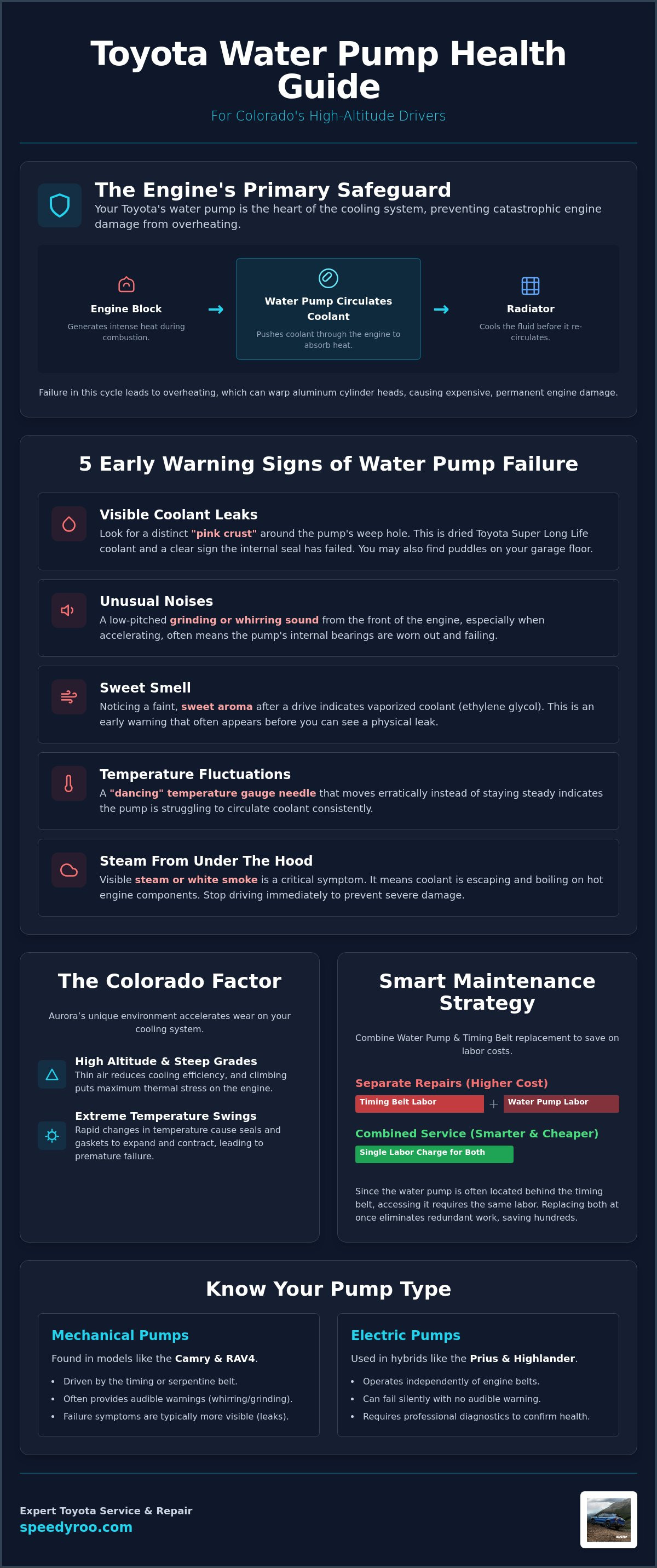
The water pump is the quiet hero of your Toyota’s engine. It acts as the heart of the cooling system, constantly circulating antifreeze through the engine block to absorb heat. Without this steady flow, the heat generated by internal combustion would quickly become destructive. Toyota engines are engineered for efficiency and longevity, but they rely on precise thermal regulation to maintain that reputation. When a pump fails, it leads to the number one engine killer: the blown head gasket. Because many Toyota models use aluminum cylinder heads, even a few minutes of extreme heat can cause the metal to warp, leading to repairs that are far more extensive than a simple pump swap.
At its core, understanding What is a Water Pump involves seeing it as a mechanical device that moves fluids. In your vehicle, it pushes coolant through a complex network of channels. If you are starting to notice signs of a leak or a rising temperature gauge, investigating a Toyota water pump replacement Aurora early can save your engine from total failure. Our local environment, with its steep climbs and high altitudes, demands that this component operates at peak performance at all times.
Understanding the Cooling Cycle
The cooling process is a continuous loop. Coolant starts in the radiator, where it’s chilled by incoming air. The water pump then pulls this fluid into the engine block and cylinder head. A thermostat acts as a gatekeeper, staying closed until the engine reaches operating temperature and then opening to allow the pump to circulate the fluid back to the radiator. Toyota vehicles specifically require “Pink” or “Super Long Life” coolant. This specialized formula contains additives designed to protect the internal seals of the pump from corrosion. Using the wrong fluid can lead to premature seal failure and leaks.
Mechanical vs. Electric Toyota Pumps
Toyota uses two primary types of water pumps depending on the drivetrain. Traditional models like the Camry or RAV4 typically use mechanical pumps driven by the serpentine belt or timing belt. These often give warning signs like a “whirring” noise or visible leaks from a weep hole. In contrast, hybrid models like the Prius or Highlander Hybrid use electric water pumps. These don’t rely on a belt and can sometimes fail without any audible warning. Because failure symptoms differ so much between these technologies, a professional diagnostic is the only way to ensure your cooling system is truly secure.
5 Warning Signs: Your Toyota Water Pump Failure Checklist
Recognizing the early symptoms of a failing water pump can be the difference between a routine service and a total engine overhaul. Because Toyotas are built with such tight tolerances, they often provide subtle clues before a catastrophic failure occurs. One of the most reliable indicators is the “weep hole” inspection. This small opening in the pump housing allows a tiny amount of coolant to escape if the internal seal is compromised. Over time, this coolant dries into a distinct pink crust. If you see this buildup, it’s a clear signal that a Toyota water pump replacement Aurora is in your near future.
Listen for a low-pitched grinding or whirring sound coming from the front of the engine. This usually indicates that the internal bearings have worn out. You might also notice a faint, sweet aroma after a long drive. This is the smell of vaporized ethylene glycol. It often precedes any visible puddles on your driveway. Following a routine of Preventive cooling-system maintenance helps you catch these issues before they escalate into a dangerous situation on the road. If the failure progresses, you’ll see more dramatic signs:
- A “dancing” temperature gauge needle that fluctuates wildly.
- Visible steam or white smoke rising from under the hood.
- Pools of bright pink or red fluid on your garage floor.
- A sudden loss of cabin heat, even when the engine is warm.
Visual Diagnostic: What to Look For
Look for “pink crust” staining around the pump and the front of the engine block. This is unique to Toyota’s Long Life Coolant. It’s also important to differentiate between a simple radiator hose leak and a pump seal leak. Check your serpentine belt; if the pump is failing, it often sprays a fine mist of coolant onto the belt, which then flings it across the engine bay in a visible pattern. If these symptoms sound familiar, having a specialist perform a pressure test can provide the peace of mind you need before your next mountain trip.
Performance Symptoms Under Load
Aurora’s geography puts unique demands on your cooling system. When you’re climbing steep hills or heading up I-70, a weak pump will struggle to move enough fluid. You might see your temperature needle rise significantly under load. If you see a Toyota check engine light Aurora, it could be triggered by a cooling system sensor detecting these temperature spikes. For hybrid owners, remember that electric pumps may fail without noise, often triggering a warning light instead. Scheduling a professional inspection for a Toyota water pump replacement Aurora is the most reliable way to ensure your vehicle remains dependable in Colorado’s unpredictable climate.
The Colorado Factor: Why Aurora Drivers Face Higher Risk
Driving a Toyota in Aurora is different from driving one at sea level. Our local climate and geography create a “perfect storm” of conditions that test the limits of your cooling system. While Toyota engineering is world-class, the physics of high-altitude driving simply cannot be ignored. For many local owners, a Toyota water pump replacement Aurora becomes necessary sooner than it might for a driver in a flatter, more temperate state. Understanding these environmental stressors helps you stay ahead of potential failures and protects your engine from the unique challenges of the Front Range.
The primary challenge is our elevation. At over 5,000 feet, the atmospheric pressure is significantly lower than at the coast. This lower pressure effectively reduces the boiling point of your engine’s coolant. A cooling system relies on pressure to keep the fluid from turning into steam; if your water pump’s seals are weakened, the system cannot maintain that pressure, leading to localized boiling inside the engine block. Additionally, we frequently experience 40-degree temperature shifts within a single 24-hour period. These rapid swings cause the rubber seals and gaskets in your pump to expand and contract constantly, eventually leading to material fatigue and leaks.
High-Altitude Cooling Stress
Summer heat in the Denver metro area adds another layer of difficulty. When you’re stuck in traffic on I-225 or climbing toward the foothills, your engine is already battling ambient temperatures that often reach the high 90s. The lack of oxygen at 5,280 feet makes engines run hotter under load because the engine must work harder and consume more fuel to compensate for the thinner air. This increased workload puts a continuous strain on the water pump impeller and bearings, making it essential to have a perfectly sealed and functioning system before the summer heat peaks.
Preventative Care for High-Mileage Toyotas
In the winter months, old or degraded coolant can begin to gel or lose its anti-corrosive properties. This “sludge” makes it harder for the pump to circulate fluid, which can lead to damaged impellers or failed bearings during cold starts. For those aiming to keep their vehicles for the long haul, investing in Toyota high mileage service Aurora is a smart move for long-term health. We typically recommend a proactive Toyota water pump replacement Aurora between 90,000 and 120,000 miles. During this window, many drivers also evaluate the Timing Belt vs. Water Pump crossover to maximize their maintenance budget and ensure total reliability for those weekend mountain escapes.
The Maintenance Crossroads: Timing Belt vs. Water Pump
Many Toyota owners reach a major mileage milestone and face a critical maintenance decision. If your vehicle uses a timing belt, the labor required to reach that belt is nearly identical to what is needed for a water pump. Because these components are located in the same difficult-to-access area behind the front engine cover, replacing them together is a standard industry recommendation. Opting for a Toyota water pump replacement Aurora during a timing belt service ensures that you aren’t paying for the same expensive labor twice just a few months apart.
The stakes are particularly high for vehicles with interference engines. In these designs, the timing belt synchronizes the movement of the pistons and valves. If a water pump bearing seizes, it can put enough stress on the belt to cause it to snap or skip. When this happens, the pistons can strike the open valves, leading to catastrophic engine damage that often costs more to fix than the car is worth. Proactive replacement turns a potential disaster into a managed maintenance task, providing peace of mind for your daily commute or mountain adventures.
To Bundle or Not to Bundle?
Analyzing the return on investment for bundled repairs is straightforward. When a technician spends hours disassembling the front of your engine to reach a timing belt, the “add-on” labor for the water pump is minimal. Waiting for the pump to fail independently means paying for that entire disassembly process a second time. We find that the 100,000-mile mark is the ideal window for a Toyota water pump replacement Aurora and timing belt service. This proactive approach significantly lowers your long-term cost per mile and prevents the anxiety of being stranded by a predictable part failure.
Identifying Your Engine Type
It is helpful to know whether your specific Toyota uses a timing belt or a timing chain. Older V6 models, such as those found in early 2000s 4Runners, Tundras, and Sequoias, almost always feature belts that require replacement every 90,000 miles. Many modern Toyota engines have transitioned to timing chains, which are designed to last the life of the engine. However, chain-driven engines still rely on a water pump that will eventually wear out. You can consult a Toyota specialist Aurora to identify your specific engine configuration via your VIN and determine the best maintenance path. If you aren’t sure when your cooling system was last serviced, book a comprehensive Toyota inspection to stay ahead of potential issues.
Expert Toyota Service at Speedy Roo Motorsports & Repair
Finding a repair facility that understands the intricate needs of Japanese engineering is vital for the longevity of your vehicle. Speedy Roo Motorsports & Repair has been an independent specialist since 2002, building a 20 year history of serving the Aurora and Centennial communities with precision and integrity. We’ve spent over two decades focusing on the specific requirements of Toyota and Lexus cooling systems, ensuring that every Toyota water pump replacement Aurora we perform meets the highest standards of craftsmanship. When you bring your vehicle to us, you aren’t just a customer; you’re a neighbor who deserves a dedicated partner in your car’s long-term health.
We utilize specialized diagnostic tools specifically designed for Japanese imports. These tools allow us to go beyond surface-level inspections and pinpoint issues that general repair shops might overlook. Whether it’s a slow leak from a traditional mechanical pump or a complex electrical failure in a hybrid model, our methodical approach ensures the job is done correctly the first time. We believe in transparency, which is why we provide honest recommendations based on the actual condition of your vehicle. If your pump is healthy, we’ll tell you. If a replacement is necessary to prevent engine damage, we’ll explain the technical reasons behind our advice.
The Speedy Roo difference lies in how we view our work. We treat every Toyota that enters our bay as if it were our own. This “Expert Neighbor” philosophy replaces the typical stress of the auto industry with a feeling of calm reliability. We prioritize solving problems correctly rather than just completing a transaction. This detail-oriented mindset is why so many local drivers trust us to handle their most complex maintenance tasks.
Why Aurora Trusts Speedy Roo
Our commitment to quality starts with the parts we install. We exclusively use high-quality OEM or equivalent components to ensure your cooling system can handle the thermal stress of Colorado’s high-altitude driving. Cutting corners with inferior parts often leads to premature failure, which is a risk we refuse to take with our customers’ safety. Our expertise extends across the entire Toyota family, and we are also a premier choice for Lexus maintenance Aurora. Our facility is conveniently located to serve the surrounding areas, including:
- Parker and Lone Tree
- Centennial and Foxfield
- The greater Denver metro area
Schedule Your Cooling System Inspection
A professional water pump evaluation at Speedy Roo is a comprehensive process. We perform pressure tests to check for internal seal leaks, inspect all coolant hoses for soft spots or cracks, and look for the specific “pink crust” indicators that signal a failing Toyota pump. Our 2026 commitment remains focused on keeping Colorado Toyotas on the road for 300,000 miles and beyond. We want to empower you with the knowledge needed to make informed decisions about your vehicle’s maintenance. Don’t wait for your temperature gauge to climb or for steam to rise from your hood. To ensure your Toyota is ready for your next mountain adventure, contact Speedy Roo for an inspection today.
Secure Your Toyota’s Reliability for the Road Ahead
Maintaining a healthy cooling system is the most effective way to protect your engine from the unique stresses of Colorado driving. By recognizing early failure signs like pink coolant crust or unusual bearing noises, you can address a Toyota water pump replacement Aurora before it leads to an expensive roadside emergency. Remember that our high-altitude environment and rapid temperature shifts accelerate wear on critical seals, making proactive inspections essential for any high-mileage vehicle.
Just as these environmental factors affect your vehicle’s seals and longevity, they also impact your home’s exterior; for expert roof maintenance and leak repair, visit uecroofing.com.
At Speedy Roo Motorsports & Repair, we’ve been serving the Aurora community since 2002. As specialists in Japanese import repair, we prioritize transparency and integrity in every diagnostic we perform. We’re here to help you navigate maintenance decisions, such as bundling your water pump and timing belt services, to ensure the best long-term value for your vehicle. Our team is dedicated to keeping your Toyota performing at its peak so you can explore the Rockies with total confidence.
Book Your Toyota Cooling System Inspection in Aurora Today
Taking care of your Toyota now ensures it will take care of you for many miles to come. We look forward to being your trusted partner in specialized vehicle care.
Just as a vehicle needs a reliable cooling system to prevent overheating, your home requires expert maintenance to handle the heat; for top-tier HVAC services, check out GAP Mechanical.
Frequently Asked Questions
How long does a Toyota water pump usually last in Colorado?
Toyota water pumps in Colorado typically last between 90,000 and 120,000 miles. Our local climate, characterized by thin air and extreme temperature shifts, puts extra stress on the pump’s internal seals. While many pumps can reach the 100,000 mile mark without a catastrophic failure, we often see early signs of weeping around the 90,000 mile service interval. Staying proactive prevents the risk of being stranded during a mountain trip.
Can I drive my Toyota with a leaking water pump?
You should not drive your Toyota if you know the water pump is leaking. Even a slow leak can lead to a sudden loss of pressure, causing the engine to overheat in minutes. Because modern Toyota engines use aluminum components, they have very little tolerance for high heat. Continuing to drive with a leak can turn a standard pump replacement into a much more expensive head gasket repair.
What color is Toyota coolant and why does it matter?
Most modern Toyotas use a specialized “Super Long Life” coolant that is bright pink in color. Older models may use a red concentrate. These formulas are specifically engineered to protect the internal gaskets and seals within your Toyota’s cooling system. You should never mix this with generic green antifreeze; doing so can create a gel-like substance that clogs the radiator and damages the water pump impeller.
Is it always necessary to replace the timing belt with the water pump?
It is not always mandatory, but it is highly recommended if your engine uses a timing belt to drive the water pump. Since both parts require the same extensive disassembly to access, replacing them together saves you from paying the labor costs twice. For many V6 models, this is the most cost-effective way to manage your maintenance. If your Toyota uses a timing chain, the two services are typically independent.
Why is my Toyota making a whining noise from the front of the engine?
A whining or high-pitched whirring noise often indicates that the internal bearings of the water pump are failing. As the bearings wear down, they create friction and noise that increases with engine speed. This is a primary warning sign that the pump is nearing the end of its life. If you hear this sound, it is important to have a professional diagnostic performed to verify if a Toyota water pump replacement Aurora is necessary.
How much does a Toyota water pump replacement cost in Aurora?
The cost for this service depends on your specific model, engine size, and whether your vehicle uses a traditional belt-driven pump or a modern electric one. Larger V6 engines often require more labor hours for disassembly compared to compact four-cylinder models. Choosing between Original Equipment Manufacturer (OEM) parts and high-quality aftermarket alternatives also influences the final price. We provide transparent estimates based on your vehicle’s specific VIN and maintenance history.
Do Toyota hybrids have different water pump issues than gas models?
Yes, Toyota hybrids like the Prius use electric water pumps rather than mechanical ones. These pumps don’t rely on a belt and can fail without making any noise at all. Instead of a whining sound, a failing hybrid pump will often trigger a warning light on your dashboard or a specific diagnostic code. Because these are critical for cooling the hybrid battery and inverter system, a specialized Toyota water pump replacement Aurora is essential.
What happens if my water pump fails while I’m driving?
If the pump fails while you are driving, your engine temperature will rise rapidly. You may see steam coming from the hood or notice a sudden drop in power as the vehicle attempts to protect itself. If this happens, pull over safely and turn off the engine immediately. Attempting to “limp” the car home can cause permanent engine damage, such as warped cylinder heads or a cracked engine block.