
Imagine it’s a sub-zero January morning in Colorado, and your Subaru’s AWD system starts making a noise that wasn’t there yesterday. You’re faced with a choice: head to a crowded dealership for a premium price or risk a general shop that might misdiagnose a brand-specific issue. Finding reliable Japanese auto repair Centennial drivers can trust shouldn’t feel like a gamble with your car’s longevity.
It’s stressful to worry about being overcharged or having a complex mechanical issue overlooked by someone who doesn’t live and breathe Japanese engineering every day. You’ve invested in a Toyota, Honda, or Nissan because of their reputation for reliability. You deserve a specialist who treats that investment with the same level of respect. This guide will show you why specialized care is essential for surviving Centennial’s high-altitude driving cycles and how to find an expert neighbor who keeps your vehicle performing through every mountain winter. We’ll explore the technical nuances of AWD systems, the benefits of specialized diagnostics, and how to extend the life of your high-mileage vehicle without the dealership stress.
Key Takeaways
- Understand why specialized Japanese auto repair Centennial services offer higher diagnostic accuracy for complex Boxer engines and Symmetrical AWD systems.
- Learn how to navigate the “Colorado Tax” by adapting your maintenance schedule to handle high altitude and extreme temperature swings.
- Discover the specific engineering requirements and fluid service intervals that help Toyota and Lexus models achieve 300,000 miles of reliable service.
- Compare the value of specialist expertise against standard dealership pricing to keep your maintenance costs manageable without sacrificing quality or integrity.
- Identify the essential AWD and 4WD system checks necessary to ensure your vehicle remains a dependable partner during harsh Colorado winters.
What Defines Specialized Japanese Auto Repair in Centennial?
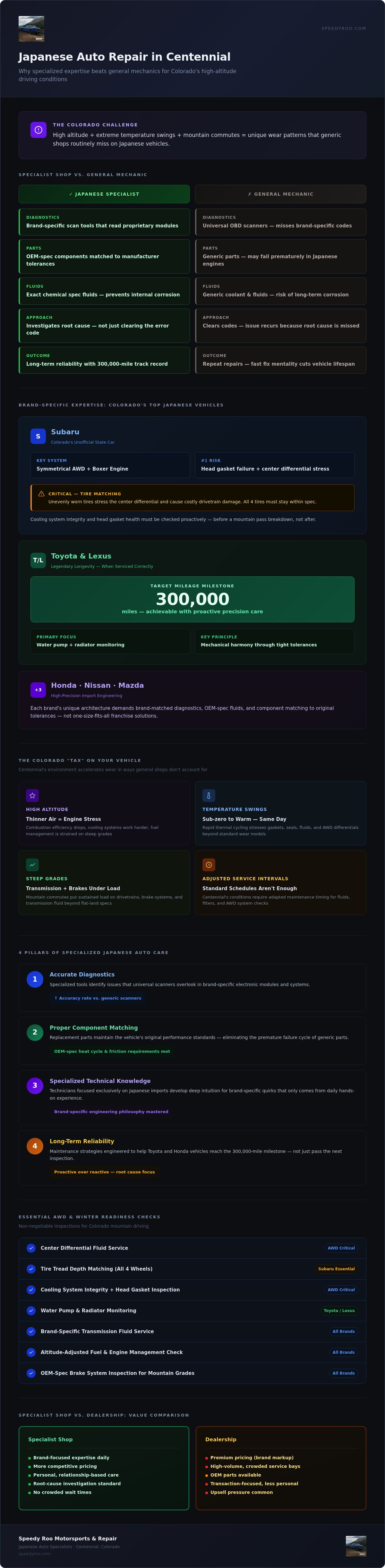
Japanese vehicles are a staple of Colorado life for a reason. From the Symmetrical All-Wheel Drive of a Subaru to the legendary longevity of a Toyota, these machines are built with specific engineering goals in mind. True Japanese auto repair Centennial isn’t just about fixing what’s broken. It’s a specialized approach that respects the unique tolerances and high-precision manufacturing of Japanese brands. While a general mechanic might understand the basics of internal combustion, a specialist understands the nuances of how these specific systems interact with our high-altitude environment.
There is a significant gap between “knowing cars” and mastering Japanese engineering. Large franchise shops often use a “one-size-fits-all” mentality, utilizing generic parts that may not meet the strict standards of a Honda or Mazda. These components often fail prematurely because they weren’t designed for the specific heat cycles or friction requirements of an import engine. Choosing a specialist ensures your vehicle receives parts and care that align with its original design, preventing the stress of repeat repairs.
The Engineering Philosophy of Japanese Brands
Japanese manufacturers like Lexus and Nissan build vehicles with a focus on mechanical harmony. Every component is designed to work within a very tight margin of error. This precision requires specialized diagnostic tools that can communicate with brand-specific modules. It also means using fluids that meet exact chemical specifications. For instance, using a generic coolant in a Japanese system can lead to internal corrosion over time. A specialist ensures that every fluid, from transmission to brake lines, matches the manufacturer’s intent perfectly.
Why Centennial Drivers Seek Specialists Over Generalists
In our community, your car is your lifeline through snowstorms and mountain commutes. Choosing dedicated Japanese auto repair Centennial services means you’re opting for a partner who understands the specific wear and tear caused by our elevation and climate. Centennial drivers often prefer the “Expert Neighbor” approach because it prioritizes long-term health over a fast transaction. A specialist won’t just clear a code; they’ll investigate why it appeared. This level of thoroughness provides a sense of calm reliability that generalist shops struggle to match.
- Accurate Diagnostics: Specialized tools identify issues that universal scanners often overlook.
- Proper Component Matching: Ensuring that replacement parts maintain the vehicle’s original performance standards.
- Specialized Knowledge: Technicians who spend every day working on Japanese imports develop an intuition for brand-specific quirks.
- Long-Term Reliability: Focusing on maintenance strategies that help a Toyota or Honda reach the 300,000-mile mark.
Expert Care for Colorado’s Favorites: Subaru, Toyota, and More
Centennial roads are a proving ground for Japanese engineering. Whether you’re commuting on I-25 or heading into the foothills, your vehicle faces thin air, steep grades, and rapid temperature swings. Finding reliable Japanese auto repair Centennial services is the first step toward ensuring your car handles these challenges without compromise. Each manufacturer has its own set of technical requirements that demand more than just a generic approach to maintenance.
Subaru Specialization: More Than Just an Oil Change
Subarus are the unofficial vehicle of Colorado, but their unique Boxer engine and Symmetrical AWD system require specific expertise. One of the most overlooked aspects of Subaru health is tire tread matching. If one tire is significantly more worn than the others, it puts immense stress on the center differential, leading to costly drivetrain repairs. We focus on addressing common head gasket concerns and cooling system integrity before they leave you stranded on a mountain pass. For those seeking Subaru Repair in Aurora: Specialist Care for Your Boxer Engine & AWD, precision is the only way to maintain that signature performance.
Toyota and Lexus: Reliability Through Precision
Toyota and Lexus models are famous for their longevity, often reaching 300,000 miles when cared for correctly. To hit those high-mileage milestones in Centennial, you must be proactive with the cooling system. Water pumps and radiators are the primary components that need monitoring as the odometer climbs. Hybrid owners of the Prius or Lexus RX series also need specialized health checks for their battery cooling fans and inverter systems. You can learn more about our methodical approach by visiting our Toyota Specialist Aurora: Your Guide to Expert Repair & Service (2026) resource.
Honda and Nissan: Transmission and Electrical Care
Modern Honda and Nissan vehicles rely heavily on complex electrical systems and specific transmission technologies. Honda’s VTEC system is remarkably durable, but it depends on perfectly clean oil and precise timing belt intervals to function. Meanwhile, Nissan’s CVT (Continuously Variable Transmission) requires proactive fluid changes to prevent the premature wear often seen in high-altitude driving. We use advanced diagnostics to solve electrical gremlins that general shops might misdiagnose, ensuring your sensors and modules communicate perfectly. If you aren’t sure about your current fluid health, a quick inspection can provide the peace of mind you need for the road ahead.
Specialist Shops vs. General Mechanics: A Comparison
Many drivers assume all auto shops are created equal. However, choosing Japanese auto repair Centennial specialists over a generalist can be the difference between a minor adjustment and a major engine overhaul. While general mechanics work on everything from domestic trucks to European sedans, a specialist focuses their entire career on specific engineering—much like how diesel owners rely on Diego’s Shop for specialized service and warrantied repairs. This repetition builds an intuitive understanding of common failure points and brand-specific quirks that a generalist might miss.
Diagnostic accuracy is where the gap becomes most apparent. Universal scanners used by general shops often provide generic error codes that lead to “parts cannon” repairs, where components are replaced one by one until the problem disappears. In contrast, a specialist uses manufacturer-specific diagnostic tools that communicate deeply with your vehicle’s proprietary software. This precision ensures you only pay for the repairs you actually need. Additionally, specialists prioritize OEM-equivalent parts. These components are designed to the exact tolerances of Japanese manufacturers, unlike the generic parts often found at high-volume chains that can fail prematurely in Colorado’s harsh conditions.
Why Dealer Specialization Matters for Your Warranty
A common misconception is that you must visit the dealership to keep your factory warranty intact. Under federal law, independent shops can perform all scheduled maintenance without voiding your coverage. The real advantage of an independent specialist is the personalized service. At a dealership, you’re often just a number in a high-volume system, communicating through a service advisor who may not have technical training. At an “Expert Neighbor” shop, you get master-tech quality and direct transparency without the dealership premium. This focused attention ensures that small issues, like a weeping water pump or a worn bushing, are caught before they become catastrophic failures.
Identifying a True Japanese Auto Specialist in Centennial
When searching for the right partner, look for a shop that invests in brand-specific equipment and maintains a methodical, organized workspace. A clean shop is often a sign of a technician who takes pride in their craftsmanship. You should also verify that the staff holds certifications relevant to your specific make. For more clarity on what to expect, read our guide on Japanese Import Repair in Aurora: 5 Common Myths Debunked for Owners. Choosing a shop that exclusively handles Japanese imports ensures your car is in the hands of someone who truly respects its engineering and its long-term health.
Protecting Your Investment: Maintenance for Centennial Drivers
Centennial’s environment presents a unique set of challenges for any vehicle. High altitude and extremely dry air create what local specialists often call the “Colorado Tax.” This isn’t a literal fee, but rather the increased wear and tear on your engine’s efficiency and longevity. To master Japanese auto repair Centennial owners must adapt their maintenance schedules to these specific conditions. Thinner air means your engine works harder to produce power, while low humidity causes rubber gaskets and hoses to become brittle faster than in coastal climates.
Preparing for the I-25 summer commute is just as vital as winterizing. Stop-and-go traffic in 90-degree heat is brutal on imports designed for more temperate zones. We recommend a thorough cooling system inspection every spring. Checking for debris in the radiator and testing the chemical balance of your coolant prevents the overheating that often leads to warped cylinder heads or blown gaskets.
AWD System Health in the Rockies
When the snow starts falling in Centennial, your AWD system is your primary safety feature. However, that security depends on the health of your differentials and transfer case. These components rely on specialized fluids that break down under the stress of mountain driving and cold starts. Fluid changes for these systems are non-negotiable if you want to avoid expensive drivetrain failures. Another critical factor is tire wear. Even a small difference in tread depth between tires can trick your AWD system into thinking a wheel is slipping, causing constant mechanical friction. You can find more detail in our Subaru AWD Service in Aurora: The Complete Maintenance Reference.
High-Altitude Performance Optimization
At 5,000 feet and above, the air is significantly less dense. This directly affects the fuel-to-air ratio in your Japanese engine. Modern ECUs do their best to compensate, but they often leave performance and fuel economy on the table. For those driving high-performance imports or modified vehicles, specialized calibration is the only way to ensure the engine isn’t running too lean or rich. This is where Dyno Tuning Aurora CO: The Complete Resource for Performance Calibration becomes an invaluable tool. A dyno test allows us to see exactly how your car is performing under load at our specific elevation.
If you haven’t had your AWD fluids or cooling system checked this season, it’s time for a professional evaluation. Schedule your specialized Japanese vehicle inspection today to keep your car performing at its peak through every Colorado season.
Why Centennial Drivers Trust Speedy Roo Motorsports & Repair
Since 2002, Speedy Roo Motorsports & Repair Inc. has served as a dedicated alternative to high-pressure dealerships. We aren’t a general repair shop that occasionally sees an import; we are an independent specialist focused exclusively on Japanese brands. This concentration of expertise allows us to provide the highest level of Japanese auto repair Centennial drivers can find. By choosing a shop that lives and breathes Japanese engineering, you ensure your vehicle receives the meticulous care it needs to handle Colorado’s demanding terrain.
Our Specialized Service Offerings
We provide comprehensive care for the brands that dominate Colorado roads. Our technicians are masters of their craft, handling everything from routine maintenance to complex mechanical overhauls. Our core services include:
- Subaru, Toyota, and Lexus: Specialized repair focusing on Boxer engines, hybrids, and high-mileage longevity.
- Honda, Nissan, and Mazda: Precision maintenance for VTEC systems, CVT transmissions, and SkyActiv technology.
- Advanced Diagnostics: Using brand-specific tools to identify issues with surgical precision.
- Aurora Dyno Tuning: Performance calibration specifically designed for our high-altitude environment.
- Pre-Sale Inspections: Helping you evaluate your next Japanese import purchase with a professional eye.
Experience the Speedy Roo Difference
The Speedy Roo difference lies in our methodical process and specialized communication. Our professional staff speaks “Japanese Car” fluently, translating complex technical issues into easy-to-digest information. We don’t believe in the “one-size-fits-all” mentality of large national chains. Instead, we prioritize the long-term health of your specific vehicle, using our two decades of experience to catch potential problems before they lead to unexpected breakdowns. This proactive approach is why our neighbors continue to trust us with their most valuable property.
Your vehicle is an investment in your freedom and safety. Don’t leave its health to a generalist who doesn’t understand the nuances of Japanese engineering. Schedule your Japanese auto service with Speedy Roo Motorsports & Repair Inc today and experience the peace of mind that comes with specialized expertise.
Secure the Longevity of Your Japanese Vehicle
Your Subaru, Toyota, or Honda is a precision-engineered investment built for longevity. Throughout this guide, we’ve highlighted why specialized diagnostic tools and a deep understanding of Japanese engineering are essential for your car’s health. Choosing the right Japanese auto repair Centennial service ensures your vehicle doesn’t just survive Colorado’s extreme altitude and weather but thrives in them. Our methodical approach catches small issues before they become costly repairs, replacing the stress of the unknown with the confidence of expert care.
Since 2002, Speedy Roo Motorsports & Repair has served as independent Japanese import experts for the local community. We focus exclusively on brands like Subaru, Toyota, Honda, and Nissan to provide a level of technical expertise that general shops simply can’t match. By prioritizing transparency and thorough maintenance, we help you reach high-mileage milestones without the dealership stress. You deserve a partner who is as invested in your car’s performance as you are.
Book Your Japanese Auto Specialist Appointment Today and experience the peace of mind that comes with professional, localized care. We look forward to keeping your vehicle reliable for every mountain pass and morning commute ahead.
Frequently Asked Questions
Is it better to take my Toyota to a specialist or the dealership?
Choosing a specialist often provides a more transparent and methodical experience than a high-volume dealership. While dealerships have brand-specific training, an independent specialist offers the same level of technical mastery with a focus on building a long-term partnership. You’ll typically find more direct communication with the technician performing the work, which ensures that no detail of your vehicle’s health is overlooked during the process.
How often does a Subaru really need AWD system maintenance in Colorado?
You should have your differential and transfer case fluids inspected every 30,000 miles, especially given Colorado’s steep grades and temperature swings. Frequent mountain driving puts additional load on the Symmetrical AWD system, making regular checks vital to prevent mechanical friction. Proactive fluid exchanges ensure that the internal components stay lubricated and protected against the stress of navigating snowy Centennial roads and high-altitude climbs.
Can a specialist shop perform maintenance without voiding my new car warranty?
Yes, federal law allows independent shops to perform all scheduled maintenance without affecting your factory warranty. As long as the service is documented and meets manufacturer standards, your coverage remains intact. This provides a reliable alternative for Japanese auto repair Centennial drivers who prefer a more personalized experience. It allows you to receive expert care from a dedicated specialist while keeping your financial protections fully active.
What are the most common issues with high-mileage Honda vehicles?
High-mileage Hondas often require attention to timing belts, water pumps, and valve adjustments to maintain their signature efficiency. You should also monitor the suspension bushings and engine mounts, as these rubber components can become brittle in Colorado’s dry climate after 100,000 miles. Addressing these wear items early prevents them from causing secondary damage to the engine or drivetrain, helping your vehicle reach its full potential.
Why is my Nissan’s CVT transmission acting strangely in cold weather?
Cold temperatures increase the viscosity of CVT fluid, which can lead to sluggish response or “shuddering” until the transmission reaches operating temperature. Regular fluid exchanges are critical for Nissans in Centennial to ensure the fluid maintains its protective properties during extreme winter cold starts. If the fluid is old or contaminated, it won’t flow correctly, leading to increased wear on the belts and pulleys inside the unit.
How does Centennial’s altitude affect my Japanese car’s performance?
Thinner air at 5,000 feet and above reduces the oxygen available for combustion, which can decrease power and fuel economy if the engine isn’t calibrated correctly. While modern ECUs adjust automatically, specialized performance tuning can optimize the air-to-fuel ratio for better efficiency in high-altitude environments. This ensures your vehicle isn’t working harder than necessary, which reduces internal stress and extends the life of your engine components over time.
What should I look for in a pre-purchase inspection for a used Subaru?
A professional pre-sale inspection should prioritize a check for head gasket leaks, cooling system integrity, and tire tread depth consistency. Since uneven tire wear can damage the center differential, verifying that all four tires match is a critical step for any used AWD vehicle. This specialized evaluation is a core part of the Japanese auto repair Centennial expertise we provide to help you buy your next import with confidence.