
With more than 72% of vehicles purchased in Colorado featuring all-wheel drive, our drivers rely on four-corner traction more than almost anywhere else in the country. You likely count on that surefooted grip every time you merge onto I-225 during a snowstorm or head into the foothills for the weekend. However, when you feel a faint shudder during a tight parking turn or realize you cannot remember your last differential service, that everyday peace of mind can turn into worry. Staying ahead of component wear requires proactive AWD system maintenance Aurora drivers can trust, especially given the strain of high-elevation climbs and sudden seasonal shifts.
Discover how proper AWD maintenance protects your Japanese vehicle against harsh Colorado driving demands and costly repairs. Below, we examine the mechanical needs of your drivetrain, map out critical fluid service intervals tailored to local conditions, and explain the essential tire rules and early warning signs that keep your vehicle dependable.
Key Takeaways
- Understand why Aurora commuting and steep mountain climbs place your drivetrain under severe-duty operating conditions.
- Discover how regular AWD system maintenance Aurora specialists provide for differentials and transfer cases stops thermal fluid breakdown before gear wear starts.
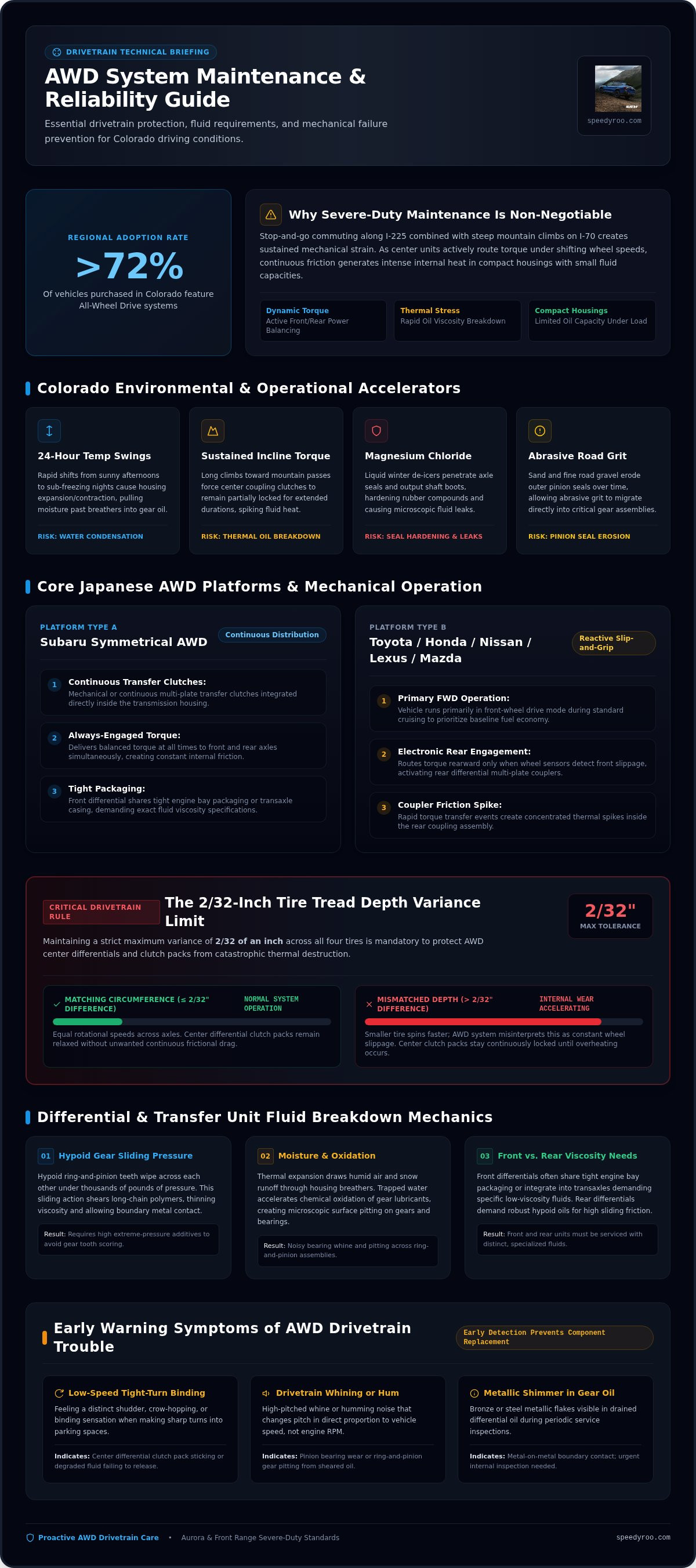
- Learn why maintaining a strict 2/32-inch tire tread depth variance is essential to protect delicate center differential assemblies.
- Spot early mechanical symptoms like low-speed binding during parking turns or drivetrain whining before they escalate into major repairs.
Why Front Range Driving Demands Rigorous AWD System Maintenance
Modern all-wheel-drive maintenance is the scheduled inspection, fluid servicing, and mechanical calibration of electronically controlled transfer cases, multi-plate clutch packs, and differentials to preserve seamless torque transfer. While standard factory manuals outline generalized service intervals, Aurora drivers operate under conditions that far exceed everyday wear. Daily stop-and-go commuting along I-225 paired with weekend climbs into the foothills forces these drivetrains to work under sustained mechanical strain.
Climbing steep mountain corridors like I-70 generates immense frictional resistance within gear assemblies. When an AWD system detects elevation grades and shifting wheel speeds, the center unit dynamically routes engine torque between the front and rear axles. This active distribution creates continuous friction, generating sustained internal heat inside compact housings holding relatively small fluid capacities. Without dedicated AWD system maintenance Aurora vehicles can experience premature thermal oil breakdown, leaving internal hypoid gears and bearings unprotected against metal-on-metal wear.
Colorado Driving Factors Accelerating Drivetrain Wear
Front Range weather swings push drivetrain components through drastic operational extremes. A single 24-hour cycle in Aurora can drop temperatures from sunny afternoons into sub-freezing nights, creating rapid expansion and contraction cycles across aluminum housings. These shifts draw moisture past vent breathers, causing water condensation to mix with gear oil.
Compounding this thermal stress, winter road maintenance introduces harsh chemical risks:
- Magnesium chloride exposure: Liquid de-icers penetrate axle seals and output shaft boots, hardening rubber compounds and causing microscopic fluid leaks.
- Sustained incline torque: Long climbs toward mountain passes force center coupling clutches to remain partially locked for extended durations, driving up fluid temperatures.
- Abrasive road grit: Sand and fine road gravel erode outer pinion seals, allowing road grit to migrate into critical gear assemblies.
Core Components Comprising Modern Japanese AWD Platforms
Japanese platforms rely on sophisticated architectures to balance efficiency and traction. The front differential handles steering angle speed differences, the rear axle drives the trailing wheels, and a central mechanism balances front-to-rear power. Understanding how these four-wheel drive systems distribute power helps clarify their unique servicing needs.
Platforms vary significantly in mechanical operation. Subaru Symmetrical AWD systems generally employ mechanical or continuous multi-plate transfer clutches integrated directly into the transmission, delivering balanced torque at all times. In contrast, reactive slip-and-grip systems found on many Toyota, Honda, Nissan, Lexus, and Mazda crossovers operate primarily in front-wheel drive, routing torque rearward only when electronic sensors detect front-wheel slip. Both designs generate substantial friction within their transfer units, making routine fluid renewal the cornerstone of dependable drivetrain performance.
Essential AWD Fluid Services: Differentials, Couplers, and Transfer Units
Every active component in an all-wheel-drive system relies on specialized fluids to survive extreme shear stress. Differential gear oil cushions hypoid ring-and-pinion teeth under thousands of pounds of pressure. Over time, thermal cycles fracture the long-chain polymers in this oil, thinning its viscosity and allowing boundary contact between gear surfaces. When fluid shears down, internal friction climbs rapidly. Moisture entering through housing breathers during heavy Front Range snowstorms triggers chemical oxidation, leading to microscopic gear pitting and noisy bearing failure.
Front differential assemblies often share tight engine-bay packaging or integrate directly into transaxle casings, demanding specific low-viscosity fluids. In contrast, rear differentials use robust hypoid gear oils engineered to handle heavy sliding friction between spiral gear teeth. Drivers looking into factory-specific maintenance schedules can review our guide to Subaru AWD service Aurora drivers trust for detailed model milestones.
Front and Rear Differential Fluid Care
As ring and pinion gears rotate under load, hypoid teeth wipe across each other rather than simply rolling together. This sliding motion wipes away standard lubricant films unless the gear oil maintains high extreme-pressure additives. Degraded fluid shows obvious indicators of failure:
- Metallic shimmer: Suspended bronze or steel particles catching the light under shop inspection lamps.
- Darkened viscosity: Burnt, black oil smelling strongly of sulfur from overheated chemical additives.
- Milky emulsion: Frothy brown fluid indicating moisture intrusion through clogged or submerged breather vents after driving through deep slush.
Center Differentials and Electronic Transfer Couplings
Center units regulate front-to-rear wheel speeds, absorbing mechanical drag whenever you navigate tight turns. In viscous couplings, high-viscosity silicone fluid shears under slip to transfer torque. Continuous slipping overheats this fluid, causing it to harden permanently and lock both axles together. In modern Japanese crossovers, electronically modulated wet multi-plate clutch packs manage power distribution across millisecond intervals.
Using incorrect lubricants creates immediate mechanical resistance. Off-the-shelf universal gear oils often lack the delicate friction modifiers required by multi-plate clutch packs. Without these exact chemical additives, clutch discs chatter, glaze over, and cause excessive heat and unwarranted wear across the entire center assembly. If your vehicle feels sluggish or drags during slow turns, scheduling dedicated AWD system maintenance Aurora specialists provide will verify that every housing contains its precise factory fluid specification.
The Mismatched Tire Rule: Protecting AWD Center Differentials
All-wheel-drive systems rely on balanced rotational speeds across all four corners. When tires have mismatched tread depths or different rolling circumferences, smaller tires must rotate faster than larger ones to travel the exact same distance. This circumference discrepancy tricks your vehicle’s center differential or multi-plate clutch pack into detecting wheel slip. Instead of disengaging on dry highway pavement, the internal mechanism slips continuously, generating extreme thermal energy that fries internal clutches and compromises gear teeth.
Consider the math behind a simple tire mismatch. A variation of just 4/32-inch in tread depth creates an outer circumference variance of approximately 0.8 inches. Over the course of a single highway mile, that smaller tire spins several additional revolutions. Multiplied across daily commutes along I-225, your drivetrain absorbs thousands of unwanted rotational stress cycles every week. Spending money on a matched set of four tires is a modest investment compared to the steep expense of a full transfer case rebuild or transmission replacement.
Circumference Tolerances Across Japanese AWD Models
Japanese engineering emphasizes precise operational tolerances. Subaru Symmetrical All-Wheel Drive enforces a strict maximum variance of 2/32-inch tread depth (or within 1/4-inch total tire circumference) between all four wheels. Toyota, Lexus, Honda, and Mazda platforms with reactive multi-plate systems also demand matched rolling radii to prevent overheating their rear drive units.
Understanding how all-wheel drive works under unequal wheel speeds highlights why even minor tread differences strain internal mechanical components:
| Tread Depth Variance | Mechanical Impact | Drivetrain Risk Level |
|---|---|---|
| 0 to 2/32-inch | Normal operating differential compensation | Safe / Factory Tolerance |
| 3/32 to 4/32-inch | Continuous slip clutch friction and elevated fluid temps | Moderate / Accelerated Wear |
| > 4/32-inch | Fluid overheating, clutch pack glazing, and differential binding | Severe / Imminent Component Failure |
Tire Rotation Disciplines and Shaving Alternatives
Consistent tire rotation is a fundamental pillar of thorough AWD system maintenance Aurora drivers rely on to prevent mechanical failure. Rotating tires every 5,000 to 6,000 miles ensures front and rear tires wear at identical rates. If you pick up an unrepairable nail in an individual tire while the remaining three have worn halfway, you don’t necessarily have to discard the entire set. Many specialized tire shops offer tire shaving, machining a brand-new replacement tire down to match the exact rolling diameter of your remaining three wheels. Finally, monitor cold tire pressures regularly during cold Front Range mornings, as an underinflated tire sags under vehicle load and reduces its effective rolling diameter.
Recognizing Early Warning Signs of AWD Drivetrain Trouble
Catching mechanical wear before complete failure saves thousands in extensive drivetrain rebuilds. Because all-wheel-drive systems link every wheel through a network of shafts, joints, and gears, a failure in one assembly produces distinct mechanical feedback. Worn carrier bearings emit a steady, hollow hum that deepens with vehicle speed. Pitted pinion bearings generate a distinct, high-pitched whine that changes pitch depending on whether you are accelerating or coasting down an off-ramp.
Driveline vibrations point to other failing components. A shudder felt through the floorboards during acceleration often signals worn inner constant velocity (CV) joints or an out-of-balance propeller shaft. If you ignore these early signs, vibration travels straight into differential output seals, causing leaks and accelerating internal wear.
Auditory and Tactile Drivetrain Symptoms
Differentiating between hub bearing failure and internal differential wear is simple when you know what to listen for:
- Gear whine vs. wheel bearing hum: Wheel bearings drone constantly and change tone as vehicle weight shifts during high-speed lane changes. In contrast, differential whine alters volume precisely when stepping on or lifting off the accelerator throttle.
- Torque bind during tight turns: Feeling the vehicle hop, buck, or drag its inside rear tire when pulling into an Aurora parking space indicates that the center coupler or multi-plate clutch pack has locked up.
- Acre sulfur odors: A pungent, burnt-egg smell coming from underneath the rear differential housing after normal highway driving indicates severely overheated gear oil breaking down past its operational limit.
Diagnostic Steps for Suspected Torque Bind
If you suspect drivetrain binding, find an open, level parking lot with dry pavement. Turn your steering wheel to full lock in one direction and let the car crawl in a slow circle at idle without touching the gas pedal. The vehicle should roll smoothly without resistance. If the car hesitates, shudders, or feels as though the brakes are dragging, the center transfer assembly is failing to allow rotational slip between the axles.
Next, check your instrument cluster for blinking AWD, traction control, or AT OIL TEMP warning lamps. Flashing lights indicate that the computer has logged a rotational speed discrepancy or fluid temperature fault. When low-speed binding or persistent warning lights occur, scheduling a comprehensive diagnostic evaluation for Subaru repair in Aurora ensures an experienced technician inspects the transfer clutch duty solenoid and hydraulic valve body. To keep every component operating within factory specifications, schedule thorough AWD system maintenance Aurora drivers depend on before minor drivetrain friction turns into major mechanical damage.
Establishing an AWD Preventive Maintenance Routine in Aurora
Most vehicle owner manuals present two maintenance schedules: normal and severe. Normal schedules assume flat highway driving in temperate climates. Daily life along the Front Range is anything but mild. Commuting through stop-and-go traffic on I-225, enduring sudden sub-zero morning cold starts, and climbing thousands of vertical feet on weekend mountain trips push drivetrains hard. For local drivers, severe-duty maintenance isn’t optional; it’s the realistic benchmark required to keep complex transfer systems running reliably.
Implementing a structured schedule for AWD system maintenance Aurora vehicles need prevents sudden component fatigue and protects expensive drivetrain assemblies from avoidable wear.
Recommended Mileage Milestones for Japanese AWD Systems
Following a disciplined milestone schedule keeps your mechanical gears, multi-plate clutches, and differential bearings operating in clean, uncompromised lubrication:
- Every 5,000 to 6,000 miles: Perform tire rotations, measure tread depths with a dedicated gauge across all four tires, and verify cold tire inflation pressures to prevent circumference mismatches.
- Every 30,000 miles: Complete a full fluid exchange for the front differential, rear differential, and center transfer assembly. Colorado’s steep grades shear fluid polymers quickly, making 30,000 miles the ideal interval rather than waiting for 60,000-mile factory recommendations.
- Every 30,000 to 60,000 miles: Conduct physical inspections of front and rear CV axle boots, differential pinion seals, and breather vents to ensure winter slush, road sand, and liquid de-icers haven’t compromised internal seals.
Specialized Care at Speedy Roo Motorsports & Repair Inc
Since 2002, Speedy Roo Motorsports & Repair Inc has served Aurora drivers as an independent Japanese import auto specialist. Modern all-wheel-drive platforms require exact fluid chemistry, precise fill levels, and nuanced diagnostic knowledge. Our shop provides deep mechanical expertise across Subaru, Toyota, Lexus, Mazda, Honda, and Nissan drivetrains, serving as a meticulous, transparent alternative to dealership service departments.
Whether you need your routine 30,000-mile fluid service completed or want an expert driveline inspection after hearing a low-speed rumble, our team is equipped to solve mechanical issues thoroughly. Take the guesswork out of your drivetrain care and schedule AWD service with Speedy Roo Motorsports & Repair Inc today to keep your vehicle running smoothly on Colorado roads.
Protect Your Drivetrain for Every Colorado Mile Ahead
Reliable all-weather traction shouldn’t come at the expense of your vehicle’s mechanical longevity. By prioritizing timely differential fluid exchanges, monitoring tire wear within strict factory tolerances, and addressing subtle warning signs like low-speed binding or gear whine early, you keep your drivetrain protected against harsh Front Range driving demands. Staying proactive with proper AWD system maintenance Aurora drivers depend on ensures you navigate sudden winter storms and steep mountain corridors with complete confidence.
Since 2002, Speedy Roo Motorsports & Repair Inc has delivered specialized Japanese vehicle care right here in Aurora. With deep expertise across Subaru, Toyota, Lexus, Mazda, Honda, and Nissan platforms, our team combines advanced diagnostic capabilities with dedicated technician precision to resolve driveline friction before it leads to costly repairs. Don’t wait for minor gear noise or binding to turn into serious component failure. Schedule your AWD system inspection with Speedy Roo Motorsports today, and enjoy the dependable, smooth performance your vehicle was built to deliver.
Frequently Asked Questions
How often should I change the differential fluid in my AWD vehicle in Colorado?
You should change your differential fluid every 30,000 miles when driving in Colorado. Standard factory schedules often suggest 60,000 miles or claim fluid lasts the vehicle’s lifetime. However, regional driving involves sustained mountain inclines, high summer heat, and freezing winters that degrade lubricants quickly. Adopting a severe-duty 30,000-mile schedule protects internal ring-and-pinion assemblies from thermal breakdown. Routine AWD system maintenance Aurora specialists perform keeps gear teeth cleanly lubricated across local commuting and high-altitude climbs.
Can I replace just one tire on my AWD car if I get a flat?
No, you should not replace just one tire unless the new tire’s tread depth matches the others within 2/32-inch. A single new tire has a larger rolling circumference than three worn tires. This size difference forces the center differential or multi-plate clutch pack to slip continuously to balance axle speeds, generating extreme internal heat. If you cannot match the exact tread depth by having the new tire shaved, replacing all four tires at once is necessary to prevent severe drivetrain strain.
What is torque bind and what causes it in all-wheel-drive vehicles?
Torque bind is a mechanical shudder or hopping sensation felt during low-speed, tight turns. It occurs when the center differential or transfer clutch pack locks the front and rear driveshafts together instead of allowing them to rotate at different speeds. The most common causes include contaminated or sheared transfer fluid, mismatched tire circumferences, or worn duty solenoids in electronically controlled multi-plate clutch packs. Left unaddressed, torque bind places severe mechanical stress on axle shafts, CV joints, and differential gears.
Why is all-wheel-drive maintenance different from four-wheel-drive maintenance?
AWD maintenance focuses on continuously active, electronically modulated friction components, whereas traditional 4WD systems use robust, part-time mechanical transfer cases. Most 4WD trucks operate in two-wheel drive until manually locked on loose terrain. In contrast, modern Japanese AWD systems operate full-time, constantly calculating slip and distributing torque across front, center, and rear housings. This continuous engagement demands strict fluid viscosity tolerances, balanced tire rolling diameters, and specialized friction modifiers that standard part-time truck drivetrains do not require.
What does a failing center differential sound like while driving?
A failing center differential typically produces a high-pitched whining noise, a grinding growl, or rhythmic clicking during turns. When internal bearings wear down, the assembly emits a noticeable hum that changes pitch when you press or release the accelerator. If internal spider gears pit or transfer clutch plates glaze, you will often hear metallic clicking or scrubbing sounds during low-speed maneuvers. Any persistent mechanical noise from underneath the center console warrants immediate inspection before internal damage spreads to connected drive units.
Does cold Aurora winter weather affect my AWD system fluids?
Yes, sub-zero winter temperatures in Aurora significantly thicken differential gear oils and transfer case fluids. Cold temperatures increase fluid viscosity, temporarily slowing initial lubrication flow across gear faces during morning cold starts along the Front Range. Additionally, rapid temperature shifts cause condensation inside axle housings through air breathers, contaminating lubricants with water. Scheduling comprehensive AWD system maintenance Aurora vehicles require ensures your housings contain clean, moisture-free synthetic fluids engineered to flow properly in deep winter chills.