
Aurora’s thin air and unpredictable winters demand more from your engine than a standard oil change can provide. If you’ve been searching for reliable Japanese vehicle maintenance Aurora drivers trust, you likely want to avoid the high costs of a dealership while ensuring your car remains dependable. It’s a common concern; nobody wants to find themselves stranded on I-225 because of a preventable mechanical failure caused by our unique “Mile High” conditions.
We understand that your vehicle is a vital part of your daily life, and you deserve a partner who respects the precision engineering of your import. In this guide, we’ll show you how specialized care tailored to Colorado’s climate can significantly extend the life and performance of your Japanese vehicle. You’ll discover the critical differences between generic service and specialist expertise, learn how to build a reliable maintenance schedule, and find out what to look for in a local shop that truly understands your car’s needs.
What You’ll Learn
- How Aurora’s high altitude and 40-degree temperature swings affect your vehicle’s air-fuel ratios and rubber components.
- Specific maintenance strategies for Subaru Boxer engines and Toyota hybrid systems to ensure long-term reliability.
- The benefits of choosing a local specialist for Japanese vehicle maintenance Aurora over a traditional dealership for better transparency.
- A practical “Mile High” checklist to keep your vehicle safe through every Colorado season, from spring potholes to summer heat.
Why Japanese Vehicle Maintenance in Aurora Requires a Specialized Approach
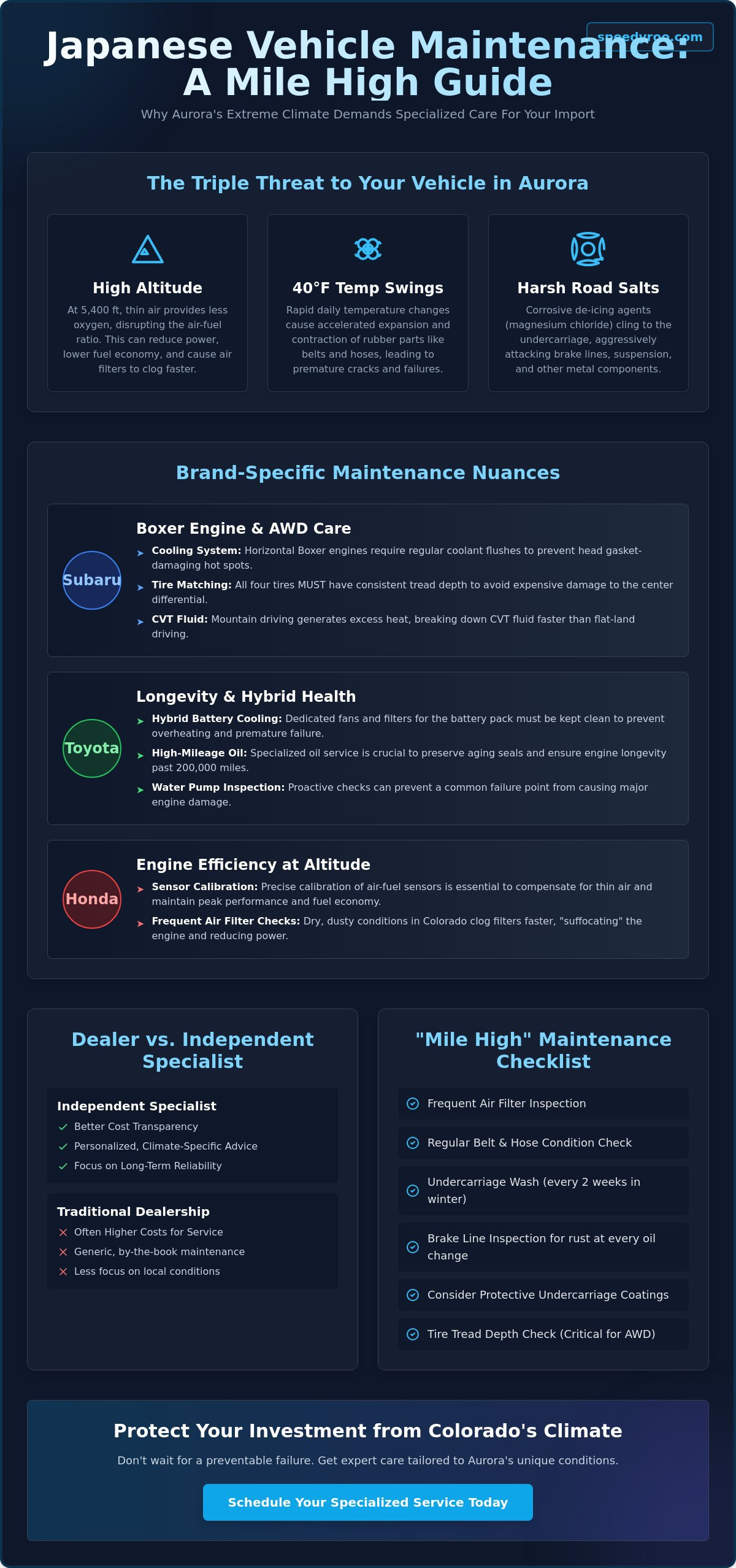
Aurora’s environment is uniquely demanding on cars. When you invest in Japanese vehicle maintenance Aurora experts understand that our 5,400-foot elevation isn’t just a statistic; it’s a mechanical challenge. The Japanese automotive industry is renowned for world-class precision engineering, but even the most reliable Toyota or Honda requires specific adjustments to handle our thin air and dramatic weather shifts. A generalist shop might provide a standard oil change, but they often overlook the subtle ways Colorado’s climate stresses specialized import systems.
Temperature swings are another major factor. It’s common for Aurora to experience 40-degree shifts in a single day. These rapid changes cause rubber components, such as serpentine belts and vacuum hoses, to expand and contract at an accelerated rate. Over time, this leads to premature cracking and seal failures that a technician unfamiliar with Japanese-specific tolerances might miss. Specialized diagnostics allow us to identify these vulnerabilities during a routine inspection, preventing a small leak from turning into a “dead-on-the-road” failure during a blizzard.
Altitude and Your Engine Performance
Thin air means less oxygen for combustion. In naturally aspirated engines found in many Mazda and Honda models, this lack of oxygen can throw off air-fuel ratios. Your car’s computer tries to compensate, but if sensors aren’t calibrated correctly, you’ll see a significant drop in fuel economy and power. Precise sensor calibration is essential for maintaining that signature Japanese efficiency at a mile high. Additionally, our dry, dusty environment means air filters clog faster than manufacturer manuals suggest. We recommend checking these more frequently to ensure your engine isn’t “suffocating” while climbing steep grades on I-70.
The Impact of Colorado Road Salts
The de-icing agents used on roads in Centennial, Parker, and Aurora are incredibly harsh. These magnesium chloride mixtures cling to the undercarriage, specifically targeting the brake lines and suspension components common in Asian imports. Because many Japanese vehicles prioritize lightweight, efficient designs, their undercarriages can be susceptible to surface corrosion if left untreated. To protect your investment, we suggest the following:
- Regular Undercarriage Washes: Rinse your vehicle every two weeks during the winter to remove salt buildup.
- Brake Line Inspections: Ensure your technician checks for “pitting” or rust on metal lines during every oil change.
- Protective Coatings: Consider specialized treatments for exposed bolts and joints to prevent them from seizing.
By focusing on these localized factors, you ensure your vehicle remains as reliable as the day it left the factory, regardless of what the Colorado sky throws at it.
The Big Three: Specialized Care for Subaru, Toyota, and Honda
While Japanese cars share a reputation for reliability, the engineering under the hood varies significantly between manufacturers. Effective Japanese vehicle maintenance Aurora drivers need must account for these mechanical differences. Whether you drive a symmetrical AWD Subaru or a high-efficiency Toyota hybrid, a generic approach to service often ignores the specific needs of these sophisticated machines. Precision matters, especially when your car faces the daily climb of the Rockies. Specialized Japanese vehicle maintenance Aurora experts provide ensures these brand-specific quirks are managed before they become costly repairs.
Subaru-Specific Maintenance Nuances
Subaru’s horizontal Boxer engine layout provides a low center of gravity, but it also places unique demands on the cooling system. Because the cylinder heads sit on the sides, gravity doesn’t assist coolant flow in the same way it does in an upright engine. Regular cooling system flushes are vital to prevent hot spots that can lead to head gasket issues. Additionally, tire matching is critical for Subaru owners. All four tires must have consistent tread depth; even a small discrepancy can cause expensive damage to the center differential. For newer models, we monitor CVT fluid degradation, as the heat from mountain driving can break down lubricants faster than expected. If you’re considering purchasing a pre-owned model, a thorough used Subaru inspection in Aurora can reveal hidden head gasket issues or drivetrain wear before you commit to the purchase.
Toyota Longevity and Hybrid Health
Precision for Honda, Nissan, and Mazda
Honda and Acura engines remain some of the most durable on the road, but they are often interference designs. This means a snapped timing belt can cause catastrophic internal damage. Sticking to strict replacement intervals and performing periodic valve adjustments keeps these engines running quietly. Similarly, Nissan and Mazda vehicles require specialized attention. Nissan’s CVTs need regular fluid changes to maintain smooth operation, while Mazda’s SkyActiv technology benefits from specific intake cleaning to prevent carbon buildup. Following standard vehicle maintenance tips is a great foundation, but brand-specific knowledge is what keeps your car on the road for decades. If you’re noticing a change in how your car shifts or handles, our team at Speedy Roo can perform a thorough diagnostic to catch issues early.
Dealer vs. Independent Specialist: Choosing Your Partner
Choosing where to take your car shouldn’t feel like a high-pressure negotiation. Many owners worry that stepping away from the dealership will compromise their car’s reliability or void their warranty. In reality, Japanese vehicle maintenance Aurora specialists often provide a level of transparency and technical focus that large dealerships struggle to match. Because independent shops rely on long-term community trust rather than high-volume sales, you’re more likely to receive an honest estimate and a clear explanation of why a specific repair is necessary. This localized approach replaces the stress of the industry with a feeling of calm reliability.
Beyond technical skill, the relationship you build with a local mechanic is invaluable. At a dealership, you rarely speak to the person actually working on your engine. You deal with a service advisor who acts as a middleman. At an independent specialist shop, the communication is direct. You can discuss your car’s history with the expert who understands its specific quirks. This personalized attention ensures that nothing is overlooked during routine Japanese vehicle maintenance Aurora residents depend on for their daily commutes.
The Myth of the “Dealer-Only” Service
It’s a common misconception that you must visit the dealer to keep your warranty intact. The federal Magnuson-Moss Warranty Act protects you, ensuring that as long as you follow official maintenance guidelines, your factory coverage remains valid regardless of where the work is performed. Independent shops often employ technicians who have spent decades focusing exclusively on brands like Subaru or Toyota, making them more adept at catching brand-specific issues than a dealer technician who might be rushed through a high-volume schedule. This specialized focus is especially valuable for a pre-sale inspection, where a meticulous eye can save you thousands by spotting hidden wear on a used import.
Advanced Diagnostics and Dyno Tuning
A key advantage of choosing a specialized local shop is access to equipment tailored for performance and longevity. While a dealer might rely on generic code readers, shops like Speedy Roo utilize Aurora Dyno Tuning to simulate real-world driving conditions under load. This is critical in Colorado. A car might perform perfectly on a flat street but struggle with air-fuel ratios while climbing a steep mountain grade. Dyno testing allows us to identify driveability issues that only appear when the engine is working hard at high altitude. Precision tuning optimizes a Japanese engine for high-altitude efficiency, ensuring your vehicle maintains its power and fuel economy despite the thin air. This methodical approach replaces guesswork with data-driven results, giving you total confidence in your vehicle’s health.
The “Mile High” Maintenance Checklist for Every Season
Living in Colorado means your vehicle faces four distinct sets of challenges every year. A standard maintenance plan might work in the Midwest, but when scheduling your Japanese vehicle maintenance Aurora residents should prioritize a seasonal approach. Our environment requires proactive care to ensure that a simple commute doesn’t turn into an expensive repair. By following a calendar-based strategy, you can address the specific stressors that our high-altitude climate places on your import.
- Spring: After a winter of navigating potholes in Lone Tree and Aurora, your suspension takes a beating. We recommend a thorough inspection of your struts and a precision alignment to prevent uneven tire wear.
- Summer: High heat combined with steep mountain climbs puts immense pressure on your cooling system. A pressure test ensures your radiator and hoses can handle the internal stress of an I-70 ascent.
- Fall: Cold weather is the ultimate test for an aging battery. We perform load testing on Nissan and Mazda models to ensure you have enough cranking amps to start on those first freezing October mornings.
- Winter: Traction is everything. This is the time for AWD system checks and fluid inspections for your differentials, ensuring your Subaru or Toyota stays planted on icy neighborhood streets.
Essential Fluid Checks for Colorado
The variable climate in the Rockies affects your car’s fluids more than you might think. Brake fluid is naturally hygroscopic, meaning it absorbs moisture from the air. In our high-altitude environment, moisture-contaminated fluid can boil during long descents down mountain passes, leading to a “spongy” pedal or brake fade. We also pay close attention to differential and transfer case fluid intervals for AWD vehicles. These components work harder in the snow and require clean lubricants to prevent internal binding. Choosing the right oil viscosity is equally vital; you need a lubricant that flows easily at sub-zero temperatures while providing protection during a 100-degree summer afternoon.
Filtration and Air Quality
Your car needs to “breathe” just as much as you do in our thin air. Colorado’s high pollen counts and dusty plains can clog a cabin air filter in a single season, reducing the efficiency of your HVAC system and impacting air quality inside the car. More importantly, your engine air filter is your first line of defense against performance loss. A dirty filter restricts airflow, which is already limited at 5,000 feet, forcing your engine to work harder and consume more fuel. We also recommend periodic fuel system cleaning. This maintains injector health and ensures proper fuel atomization, which is critical for clean combustion at high altitudes. If you haven’t had your systems evaluated recently, schedule a comprehensive seasonal inspection to keep your vehicle running at its peak.
Speedy Roo: Aurora’s Trusted Japanese Automotive Specialists
Since 2002, Speedy Roo Motorsports & Repair Inc, operating as Speedy Roo, has been a staple in the Aurora, Denver, and Centennial communities. We aren’t a generalist shop that tries to be everything to everyone. Instead, we maintain a dedicated focus on the Japanese brands we know best: Subaru, Toyota, Lexus, Mazda, Honda, and Nissan. This specialization allows us to master the intricate engineering details discussed earlier, from the cooling needs of a Boxer engine to the filtration requirements of a Toyota hybrid. When you choose us for Japanese vehicle maintenance Aurora, you’re choosing a team that understands exactly how our local environment impacts your specific make and model.
Our “Honest Specialist” approach is the foundation of everything we do. We believe in transparent pricing and methodical repairs that prioritize the long-term health of your vehicle over a quick transaction. This means providing clear estimates and taking the time to explain the reasoning behind our recommendations. Whether we’re performing a routine oil service or utilizing our specialized Aurora Dyno Tuning to optimize your engine for high-altitude performance, our goal is to put you at ease. We also provide meticulous pre-sale inspections to help local buyers make informed decisions, ensuring that your next import is as reliable as the one you’re driving now.
Our Commitment to the Community
Our local expertise in Aurora, Parker, and Lone Tree makes a genuine difference for your daily commute. We know the specific stress that stop-and-go traffic on E-470 or the steep climbs into the foothills place on your drivetrain. Our customer-first philosophy means we treat your vehicle like it was our own, focusing on precision and reliability above all else. This specialized knowledge doesn’t just provide peace of mind; it saves you money over the long term by identifying small issues before they require major, dealer-level repairs. We take pride in being a dependable partner for our neighbors, replacing the typical stress of car care with a relationship built on trust.
Schedule Your Maintenance Today
We invite you to experience the difference that specialized Japanese auto repair can make for your vehicle’s longevity. Our professional staff operates out of a clean, organized facility designed to handle everything from standard fluid changes to complex diagnostics with ease. We’ve spent over two decades refining our processes to ensure that every car leaving our shop is prepared for the unique challenges of Colorado driving. Don’t wait for a small maintenance item to become a major headache on the side of the road. Book your specialized Japanese vehicle maintenance at Speedy Roo today! and let us help you keep your vehicle performing at its peak for years to come.
Secure the Future of Your Japanese Import
Your vehicle is an investment in your daily freedom and long-term reliability. Navigating the thin air and dramatic temperature swings of the Rockies requires more than generic care. By prioritizing a specialized maintenance schedule and choosing an expert who understands the nuances of Japanese engineering, you protect your car’s performance and its resale value. We’ve seen how the right approach to Japanese vehicle maintenance Aurora drivers rely on can turn a high-mileage commuter into a dependable companion for years to come.
At Speedy Roo, we’ve been serving our neighbors since 2002. Our specialists focus exclusively on brands like Subaru, Toyota, Honda, and Nissan, utilizing advanced tools like on-site Dyno Tuning to ensure your engine is perfectly calibrated for our unique altitude. We invite you to move from uncertainty to confidence by choosing a partner dedicated to your vehicle’s health. Schedule Your Specialist Japanese Maintenance Appointment with us today. Your car has taken care of you through every mountain pass and winter storm; now it’s time to return the favor with the precise care it deserves.
Frequently Asked Questions
How often should I have my Japanese vehicle serviced in Aurora?
You should generally follow the manufacturer’s “severe driving” schedule due to Colorado’s high altitude and extreme temperature swings. This typically means an oil change and safety inspection every 5,000 miles. For Japanese vehicle maintenance Aurora owners find that proactive seasonal checks are the best way to prevent unexpected breakdowns during winter storms or summer mountain climbs.
Does a specialized independent shop cost more than a general mechanic?
While a generalist might seem cheaper initially, specialized shops often provide better long-term value. We use brand-specific diagnostic tools that identify issues faster and more accurately than generic equipment. This prevents the “parts cannon” approach where you pay for unnecessary repairs. Our expertise in Japanese engineering ensures the job is done correctly the first time, saving you both time and money.
Will getting my Toyota serviced at Speedy Roo void my warranty?
No, servicing your Toyota or Lexus at an independent shop will not void your factory warranty. Federal law, specifically the Magnuson-Moss Warranty Act, ensures you have the right to choose your service provider. We use high-quality parts and follow all manufacturer-required protocols. Just keep your service records organized to demonstrate that you’ve maintained the vehicle according to the official schedule.
Why is Subaru maintenance different from other Japanese brands?
Subaru vehicles utilize a unique horizontal Boxer engine and a Symmetrical All-Wheel Drive system. This layout requires specific attention to cooling system health and precise tire matching to prevent differential damage. Unlike a transverse engine in a Honda or Toyota, the Boxer’s seals and gaskets face different gravitational stresses; this makes specialized knowledge essential for long-term reliability in our climate.
What are the signs that Aurora’s altitude is affecting my car’s performance?
Common signs include a noticeable loss of power when merging onto the highway or a sudden drop in fuel efficiency. You might also notice your transmission shifting more frequently as the engine struggles to find power in the thin air. These issues often stem from an air-fuel ratio that hasn’t been optimized for high altitude, which is a common focus for Japanese vehicle maintenance Aurora specialists.
Can you perform pre-purchase inspections for used Japanese cars in Aurora?
Yes, we specialize in pre-purchase inspections for used Japanese vehicles, including a comprehensive used Subaru inspection in Aurora that evaluates the Boxer engine, Symmetrical AWD system, and other model-specific components that are prone to wear from Colorado’s demanding mountain driving conditions.
Do Japanese cars really need specialized coolant and fluids?
Yes, Japanese manufacturers often require specific fluid chemistries to protect internal components. For example, many Honda and Toyota models use non-silicate, organic acid technology (OAT) coolants. Using a generic “all-makes” fluid can lead to water pump seal failure or internal clogging. We always use the correct, high-standard fluids designed for your vehicle’s specific engineering to ensure its long-term health.
How does dyno tuning help a daily driver in the Denver area?
Aurora Dyno Tuning isn’t just for performance enthusiasts; it’s a powerful tool for daily drivers. By simulating real-world loads, we can calibrate your engine to perform efficiently at 5,000 feet. This optimization improves throttle response and fuel economy, making your daily commute through Denver and Aurora much smoother. It ensures your car isn’t working harder than it needs to in our thin atmosphere.