
Would you trust a mountain athlete’s health based on a thirty-second pulse check? In Colorado, a used Subaru is that athlete, and a basic safety check rarely reveals the true condition of its Boxer engine or Symmetrical AWD system. Scheduling a professional used Subaru inspection in Aurora is the only way to ensure your potential new car isn’t hiding a costly head gasket leak or drivetrain fatigue from years of intense mountain commutes.
We understand that while you want the legendary capability of a Subaru, you don’t want to inherit someone else’s maintenance debt. It’s stressful to wonder if a slight vibration during a turn is a normal trait or a sign of a failing center differential. This guide provides the expert-led framework you need to navigate the local market with total confidence, using a checklist designed for the unique mechanical needs of these vehicles.
We’ll walk through the specific red flags to watch for during your test drive, explain why a specialist’s evaluation is your best defense against hidden damage, and show you how to use mechanical facts as powerful negotiation leverage. By the end of this article, you’ll know exactly what it takes to find a reliable partner for your next Colorado adventure.
Key Takeaways
- Generic safety checks often overlook the unique mechanical blueprint of a Subaru; learn why a specialized evaluation is necessary to catch Boxer-specific issues early.
- A professional used Subaru inspection in Aurora reveals hidden engine concerns like head gasket leaks and oil consumption patterns common in specific model years.
- Protect the Symmetrical AWD system by understanding the critical 2/32-inch tire diameter rule and how to detect torque bind during your test drive.
- Identify common high-mileage “Colorado Factor” issues, including failing rear wheel bearings and cracked control arm bushings that compromise steering precision.
- Gain the confidence to negotiate repairs or walk away from a bad deal by categorizing inspection findings into immediate needs versus long-term monitoring.
Why a Specialized Used Subaru Inspection in Aurora is Essential
A specialized Used Subaru inspection Aurora is far more than a simple safety check. It’s a targeted mechanical audit of the unique engineering that makes these vehicles famous. While a generic shop might check your blinkers and brake pads, a Subaru-specific Pre-Purchase Inspection (PPI) focuses on the unique architecture of the Boxer engine and the intricacies of Subaru’s Symmetrical All-Wheel Drive system. These components require a trained eye to spot subtle “sweating” on a head gasket or the specific vibration of a failing center differential before they become multi-thousand-dollar repairs.
Generic inspections often miss critical failure points because they treat every Japanese import the same. Subaru engines have a horizontal layout that creates specific oil flow and cooling requirements. If a technician isn’t looking for the exact signs of external coolant seepage or timing belt tensioner fatigue, you could buy a car that looks perfect on paper but is weeks away from a major breakdown. Investing in a professional pre-sale vehicle evaluation Aurora often pays for itself immediately. The detailed report gives you the facts needed to negotiate a lower price or ask the seller to perform necessary repairs before you sign the title.
Independent Specialists vs. Dealership Inspections
Choosing an independent specialist offers a level of unbiased reporting that dealerships often struggle to match. Dealerships are frequently focused on moving inventory or maintaining “Certified” statuses that might overlook long-term wear. An independent shop has no incentive to hide flaws. We have spent decades working on Subarus with 100,000 miles or more, which are the exact vehicles dealerships rarely service. This “Subaru Guru” advantage means we can hear the specific bearing hum or engine tick that a general mechanic would simply ignore as normal road noise.
The ‘Colorado Car’ Reality
Driving in Aurora and the surrounding foothills puts extreme stress on a vehicle. High-altitude oxygen levels mean the engine works harder to maintain power, which accelerates wear on the cooling system. We also have to contend with magnesium chloride and road salt used during our winters. These chemicals can cause severe underbody corrosion on suspension bolts and exhaust components that cars from warmer climates don’t face. Mountain grade fatigue is another local factor; we look for signs of overheated transmissions and warped rotors caused by heavy braking on steep descents. We ensure the car you’re buying is actually prepared for another decade of Colorado life.
The Boxer Engine Checklist: Identifying Critical Failure Points
The Boxer engine is the heart of the Subaru experience. Its horizontal layout provides a low center of gravity that improves handling, but it also means gravity is constantly pulling oil and coolant against the head gaskets. A thorough used Subaru inspection in Aurora starts by getting the car on a lift to inspect the underside of the cylinder heads. While the newer FB-series engines found in post-2011 models moved to a timing chain, older EJ25 engines require a timing belt replacement every 105,000 miles. Neglecting this service is a leading cause of catastrophic engine failure in high-mileage Foresters and Outbacks.
For buyers eyeing a WRX or Forester XT, turbocharger health is a primary concern. We look for oil contamination in the intercooler and check for “shaft play” in the turbo itself. Following consumer advice from the FTC, you should never take a seller’s word on maintenance history; always verify the current mechanical state with an independent specialist. If you are unsure about the service history of a performance model, our team can provide a detailed evaluation of the drivetrain to ensure the turbo is still boosting efficiently.
Head Gaskets and Oil Seal Integrity
We often use the “cardboard test” during an inspection. By placing clean material under the engine during a warm-up, we can identify weeping oil that collects on the plastic undertray. It is vital to distinguish between a “seep,” which is common in older Subarus, and a “leak” that requires immediate attention. We also check spark plug tube seals. When these fail, oil saturates the spark plugs, leading to misfires and expensive ignition repairs. Identifying these external head gasket leaks early is the difference between a minor negotiation point and a four-figure repair bill.
Cooling System and Overheating Prevention
Subarus are sensitive to temperature. The use of the specific Subaru Blue Super Coolant is non-negotiable for the longevity of the seals. In Colorado, our extreme temperature swings from sub-zero mornings to hot afternoon commutes put immense pressure on plastic components. We frequently see radiator end-tank cracking in vehicles that have spent several winters in Aurora. Because a cooling failure can warp the heads of a Boxer engine in minutes, professional Subaru repair Aurora CO often begins with a cooling system pressure test to find microscopic leaks before they cause a breakdown on a mountain pass.
Evaluating Symmetrical AWD and Drivetrain Health
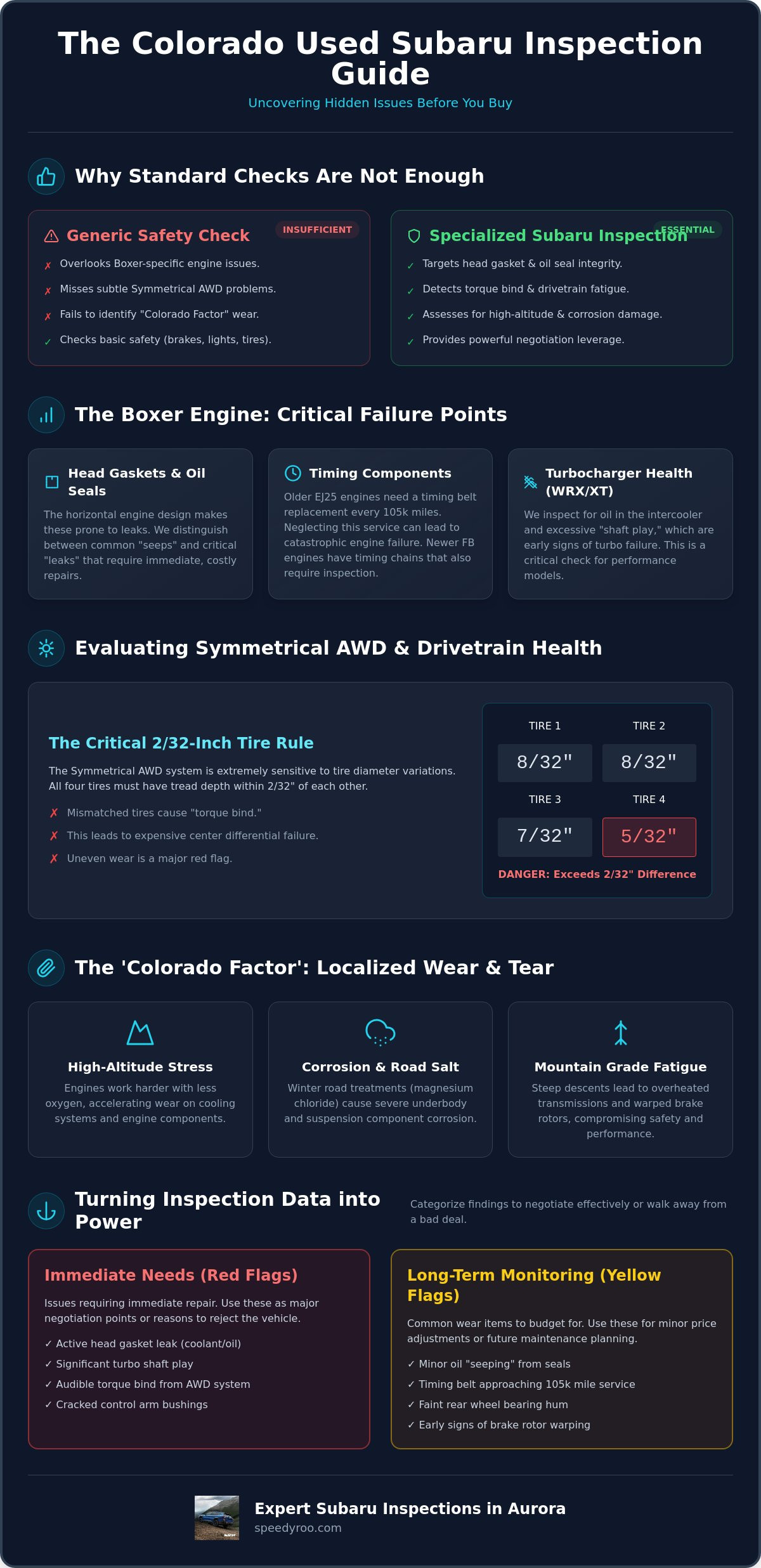
Subaru’s Symmetrical AWD is a world-class system, but it requires mechanical symmetry to survive. A proper Used Subaru inspection Aurora must prioritize the drivetrain, as these components are often the most expensive to replace. Unlike front-wheel-drive competitors, a Subaru cannot tolerate mismatched tire diameters. Using a professional inspection checklist during your test drive helps identify if the previous owner prioritized drivetrain health or simply ignored it. We look for specific patterns of wear that tell the story of how the car was driven through the Rockies.
The 2/32-inch rule is the gold standard for these vehicles. If the tread depth between any two tires varies by more than this amount, the center differential is forced to compensate for different rotational speeds. This constant friction generates internal heat that eventually fries the viscous coupler or the electronically controlled clutch packs. It’s a silent killer that doesn’t always trigger a dashboard light until the damage is done.
Tire Matching and Center Differential Wear
Buying a car with one brand-new tire and three worn ones is a major red flag. This “hidden cost” often surfaces months later when the AWD system begins to fail. Mismatched tires destroy the viscous coupler, leading to “torque bind.” You’ll feel this as a distinct shudder or hopping sensation during tight, low-speed turns, such as pulling into a grocery store parking spot. For more technical details on these tolerances and how we measure them, see our guide on Subaru AWD service Aurora.
CVT and Manual Transmission Assessment
Transmission health is another high-stakes area during our evaluation. In Lineartronic CVTs, we listen for the “Subaru Chirp”—a high-pitched sound during acceleration—or feel for a delay when shifting from Park to Drive. These are often early indicators of a failing valve body. In manual WRX or Crosstrek models, we carefully check the clutch take-up point. A high or “on-off” clutch feel often points to “launch” abuse by a previous driver. We also inspect the drive axle boots for tears; even a small crack allows grease to escape and Colorado road grit to enter, quickly destroying the CV joint.
Finally, the condition of the differential fluid provides a window into the car’s past. Clean, honey-colored gear oil suggests a proactive owner who followed the maintenance schedule. Dark, burnt-smelling fluid indicates the AWD system has been working overtime, likely due to heavy mountain towing or long-term tire mismatches. We provide a clear verdict on whether the drivetrain is healthy or a ticking financial time bomb.
Suspension, Steering, and the ‘Colorado Factor’
Colorado isn’t just a scenic backdrop; it’s a high-stress testing ground for every suspension component. A comprehensive Used Subaru inspection Aurora must account for the specific fatigue caused by our local terrain. While the engine and AWD system get most of the attention, the chassis often tells the real story of how a vehicle was treated. We look for signs of “mountain life” that a general mechanic might overlook, such as accelerated wear on the bushings and steering links.
One of the most frequent complaints in high-mileage Subarus is a persistent, low-frequency drone that sounds like road noise. This is almost always a failing rear wheel bearing. These components take the brunt of the load during mountain cornering and often fail prematurely in our environment. We also pay close attention to the lower control arm bushings. Subaru designs these to be soft for a comfortable ride, but they are prone to horizontal tearing. When they fail, you’ll notice vague steering and a distinct “clunk” when hitting small bumps or expansion joints on the highway.
Our local potholes and washboard dirt roads lead to strut leakages that cause the car to “bottom out” or bounce excessively after a dip. We also check for the “Death Wobble,” a violent steering wheel vibration often caused by worn tie rod ends or a loose steering rack. If the steering feels heavy or “notchy,” it could indicate a failing power steering pump or a leak in the high-pressure lines. Both are common in vehicles that have endured years of cold-start Colorado winters.
Undercarriage and Suspension Bushings
Older Outbacks and Foresters frequently show structural rust on the rear subframe. This is a direct result of the magnesium chloride used on Aurora roads during the winter. We also evaluate any aftermarket lift kits. While popular in Colorado, poorly installed kits can ruin suspension geometry and put extreme stress on CV axles. This leads to premature joint failure and can even impact the AWD system’s efficiency over time. We ensure any modifications haven’t compromised the vehicle’s long-term reliability.
Braking Performance and Fluid Health
Heavy braking on I-70 descents often leads to warped rotors, which you’ll feel as a pulse in the brake pedal. We also test the moisture content of the brake fluid. In our varied climate, fluid can absorb water over time, leading to a spongy pedal and internal corrosion of the ABS module. Following [Japanese vehicle maintenance Aurora](https://www.speedyroo.com/japanese-vehicle-maintenance-in-aurora-expert-tips-for-longevity/) standards, we recommend a flush every two years to ensure your stopping power remains consistent on steep grades.
To see the full health report of your potential new vehicle before you buy, schedule a pre-sale inspection with our specialists today.
The Pre-Purchase Decision: Turning Inspection Data into Power
Once the technical teardown is finished, the focus shifts from data collection to strategic decision-making. A professional Used Subaru inspection Aurora shouldn’t just leave you with a list of parts; it should provide a clear roadmap for your purchase. We categorize every finding into three distinct tiers: immediate safety or mechanical priorities, upcoming maintenance needs, and items to monitor over the next year. This clarity replaces the anxiety of the unknown with the confidence of a well-informed buyer. You’re no longer guessing about the car’s health; you’re looking at a documented reality that dictates the true value of the vehicle.
The repair estimate included with your report is your most powerful tool during the final price talk. If we identify significant deferred maintenance, that isn’t necessarily a reason to abandon the car. Instead, it’s an objective, fact-based reason to ask the seller for a price adjustment. Most private sellers and dealerships are willing to negotiate when presented with a specialist’s report rather than a vague “I think something is wrong” feeling. Think of this evaluation as the best insurance policy for your investment, protecting you from a “lemon” that could cost thousands in the first month of ownership.
Red Flags vs. Normal Maintenance
Distinguishing between a dealbreaker and a standard service item is crucial for used car buyers. For example, while we previously discussed how external head gasket seepage is a common negotiation point, structural rust on the rear subframe or a CVT transmission that shudders during a test drive are often “walk away” red flags. These issues frequently cost more to fix than the vehicle’s market value. We also look for a consistent paper trail. Service records that validate the inspection findings prove the previous owner took the specific needs of a Subaru seriously, which adds significant long-term value to the car.
The Speedy Roo Motorsports & Repair Inc Advantage in Aurora
Our approach goes deeper than the surface-level checks you’ll find at a generic shop. We use specialized Subaru diagnostic software and tools designed specifically for the Boxer engine and Symmetrical AWD architecture. This allows us to see data points like fuel trim levels and CVT fluid degradation that standard scanners miss. We believe in transparent, honest reporting that explains the mechanical “why” behind every recommendation we make. We want you to feel empowered, not pressured. Don’t leave your mountain adventures to chance. Schedule your pre-sale evaluation with Speedy Roo Motorsports & Repair Inc today and ensure your next Subaru is truly ready for the long haul.
Secure Your Next Colorado Adventure
Finding a reliable used Subaru in Colorado is about more than just a clean title and a shiny exterior. It’s about ensuring the complex mechanical systems are ready for the unique demands of high-altitude driving and mountain passes. By prioritizing a specialized Used Subaru inspection Aurora, you protect yourself from the hidden costs of drivetrain fatigue and the structural wear caused by our local road treatments. If your inspection uncovers cosmetic or structural body issues, specialized centers like Mad Auto Design exemplify the professional care needed to restore a vehicle’s appearance and integrity. You’ve learned how to identify the critical red flags and how to turn professional diagnostic data into real negotiation power at the closing table.
At Speedy Roo Motorsports & Repair Inc, we bring over 20 years of dedicated Subaru expertise to every evaluation. Our facility is equipped with specialized diagnostic tools that go far beyond generic safety checks, providing you with a transparent and honest assessment of your potential investment. We take pride in our reputation for integrity and clear communication, helping our neighbors make smart decisions for their long-term property health. Don’t leave your mountain safety to chance. Book Your Specialist Subaru Pre-Purchase Inspection at Speedy Roo Motorsports & Repair Inc and drive away with total peace of mind. We look forward to helping you start your next journey with confidence.
Frequently Asked Questions
Is a used Subaru inspection really necessary if the CARFAX is clean?
Yes, a clean history report is only the first step. CARFAX documents reported accidents and service visits, but it cannot detect current mechanical fatigue like a weeping head gasket, internal CVT wear, or mismatched tire diameters. A professional Used Subaru inspection Aurora identifies active issues that haven’t been reported to insurance or dealership databases.
How much does a pre-purchase Subaru inspection typically cost in Aurora?
Pricing for a pre-purchase evaluation varies based on the depth of the electronic data analysis and mechanical audit. While basic safety checks are common, a specialized audit of the Boxer engine and AWD system is a more detailed process. We suggest focusing on the depth of the report rather than just the initial fee, as identifying a single major issue can save you thousands in future repair costs.
What are the most common ‘dealbreaker’ issues found in used Subarus?
Structural rust on the rear subframe and severe torque bind in the AWD system are the most frequent dealbreakers. While many engine issues can be negotiated as maintenance items, structural corrosion from Colorado road salt or a failing center differential often costs more to repair than the vehicle is worth. We also consider signs of previous “launch” abuse in performance models to be a significant red flag.
Can a generic mechanic perform a proper Subaru AWD inspection?
While a general mechanic can check basic safety items, they often lack the specialized knowledge required for the Symmetrical AWD system. Subaru drivetrains have very specific tolerances, such as the 2/32-inch tire diameter rule, that generalists frequently overlook. A specialist knows the exact “shudder” or “chirp” that indicates a failing viscous coupler or valve body before it triggers a dashboard light.
How long does a professional used Subaru inspection take?
A comprehensive evaluation typically takes between 90 minutes and two hours. This timeframe allows our technicians to perform a cold-start check, a thorough test drive to monitor transmission behavior, and a detailed undercarriage inspection on a lift. We also perform a full electronic diagnostic scan to check for hidden codes that may have been recently cleared.
What should I look for during a Subaru test drive before calling a mechanic?
Listen for a low-frequency drone that changes with speed, which often indicates a failing rear wheel bearing. You should also perform several tight, low-speed circles in a parking lot to feel for any “hopping” or binding in the drivetrain. Pay close attention to the smell of burning oil or coolant after the engine is warm, as this is a primary sign of external head gasket seepage.
Does Speedy Roo Motorsports & Repair Inc inspect modified or tuned Subarus like the WRX?
Yes, Speedy Roo Motorsports & Repair Inc specializes in performance models and has on-site dyno tuning capabilities to evaluate modified vehicles. We check for the quality of aftermarket installations and ensure the engine calibration is safe for Colorado’s altitude. Our team can identify if a car was previously “returned to stock” to hide heavy modifications or track abuse.
Should I worry about the head gasket issue on a newer 2020+ Subaru model?
No, the catastrophic head gasket failures common in older EJ-series engines are largely a thing of the past. Newer models use the FB-series engine, which features a significantly improved cooling jacket and gasket design. While any engine can develop leaks over time, a Used Subaru inspection Aurora for a 2020+ model focuses more on CVT health, electronics, and standard suspension wear.