
You’re driving down Arapahoe Road when a faint, rhythmic thumping starts beneath your floorboards, turning your peaceful commute into a stressful guessing game. It’s a feeling most drivers know well. That sudden, unfamiliar sound usually brings a wave of anxiety about a potential breakdown or the fear of being overcharged for repairs you don’t actually need. Finding a strange noise from car diagnosis Centennial expert can feel like a high-stakes mission when you aren’t sure how to describe the sound or what the solution might be. With the average vehicle on the road now 12.6 years old according to S&P Global Mobility, these mechanical warnings are more common than ever.
We understand that your Japanese import requires a specific level of care to stay reliable. This guide will help you identify exactly what those mysterious sounds mean and how a professional diagnosis can prevent small issues from turning into costly engine or transmission failures. You’ll learn to distinguish between a harmless rattle and a critical warning sign. We will also provide a clear roadmap for discussing these issues with a local specialist, ensuring you get the peace of mind that your vehicle is safe for the Colorado roads.
Key Takeaways
- Categorize your car’s sounds into squeals, grinds, or clunks to understand which issues require immediate attention before repair costs escalate.
- Perform a simple, safe “listen test” at home so you’re ready to describe exactly where a sound is coming from when you visit a mechanic.
- Learn why specific brands like Subaru and Toyota have unique “sound signatures” that require a specialized strange noise from car diagnosis Centennial experts provide.
- Discover how professional road testing under local Centennial driving conditions helps technicians replicate and isolate elusive mechanical problems.
- Understand how addressing a single failing component now prevents a “domino effect” that could lead to catastrophic engine failure; it’s the best way to protect your investment.
Decoding the Symphony: Common Car Noises and Their Meanings
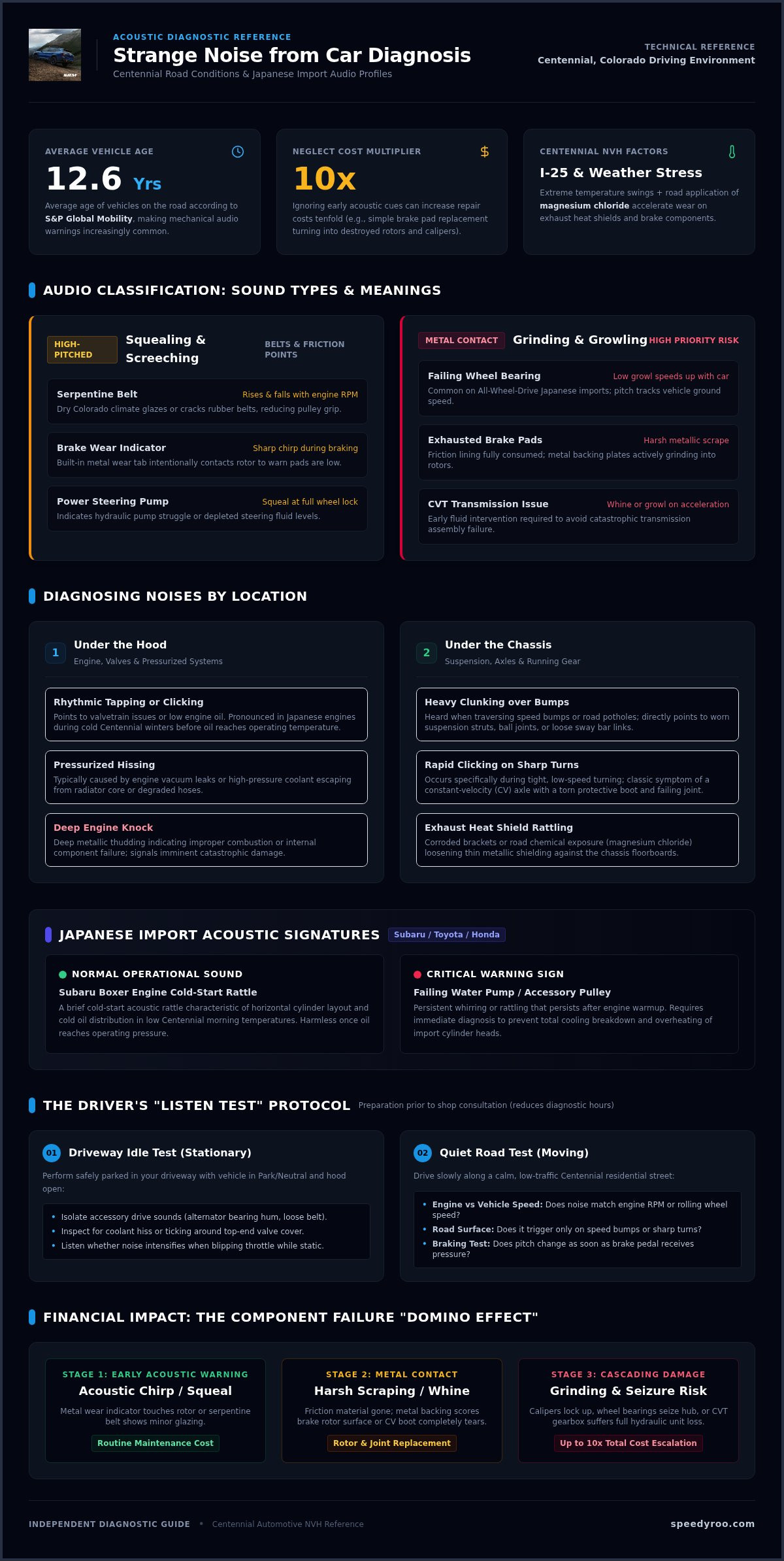
Every driver hears it eventually: a sound that wasn’t there yesterday. While it’s tempting to turn up the radio and hope the sound disappears, ignoring these acoustic cues can lead to a 10x increase in repair costs. Replacing worn brake pads is a routine maintenance task, but waiting until you hear metal-on-metal grinding can destroy rotors and calipers, turning a simple service into a major overhaul. Seeking a strange noise from car diagnosis Centennial specialist early is the most effective way to protect your budget and your vehicle’s longevity.
In Centennial, our extreme temperature swings and the heavy use of magnesium chloride on roads like I-25 accelerate wear on exhaust shields and brake components. These environmental factors directly impact the automotive noise, vibration, and harshness (NVH) profile of your vehicle. Distinguishing between “normal” operational sounds, like the brief cold-start rattle of a Subaru Boxer engine, and “warning” noises, like a failing water pump, requires a trained ear and specialized diagnostic equipment.
Squealing and Screeching: Belts and Brakes
High-pitched squealing that rises and falls with engine RPM usually points to a serpentine belt. In our dry Colorado climate, rubber belts can glaze or crack, losing their grip on the pulleys. If you hear a sharp “chirp” while braking, that’s often the built-in wear indicator. It’s a small metal tab designed to contact the rotor to alert you that your pads are low. You might also notice a power steering squeal when turning the wheel to full lock, which often indicates the pump is struggling or the fluid is depleted.
Grinding and Growling: Bearings and Metal Contact
Grinding is rarely a minor issue and typically indicates metal-on-metal contact. A low-frequency growl that changes intensity with vehicle speed often signals a failing wheel bearing. This is a common occurrence on the all-wheel-drive systems found in many Japanese imports. If the sound is a harsh, metallic scrape every time you apply the brakes, your pads are likely exhausted. Transmission growl or a high-pitched whine during acceleration is a serious warning sign for CVT systems. Addressing these sounds through a fluid intervention can save you from a complete unit failure.
Diagnosing Noises by Location: Where is it Coming From?
Pinpointing where a sound originates is the first step in a successful strange noise from car diagnosis Centennial process. You can perform a safe “listen test” by first idling the vehicle in your driveway. With the hood popped, you can often isolate accessory sounds like a failing alternator or a leaking water pump. For noises that only occur while moving, find a quiet street to determine if the sound is related to engine speed or vehicle speed. This distinction is vital for your technician. Knowing if a sound happens when you hit a bump or only when you accelerate helps narrow down the list of potential culprits quickly.
Consulting an FTC guide on auto repair basics can help you organize these observations. It provides a solid foundation for understanding how to describe symptoms to a technician, which helps avoid unnecessary diagnostic time and ensures you get an accurate estimate. Being prepared with these details replaces the typical stress of a shop visit with a feeling of calm reliability.
Under the Hood: Engine and Accessory Sounds
A rhythmic tapping or clicking sound from the top of the engine is often a sign of valve train issues or simply low oil levels. In Japanese engines, these sounds can become more pronounced during our cold Centennial winters before the oil reaches operating temperature. Hissing sounds are typically caused by vacuum leaks or coolant escaping under pressure from a hose or the radiator. Engine knock is a deep, metallic thudding sound that indicates improper combustion or internal component failure, often signaling imminent and catastrophic engine damage.
Under the Chassis: Suspension and Drivetrain
Noises from the “feet” of your car usually involve the suspension, tires, or brakes. A heavy clunking sound when driving over speed bumps or potholes often points to worn struts, ball joints, or sway bar links. If you hear a rapid clicking sound specifically during sharp turns at low speeds, your CV axle likely has a torn boot and a failing joint. Because these components are critical for safety, a quick check-up for Honda repair and service or your specific brand can prevent a breakdown on the road.
Undercarriage rumbles and rattles are frequently caused by loose exhaust heat shields or rusted hangers. In Colorado, road chemicals often eat through these thin metal components, creating a buzzing sound at specific RPMs. If you drive a Subaru, these chassis noises often relate to the complex drivetrain, making a specialized Subaru AWD service Aurora inspection essential for maintaining peak performance and safety.
Common ‘Sound Signatures’ of Japanese Imports
Japanese engineering follows distinct philosophies that result in unique mechanical “sound signatures.” Diagnosing these requires more than just general knowledge. It demands a deep understanding of how these specific systems age and react to the high-altitude environment of the Front Range. When you seek a strange noise from car diagnosis Centennial service, you want a team that knows the difference between a normal operational hum and a brand-specific warning sign. Standardized testing through ASE-certified automotive professionals ensures that technicians stay current on these evolving Japanese technologies, from hybrid drivetrains to advanced variable valve timing.
For example, a high-pitched whine in a Nissan or Honda often signals a specific transmission behavior, while a similar sound in a Toyota might point toward the cooling system. These nuances are why a brand-specific approach is vital. General shops might misdiagnose a harmless operational sound as a major failure, or worse, miss a critical warning sign that is unique to your vehicle’s make.
The Subaru Boxer Sound Profile
Subaru’s horizontally opposed engine creates a unique “Boxer rumble” that owners love. However, you should listen for a metallic buzzing during acceleration. This usually indicates a loose exhaust heat shield, a common victim of Colorado road chemicals, rather than internal engine trouble. In older EJ-series engines, a rhythmic slapping sound can indicate a worn timing belt tensioner. Because these are interference engines, ignoring this sound can lead to total engine failure. This is why specialized Subaru repair Aurora CO is critical; the tools and experience required to service a Boxer engine differ significantly from standard inline designs.
Toyota and Honda Reliability Noises
Toyota and Lexus models are renowned for longevity, but they aren’t silent. A high-pitched, metallic rattle on a high-mileage Camry or RAV4 often points to a timing chain that has stretched or a failing VVTi (Variable Valve Timing with intelligence) gear. Honda and Nissan vehicles equipped with CVTs have a specific “whine” when the fluid breaks down. If this whine becomes a loud drone, the transmission belt may be slipping. In cold Colorado mornings, you might also hear a distinct “moan” from a Honda power steering pump. This is a common issue caused by a tiny O-ring that hardens in the cold and allows air into the system. Identifying these bushing or pump issues early prevents the “domino effect” of component failure.
The Professional Diagnostic Process in Centennial
Modern vehicle diagnostics is a sophisticated blend of traditional mechanical expertise and advanced digital analysis. When you bring your vehicle in for a strange noise from car diagnosis Centennial, the process is methodical and transparent. We don’t just guess; we use a structured approach to move from your initial observation to a precise technical solution. This organized momentum ensures that we address the root cause rather than just treating a symptom, saving you time and preventing unnecessary parts replacement.
Our approach mirrors a well-organized professional process, typically starting with a clear identification of your specific concern. By combining your real-world observations with our specialized tools, we create a comprehensive picture of your vehicle’s health. This collaborative method is why we’ve been a trusted independent specialist since 2002, helping Centennial residents maintain their Japanese imports with confidence and clarity.
Step 1: The Client Interview and Road Test
Your description of the sound is the most valuable tool we have. During the initial consultation, we’ll ask specific questions to narrow the field: Does the sound occur during a cold start? Does it change when you apply the brakes or accelerate? We also need to know where the sound resonates, whether it’s felt through the floorboard, the steering wheel, or the rear of the cabin. To replicate the issue accurately, we often perform road tests on local Centennial routes. Driving on specific inclines or replicating the stop-and-go conditions near I-25 helps us hear the noise in the exact environment where you first noticed it.
Step 2: Advanced Technical Evaluation
Once we’ve replicated the sound, we move into the shop for a deeper technical evaluation. We utilize factory-level scan tools to check for “silent” trouble codes that might not trigger a dashboard light but indicate a failing sensor or solenoid. A comprehensive Japanese car inspection Aurora specialists perform often involves pressure testing systems to find elusive hissing leaks in the vacuum or cooling lines. For mechanical rattles, we use “chassis ears,” which are wireless acoustic sensors clipped to suspension components or differentials. These sensors allow us to pinpoint the exact bearing or bolt that is causing the disturbance while the car is in motion. If you’re ready to stop the guessing game and get an honest assessment, schedule your diagnostic appointment today to ensure your vehicle remains safe and reliable.
Why Prompt Diagnosis is Your Best Financial Strategy
Addressing a mechanical sound early isn’t just about comfort. It’s a calculated financial decision. A strange noise from car diagnosis Centennial specialists provide can identify a failing component before it triggers a “domino effect” throughout your vehicle’s systems. For instance, a worn wheel bearing that begins as a faint hum can eventually seize, damaging the hub assembly and even the axle. By the time the noise becomes unbearable, the repair bill has often tripled. Taking action when the sound first appears protects both your safety and your bank account.
Safety remains the most critical factor. Noises related to your steering or braking systems often signal imminent failure that puts you and your family at risk. Beyond safety, maintaining a quiet, well-running vehicle significantly impacts its resale value. In the Centennial and Aurora used car market, buyers prioritize vehicles with documented maintenance and a lack of mechanical rattles. This is why a pre-sale vehicle evaluation Aurora buyers rely on focuses heavily on acoustic diagnostics to protect their investment.
The Cost of Procrastination
Fixing a car by turning up the radio is the most expensive strategy an owner can adopt. Replacing a squealing serpentine belt might cost a few hundred dollars. If that belt snaps and causes the engine to overheat, you could face a $4,000 engine rebuild. Prompt action replaces the anxiety of a potential breakdown with the peace of mind that comes from a definitive “all clear” from a specialist. Knowing exactly what’s happening under the hood allows you to plan your maintenance budget effectively rather than reacting to a roadside emergency.
Booking Your Diagnosis at Speedy Roo
Since 2002, our team has served as the “Expert Neighbor” for Japanese import owners in Centennial. We’re committed to transparent, “no-surprises” diagnostic reporting that empowers you to make informed decisions about your vehicle’s health. When you choose us for a strange noise from car diagnosis Centennial service, you receive a methodical breakdown of our findings. We don’t believe in high-pressure sales. We believe in building long-term trust through honest craftsmanship. To prepare for your appointment, try to note the specific conditions when the noise occurs, such as vehicle speed or engine temperature. This information helps us move quickly toward a solution, ensuring your Subaru, Toyota, or Honda stays on the road for years to come.
Restore Peace to Your Daily Drive
Identifying an unfamiliar sound is the first step toward preserving the health of your Japanese import. You’ve learned how specific signatures, like the rhythmic hum of a failing bearing or a high-pitched belt squeal, act as early warning systems for your vehicle’s most critical components. By choosing to address these signs now, you aren’t just fixing a rattle; you’re protecting your safety and ensuring your car maintains its long-term value in the Colorado market. Professional intervention replaces the stress of uncertainty with a clear, honest plan for your vehicle’s longevity.
At Speedy Roo, our ASE Certified Technicians have provided specialized care as an independent Japanese specialist since 2002. We possess the brand-specific tools and experience required to handle the unique engineering of Subaru, Toyota, and Honda models. If you’re tired of guessing what that thumping or buzzing means, a strange noise from car diagnosis Centennial specialists provide will give you the definitive answers you need. Schedule your professional noise diagnosis at Speedy Roo today to get back on the road with total confidence. Your car is talking to you, and we’re here to help you listen.
Frequently Asked Questions
Is it safe to drive my car if it’s making a strange noise?
Safety depends entirely on the sound’s origin. A high-pitched squeal from a brake wear indicator usually means you have time to reach a shop, but a deep metallic grinding or a sudden clunk while steering indicates a critical failure. If your vehicle feels unstable or the noise is accompanied by a warning light, it isn’t safe to continue driving. Seeking a professional strange noise from car diagnosis Centennial specialist immediately prevents a minor issue from becoming a dangerous breakdown on I-25.
How much does a car noise diagnostic cost in Centennial?
Diagnostic fees in the Centennial and Denver South metro area vary depending on the facility type and the complexity of the issue. Most independent repair shops benchmark their diagnostic rates against local labor standards to cover the time spent with specialized acoustic tools and scan equipment. While dealerships often have higher non-refundable fees, local specialists typically provide a comprehensive report that helps you prioritize repairs. It’s best to check with a trusted local expert for their current evaluation process.
Why does my car only make a squealing noise when it’s cold outside?
Cold Colorado mornings often cause rubber components like serpentine belts to harden and lose flexibility. When you start your engine, the belt may slip against the pulleys until the friction generates enough heat to soften the rubber, causing the squeal to stop. This is a common occurrence in our climate. However, it can also indicate a failing belt tensioner or an accessory pulley bearing that is struggling to rotate in freezing temperatures, which requires professional attention.
Can a strange noise be caused by low engine oil or fluids?
Yes, low fluid levels are a frequent source of mechanical sounds. A rhythmic tapping usually indicates low engine oil, which prevents the valve train from being properly lubricated. If you hear a groaning or whining sound when turning the steering wheel, your power steering fluid might be low or contaminated. In Japanese imports, using the correct specialized fluids is essential for long-term health. Checking your dipsticks and reservoirs is the first step in any strange noise from car diagnosis Centennial procedure.
What should I tell my mechanic about the noise I’m hearing?
Be as specific as possible about the “when, where, and what.” Tell your mechanic if the noise happens only during a cold start, at a specific speed, or when turning the wheel in a certain direction. Describe the sound using words like “thump,” “chirp,” or “grind.” Mention if you feel a vibration in the steering wheel or floorboards. This detailed information helps the technician replicate the sound quickly during a road test on local Centennial streets.
Why does my Subaru make a rattling sound when I accelerate?
Subarus are prone to heat shield rattles caused by the corrosion of factory welds. In the Front Range, the liquid magnesium chloride used on winter roads eats away at these thin metal shields, causing them to buzz against the exhaust manifold during acceleration. While annoying, this is usually a simple fix. However, a similar rattle could also point to a worn timing belt tensioner or internal engine issues, making a professional evaluation vital to rule out a more catastrophic mechanical failure.
Can an old battery or alternator cause a whining noise?
An alternator can definitely produce a high-pitched whining or growling noise when its internal bearings begin to fail. While a battery itself is silent, a weak or old battery forces the alternator to work at maximum capacity to maintain the vehicle’s electrical load. This extra strain can accelerate bearing wear. If the whine changes in pitch as you rev the engine, it’s a strong sign that the alternator or one of the pulleys in the accessory drive system needs attention.
How long does a professional noise diagnosis usually take?
A thorough diagnostic appointment typically takes between one and two hours. This timeframe allows the technician to perform a visual inspection, connect digital scan tools, and conduct a road test to replicate the sound under specific driving conditions. Some elusive rattles might require more time to isolate using specialized acoustic sensors like chassis ears. We respect your time and aim to provide a clear, honest report as efficiently as possible without overlooking any critical mechanical details.