
Imagine you’re descending a steep mountain grade on I-70 when you notice a slight vibration in the steering wheel or a high-pitched squeal every time you slow down. For Colorado drivers, these aren’t just minor annoyances; they’re signs that your vehicle’s most critical safety feature needs professional attention. When you’re looking for reliable Subaru brake repair Aurora specialists, you want to know that your car can handle the heat of a long descent and the sudden stops of city traffic with total precision.
We understand the stress of choosing between an expensive dealership and a general repair shop that might not understand how your brakes interact with your EyeSight driver assist technology. You deserve a braking system that’s quiet, responsive, and ready for any weather. This guide explains why Subarus require a specialized approach to maintenance and how the right parts ensure your Symmetrical All-Wheel Drive stays effective. We’ll look at the specific needs of your vehicle’s stopping system so you can maintain confidence behind the wheel without overpaying for honest, expert service.
Key Takeaways
- Learn how Aurora’s winter road salt impacts Subaru calipers and how to identify the “Subaru Shakes” during mountain descents.
- Understand the technical link between your braking system and Subaru’s Symmetrical All-Wheel Drive and EyeSight safety features.
- Discover why choosing an independent specialist for Subaru brake repair Aurora provides superior value and specialized knowledge compared to a local dealership.
- Identify which performance upgrades, such as ceramic pads or slotted rotors, are most effective for handling Colorado’s steep terrain.
- Learn about the importance of a 32-point inspection in maintaining your vehicle’s stopping power and overall reliability.
Recognizing Subaru-Specific Brake Wear in Aurora’s Climate
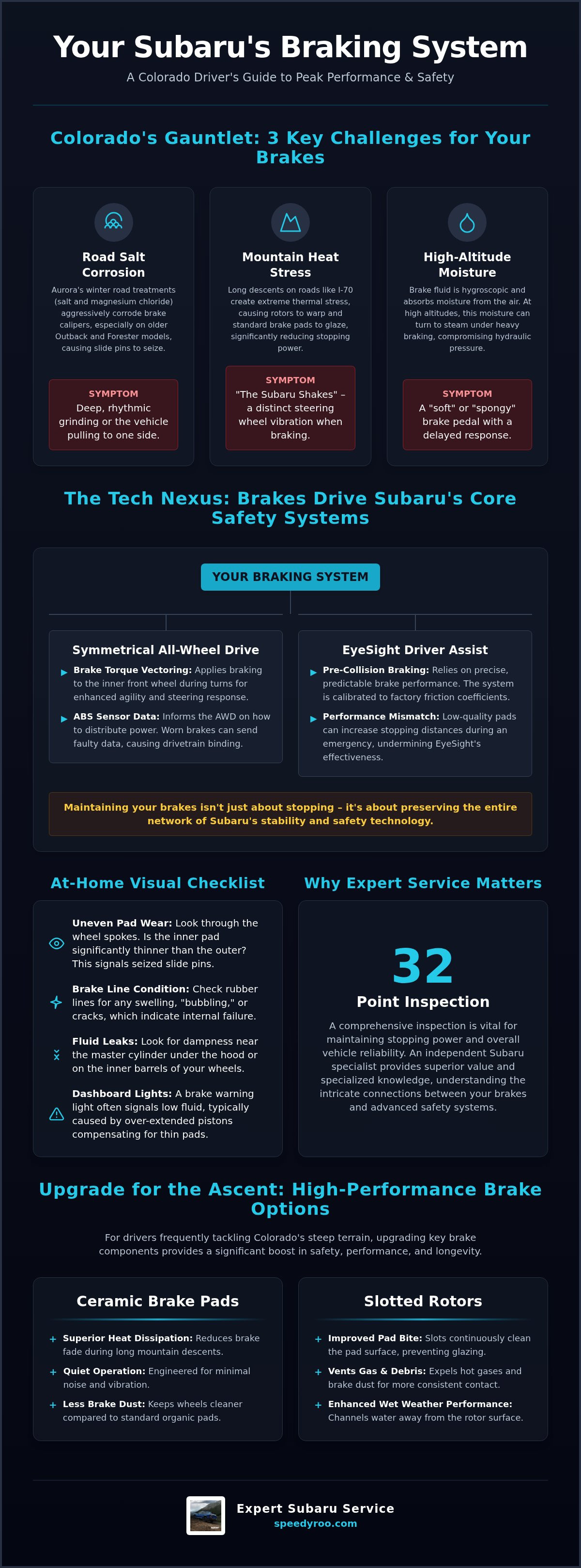
Aurora’s winters aren’t just hard on your commute; they’re brutal on your vehicle’s braking hardware. Road salt and magnesium chloride used on local streets act as catalysts for corrosion, particularly on the calipers of older Outback and Forester models. This oxidation often leads to seized slide pins, which prevents the brake pads from retracting fully after you lift your foot off the pedal. Unlike the predictable high-pitched squeal of a wear indicator designed to alert you to thin pads, a seized pin often results in a deep, rhythmic grinding or a vehicle that pulls to one side. When you need Subaru brake repair Aurora services, addressing these corrosion issues early can save the rotors from permanent heat damage.
The Impact of Colorado’s I-70 Corridor on Brake Longevity
Driving from the high peaks back down to the plains puts extreme thermal stress on your rotors. This constant friction causes heat soak, which can lead standard organic pads to glaze. Glazing creates a smooth, glass-like surface on the pad that significantly reduces stopping power and causes a noticeable fade during long descents. If you experience the “Subaru Shakes,” a distinct steering wheel vibration during mountain driving, it usually indicates that your rotors have developed thickness variations from excessive heat. This mechanical health is vital because your brakes are a primary input for Subaru’s Symmetrical AWD system. Additionally, Colorado’s climate contributes to “soft” pedals. Brake fluid is hygroscopic, meaning it absorbs moisture from the air. At high altitudes and under heavy loads, this moisture can turn to steam, creating a spongy pedal feel that compromises your safety. We recommend using high-boiling-point fluid to ensure consistent performance during summer mountain treks.
Visual Warning Signs for Subaru Owners
You don’t always need a shop lift to spot potential trouble. Subaru owners can often see signs of wear by looking through the wheel spokes. Check for uneven pad wear; Subaru’s sliding caliper designs often show significantly more wear on the inner pad if the slide pins aren’t moving freely. You should also inspect the rubber brake lines for any signs of swelling or “bubbling,” which indicates the internal structure is failing. If you notice dampness near the master cylinder or on the inner wheel barrels, it’s a sign of a leak that requires immediate attention. Dashboard lights are also critical indicators. While they sometimes signal a simple sensor issue, they often trigger when fluid levels drop because the brake pistons are over-extended to compensate for thin pads. Catching these signs early ensures your Subaru brake repair Aurora is a routine maintenance task rather than an emergency fix.
The Technical Connection: How Brakes Impact Subaru’s Symmetrical AWD
Subaru’s engineering philosophy relies on a holistic approach where every component works in harmony. Your brakes do more than stop the car; they act as a primary steering tool for the All-Wheel Drive system. Through Brake Torque Vectoring, the car applies light braking force to the inner front wheel during a turn. This creates a yaw moment that pulls the nose into the corner, making the car feel more agile. This technology is a core component of Subaru’s Vehicle Dynamics Control (VDC), which constantly monitors wheel speed and steering angle to prevent skids.
The relationship between ABS sensors and the AWD system is equally vital. These sensors provide the data needed to manage power distribution between the front and rear axles. If your brakes apply uneven force due to worn components, it can cause drivetrain binding or premature wear on the center differential. Electronic Brakeforce Distribution (EBD) helps mitigate this by adjusting the pressure to each wheel based on load, but it can’t compensate for hardware that’s physically failing. When scheduling a Subaru brake repair Aurora, you’re not just buying pads; you’re maintaining a complex stability network.
EyeSight Driver Assist and Brake Calibration
Precise brake response is non-negotiable for vehicles equipped with EyeSight Driver Assist. This system uses stereo cameras to calculate the exact distance and pressure needed for Pre-Collision Braking. If you install low-quality, generic pads, the friction coefficient might not match the system’s factory-programmed parameters. This mismatch can increase stopping distances during an emergency. It’s essential to verify that the safety tech “sees” the new braking capacity correctly after any major service. Your safety depends on the system’s ability to predict exactly how the car will react when the computer takes over.
The Boxer Engine and Braking Dynamics
The Boxer engine’s low center of gravity significantly changes how weight transfers during heavy braking. Unlike taller engines that cause the nose to dive aggressively, a Subaru stays relatively flat. This requires a specific brake bias to ensure the rear tires contribute their fair share of stopping power. We also monitor vacuum pump health, as these engines rely on a consistent vacuum for the brake booster to function effectively. If you’ve noticed your car feels unsettled during cornering, a specialized Subaru inspection can identify whether your braking system is communicating correctly with your drivetrain.
Independent Subaru Specialist vs. Aurora Dealerships
Choosing where to take your vehicle for Subaru brake repair Aurora often comes down to a choice between a large dealership and a local specialist. While dealerships often lean on the “factory-trained” label, an independent specialist offers a level of nuanced understanding that only comes from years of focused work on specific Japanese platforms. Since 2002, our team has refined this expertise, moving beyond generic checklists to provide deep diagnostic insights. Our technicians don’t just see a car; they see the evolution of the brand, from the classic EJ series engines to the modern FA powerplants. This technical history allows us to identify whether a vibration is a simple rotor issue or a more complex interaction within the drivetrain.
The Cost Advantage of Specialist Care
One of the most immediate differences you’ll notice is the transparency in pricing. Dealerships often carry significant overhead that translates into higher labor rates and a “replace-only” mentality. As an independent specialist, we focus on providing value by identifying exactly what needs attention. We often find ways to service and repair components that a dealership might simply swap for a costly new assembly. This approach provides long-term savings, especially when we tailor maintenance schedules to the specific demands of Aurora’s stop-and-go traffic and mountain commutes. We offer both OEM parts and high-quality aftermarket alternatives, giving you the flexibility to choose the best fit for your budget without compromising on safety.
Diagnostic Precision and Tooling
Modern Subarus are rolling computers, and their braking systems are integrated with sophisticated stability controls. We invest in the same Subaru-specific scan tools used by the factory to communicate with your ABS and Vehicle Dynamics Control (VDC) modules. This precision ensures that when we perform Subaru brake repair Aurora, every sensor is calibrated and every fault code is accurately addressed. Dealing directly with the technician who works on your car creates a level of accountability you won’t find at a service desk. You’ll get an honest assessment of your vehicle’s health from a specialist who understands the brand’s unique quirks. Our commitment to using precision equipment means your car leaves our shop with the same responsive, predictable stopping power it had the day it was built.
High-Performance Brake Upgrades for Colorado Driving
For some drivers, standard factory specifications are just a starting point. When you’re frequenting the I-70 corridor or towing a trailer through the Rockies, your braking needs change. Choosing a high-performance Subaru brake repair Aurora specialist means you have access to components designed to exceed the limitations of stock hardware. We help you navigate the options between daily reliability and the extreme demands of mountain performance.
Ceramic pads are a popular choice for their superior heat management and significant reduction in brake dust. Unlike metallic pads, they handle high temperatures without losing their friction coefficient. For rotors, we generally recommend slotted designs over drilled ones for Colorado drivers. While drilled rotors look aggressive, they are prone to stress cracking under the extreme thermal cycles of mountain descents. Slotted rotors effectively vent gases and debris while maintaining the structural integrity needed for heavy use.
Upgrading to stainless steel brake lines is another effective way to improve safety and control. Factory rubber lines can expand under pressure, leading to a “mushy” pedal feel. Stainless steel braiding prevents this expansion, providing a firmer and more predictable pedal response. We also suggest high-performance brake fluid with a higher boiling point, which is essential for preventing brake fade during spirited driving or heavy towing.
Upgrading for the I-70 Corridor and Towing
Larger models like the Ascent and Outback carry significant weight, which generates immense heat during downhill grades. We select pads that offer a strong “cold bite,” ensuring they work immediately on freezing Aurora mornings, while still offering the thermal capacity to handle long descents without fading. Better heat dissipation protects your rotors from warping, extending the life of your entire system even under heavy loads.
The Performance Enthusiast’s Choice
For WRX owners, matching your stopping power to your dyno-tuned performance gains is a matter of safety and balance. We offer specialized caliper options and Brembo upgrades that provide the clamping force needed for high-output vehicles. Most importantly, we ensure these upgrades don’t interfere with your factory safety systems. If you’re ready to enhance your stopping power, schedule a consultation with our performance team today.
Reliable Subaru Brake Service at Speedy Roo Motorsports
Since 2002, Speedy Roo Motorsports has served as a dedicated alternative to the high-pressure environment of big-box dealerships. Our deep roots in the Aurora and Denver metro area have allowed us to build a reputation based on technical precision and local trust. When you choose us for Subaru brake repair Aurora, you’re partnering with a team that views your vehicle’s safety as a personal responsibility. We don’t just replace parts; we restore the engineering integrity that makes your vehicle a leader in AWD safety. Our convenient location is designed to serve local commuters who need reliable, expert care without the typical stress of the auto industry.
Our diagnostic process is designed to be exhaustive and transparent. Every brake service begins with a thorough 32-point inspection that covers everything from pad thickness and rotor surface to the health of your brake lines and master cylinder. We believe in an “open shop” philosophy where we show you the actual wear on your components before any work begins. This ensures you understand the reasoning behind our recommendations. By replacing uncertainty with clear, visual evidence, we help you make informed decisions about your vehicle’s long-term health.
Why We Are Aurora’s Independent Subaru Authority
Our expertise comes from a place of genuine passion. We have built our reputation on Subaru repair and specialist care, and many of our technicians own, drive, and even race the same models we service daily. This first-hand experience means we recognize subtle issues that general mechanics might overlook. There is a culture of pride in every bolt turned at Speedy Roo. We treat every Forester, WRX, and Outback with the meticulous craftsmanship required to handle the demanding conditions of the Rocky Mountains. We aren’t just fixing cars; we’re maintaining the community’s trust one brake job at a time.
Scheduling Your Brake Inspection
We’ve streamlined our process to respect your time and provide a seamless experience. You can easily book an appointment through our online portal or call us for a direct phone consultation with a specialist. During your first visit, you can expect a welcoming environment with amenities designed for local commuters who need to stay productive. To ensure your peace of mind, we back our work with a comprehensive warranty on both parts and labor. We stand behind our repairs because we know the quality of the components we install and the skill of the experts who perform the work. Your safety on the road is our primary metric of success.
Maintain Your Stopping Power for the Road Ahead
Your vehicle’s braking system is a complex network that directly influences the performance of your Symmetrical AWD and EyeSight safety features. Addressing local challenges like road salt corrosion and high-altitude heat is essential for maintaining a responsive pedal and quiet operation. Choosing a specialist ensures that these technical nuances are respected while providing a level of personalized care that larger dealerships often lack. It’s about more than just replacing pads; it’s about protecting the engineering that keeps your family safe on mountain descents.
Since 2002, Speedy Roo Motorsports has served as the premier choice for Subaru brake repair Aurora. Our specialized Japanese import technicians leverage decades of experience to provide honest, transparent service backed by a 5-star local reputation. We invite you to Schedule Your Subaru Brake Inspection at Speedy Roo Today and experience the difference that methodical, expert care makes. Drive with confidence knowing your car is prepared for whatever the Colorado climate brings your way.
Frequently Asked Questions
How much does Subaru brake repair typically cost in Aurora?
Service costs vary based on whether you need a simple pad replacement or a comprehensive service including rotors and fluid. Factors include your specific model, such as an Ascent versus an Impreza, and your choice between OEM or high-performance parts. In Aurora, labor rates for specialized Japanese technicians are often more competitive than dealership prices. We provide a detailed estimate after our 32-point inspection to ensure you only pay for necessary repairs.
How often should I have my Subaru brakes inspected in Colorado?
We recommend having your brakes inspected every 6,000 miles or during every oil change. Colorado’s unique environment, including steep mountain descents and heavy winter road salt, accelerates wear compared to flatter regions. Frequent checks help identify seized slide pins or early signs of rotor warping before they lead to expensive repairs. Regular maintenance ensures your stopping power remains consistent for city driving in Aurora or trips to the high country.
Do I need to go to a Subaru dealer to have my brakes fixed?
No, you have the legal right to choose any repair facility under Colorado law. Independent specialists often provide more focused expertise on the Subaru platform than general shops or large dealerships. At our Aurora facility, we use factory-grade diagnostic tools to handle complex systems like ABS and VDC. This allows us to provide high-quality Subaru brake repair Aurora while offering a more personalized, community-focused experience than a corporate service department.
What causes my Subaru steering wheel to shake when I hit the brakes?
Steering wheel vibration, often called the “Subaru Shakes,” is typically caused by warped front rotors or uneven brake pad deposits. This occurs when rotors are subjected to extreme heat during long mountain descents on I-70. When the metal becomes too hot, it can develop thickness variations that you feel through the wheel. Professional resurfacing or replacement is usually necessary to restore a smooth, safe braking experience and prevent further wear on your suspension components.
Can I use ceramic brake pads on my Subaru Forester or Outback?
Yes, ceramic pads are an excellent choice for Forester and Outback models used in Colorado. They handle the high temperatures of mountain driving better than standard organic pads and produce significantly less dust. However, it’s vital to choose a high-quality ceramic compound that maintains a strong “cold bite.” This ensures your brakes work effectively on freezing winter mornings in Aurora before the system has had a chance to warm up.
Will changing my own brakes affect my Subaru EyeSight system?
While a simple pad change doesn’t usually require EyeSight recalibration, the system relies on precise stopping distances to function correctly. If you use generic parts with different friction levels, it could impact the Pre-Collision Braking performance. Professional Subaru brake repair Aurora includes testing to ensure your safety technology and mechanical hardware are perfectly synchronized. We recommend a professional inspection to verify that your cameras and brakes are communicating as the manufacturer intended.
How long does a standard brake pad and rotor replacement take?
A standard pad and rotor replacement typically takes between 1.5 and 3 hours per axle. The exact time depends on the amount of corrosion present, which is often high in the Denver metro area due to winter road treatments. Seized slide pins or rusted bolts can extend the process. Our technicians work methodically to ensure every component is cleaned, lubricated, and torqued to factory specifications for long-term reliability and safety on the road.
Why are my Subaru brakes squeaking even though the pads look thick?
Squeaking often indicates glazed pads or a lack of proper lubrication on the caliper contact points. If you’ve recently descended a steep mountain grade, the extreme heat may have hardened the pad surface, reducing its effectiveness and causing noise. It could also be a sign of a seized slide pin preventing the pad from retracting fully. A specialized inspection can identify whether the noise is a simple vibration or a symptom of a mechanical failure.