
You’re driving through Aurora when that dreaded amber glow suddenly appears on your dashboard. Within seconds, your cruise control light starts flashing and your EyeSight driver assist system disables itself entirely. It’s a frustrating experience that often triggers immediate anxiety about hidden engine problems or expensive repairs. You aren’t alone in feeling confused by why a simple engine light would shut down your safety features, but there’s a logical reason behind how Subaru’s onboard diagnostics operate.
We understand that you need clear answers without the high-pressure sales tactics of a generic repair shop. This guide explains exactly what your Subaru check engine light Aurora means in the context of our unique Colorado climate. You’ll learn to distinguish between a minor sensor glitch caused by high-altitude air pressure and a major mechanical failure that requires immediate attention. We’ll also preview what to expect regarding 2026 labor rates in the Denver metro area and why your Boxer engine deserves a specialist’s touch. By the end of this article, you’ll have the confidence to handle that warning light with a plan that protects both your vehicle’s longevity and your budget.
Key Takeaways
- Learn to distinguish between a minor sensor glitch and a critical engine failure by identifying the difference between a steady and blinking dashboard light.
- Discover how Aurora’s high-altitude environment triggers specific Subaru check engine light Aurora codes and why thin air impacts your Mass Air Flow sensor.
- Understand why “free code scans” at parts stores are often misleading and why a professional diagnostic process is required to find the actual root cause.
- Get a clear 5-step safety plan to follow when your warning lights appear, ensuring you protect your Boxer engine from further damage.
- Find out why specialized Subaru knowledge is essential for resolving complex EyeSight and cruise control shutdowns that generic shops often struggle to fix.
Decoding the Subaru Check Engine Light: What Is Your Car Telling You?
Every modern Subaru is equipped with a sophisticated Malfunction Indicator Lamp (MIL), more commonly known as the check engine light. This icon serves as the primary communication channel between your vehicle’s Engine Control Unit (ECU) and your dashboard. When the ECU detects a sensor reading that falls outside of pre-programmed parameters, it triggers this light to alert you to a potential issue. The Subaru check engine light Aurora is a safety-first diagnostic protocol specifically designed to monitor and protect the unique architecture of the Boxer engine from avoidable wear or damage.
Solid vs. Flashing Warning Lights
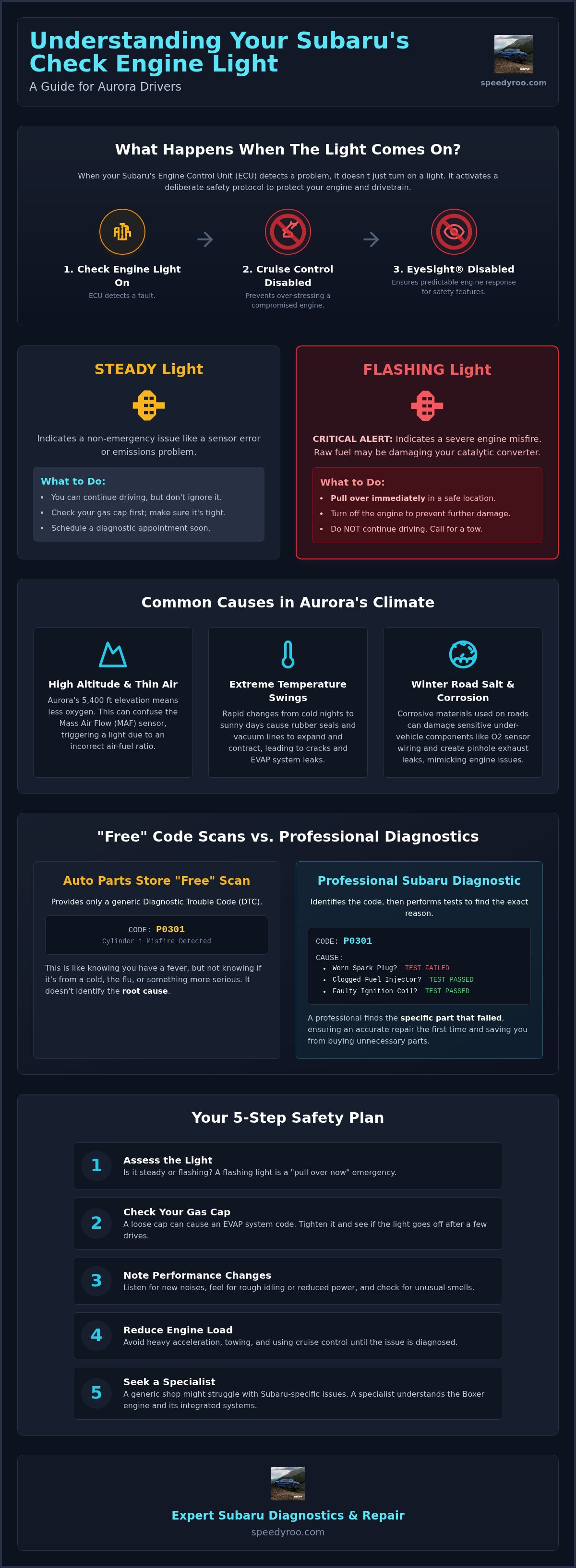
A solid yellow light is the most common occurrence for drivers. It typically signals a non-emergency issue, such as a localized sensor error or a minor emissions problem. While you can usually finish your daily commute to Denver or run errands around town, you shouldn’t ignore it. Prolonged driving with a solid light can lead to degraded fuel economy and eventually cause expensive catalytic converter damage. It’s a signal that your car needs attention soon, but it doesn’t require an immediate tow truck.
Conversely, a flashing light indicates a critical engine misfire. This is a high-priority alert that requires you to pull over immediately. A misfire allows raw fuel to enter the exhaust system, which can overheat and destroy the catalytic converter in a matter of minutes. If you see that light blinking, it means your vehicle needs a specialized diagnostic review before it’s safe to drive again. Ignoring a flashing light almost always leads to significantly higher repair costs.
Secondary Warning Systems: EyeSight and Cruise Control
Many owners are startled when their dashboard suddenly looks like a “Christmas tree.” When a Subaru check engine light Aurora activates, the vehicle often disables the Cruise Control, Brake, and EyeSight Driver Assist systems simultaneously. This isn’t a sign that your safety technology has failed. Instead, it’s a deliberate safety protocol used by Subaru to protect the drivetrain.
Engineers designed the ECU to disable these features to prevent the vehicle from over-extending a potentially compromised engine. For example, the Cruise Control system might demand sudden throttle adjustments that a struggling engine cannot safely provide. Similarly, the EyeSight system relies on precise engine response to manage automatic braking and lane-keep functions. By disabling these auxiliary systems, the car ensures you maintain full manual control. This integrated approach ensures the longevity of your Outback or Forester while keeping you safe on the road.
Common Causes for a Subaru CEL in the Aurora Climate
Aurora’s geography plays a significant role in how your car’s computer interprets data. At an elevation of roughly 5,400 feet, the thin air directly impacts the readings of your Mass Air Flow (MAF) sensor. If this sensor is coated in the fine dust typical of the Colorado plains, it can’t accurately measure oxygen intake. This mismatch often triggers a Subaru check engine light Aurora because the engine can’t maintain its ideal air-fuel ratio. It’s a common environmental stressor that generic shops often misdiagnose as a total engine failure.
Many drivers hope a loose gas cap is the culprit. While it’s a valid first check for an EVAP system leak, it’s rarely the final solution for modern vehicles. Along the Front Range, extreme temperature swings are a much more common cause of vacuum leaks. Rapid shifts from freezing nights to sunny afternoons cause rubber seals to expand and contract, eventually creating tiny fissures in the EVAP lines. These small leaks are enough to trip a sensor and disable your cruise control system.
Winter road salt also takes a heavy toll on your vehicle’s underside. The corrosive mixture used on local roads can eat through Oxygen (O2) sensor wiring or create pinhole exhaust leaks. These issues mimic internal engine problems on your dashboard but are actually results of external environmental wear. Addressing these early prevents the corrosive damage from spreading to more expensive components.
Sensors and Air-Fuel Ratio
The Air-Fuel (A/F) sensor is the Boxer engine’s primary tool for adjusting to altitude changes. In high-mileage Subarus, failing knock sensors can also cause the ECU to pull timing, resulting in sluggish performance. If you notice your car struggling on steep inclines or during rapid temperature drops, it’s time for specialized Subaru repair and service to ensure your sensors are functioning within spec. Specialized cleaning of the MAF sensor often resolves these issues without the need for part replacements.
The Infamous P0420 Code: Catalytic Efficiency
The P0420 code is a frequent visitor for local owners dealing with a Subaru check engine light Aurora. This code indicates that the catalytic converter’s efficiency has dropped below a specific threshold. However, this doesn’t always mean you need a new converter. A simple exhaust leak upstream of the sensor can trick the computer into throwing this code. We use precise diagnostic equipment to distinguish between a dead converter and a minor leak, ensuring you don’t pay for parts you don’t actually need.
Diagnostic Process: Why ‘Free Code Scans’ Can Be Misleading
Many drivers head to a local parts store for a free scan the moment their Subaru check engine light Aurora appears. While these scans provide a four-digit code, they don’t provide a repair manual. A code is simply a starting point that tells you which system is reporting an error, not which specific part has failed. Professional Subaru diagnostics involve live-data streaming and physical testing to verify the root cause before any parts are replaced.
Take the P0171 “Lean” code as a prime example. This code indicates there is too much air and not enough fuel in the combustion chamber. However, that imbalance could be caused by a vacuum leak, a failing fuel pump, a clogged fuel injector, or even a simple tear in an air intake boot. Without a deep dive into the system’s live data, you might end up firing the “parts cannon” and paying for several expensive sensors that were perfectly fine. This guesswork is a common reason why Aurora owners feel frustrated by recurring dashboard warnings.
Live Data and Freeze Frame Analysis
When we connect our specialized diagnostic tools, we look far beyond the active code. We examine “Freeze Frame” data, which captures a snapshot of every engine parameter at the exact second the light triggered. This allows us to see if the fault occurred at idle, under heavy load, or while cruising on the highway. We monitor fuel trims to see how the ECU is compensating for Aurora’s thin air and high altitude. Generic OBD-II readers often lack the depth to see these Subaru-specific data pids, leading to incomplete or incorrect conclusions.
Independent Specialist vs. General Mechanic
Choosing a shop with specialized knowledge is vital because Subaru’s unique ECU logic differs significantly from domestic or European brands. Understanding Japanese import repair in Aurora requires a technician who sees hundreds of Boxer engines every year and knows their specific quirks. A general mechanic might misinterpret a sensor reading that is actually normal for a high-altitude Subaru. We prioritize transparency by showing you the actual data logs and explaining the “why” behind our recommendations. This methodical approach replaces the stress of the unknown with the confidence of a verified expert solution.
What to Do When the Light Comes On: A 5-Step Safety Plan
The moment that yellow icon appears, your first priority is a quick safety assessment. Feel for any unusual vibrations, listen for new engine noises, and notice if the car feels sluggish or underpowered. If the vehicle is shaking or losing power significantly, pull over to a safe spot immediately. You should also glance at your instrument cluster to ensure the temperature needle isn’t climbing into the red and the oil pressure light isn’t active. These gauges provide critical context for the Subaru check engine light Aurora, helping you determine if the issue is a minor sensor error or a catastrophic mechanical failure.
If the car feels normal, the next step is the classic “Gas Cap Reset.” Pull over and ensure your fuel cap is tightened until it clicks at least once. It’s important to remember that the light won’t disappear instantly; it often takes several drive cycles for the computer to re-verify that the EVAP system is sealed. You should strictly avoid heavy acceleration or towing while the CEL is illuminated to prevent putting unnecessary stress on a potentially compromised system. Scheduling a professional evaluation early is the best way to ensure a simple sensor glitch doesn’t escalate into a much more expensive catalytic converter replacement.
Safe Driving Practices with a Solid CEL
Driving with a solid yellow light requires a change in your typical routine. We recommend avoiding the steep climbs into the foothills or mountains until the system is cleared. The increased engine load from high-altitude inclines can exacerbate underlying issues. Try to limit your speeds on I-225 and avoid aggressive lane changes that require wide-open throttle. If the light begins to flash or the car exhibits severe bucking, call a tow truck immediately rather than attempting to limp the vehicle to the shop.
Preparing for Your Service Appointment
Before you arrive at the shop, take a moment to note the specific conditions when the light first appeared. Was the engine cold? Were you merging onto the highway or sitting at a red light on Parker Road? This information is incredibly helpful for our technicians. You should also consider if you’ve had any recent Subaru repair in Aurora CO that might be related to the current fault. Most importantly, don’t clear the code yourself with a handheld scanner. Doing so wipes the “Freeze Frame” data we need to accurately diagnose the root cause of the problem.
If your dashboard is glowing, don’t wait for a small problem to become a major expense. You can schedule your expert Subaru diagnostic appointment today and let our specialists provide the clear answers you deserve.
Expert Subaru Diagnostics at Speedy Roo Motorsports & Repair Inc
Since 2002, our team at Speedy Roo Motorsports & Repair Inc has served as the premier independent alternative for owners facing a Subaru check engine light Aurora. With over two decades of specialized experience, we’ve mastered the nuances of the Boxer engine, from the early EJ series to the advanced FA and FB powerplants found in modern models. Our facility is specifically built to address the unique technical requirements of these engines and the Symmetrical All-Wheel Drive systems they power. We don’t just clear fault codes; we invest the time to understand the underlying mechanical or electrical cause. This methodical approach ensures your repair is handled correctly the first time, preventing the stress of a recurring warning light during your commute through Centennial or Parker.
Our Aurora facility bridges the gap between a generic local shop and a high-cost dealership. We utilize dealership-level diagnostic software and high-precision tools, yet we maintain the approachable, transparent atmosphere of a neighborhood specialist. Our deep background in dyno tuning Aurora CO gives us a distinct advantage when solving complex driveability issues. Because we understand engine calibration at a performance level, we can identify subtle sensor drift, fuel trim imbalances, or vacuum leaks that standard diagnostic protocols often overlook. This high-level expertise allows Speedy Roo Motorsports & Repair Inc to resolve problems that leave other shops guessing.
The Speedy Roo Difference
Owners of the WRX, Outback, and Forester across the Front Range trust us because we live and breathe these vehicles daily. We recognize that Colorado’s climate is uniquely demanding on automotive components, so we prioritize high-quality parts that can withstand extreme temperature swings and corrosive road salt. You won’t encounter high-pressure sales tactics or hidden fees here. Instead, we offer transparent reporting and community-focused pricing that reflects our commitment to being your long-term automotive partner. We take pride in the meticulous care we provide, ensuring every vehicle that leaves our bay is reliable and prepared for the road ahead. Our “Honest Specialist” philosophy means we treat your car with the same precision we would our own.
Schedule Your Subaru Diagnostic in Aurora
If your dashboard is currently signaling for help, we’re ready to provide a comprehensive solution. Our Henger St. facility is conveniently located to serve drivers from Denver, Parker, and Centennial who need reliable answers. During your visit to Speedy Roo Motorsports & Repair Inc, you can expect a thorough evaluation of your Subaru check engine light Aurora followed by a clear, data-backed explanation of our findings. We’ll walk you through the necessary steps to restore your vehicle’s health and provide a detailed estimate before any work begins. Our goal is to empower you with knowledge so you can make informed decisions about your vehicle’s longevity. Contact us today to clear your dashboard and regain the peace of mind that comes with expert, specialized care.
Regain Your Peace of Mind on the Road
Addressing a dashboard warning doesn’t have to be a stressful experience. You now understand the vital difference between a solid and flashing light, along with how Aurora’s high-altitude environment impacts your Boxer engine’s sensors. By following a structured safety plan and looking beyond basic code scans, you can prevent minor sensor glitches from escalating into costly mechanical failures.
Pinpointing the exact cause of a Subaru check engine light Aurora requires the specialized touch of an expert who understands these vehicles inside out. As independent Subaru specialists since 2002, we combine A+ rated local expertise with advanced diagnostic equipment specifically designed for Japanese imports. Our goal is to provide the transparent, reliable service you need to keep your Outback, Forester, or WRX running at its best for years to come.
Schedule your expert Subaru diagnostic at Speedy Roo today! We look forward to helping you clear your dashboard and providing the honest, specialized care your vehicle deserves.
Frequently Asked Questions
Can I drive my Subaru with the check engine light on?
You can typically drive short distances if the light is solid yellow and the car exhibits no unusual symptoms. However, you should avoid heavy loads or high speeds until a technician evaluates the system. If the light is flashing, you must pull over and stop the engine immediately. A flashing light indicates a severe misfire that can destroy your catalytic converter in a matter of minutes.
Why is my Subaru cruise control light flashing at the same time as the check engine light?
Subaru engineers designed the vehicle to disable the cruise control and EyeSight systems whenever the engine computer detects a fault. This is a deliberate safety protocol intended to prevent the car from making autonomous throttle adjustments while the engine is potentially compromised. It ensures the driver maintains full manual control of the vehicle until the Subaru check engine light Aurora is properly diagnosed and cleared.
Will a loose gas cap really trigger a check engine light in my Forester?
A loose, damaged, or incorrect gas cap is a very common cause for a check engine light. The fuel system is pressurized to prevent harmful vapors from escaping into the atmosphere. If the cap doesn’t provide a perfect seal, the sensors detect a pressure drop and trigger an EVAP system code. Always ensure your cap clicks at least once after refueling to maintain the necessary vacuum seal.
How much does a Subaru check engine light diagnostic cost in Aurora?
Professional diagnostic fees vary depending on the complexity of the electrical testing required. While some shops offer basic code reading for free, a comprehensive diagnostic involves using specialized software to analyze live data and verify component failures. This prevents you from wasting money on unnecessary parts. It’s best to contact a local specialist directly to discuss their current diagnostic rates for your specific Subaru model.
How do I reset the check engine light on my Subaru Outback?
The only proper way to reset the light is to identify and repair the root cause of the fault. Once the repair is finished, the onboard computer will typically clear the light after several successful drive cycles. We don’t recommend disconnecting the battery to clear codes. Doing so erases critical “Freeze Frame” data and diagnostic history that our technicians need to ensure your vehicle is actually safe to drive.
What is a P0420 code and is it expensive to fix?
A P0420 code indicates that the catalytic converter’s efficiency has dropped below a specific threshold. While replacing a converter is a notable repair, the code doesn’t always mean the converter is dead. A simple exhaust leak or a failing oxygen sensor can often trick the computer into throwing this code. A specialized Subaru check engine light Aurora inspection can determine if a minor repair can resolve the issue first.
Can the altitude in Aurora cause my check engine light to come on?
Altitude itself won’t trigger a light on a healthy car, but it can expose aging sensors. At 5,400 feet, the air is significantly thinner, which requires your Mass Air Flow (MAF) sensor to be highly accurate. If that sensor is dirty or failing, the thin air in Aurora can push it outside of its normal operating parameters. This often results in a “Lean” or “Rich” mixture code that wouldn’t appear at sea level.
Does an aftermarket gas cap work for Subarus?
We strongly recommend using an OEM (Original Equipment Manufacturer) gas cap rather than an aftermarket version. Subaru’s EVAP sensors are incredibly sensitive to the exact seal pressure provided by the cap. Many aftermarket caps don’t meet these precise specifications, which can lead to recurring “nuisance” lights. Using a genuine part is a simple and inexpensive way to ensure your fuel system remains properly sealed and your dashboard stays clear.