
Your Subaru’s timing belt will never give you a warning sign, a squeak, or a dashboard light before it snaps. For many local drivers, the thought of a sudden engine failure while merging onto I-225 is a constant source of anxiety. It’s understandable to feel hesitant about the cost of major maintenance, especially when you aren’t sure which extra parts are truly necessary. Choosing a specialist for your Subaru timing belt service Aurora is the single most important step you can take to protect your Boxer engine from total destruction.
We agree that automotive maintenance should be transparent and straightforward, not a guessing game of hidden fees. You’ll learn exactly why this service is a system restoration rather than a simple part swap, ensuring your vehicle stays reliable for years to come. We’ll also clarify the 105,000-mile replacement rule and explain which additional components, like the water pump and seals, actually deserve your attention while the engine is open.
Key Takeaways
- Understand why the interference design of the Boxer engine makes the timing belt a non-negotiable maintenance item to avoid catastrophic failure.
- Identify the standard 105,000-mile interval and why Aurora’s specific climate may require more frequent check-ups for your Subaru timing belt service Aurora.
- Learn how replacing the water pump and seals during the same visit maximizes your investment and prevents future labor expenses.
- Discover why specialized knowledge of the Boxer engine’s unique layout is essential for precise crankshaft and camshaft synchronization.
- Explore how a methodical, specialist-led approach provides the transparency and reliability needed for long-term vehicle health.
Understanding the Subaru Timing Belt: The Heartbeat of Your Boxer Engine
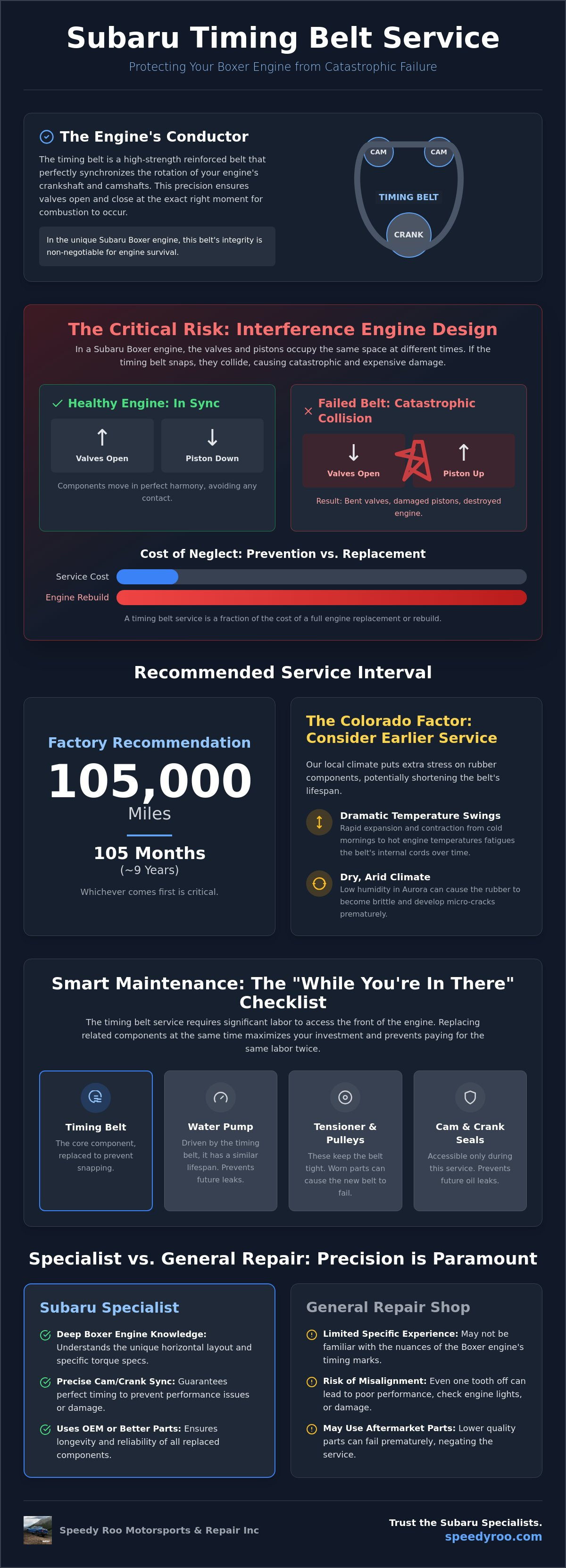
The timing belt acts as the mechanical conductor of your engine, orchestrating a complex dance between heavy internal components. It’s a reinforced loop that synchronizes the rotation of the crankshaft and the camshafts with absolute precision. This synchronization ensures that the intake and exhaust valves open and close at the exact right moments during the combustion cycle. Without this precise timing, the engine cannot breathe, fuel cannot ignite properly, and the vehicle simply won’t run. For residents in Colorado, staying on top of a Subaru timing belt service Aurora is the best way to ensure this mechanical harmony continues for another 100,000 miles.
Precision is the defining characteristic of the Boxer engine. Because the pistons move horizontally, the timing belt must travel a specific path to keep both sides of the engine in sync. It’s not just a simple rubber band; it’s a high-strength component designed to withstand extreme heat and tension. If the belt stretches or the teeth wear down, the engine’s heartbeat becomes irregular, leading to poor performance or total failure.
The High Stakes of an Interference Engine
Subaru Boxer engines are engineered as an interference engine, which means timing is a matter of survival for the motor. In this design, the valves and pistons occupy the same physical space within the cylinder, just at different times. The timing belt is the only barrier preventing a physical collision between them. If the belt fails, the valves will strike the pistons with incredible force. This almost always leads to bent valves, cracked pistons, and a destroyed cylinder head. While a standard Subaru timing belt service Aurora is a significant maintenance item, the cost is minimal compared to a complete engine overhaul or a full engine replacement.
Why Subarus Use Belts Instead of Chains
Many owners ask why their vehicle uses a belt instead of a permanent metal chain. For the horizontal Boxer layout, belts provide distinct advantages in terms of weight and friction. A lighter belt allows the engine to rev more freely and contributes to the smooth, quiet operation Subaru owners enjoy. While newer models have moved toward chains, many vehicles on the road still rely on the belt’s flexibility and efficiency. The primary trade-off is that belts have a finite lifespan. Adhering to a strict maintenance schedule ensures you get the performance benefits of a belt without the risk of an unexpected break. It’s a system designed for performance, provided the owner respects the service intervals.
When to Schedule Your Subaru Timing Belt Service in Aurora
Subaru defines a clear factory maintenance schedule for their vehicles, recommending a timing belt replacement every 105,000 miles or 105 months. This seven year mark is just as critical as the mileage. Even if your car spends most of its time in a garage, the rubber material in the belt naturally degrades over time. For local drivers, staying on top of a Subaru timing belt service Aurora is about more than just checking a box on a list; it’s about accounting for the specific environmental stresses of the Front Range.
Wait times can be dangerous. Many owners believe they can push the service to 120,000 miles or beyond, but the risk grows exponentially with every mile past the recommendation. If you’re unsure where your vehicle stands in its maintenance cycle, a quick check of your service records or a professional Subaru repair and service consultation can provide the peace of mind you need to keep driving confidently.
The Colorado Factor: Dry Air and Temperature Swings
Aurora’s climate is notoriously dry. This low humidity is a silent enemy of rubber components. Without moisture in the air, the timing belt can become brittle and develop microscopic cracks long before the 105,000 mile mark. Our dramatic temperature swings also play a role. A belt that’s frozen at 10 degrees in the morning and then heated to operating temperatures during a commute experiences significant expansion and contraction. This cycle eventually fatigues the internal Kevlar cords, making the “Severe Service” schedule a much safer bet for Colorado residents. To understand exactly which mileage milestones matter most in our local environment, the Subaru maintenance schedule Aurora owners should follow outlines a comprehensive Colorado-focused checklist for every major service interval.
Warning Signs You Shouldn’t Ignore
Identifying a problem before it becomes a crisis is vital. You might notice a rhythmic ticking or slapping sound coming from behind the front engine cover. This often indicates the belt has stretched or a tensioner is failing to keep it tight. In some cases, a worn belt can cause the engine to misfire or run roughly as the timing slips by just a fraction of a degree. However, the most important thing to remember is that many belts show no symptoms at all. They often look perfectly fine on the outside right up until the moment they snap, which is why proactive replacement is the only reliable strategy.
The “While You Are In There” Checklist: Maximizing Your Investment
Replacing only the belt during a Subaru timing belt service Aurora is a risky half-measure that often leads to expensive regret. The timing belt is part of a complex ecosystem of moving parts, all of which have been spinning for the same 105,000 miles. Because the labor required to access these components is the most significant portion of the total cost, it makes financial sense to refresh the entire system at once. We call this concept “overlapping labor.” By installing new support parts now, you essentially get the installation labor for free, protecting your engine from future failures that would require paying for the same teardown all over again.
The Water Pump and Thermostat
In most Boxer engines, the timing belt physically drives the water pump. If the pump’s internal bearings fail or the seal begins to weep, it can contaminate your brand-new belt with engine coolant. This chemical exposure weakens the rubber and leads to premature failure. Replacing the water pump and thermostat together ensures your cooling system remains robust. This is especially vital for maintaining stable engine temperatures during steep climbs into the Colorado mountains, where cooling demands are at their highest. For a deeper understanding of how your entire cooling system works together, our guide on Subaru cooling system repair Aurora owners rely on covers every component in detail.
Idler Pulleys and the Hydraulic Tensioner
Four idler pulleys guide the belt along its precise path. These pulleys rely on small internal bearings that eventually dry out and seize. If a single $50 pulley stops spinning, it will snap a new belt in seconds. The hydraulic tensioner is another common failure point that deserves attention. It maintains the exact amount of pressure needed to keep the belt from slipping. If the tensioner loses its charge, the belt can jump teeth on the gears, resulting in the same catastrophic engine damage as a snapped belt.
Front Main and Camshaft Seals
While the timing cover is removed, we have a clear view of the front main and camshaft seals. These seals keep engine oil contained. Over time, they can become brittle and start to leak. Oil is a natural solvent for rubber; even a small seep can cause a timing belt to swell and fail unexpectedly. A comprehensive Subaru timing belt service Aurora should always include a thorough inspection of these seals. Refreshing them at the 105,000-mile mark is a proactive step that prevents the dreaded “Subaru oil smell” and ensures the longevity of your Subaru repair Aurora CO. It’s about doing the job right the first time so you don’t have to do it again.
Specialist vs. General Repair: Why Precision Matters
While many general repair shops are capable of handling standard inline engines, the flat-four Boxer layout demands a specialized level of precision. Performing a Subaru timing belt service Aurora isn’t just about swapping a belt; it involves navigating a unique geometry where the belt must wrap around four different camshaft pulleys on Dual Overhead Cam (DOHC) models. This complexity is why specialized knowledge is a necessity rather than a luxury. A specialist understands the nuances of the horizontal engine, ensuring that every component is handled with the meticulous care it requires.
The Dangers of Being “One Tooth Off”
General shops often struggle with the “triple-mark” alignment system found on modern Subarus. This system requires the technician to align marks on the belt with specific notches on the crankshaft and all four camshaft gears simultaneously. If the alignment is off by even a single tooth, the engine’s valve timing will be slightly retarded or advanced. You might notice poor fuel economy, a lack of power, or a persistent “Check Engine” light that stays illuminated. Over time, this slight inaccuracy puts uneven stress on the valvetrain and can lead to premature wear. Specialists use specific procedures and camshaft locking tools to prevent the cams from snapping out of position during the swap, ensuring the synchronization is perfect before the engine is ever started.
Quality of Parts: OEM vs. Aftermarket
The quality of the components used is just as important as the skill of the technician performing the work. Many “budget” timing belt kits found online or at general parts stores use inferior bearings in the idler pulleys, often sourced from manufacturers that don’t meet factory standards. We’ve seen these cheaper alternatives fail in as little as 20,000 miles, which defeats the purpose of the service. We prioritize Japanese-made idlers and OEM-specification belts because they match the high standards of the original factory build. This meticulous choice of parts provides the long-term health and reliability your vehicle deserves.
Specialized tools also play a critical role in protecting your investment. For example, using the correct crank pulley tool prevents damage to the sensitive harmonic balancer, a part that general mechanics might accidentally mar with universal pry bars. This level of detail is what separates a standard repair from a specialist restoration. When it’s time to protect your engine, don’t settle for a “one size fits all” approach. You can schedule your Subaru repair and service with our team to ensure every mark is aligned and every bolt is torqued to exact factory specifications.
Professional Subaru Timing Belt Service at Speedy Roo Motorsports & Repair Inc
Since 2002, Speedy Roo Motorsports & Repair Inc has served as a dedicated independent specialist for local drivers. We’ve spent over two decades mastering the intricacies of the Boxer engine, making us a trusted choice for your Subaru timing belt service Aurora. Our team doesn’t just view this as a routine task; we see it as a critical procedure that ensures the continued life of your vehicle. This long history in the community has built a foundation of trust and technical excellence that general shops simply can’t replicate.
Our background in high-performance tuning informs every standard maintenance job we perform. Because we offer specialized services like Aurora Dyno Tuning, we understand exactly how internal engine components behave under extreme stress. This expertise translates into a more thorough process for your timing belt replacement. We don’t just pull the old belt off and slap a new one on. Our technicians at Speedy Roo Motorsports & Repair Inc meticulously clean the entire timing area, inspect the front of the engine for any hidden issues, and use precise torque sequences for every bolt.
Transparency is a core value of our business. We believe you should feel empowered and informed about the state of your car. During the service, we’re happy to show you the condition of your old belt, idlers, and water pump. Seeing the microscopic cracks in a 105,000-mile belt or feeling the “gritty” rotation of a worn pulley often clarifies why this investment is so vital. It’s our way of partnering with you in your vehicle’s longevity, replacing stress with a feeling of calm reliability.
Expert Neighbor Service in Aurora
Our specialized focus has earned us a reputation as the “Subaru Guru” of the Denver metro area. We take pride in offering honest pricing and craftsmanship that reflects our commitment to excellence at Speedy Roo Motorsports & Repair Inc. Beyond just the timing belt, we help you look at the big picture of your vehicle’s health. Whether it’s identifying a small oil seep early or checking your cooling system’s efficiency, we’re here to ensure your car is ready for your next mountain adventure. For drivers who want to stay ahead of overheating issues on those mountain runs, our comprehensive resource on Subaru cooling system repair in Aurora explains exactly what to watch for and when to act. We aim to be a dedicated partner in the long-term health of your property.
Schedule Your 105k-Mile Service
When you bring your vehicle to our Aurora facility, you can expect a streamlined and professional experience. We start with a comprehensive quote tailored specifically to your model and year, ensuring there are no surprises when the work is finished. Our methodical approach means your car is handled with the highest level of care from start to finish. If you’re approaching that critical 105,000-mile mark, it’s time to act. Book your Subaru timing belt service Aurora with the specialists at Speedy Roo Motorsports & Repair Inc today to protect your Boxer engine for the road ahead.
Protect Your Subaru for the Front Range Roads Ahead
Proactive maintenance is more than a mechanical requirement; it’s an investment in the continued adventures your vehicle provides. By completing this service before the critical limit, you preserve the integrity of your engine and avoid the stress of unexpected breakdowns. A thorough Subaru timing belt service Aurora ensures that your car remains a reliable partner for every commute and weekend excursion. This methodical approach to care reflects the high standards of craftsmanship your vehicle deserves and protects the long-term health of your property.
Since 2002, Speedy Roo Motorsports & Repair Inc has served the local community with specialized expertise and a commitment to transparency. We use the precise tools and high-quality components necessary to safeguard your Boxer engine against the unique challenges of Colorado driving. You can Schedule Your Subaru Timing Belt Service at Speedy Roo Motorsports & Repair Inc to ensure your vehicle receives the meticulous attention it needs. We are proud to be your dedicated partner in automotive longevity, providing the expert care that keeps you moving forward with confidence.
Frequently Asked Questions
How much does a Subaru timing belt service cost in Aurora?
Total costs depend on your specific model and the comprehensive nature of the kit used for the repair. Factors such as whether you choose to replace the water pump, camshaft seals, and hydraulic tensioner will influence the final quote. Since labor is the most significant portion of the expense, we recommend requesting a model-specific estimate that covers all necessary support components to ensure a long-lasting repair.
Can I drive my Subaru if the timing belt is squeaking?
You should stop driving immediately if you hear a rhythmic chirping or squeaking noise from the front engine cover. While the rubber belt itself is usually silent, these sounds often signal a failing idler pulley bearing or a weak tensioner. If these components seize, they will cause the belt to snap or jump teeth, leading to the catastrophic engine failure we aim to avoid through proactive maintenance.
Do all Subaru models have timing belts?
No, many modern Subarus have transitioned to timing chains which are designed to last the life of the motor. Generally, older EJ-series engines require a regular Subaru timing belt service Aurora, while newer FB-series engines found in most post-2011 Foresters and Imprezas use chains. If you’re unsure which system your vehicle uses, our team can quickly identify your engine type based on your VIN or model year.
How long does a timing belt replacement take?
A professional replacement typically requires between four and six hours of shop time to complete correctly. This duration allows our technicians to perform a methodical teardown, a deep cleaning of the timing housing, and a precision installation of the new belt and pulleys. We take this time to ensure every timing mark is perfectly aligned and every bolt is torqued to exact factory specifications.
Is it worth replacing the water pump at the same time?
Yes, replacing the water pump is a highly strategic move because the timing belt physically drives the pump in most Boxer engines. Since the technician has already performed the labor to access the belt, installing a new pump adds very little to the total bill. This prevents you from paying for the same expensive labor twice if the pump starts leaking a few months after your belt service.
What happens if my Subaru timing belt breaks while driving?
If the belt snaps while the engine is running, the internal synchronization is lost and the pistons will strike the open valves. This collision causes significant internal damage, including bent valves and cracked pistons. Because the Boxer is an interference engine, a snapped belt usually results in a repair bill that is several times higher than the cost of the preventative maintenance service.
Does the 105,000-mile interval apply to the Subaru WRX and STI?
While the factory recommends 105,000 miles, many performance enthusiasts choose to perform their Subaru timing belt service Aurora closer to the 90,000-mile mark. High-performance engines like those in the WRX and STI operate under higher heat and stress levels, which can accelerate the wear on rubber components and tensioners. Proactive replacement is a small price to pay for protecting a high-output turbocharged engine.
Can I visually inspect my timing belt myself?
You can remove a small plastic inspection cover to see a section of the belt, but this rarely provides a complete picture of its health. A belt can appear perfectly fine on the outside while the internal structural cords are fatigued or the idler pulleys are nearing failure. Following the age and mileage intervals is a much more reliable strategy than relying on a limited visual check. For a broader view of all the service milestones that protect your vehicle in Colorado’s demanding conditions, our essential Subaru maintenance schedule for Colorado drivers provides a complete Aurora owner’s checklist to keep you ahead of every critical interval.