
Driving a factory-tuned Subaru at 5,000 feet is often like asking an athlete to run a marathon while breathing through a straw. You’ve likely felt that sluggish turbo lag when merging onto I-70 or noticed your fuel economy dipping on those steep mountain passes. This is why Subaru ECU tuning Aurora has become such a vital service for local owners; it’s about making sure your car isn’t struggling against the thin air. It’s stressful to wonder if your engine is working too hard just to keep up, and we believe your vehicle should feel as capable on a mountain peak as it does at sea level.
In this guide, you’ll learn how a professional tune compensates for high-altitude oxygen density while keeping your engine safe on 91 octane fuel. We will look at how to achieve crisper throttle response and optimized engine maps that prioritize both performance and long-term health. By the end, you’ll understand how to gain reliable power that’s built specifically for the unique demands of the Rockies.
Key Takeaways
- Learn how to regain the power lost to Aurora’s 5,000-foot elevation by recalibrating your engine for lower oxygen density.
- See why professional Subaru ECU tuning Aurora is critical for safely running local 91 octane fuel without risking engine damage.
- Understand the limitations of generic “off-the-shelf” maps and why custom dyno tuning is the only way to achieve peak reliability in the Rockies.
- Discover the “Stage 0” philosophy that ensures your vehicle is healthy and ready for performance upgrades before any software changes occur.
- Gain peace of mind by partnering with specialists who’ve spent over 20 years perfecting Subaru performance for Colorado’s unique environment.
Subaru ECU Tuning in Aurora: Why Altitude Changes Everything
ECU tuning is the process of recalibrating your car’s Engine Control Unit (ECU), which acts as the brain of the vehicle. By adjusting parameters like fueling, ignition timing, and boost pressure, we can optimize how your Boxer engine performs in specific environments. In Aurora, this recalibration isn’t just about speed; it’s about survival. Our goal is to ensure your vehicle operates with the same precision at high elevation as it would at sea level.
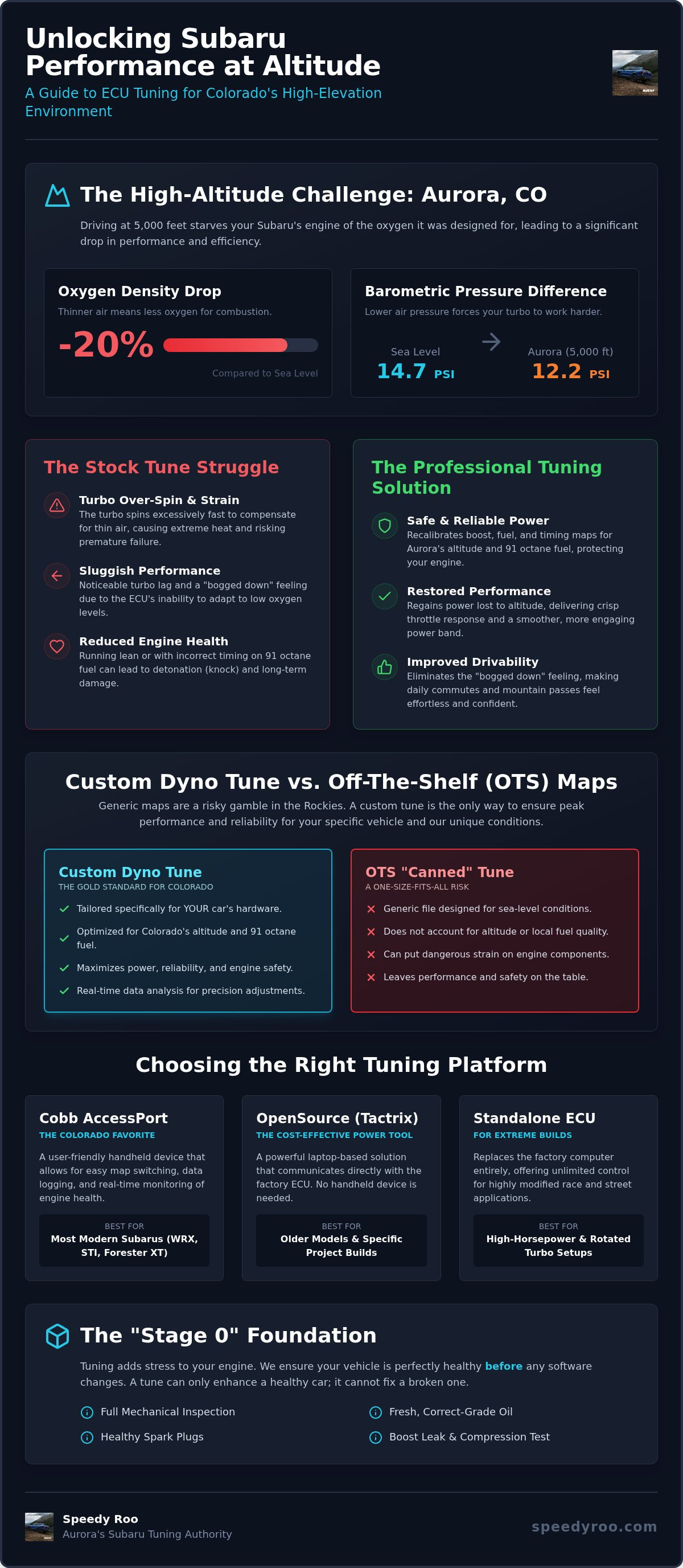
Aurora sits at an elevation of over 5,000 feet, where the air is significantly thinner than at sea level. Oxygen density drops by nearly 20% compared to coastal regions. Most factory engine maps are designed for sea-level conditions and generalized settings. When you drive a stock Subaru in the Rockies, the ECU often struggles to compensate for this lack of oxygen. This leads to sluggish performance, increased turbo lag, and poor fuel efficiency.
For turbocharged models, this “Thin Air Factor” is especially dangerous. To reach the boost levels requested by a sea-level map, the turbocharger has to spin much faster to compress the thinner air. This “over-spinning” creates excessive heat and puts immense strain on the turbo’s bearings. Subaru ECU tuning Aurora allows us to set realistic boost targets and safety limits that respect the local barometric pressure, protecting your hardware from premature failure.
The Science of Barometric Compensation
Your Subaru uses a Manifold Absolute Pressure (MAP) sensor to monitor the weight of the air entering the engine. At sea level, atmospheric pressure is roughly 14.7 psi, but in Aurora, it drops to about 12.2 psi. A proper tune uses “Correction Factors” to adjust the engine’s behavior based on these real-time readings. This ensures that whether you are commuting through town or climbing a mountain pass, the engine maintains a safe air-to-fuel ratio and avoids the risk of detonation.
Turbocharged vs. Naturally Aspirated Tuning
While WRX and STI models see the most dramatic power gains from altitude-specific tuning, naturally aspirated models like the Crosstrek or Forester still benefit. For non-turbo engines, we focus on improving throttle response and smoothing out the power band. This helps eliminate that “bogged down” feeling when pulling away from a stoplight in thin air.
We also address heat soak, a common issue during Aurora’s hot summer months. Thinner air is less efficient at cooling your intercooler and radiator. By optimizing cooling fan cycles and ignition timing through Subaru ECU tuning Aurora, we can keep your engine running cooler and more reliably during those high-temperature climbs.
Choosing the Right Subaru Tuning Platform
Selecting a platform is the first major decision in your performance journey. Most Subaru repair shops in Aurora utilize three distinct methods to recalibrate your vehicle. Each offers different levels of control, safety, and cost. Understanding these options helps you choose the tool that best matches your driving goals and budget.
- Cobb AccessPort: This is the industry standard for most modern Subarus. It’s a handheld device that plugs into your OBDII port, making it incredibly user-friendly. It includes built-in safety features and allows for easy data logging.
- OpenSource (Tactrix): This method uses a laptop and a specialized cable to talk directly to the factory computer. It’s a powerful, cost-effective option often used for older GD-series WRXs or specific project builds where a handheld device isn’t required.
- Standalone ECUs: Systems like Link or Haltech replace the factory computer entirely. These are reserved for extreme builds, such as those with rotated turbo setups or built blocks targeting very high horsepower.
Cobb AccessPort: The Colorado Favorite
In our region, flexibility is key. The AccessPort allows you to switch between maps quickly. If you’re heading into the high country where fuel quality might be questionable, you can easily flash a “Valet” or “Economy” map to protect the engine. It also provides real-time monitoring of critical metrics like “Fine Learning Knock Correction.” This specific data point is vital for Subaru ECU tuning Aurora because it tells you if the engine is pulling timing due to low-quality 91 octane fuel. Having this visual feedback on your dashboard provides immense peace of mind during mountain climbs.
When to Go Standalone
The factory Subaru ECU is remarkably capable, but it eventually hits a ceiling. Once you move toward heavy modifications like massive fuel injectors and rotated turbochargers, the stock logic can become a bottleneck. Standalone systems offer advanced engine protection that factory computers simply cannot match. For instance, they can automatically cut boost if fuel pressure drops or if oil temperatures exceed a safe threshold. These systems require expert installation and methodical calibration to function correctly. If you’re planning an extensive build, discussing your goals with a specialist at Aurora Dyno Tuning is the best way to ensure you pick the right hardware for long-term reliability.
Custom Dyno Tune vs. Off-the-Shelf (OTS) Maps
Off-the-shelf (OTS) maps, frequently called “canned tunes,” are pre-packaged software files designed to work on a broad range of vehicles with similar hardware. While they offer a convenient entry point into performance, they suffer from the “Average Joe” problem. These maps are typically written and tested at sea level using 93 octane fuel. In Aurora, we have neither of those things. Using a generic map intended for a coastal environment can lead to inconsistent performance or, in worse cases, engine damage due to improper fueling and timing for our thin air.
A custom dyno tune in Aurora provides a map built specifically for your car’s current mechanical health and our local atmospheric conditions. During a custom session, we monitor every vital sign of the engine in real-time. This allows us to build in a much larger safety margin. We can precisely adjust parameters to prevent engine knock, which is a significant risk when a sea-level map tries to demand too much boost or timing from a car running on Colorado’s 91 octane fuel.
The 91 Octane Struggle in the Rockies
Colorado’s premium fuel is generally lower quality than the 93 octane found in many other states. This lower stability makes the engine more prone to detonation, especially under the high load of mountain climbing. Subaru ECU tuning Aurora focuses on compensating for this “noisy” fuel by optimizing ignition timing to keep the engine out of the danger zone. For enthusiasts looking for a safer way to make more power, we often recommend E85 or Flex Fuel configurations. E85 has a much higher resistance to knock, providing a cooling effect that is incredibly beneficial for Boxer engines in our dry, high-altitude climate.
Drivability and the Torque Curve
While many people focus on peak horsepower, a smooth torque curve is far more important for daily driving on I-225 or E-470. We aim to optimize the “Power Band” so that your Subaru feels responsive at the RPMs where you actually spend your time. By using aggressive wastegate management, we can significantly reduce turbo lag. This ensures that when you’re merging into traffic or overtaking on a steep incline, the power is delivered predictably and smoothly. This specialized approach to Subaru ECU tuning Aurora transforms the car from a peaky, temperamental machine into a refined, mountain-ready daily driver.
Preparation: The “Stage 0” Checklist for Tuning Success
Tuning is not a repair for a poorly running car. In fact, adding performance software to a vehicle with existing mechanical issues is a recipe for expensive failures. We follow a “Stage 0” philosophy, which means a car must be 100% healthy before we ever touch the software. This preparation phase is the most critical part of Subaru ECU tuning Aurora because it ensures your engine can actually handle the increased boost and optimized timing we plan to introduce.
The first step in this journey is a professional car inspection. We look for the “tune killers” that often plague Colorado Subarus, such as aging vacuum lines, hairline cracks in turbo inlets, and dirty Mass Air Flow (MAF) sensors. Thinner air at our elevation already forces your turbo to work harder. If you have a boost leak, the turbocharger will try to “over-spin” to compensate, which can lead to catastrophic failure on the dyno rollers.
Drivetrain health is equally important. Subaru’s Symmetrical All-Wheel Drive system requires matching AWD tires with consistent tread depth. If your tire diameters vary by more than 2/32nds of an inch, the center differential can bind during high-speed dyno pulls. This not only skews your horsepower data but can also damage your drivetrain components. Before you book your session, schedule a pre-tune inspection to verify your car is ready for the heat.
Mechanical Prerequisites
We recommend performing a boost leak test, or smoke test, to ensure every connection in your intake tract is airtight. Even a tiny pinhole leak will cause the engine to run rich, leading to carbon buildup and lost power. We also check for oil leaks and verify that your cooling system is robust. High-load dyno pulls generate significant heat, so your radiator and fans must be in top condition. Finally, we verify the age and gap of your spark plugs. High-boost applications require a precise, often tighter, gap to prevent “spark blow-out” under load.
Fuel and Fluid Readiness
You should arrive at your tuning appointment with a full tank of the specific fuel you want to use. If you’re tuning for 91 octane, don’t show up with a half-tank of old fuel from a questionable gas station. Fresh oil and a clean air filter are also mandatory. Dirty filters restrict airflow, while old oil can lead to inconsistent pressure readings. We also double-check tire pressure and overall tire condition; safety is our primary concern when a vehicle is strapped down and running at triple-digit speeds on the dyno.
Why Speedy Roo is Aurora’s Subaru Tuning Authority
Since 2002, we’ve dedicated ourselves to the precision maintenance and calibration of Japanese performance platforms. With over 20 years of Aurora-specific experience, we’ve seen how the high-altitude environment of the Rockies can challenge even the most robust Boxer engines. Our role is to act as your “Expert Neighbor,” providing the technical depth of a high-end racing shop with the transparency and warmth of a local independent garage. We aren’t here just to sell a software flash; we’re here to partner with you in the long-term health of your vehicle.
Our “Honest Specialist” philosophy means we prioritize your car’s mechanical integrity above all else. We won’t perform Subaru ECU tuning Aurora on a vehicle that isn’t ready for it. If our initial health check reveals a boost leak or a failing sensor, we’ll tell you immediately. Because we are a full-service repair facility, we can handle those repairs in-house, ensuring your car is perfect before it ever hits the rollers. This integrated approach is why local enthusiasts trust us with their daily drivers and weekend projects alike.
The Subaru Specialist Advantage
We have a deep understanding of the unique architecture of the Boxer engine, particularly its cooling requirements and oiling systems. Aurora’s thin air and steep inclines place specific stresses on these engines that sea-level shops simply don’t have to account for. By utilizing our in-house precision dyno equipment, we gather real-world data from your specific vehicle. This eliminates the guesswork and allows us to create a calibration that is both powerful and safe for I-70 mountain climbs. We know exactly how to balance boost and timing to keep your engine running efficiently without sacrificing reliability.
Get Started with Your Performance Baseline
Your journey starts with a comprehensive consultation and health check. We’ll discuss your specific goals, whether you’re looking for better fuel economy on 91 octane or maximum power for track days. On your first dyno day, you’ll experience a methodical process where every pull is monitored for safety and consistency. We take pride in delivering results that you can feel through the steering wheel and see on the data logs. If you’re ready to see what your car is truly capable of, schedule your Subaru ECU tuning session today and experience the difference that specialized local expertise makes.
Prepare Your Subaru for Every Mountain Pass
Navigating the unique challenges of Colorado’s elevation requires more than just standard maintenance. It demands a calibration that respects the thin air and lower fuel quality found in the Rockies. By prioritizing a “Stage 0” health check and choosing a custom map over generic software, you ensure your Boxer engine remains reliable whether you are commuting in town or climbing a steep mountain pass.
At Speedy Roo, we’ve served as an independent Subaru specialist since 2002. Our in-house Mustang Dynamometer allows us to provide precise, data-driven results that generic tunes simply cannot match. We focus on high-altitude performance calibration to give you a smoother torque curve and safer power gains. When you choose Subaru ECU tuning Aurora, you are investing in the longevity of your vehicle and the quality of every drive.
We invite you to join our community of enthusiasts who value meticulous care and honest expertise. Let’s make sure your car is as ready for the mountains as you are.
Optimize Your Subaru for the Rockies-Book Your Tune Now
Frequently Asked Questions
Does ECU tuning void my Subaru factory warranty?
ECU tuning usually gives dealerships grounds to deny powertrain warranty claims. While the Magnuson-Moss Warranty Act provides some protection, most manufacturers will flag a modified ECU if a major engine failure occurs. It’s best to assume that performance software changes will impact your coverage. We recommend discussing this with your service advisor before proceeding if your vehicle is still under a new car warranty.
How much horsepower can I expect from a Stage 1 tune in Aurora?
On a modern WRX or STI, a Stage 1 calibration typically yields gains of 15 to 30 wheel horsepower depending on the model. These numbers are often lower than sea-level results because we prioritize safety in our thin air. Subaru ECU tuning Aurora focuses on smoothing out the power delivery and improving low-end torque rather than chasing a specific peak number that might compromise your engine’s longevity.
Is it safe to tune a high-mileage Subaru Forester or Outback?
It is safe as long as the vehicle passes a rigorous “Stage 0” inspection first. High-mileage naturally aspirated models benefit from improved throttle response and transmission logic. For turbocharged models with over 100,000 miles, we pay close attention to the health of the turbo seals and compression levels. If the engine is mechanically sound and well-maintained, a conservative tune helps it run more efficiently in our high-altitude environment.
What is the difference between an E-tune and a professional dyno tune?
An E-tune is a remote process where logs are sent back and forth via email, while a professional dyno tune happens in person with real-time monitoring. Dyno tuning is superior because the tuner can hear and feel the car’s reactions immediately. It also allows for steady-state tuning, which is essential for perfecting drivability on steep mountain grades. This hands-on approach provides a much higher level of safety.
Do I need to upgrade my fuel pump for a 91 octane tune in Colorado?
For a standard Stage 1 or Stage 2 setup on 91 octane, the factory fuel pump is usually sufficient. However, upgrading to a higher-flow pump is a smart reliability modification as it provides a larger safety margin during high-load climbs. If you plan to use E85 or Flex Fuel, a high-flow fuel pump and larger injectors are mandatory to meet the increased volume demands of that specific fuel type.
How long does a professional Subaru ECU tuning session take?
A typical session usually takes between three and five hours. This includes the initial “Stage 0” health check, strapping the car to the dyno, and the actual calibration process. We take a methodical approach, allowing the car to cool down between pulls to ensure the data is consistent. We never rush the process because precision and safety are our top priorities for every customer who visits us.
Can ECU tuning improve my gas mileage for mountain driving?
Yes, many owners see a slight improvement in fuel economy because the engine operates more efficiently. By optimizing the air-to-fuel ratios and ignition timing for 5,000 feet, the engine doesn’t have to work as hard to maintain speed. While you might see a gain of one to two miles per gallon during steady highway cruising, your actual results will always depend heavily on your specific driving habits.
Why does my Subaru feel slower in the summer in Aurora?
This is caused by “Heat Soak” and the decrease in air density as temperatures rise. Hot air contains less oxygen, which means the ECU must pull timing or reduce boost to prevent detonation. Subaru ECU tuning Aurora helps mitigate this by optimizing cooling fan triggers and adjusting temperature-based compensation tables. This ensures your car remains consistent and responsive even when the pavement temperatures on E-470 are at their highest.