
You’re merging onto I-70, heading toward the mountains for a weekend getaway, but as the elevation climbs, your Subaru feels like it’s dragging an invisible anchor. It is a common frustration for local drivers because Colorado’s thin air is a notorious thief of horsepower, especially for turbocharged Boxer engines originally calibrated for sea-level conditions. Many owners worry that pushing for more power might compromise their engine’s longevity, yet leaving it stock often means struggling through inconsistent performance as the weather shifts. Professional Subaru performance tuning Aurora addresses these concerns by calibrating your vehicle specifically for our unique atmospheric pressures.
We believe that a great tune should offer peace of mind alongside increased capability. This article will show you how expert adjustments can transform your driving experience, providing the crisp throttle response and reliable power needed to handle steep grades with ease. You’ll discover how we use real-world data and precise dyno calibration to unlock measurable gains while keeping your vehicle safe, reliable, and compliant with local standards.
Key Takeaways
- Understand the “Altitude Tax” and how professional calibration helps your turbocharger compensate for Aurora’s thin air without overworking the engine.
- Learn why Subaru performance tuning Aurora utilizes chassis dynos to ensure your vehicle is safe and responsive in real-world Colorado driving conditions.
- Explore the differences between Stage 1 software updates and Stage 2 hardware integrations to find the right balance for your daily commute or mountain adventures.
- Discover the specialized maintenance routines, including high-grade lubricants and colder spark plugs, required to protect a high-performance Boxer engine.
- Gain insight into a tuning philosophy that prioritizes long-term vehicle health and reliable power over chasing the highest possible horsepower figures.
Why Subaru Performance Tuning is Essential for Aurora Drivers
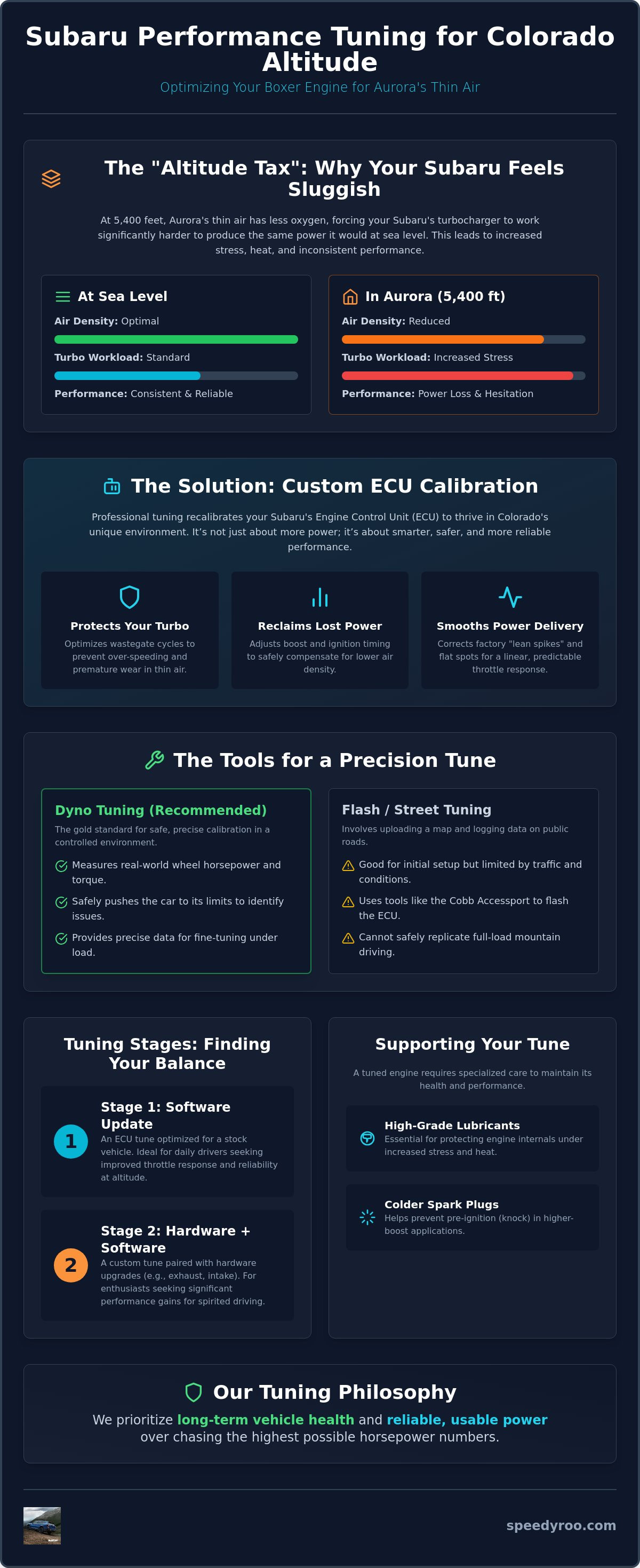
At its core, Engine tuning for a Subaru involves the precise recalibration of the Engine Control Unit (ECU). Think of the ECU as the brain of your vehicle. It dictates how much fuel to spray, when to fire the spark plugs, and how much boost the turbocharger should generate. While your Subaru left the factory with a capable map, that software was designed to meet strict emissions standards at sea level. In Aurora, where the elevation sits at approximately 5,400 feet, those standard settings often fall short of expectations. Professional Subaru performance tuning Aurora isn’t just about chasing high numbers on a graph. It is about optimizing your vehicle to thrive in a specific environment it wasn’t originally programmed for.
We often refer to the “Altitude Tax” when discussing local performance. Because the air is thinner in Colorado, there’s less oxygen available for combustion. To compensate and hit its target boost, your turbocharger has to spin significantly faster and work harder than it would in a coastal city. This added stress can lead to increased heat and premature wear if the ECU isn’t properly adjusted to handle the lower air density. The goal of a professional tune is to balance increased torque with long-term engine longevity, ensuring your car stays reliable for years to come. If you drive any performance vehicle at this elevation, our complete resource for performance calibration in Aurora CO explains how thin-air conditions affect factory settings across all makes and models.
The Impact of Colorado Altitude on Boost
Air density directly affects the critical oxygen-to-fuel ratio required for efficient power. When you use “off-the-shelf” maps designed for general use, they often fail to account for the specific barometric pressures found in the Mile High region. A custom tune adjusts the wastegate duty cycles to manage this reality. This ensures the turbo doesn’t “over-speed” while trying to reach unattainable boost targets. By calibrating for our specific elevation, we protect the mechanical integrity of the turbo while reclaiming the power lost to thin air. A tailored approach typically focuses on:
- Optimizing wastegate duty cycles to prevent turbo fatigue.
- Adjusting target boost levels to realistic local parameters.
- Refining ignition timing to account for Colorado’s specific fuel grades.
Correcting Factory Lean Spikes
Many modern Subarus suffer from factory tuning “flat spots” or lean spikes, particularly during the transition from closed-loop to open-loop fueling. You might feel this as a hesitation or a sudden jerkiness when you accelerate onto the highway. Tuning smooths out these inconsistencies, creating a much more linear and predictable power delivery. More importantly, a custom-calibrated fuel map provides a necessary safety margin. It ensures your engine receives the correct amount of fuel at the right time, preventing the dangerous “leaning out” that can lead to catastrophic engine damage under heavy load. Owners of other Japanese imports facing the same thin-air challenges can find tailored guidance in our performance car tuning Aurora CO guide for Japanese imports, which covers how altitude affects naturally aspirated and turbocharged platforms alike.
The Tools of the Trade: Dyno Tuning vs. Flash Tuning
Effective calibration requires a reliable interface and precise measurement. In the world of Subaru, the Cobb Accessport has become the industry standard for managing the ECU. It acts as a bridge between our laptops and your vehicle, allowing us to rewrite the software that controls engine behavior. While “flash tuning” refers to the act of uploading these new maps, the real work happens during the data logging phase. We monitor knock sensors, air-intake temperatures, and ignition timing in real-time to ensure every adjustment remains within safe mechanical limits. This level of scrutiny is what separates a generic, one-size-fits-all map from a professional Subaru performance tuning Aurora service.
Many owners ask about the difference between a “street tune” and a “dyno tune.” A street tune involves logging data while driving on public roads, which has inherent limitations due to traffic, speed limits, and changing conditions. A dyno tune, however, takes place in a controlled shop environment where we can push the car to its limits safely. We use a chassis dyno to measure real-world wheel horsepower and torque, providing a visual and mathematical representation of how your car is performing. This data allows us to identify and fix small issues before they become expensive problems.
Why We Use the Cobb Accessport
The Accessport is more than just a delivery device; it is a powerful diagnostic tool that stays in your car. It allows you to switch between different maps easily, such as moving from a daily 91 octane map to a performance-oriented E85 calibration. As of June 2026, the latest firmware updates support the newest 2026 WRX models, ensuring that even the latest Boxer engines can benefit from optimized software. You can monitor engine health on the fly and, if you ever decide to sell the vehicle or need to return to stock for emissions testing, the device makes the reversion process straightforward and clean. If you are curious about how your current setup is performing, an Aurora Dyno Tuning session can provide the clarity you need.
The Precision of Dyno Calibration
A chassis dyno allows a tuner to hold the engine at specific RPM and load cells that are nearly impossible to maintain safely on the street. This steady-state tuning is vital for perfecting fueling and timing across the entire powerband. By simulating the exact resistance your car faces on the road, we can refine the driveability of the car in ways a simple road test cannot. A chassis dyno helps simulate Aurora’s unique load conditions for accurate results, ensuring your Subaru handles a steep mountain climb just as well as a flat highway. This controlled environment is the only way to achieve maximum precision while keeping the engine safe from unexpected variables. Drivers of other performance vehicles in the area can find equally detailed guidance in our Aurora CO dyno tuning guide covering Toyota performance tuning and beyond.
Subaru Tuning Examples: From Daily Driver to Track Star
Choosing a build path for your vehicle depends largely on your goals for driveability and power. While every car is unique, the industry typically categorizes upgrades into “stages” to help owners understand the relationship between hardware and software. In our high-altitude environment, these stages aren’t just about speed. They’re about making the car more capable of handling the thin air and steep grades of the Rockies. Whether you want a subtle improvement for your commute or a dedicated mountain car, Subaru performance tuning Aurora provides a structured way to reach those goals safely.
Beyond the engine, a truly capable mountain vehicle often requires attention to its suspension and ground clearance. Industry experts at Veloce Tuning point out that a well-rounded build focuses on both power and the physical ability to handle varied terrain.
Typical power gains vary by model, but most owners see a noticeable shift in how the car delivers torque. A Stage 1 setup often provides a modest but meaningful increase in area under the curve, while moving to Stage 2 or Flex Fuel can result in much more significant jumps in performance. We always prioritize a smooth powerband over peak numbers to ensure the car remains a joy to drive every day.
Stage 1: The Perfect Commuter Upgrade
The Stage 1 approach is often called “OEM Plus.” It focuses entirely on software recalibration without requiring any physical modifications to the engine bay. By optimizing the ignition timing and boost curves, we can make the car feel much more responsive during your morning commute. It’s a sleeper setup. You get improved throttle response and slightly increased boost pressure while maintaining a completely stock appearance. Many drivers also report better fuel economy after a Stage 1 tune because the engine no longer has to fight against the inefficient factory fuel maps designed for sea-level emissions.
Stage 2: Unlocking the Boxer Rumble
Stage 2 is where the character of the Subaru Boxer engine really comes to life. This level involves integrating hardware like a high-flow downpipe and intake with a matching software calibration. These parts reduce backpressure, allowing the turbo to breathe more easily. This is particularly helpful for mountain climbing, as it significantly improves mid-range torque. However, the thinner air in Aurora can lead to “boost creep” if the wastegate cannot keep up with the increased flow. A professional tune is essential at this stage to manage these pressures and keep the engine within safe operating parameters.
The E85 Factor: Flex Fuel in Colorado
For those seeking the ultimate Colorado setup, E85 is often considered a “cheat code.” Ethanol has a much higher effective octane rating than the 91 octane fuel found at local pumps. It also possesses incredible cooling properties that help resist engine knock, which is a major concern in high-load, high-altitude environments. A Flex Fuel sensor allows the ECU to adjust the tune in real-time based on the ethanol content in your tank. This provides the safety and massive power potential of E85 when it’s available, while still allowing you to fill up with standard gasoline whenever necessary.
Supporting Your Tune: Maintenance for High-Performance Subarus
Maintaining a high-performance vehicle requires a shift in mindset. When you opt for Subaru performance tuning Aurora, you are essentially asking your engine to operate at a higher capacity than its original factory settings. This is perfectly safe when managed correctly, but it does mean the standard maintenance schedule in your owner’s manual no longer applies. Tuned engines generate more heat and internal pressure, which breaks down engine oil much faster than a stock setup. We recommend switching to high-grade synthetic lubricants and shortening your oil change intervals to every 3,000 miles to ensure maximum protection for your bearings and piston rings.
Spark plugs also play a critical role in a high-boost environment. Standard plugs may struggle with the increased heat, leading to inconsistent spark or even dangerous pre-ignition. Installing “one step colder” spark plugs helps pull heat away from the combustion chamber more effectively, providing a more stable environment for your fuel to burn. Beyond the engine, you must ensure your transmission and differentials are up to the task of handling the increased torque. Relying on specialized Subaru repair Aurora CO ensures that every component of your drivetrain is inspected for the stability needed to support your new power levels.
Managing Turbo Health
Your turbocharger is the heart of your performance build, and it bears the brunt of the increased workload. Higher boost levels put additional stress on turbo seals and internal bearings. If you notice blue smoke from the exhaust or unusual whistling sounds, it might be time to look into Subaru turbo repair Aurora before a small leak becomes a major failure. A simple but effective tip for longevity is to allow for a “cool down” period. After a spirited drive up a mountain pass, let your engine idle for sixty seconds before turning it off. This keeps oil flowing through the turbo while it cools down, preventing the oil from “coking” or burning inside the hot center section.
Cooling System Upgrades
Heat is the enemy of performance, especially during a summer climb toward the Eisenhower Tunnel. Upgraded aluminum radiators and larger intercoolers are the best friends of a tuned Subaru. These components help maintain lower intake air temperatures, which prevents the ECU from pulling timing to protect the engine. We also suggest installing silicone hose kits. Standard rubber hoses can soften and expand under higher boost pressures, eventually leading to leaks that rob you of power. If you are ready to build a more resilient setup, you can schedule a performance consultation with our team today.
The Speedy Roo Advantage: Aurora’s Independent Subaru Gurus
Since 2002, our team has focused on the unique engineering of the Subaru Boxer platform. We’ve spent over two decades right here in Aurora, refining our techniques to meet the demands of Colorado’s high-altitude environment. This specialized experience means we don’t view your car as just another project on the lift. We understand the specific mechanical nuances of the AWD system and the turbocharged Boxer engine. Our philosophy centers on “Reliable Power,” which means we prioritize the long-term health of your engine over chasing the highest possible number on a dyno sheet. A “glory run” is useless if your car isn’t dependable enough for a trip across the Continental Divide.
Our comprehensive approach combines deep mechanical expertise with sophisticated digital calibration. We don’t just upload a pre-made file and send you on your way. Instead, we look at your vehicle as a holistic system. Before any tuning begins, we ensure the mechanical foundation is solid, checking for boost leaks, worn sensors, or tired turbochargers. This dual focus on hardware and software is what allows us to deliver a driving experience that is both powerful and predictable. We invite you to visit our shop for a consultation where we can discuss your specific goals, whether you are looking for a more responsive daily driver or a dedicated mountain machine.
Why Local Expertise Matters
Colorado presents environmental variables that tuners in other parts of the country simply don’t encounter. We’re intimately familiar with the specific quality of 91 octane and E85 fuel available at local stations, and we know exactly how our thin air affects combustion. As an independent shop, we take pride in building lasting relationships with our customers. We often know the entire history of the vehicles we service, which allows us to provide more accurate recommendations and honest pricing. You aren’t just a transaction to us; you’re a member of a local community of enthusiasts who value precision and craftsmanship.
Ready to Transform Your Drive?
The journey from a stock factory setting to a professionally optimized vehicle is one of the most rewarding upgrades you can give your Subaru. By addressing the “altitude tax” and smoothing out factory hesitations, we can make your car feel the way it was always intended to drive. Whether you’re interested in a Stage 1 software refresh or a full Flex Fuel conversion, Subaru performance tuning Aurora provides the measurable gains and peace of mind you deserve. We’re here to guide you through every step of the process, ensuring your build is both safe and exhilarating. Schedule your Subaru performance tuning session at Speedy Roo today! and let’s unlock the true potential of your Boxer engine.
Elevate Your Colorado Driving Experience
Driving in the Rockies shouldn’t feel like a compromise. By recalibrating your ECU for high-altitude conditions and selecting a build path that aligns with your goals, you can reclaim the responsiveness your Subaru was designed to deliver. Whether you are starting with a Stage 1 software update or building a track-ready Flex Fuel machine, the focus should always remain on precision and long-term mechanical health. This approach ensures your car handles the steep grades of the Eisenhower Tunnel with ease while maintaining the reliability you need for daily life.
At Speedy Roo, we’ve specialized in the Subaru platform since 2002. Our facility features an in-house AWD Dyno and Cobb Certified tuning capabilities to ensure every adjustment is measured and safe. When you choose Subaru performance tuning Aurora, you are investing in a vehicle that is optimized for our unique local environment by experts who know your car inside and out. Book Your Subaru Dyno Tuning Appointment in Aurora to discuss your build with our team. We look forward to helping you navigate the mountains with newfound confidence and power.
Common Questions About Subaru Performance Tuning
Will performance tuning my Subaru void my warranty?
Modification of the factory ECU software can lead a dealership to deny warranty claims on powertrain components. While the law protects consumers from having a warranty voided entirely for unrelated repairs, most manufacturers won’t cover failures they attribute to increased boost or altered timing. It’s best to assume that performance modifications move the responsibility for engine and transmission health from the manufacturer to the owner.
How much horsepower can I expect from a Stage 1 tune in Aurora?
A typical Stage 1 calibration for a modern WRX or STI often results in a 10% to 15% increase in usable torque and horsepower. In our specific environment, the primary benefit of Subaru performance tuning Aurora is reclaiming the power lost to the “altitude tax.” Rather than just chasing a peak number, the tune focuses on making the power delivery more consistent as you climb through varying elevations.
Is E85 readily available for tuning in the Denver and Aurora area?
Yes, E85 is widely available at many fueling stations throughout the Aurora and Denver metro area. This high availability makes Flex Fuel one of the most popular and effective upgrade paths for local Subaru owners. Because ethanol is highly resistant to engine knock in thin air, it provides a significant safety margin that standard 91 octane pump gas cannot match.
How long does a typical dyno tuning session take at your shop?
A professional dyno session usually takes between three and five hours to complete correctly. This timeframe includes the initial mechanical inspection, strapping the vehicle to the rollers, and performing multiple pulls to calibrate the engine across different load and RPM cells. We take our time to ensure the results are repeatable and the engine’s vitals remain stable under stress.
Can I tune my Subaru if it is an automatic (CVT) transmission?
You can tune a Subaru equipped with a CVT, but the approach must be more conservative than with a manual gearbox. We focus on sharpening throttle response and improving mid-range torque while staying within the mechanical torque limits of the transmission’s chain and pulleys. This provides a more engaging drive without compromising the long-term reliability of the CVT unit.
Do I need to upgrade my fuel pump before getting a custom tune?
The factory fuel pump is generally sufficient for Stage 1 and basic Stage 2 builds running on standard pump gas. However, if you intend to move to a Flex Fuel setup or a high-output turbocharger, an upgraded fuel pump becomes a requirement. Ethanol requires about 30% more volume than gasoline to achieve the same energy output, so a higher-flow pump ensures the engine never leans out. If you also own a Toyota or another Japanese import and want to understand how these same principles apply across different platforms, our performance car tuning Aurora CO guide for Japanese imports walks through the Stage 0 foundation work every build should start with.
What happens if I need to pass a Colorado emissions test with a tuned car?
Most modern performance tunes are designed to maintain the necessary OBDII readiness monitors required for Colorado emissions testing. If your vehicle’s hardware remains compliant, such as keeping the factory catalytic converters, a proper tune shouldn’t prevent you from passing. If you have concerns, the Cobb Accessport allows you to quickly revert to a stock map for testing purposes.
Is tuning safe for a high-mileage Subaru engine?
Tuning is safe for high-mileage engines as long as the mechanical foundation is solid. We always recommend a thorough inspection, including a compression or leak-down test, before starting the process on an older vehicle. In some cases, a custom tune can actually help an older engine by smoothing out fueling and reducing the stress caused by the inefficient factory sea-level maps.