
You’re merging onto I-225 when that familiar surge of power suddenly vanishes, replaced by a metallic whine and a faint cloud of blue smoke in your rearview mirror. When you start looking for Subaru turbo repair Aurora specialists, it’s easy to feel overwhelmed by the fear of a total engine replacement or the high costs often associated with local dealerships. It’s frustrating to guess whether your car is just struggling with the altitude or if a mechanical failure is truly imminent.
We understand that your Subaru is more than just a commuter car; it’s a performance machine that requires a methodical approach. This article will help you master the specific signs of turbo failure and explain why specialist repair is critical for your engine’s longevity. You’ll gain a clear understanding of the diagnostic process, the difference between OEM and performance replacements, and how Colorado’s unique atmospheric conditions impact your turbo’s health. We’ll walk through exactly what to look for so you can move from a state of uncertainty to total confidence in your vehicle’s health.
Key Takeaways
- Learn to identify the specific sounds and exhaust patterns that signal a failing turbo before they lead to significant engine damage.
- Understand the critical role of oil flow and how common filter issues can cause premature wear on your high-performance components.
- Explore the diagnostic steps used during a professional Subaru turbo repair Aurora, including precision smoke testing and shaft play evaluations.
- Compare the long-term benefits of OEM replacements against performance upgrades to find the right balance for your vehicle’s longevity.
- Discover why the specialized nuances of the Boxer engine require a methodical, expert approach to ensure a reliable and lasting repair.
Identifying Subaru Turbocharger Failure Signs in Aurora
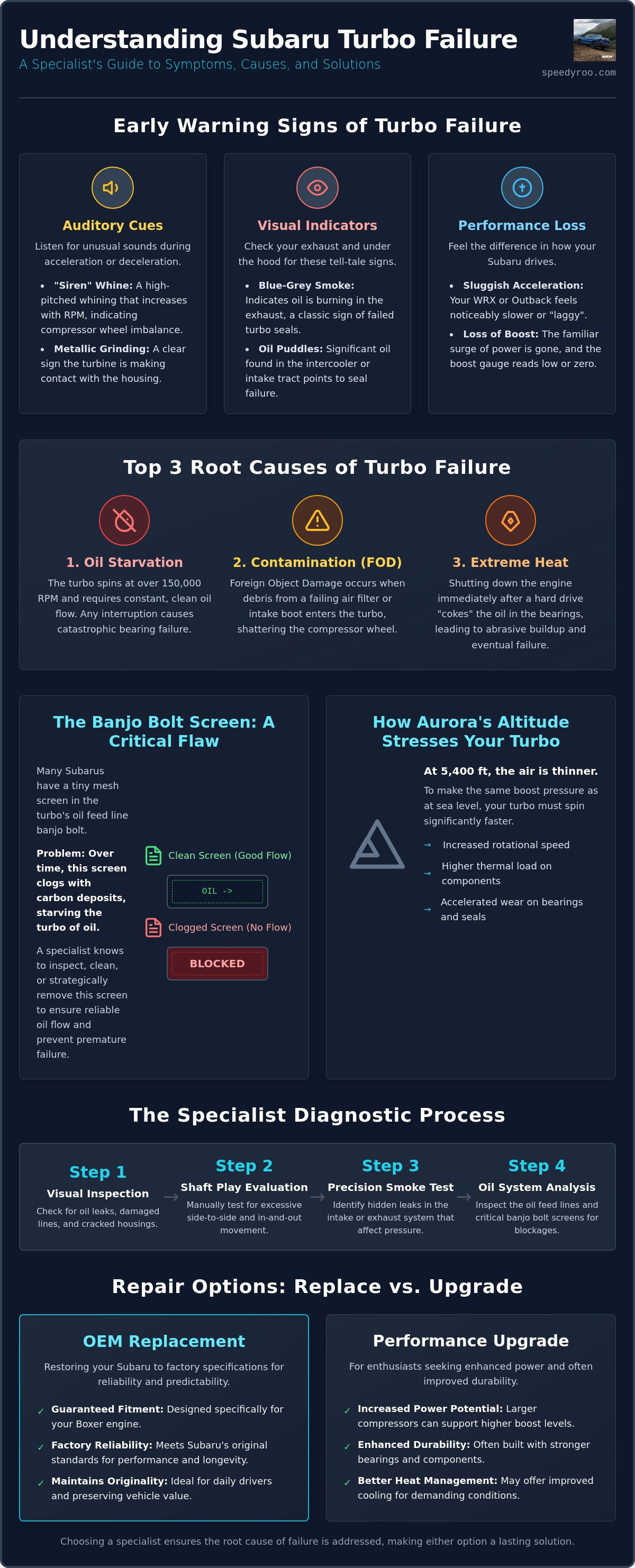
Identifying the early warning signs of a failing turbocharger is the most effective way to prevent a catastrophic engine failure. Before diving into the mechanics, it helps to understand what a turbocharger is; it’s a precision instrument that uses exhaust gases to force more air into your engine. When this component begins to fail, it communicates through very specific auditory and visual cues. If you notice a sudden loss of boost pressure or your WRX feels sluggish during acceleration, your turbo may be struggling. A quick check of the intercooler or intake tract can often reveal the culprit; while a light film of oil is common due to the PCV system, a puddle of oil indicates that the internal seals have likely failed. Recognizing these symptoms early and seeking professional Subaru turbo repair Aurora services can save your Boxer engine from ingesting metal debris.
Common Auditory and Visual Symptoms
Differentiating between normal performance sounds and mechanical failure is a key skill for any Subaru owner. You might be used to a gentle wastegate flutter, which sounds like a light “chatter” when you lift off the throttle. However, a metallic grinding or scraping sound is a red flag that the internal turbine is making contact with the housing. The “siren noise” is a distinct, high pitched whining sound that indicates a compressor wheel imbalance. You should also watch your mirrors for blue-grey exhaust smoke. While white smoke often points to coolant, this blue tint is the hallmark of burning oil. In a Boxer engine, the smell of burning oil is acrid and heavy, distinct from the sweet scent of a coolant leak.
How Aurora Altitude Affects Turbo Stress
Living in Aurora presents unique challenges for forced induction engines. At an elevation of roughly 5,400 feet, the air is significantly thinner than at sea level. To achieve the same target boost pressure your car’s computer demands, the turbocharger must spin much faster than it would on the coast. This increased rotational speed puts a higher thermal load on the entire cooling system and forces the turbo to operate closer to its “choke point” on the compressor map. For high mileage Outbacks and WRXs, this constant “over-spinning” leads to premature bearing wear and accelerated seal degradation. This local environment is why Subaru turbo repair Aurora specialists focus so heavily on cooling efficiency and oil quality; the margin for error is much smaller at a mile high. Pairing your turbo repair with professional Subaru performance tuning Aurora can help recalibrate your engine’s boost targets specifically for our thin atmosphere, reducing the strain on your newly repaired components.
Why Subaru Turbos Fail: Root Causes and Prevention
A successful Subaru turbo repair Aurora requires more than just swapping out a damaged part. It demands a forensic look at what caused the failure in the first place. Understanding How Turbochargers Work reveals why they are so sensitive; these units spin at speeds exceeding 150,000 RPM while being exposed to extreme exhaust temperatures. If the oil supply is compromised for even a few seconds, the resulting friction creates enough heat to weld the bearings to the shaft. We focus on identifying these underlying issues to ensure your replacement doesn’t suffer the same fate as the original.
Carbon buildup in oil feed lines often acts like a clogged artery, slowly starving the unit of its lifeblood. Another common culprit is foreign object damage (FOD). This happens when brittle plastic from a failing intake boot or a small piece of debris is sucked into the compressor wheel. At high speeds, even a tiny fragment can shatter the wheel blades and send metal shards directly into your engine cylinders. Preventing these issues starts with meticulous maintenance and a deep understanding of Subaru’s unique engineering quirks.
The Banjo Bolt and Oil Feed Line Dilemma
Many performance Subaru models feature a small mesh screen hidden inside the banjo bolt of the turbo oil supply line. While these were designed to catch contaminants, they often become a liability. Over time, these screens clog with tiny carbon deposits, leading to total oil starvation. During a comprehensive Subaru repair Aurora CO, we prioritize inspecting these filters. In many cases, removing or replacing these screens is the best way to ensure your performance engine receives the consistent lubrication it needs to thrive in Colorado’s demanding climate.
Heat Management and Coolant Flow
Heat is the primary enemy of any turbocharger. When you shut off your engine immediately after a hard drive, the oil sitting in the turbo’s bearing housing stops moving. The extreme residual heat “cooks” that stagnant oil, turning it into a hard, abrasive sludge known as coking. This sludge eventually blocks oil passages and destroys the delicate seals. While Subaru’s cooling system is designed to circulate fluid after shutdown, it only works effectively if the coolant is fresh and free of debris. Regular, specialized coolant flushes are essential for maintaining this thermal protection. If you suspect your turbo is running hot, a professional diagnostic can help you decide if it’s time for a targeted service to protect your engine’s longevity.
Repair, Replace, or Upgrade: Evaluating Your Options
Facing a mechanical failure often leads to a critical decision: do you restore what you have, buy new, or take the opportunity to improve? When you seek a Subaru turbo repair Aurora, we start by evaluating the structural integrity of your current unit. If the cast iron exhaust housing is free of heat-related stress cracks and the internal bores are within tolerance, a professional rebuild is often a viable and cost-effective path. However, if the rotating assembly has suffered catastrophic shaft play and scored the housing walls, replacement becomes the only safe option to ensure long-term reliability.
It is helpful to understand your consumer rights in auto repair when making this choice. Federal law protects your right to choose independent specialists for these complex tasks without jeopardizing your vehicle’s standing. This freedom allows you to choose between standard journal-bearing units, which are reliable and budget-friendly, or modern ball-bearing upgrades. Ball-bearing turbos offer significantly reduced friction and faster spool times, which is a major advantage when navigating the steep inclines of the Rockies or merging onto high-speed Colorado highways.
When a Professional Rebuild is the Right Choice
A successful rebuild hinges on two factors: the condition of the core and the precision of the assembly. We meticulously inspect the housings for any signs of warping or hairline fractures that could lead to boost leaks. If the core is salvageable, the most critical step is precision balancing of the new rotating assembly. A poorly balanced turbo will fail within 500 miles because even a microscopic weight imbalance creates massive vibration at high speeds. This methodical approach ensures that your restored unit meets or exceeds the reliability of a factory-new component.
Performance Upgrades for Colorado Drivers
For many Subaru owners in the Denver metro area, stock performance isn’t always enough to combat the power-sapping effects of high altitude. Upgrading to a slightly larger turbocharger can provide the extra airflow needed to maintain sea-level power at 5,000 feet and beyond. Many of the Toyota performance tuning Aurora principles we utilize also apply to Subaru boost maps, focusing on optimizing the air-to-fuel ratio for our thin atmosphere. Keep in mind that performance turbos often require supporting modifications, such as high-flow fuel injectors and larger intercoolers, to manage the increased thermal load safely. A comprehensive Subaru performance tuning Aurora service ensures your engine management system is properly calibrated to take full advantage of any hardware upgrades while protecting your engine at altitude.
This commitment to precision hardware and calibration is a trait shared by racing enthusiasts who utilize Apevie Simulators to achieve professional-grade performance in their virtual driving setups.
The Specialized Turbo Repair Process at Speedy Roo
Our approach to Subaru turbo repair Aurora is rooted in a culture of precision and excellence. We don’t believe in simply replacing parts until the problem disappears; instead, we follow a methodical diagnostic path. This ensures we solve the root cause of the failure, protecting your investment and your engine’s long-term health. By treating the turbocharger as part of a complex system rather than an isolated component, we can guarantee a more reliable result for your performance vehicle.
This philosophy of treating a vehicle as a complete high-performance system is also central to the work done at Oztrack Performance Tuning & Engines, an automotive workshop dedicated to precision engine rebuilding and enhancements.
Comprehensive Diagnostics and Smoke Testing
A “blown turbo” diagnosis often begins with a simple search for a five-dollar vacuum leak. Many performance issues that feel like mechanical failure are actually caused by small cracks in vacuum lines or brittle intake boots. We use professional smoke testing to identify these leaks within the turbo inlet pipe or intercooler couplers. By data logging the wastegate duty cycle, we can see exactly how the car’s computer is trying to manage boost. This helps us differentiate between a physical turbo failure and an electronic control issue, ensuring we only recommend the repairs you actually need.
Installation Best Practices to Prevent Re-failure
When a replacement is necessary, we follow a strict set of installation protocols designed to eliminate the risk of a repeat failure. We always replace the oil feed lines and gaskets during the process. Reusing old lines is a risk we don’t take, as hidden carbon deposits can quickly starve a brand-new unit. We also meticulously inspect the compressor wheel for any signs of “dusting” or blade deformation, which often indicates that debris has entered the intake tract. Before the job is finished, we perform a system-wide cleaning to flush the intercooler and oil passages, ensuring no metallic contaminants remain to threaten your engine’s sensitive main bearings.
One of our most critical steps is “priming the turbo.” This involves manually ensuring oil reaches the internal bearings before the first engine start. Without this step, the turbo would spin at high speeds for several seconds without lubrication, causing immediate and permanent damage. Once the hardware is installed, we utilize our specialized Aurora dyno equipment to verify that boost levels are safe and consistent across the entire RPM range. This final verification ensures that the repair is perfect and that your Subaru is ready for the road. If you’re noticing a loss of power or strange noises, schedule a professional diagnostic check with our team to catch small issues before they become expensive repairs.
Why Choose an Independent Subaru Specialist in Aurora?
Selecting the right partner for a Subaru turbo repair Aurora is a decision that directly impacts the longevity of your performance vehicle. While general repair shops or large dealerships are available, they often lack the specialized focus required for the unique engineering of the Boxer engine. We’ve built our reputation on a deep understanding of these specific powerplants. This expertise allows us to provide more than just a quick fix; we offer solutions that address the inherent weaknesses of factory components. Our commitment to the local Aurora and Denver car community means we treat every vehicle as if it were our own, ensuring that your car is ready for the demands of Colorado’s roads.
Dealership vs. Independent Specialist
The primary difference between a dealership and an independent specialist is the approach to problem-solving. Dealers often operate under a “replace-only” mentality, swapping out entire assemblies with factory parts that may eventually fail in the same way. We prefer a “repair-and-improve” philosophy. This means we can source high-quality aftermarket components that are often more durable and offer better performance for mountain driving. We also provide flexible tuning solutions that help your engine adapt to our specific altitude. Pairing these repairs with a comprehensive Subaru AWD service Aurora ensures your entire drivetrain is optimized for reliability and power.
Long-term Maintenance for Turbocharged Subarus
Living at a mile high means your maintenance schedule shouldn’t be “standard.” The thinner air in Aurora puts extra stress on your turbocharger, requiring more frequent attention to oil quality and cooling efficiency. We recommend the following practices for every turbocharged Subaru owner:
- Frequent Oil Changes: Aim for oil changes every 3,000 to 3,500 miles to prevent the thermal breakdown of lubricants.
- Thermal Management: Allow your engine to warm up before pushing it hard, and let it idle for 60 seconds after a spirited drive to cool the turbo bearings.
- System Inspections: Regularly check vacuum lines and intake boots for cracks that could lead to boost leaks.
By following these steps, you can significantly reduce the risk of catastrophic failure. We believe in empowering our customers with the knowledge they need to be proactive partners in their car’s health. If you suspect your turbo is losing its edge or if you’ve noticed a change in your engine’s behavior, schedule a diagnostic at Speedy Roo. Our team is ready to provide the honest, expert guidance you need to keep your Subaru performing at its best for years to come.
Restore Your Subaru’s Performance Today
Navigating the complexities of forced induction requires a partner who understands the specific needs of the Boxer engine. By identifying auditory warning signs early and addressing critical root causes like oil starvation, you can prevent minor issues from becoming catastrophic failures. Whether you choose a professional rebuild or a performance upgrade, the right diagnostic path is essential for ensuring your vehicle’s long-term health in our demanding Colorado climate. Taking a proactive approach now protects your engine and ensures your car remains a reliable partner for your mountain adventures.
At Speedy Roo, we’ve specialized in Subaru care since 2002. We combine the personal touch of an independent shop with the sophisticated expertise you’d expect from a dealership. Our facility features in-house Dyno tuning to ensure every Subaru turbo repair Aurora is calibrated with absolute precision for our local altitude. We’re committed to being a transparent partner in your car’s longevity, providing the methodical care your performance engine deserves. Schedule Your Subaru Turbo Diagnostic at Speedy Roo Today and let our team restore the power and reliability you expect from your vehicle. We look forward to helping you stay on the road with confidence.
Frequently Asked Questions
How much does a Subaru turbo repair cost in Aurora?
The total cost of a repair depends on whether the unit can be professionally rebuilt or if a full replacement is required. Factors such as the specific Subaru model, the extent of internal damage, and the need for new oil feed lines will influence the final estimate. A thorough diagnostic is the most reliable way to understand the scope of work needed for your performance engine.
Can I drive my Subaru with a failing turbo?
It’s highly recommended that you stop driving your vehicle immediately if you suspect the turbocharger is failing. When a turbo fails, it can send metal fragments directly into the engine’s intake, which often leads to a complete engine seizure. If you notice a sudden loss of power or see blue smoke, having the car towed to a specialist is the safest way to prevent a much more expensive repair bill.
What is the “death whine” in a Subaru turbo?
The “death whine” is a distinct, high pitched siren sound that occurs when the turbo’s internal bearings have failed. This failure allows the turbine shaft to wobble, causing the compressor wheel to scrape against the inner housing. If you hear this metallic whistling during acceleration, it’s a clear sign that the rotating assembly is no longer balanced and requires urgent attention.
How long do Subaru turbochargers typically last?
Most factory Subaru turbochargers are designed to last between 100,000 and 150,000 miles when the vehicle is meticulously maintained. Their actual lifespan is heavily influenced by the quality of oil used and how often it’s changed. In demanding environments like Colorado, staying on top of maintenance is the best way to ensure your turbo reaches its maximum potential mileage.
Why do Subaru turbos fail more often in Colorado?
Colorado’s thin air requires the turbocharger to work much harder and spin faster to achieve the same boost levels as a car at sea level. This increased workload generates significantly more heat, which can break down engine oil faster and put extra stress on the bearings. Because of these factors, a specialized approach to Subaru turbo repair Aurora is necessary to account for our unique atmospheric conditions.
Is it better to rebuild or replace a Subaru turbo?
A rebuild is a great option if the outer housings are still in excellent condition and haven’t been scored by the compressor blades. However, if there are heat cracks in the exhaust housing or significant damage to the internal bores, a full replacement is the only way to ensure a reliable fix. We evaluate each unit individually to help you decide which path makes the most sense for your car’s longevity.
Will a performance turbo upgrade pass Colorado emissions?
Many performance upgrades can pass local emissions testing as long as the vehicle’s software is properly calibrated and the catalytic converters remain intact. It’s important to choose a shop that understands local compliance and can provide precise tuning for high altitude driving. A well-executed upgrade should improve power without causing your car to fail a standard emissions inspection.
What is a banjo bolt filter and should I remove it?
The banjo bolt filter is a tiny mesh screen located in the turbocharger’s oil supply line that’s meant to catch debris. While it sounds helpful, these screens often clog with carbon and starve the turbo of oil, leading to a quick failure. Many experts recommend removing these screens during a Subaru turbo repair Aurora service to ensure the unit always receives a steady flow of clean oil.