
Could your Toyota’s transmission be working twice as hard just because you live at 5,400 feet? While these vehicles are famous for their reliability, the thin air and steep climbs of the Front Range create a high-stress environment that many standard maintenance schedules don’t fully account for. It’s completely normal to feel a sense of dread when you notice a slight slip or a strange vibration while merging onto I-225; the fear of a sudden, catastrophic failure is enough to keep any driver on edge. You deserve to know exactly what is happening under the hood without the anxiety of impersonal dealer pricing or vague explanations.
By choosing specialized Toyota transmission repair Aurora, you’re ensuring that your vehicle receives care tailored to Japanese engineering and Colorado’s unique climate. This guide will help you identify shifting issues before they turn into expensive breakdowns and explain the critical differences between maintaining a CVT and a traditional automatic system. We will also explore how precision diagnostics and the use of OEM parts can extend the life of your high-mileage vehicle, moving you from a state of uncertainty to total confidence in your car’s performance.
Key Takeaways
- Recognize how cold Aurora mornings affect your transmission fluid and learn to spot early symptoms before they lead to expensive repairs.
- Understand the thermal impact of high-altitude driving on your transmission cooler and why standard service intervals may not be enough in Colorado.
- Gain clarity on the specific maintenance requirements for Toyota’s CVT versus traditional automatic systems to preserve your vehicle’s health.
- Learn why specialized Toyota transmission repair Aurora utilizes data-pattern diagnostics to find the root cause of shifting issues instead of just reading basic error codes.
- Discover the benefits of choosing an independent, Japanese-focused specialist who prioritizes transparency and long-term reliability over quick transactions.
Understanding Your Toyota Transmission System
Your Toyota’s transmission is the powerhouse component that translates engine torque into wheel movement. It is a complex assembly of gears, clutches, and sensors designed to manage power efficiently across varying speeds. While Toyota vehicles are celebrated for their longevity, their transmissions operate under strict fluid and pressure requirements. Maintaining these standards is essential for preventing premature wear. For those interested in the mechanics, learning How Automatic Transmissions Work reveals how planetary gearsets and torque converters collaborate to keep you moving.
In recent years, Toyota has transitioned many models toward Continuously Variable Transmissions (CVTs). These systems provide seamless acceleration and improved fuel economy, but they operate differently than the geared systems of the past. Because of these distinct designs, seeking specialized Toyota transmission repair Aurora is vital. A general shop might overlook the nuanced requirements of Toyota’s unique solenoid and valve body configurations, which act as the hydraulic brain of the unit. These components require precise electronic signals and clean fluid to function correctly.
Automatic vs. CVT: What’s in Your Toyota?
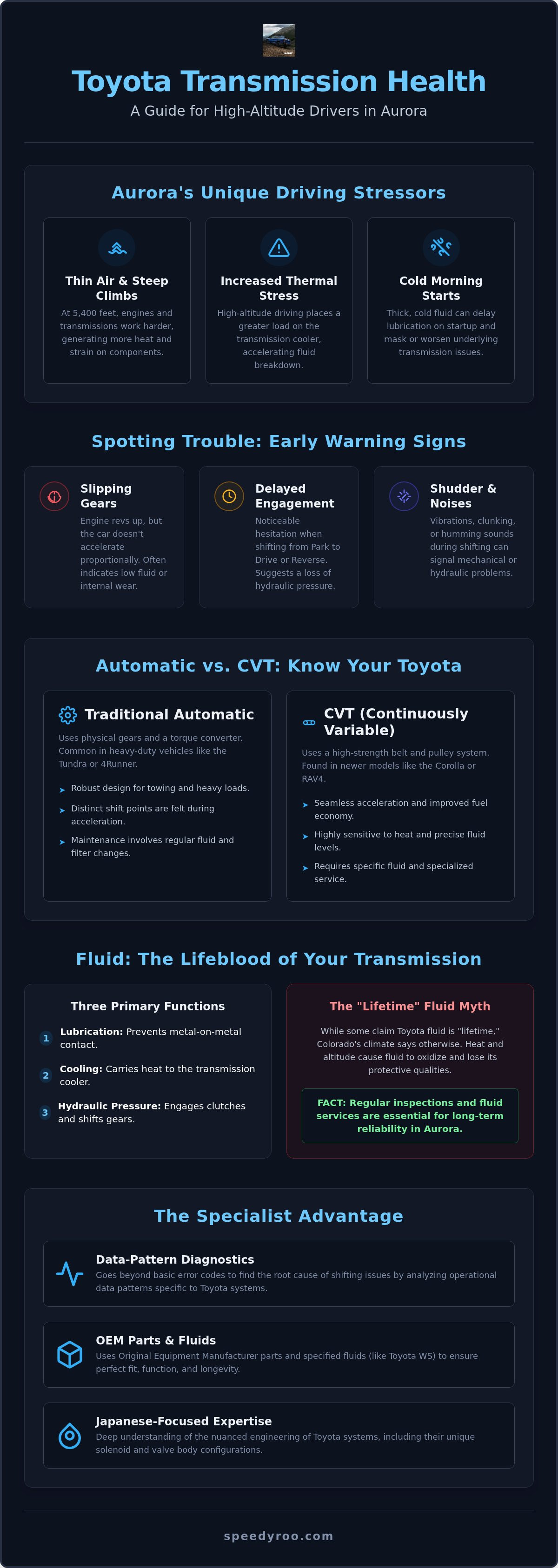
The technology under your floorboards depends largely on your vehicle’s model and year. Traditional automatics are still common in heavy-duty vehicles like the Tundra or 4Runner. These use physical gears and a torque converter to swap speeds. Conversely, newer models like the Corolla or RAV4 often feature a CVT. Instead of gears, a CVT uses a high-strength belt-and-pulley system. This allows the engine to stay in its most efficient power band. Maintenance needs for these two technologies are not interchangeable; a CVT is particularly sensitive to heat and requires precise fluid levels to avoid pulley slip.
The Role of Transmission Fluid in Toyota Reliability
Fluid is the lifeblood of your transmission. Toyota specifies World Standard (WS) fluid for most modern models. This isn’t just a basic lubricant. It is a sophisticated hydraulic fluid designed for specific friction characteristics. It serves three primary functions:
- Lubrication: It prevents metal-on-metal contact between moving parts.
- Cooling: It carries heat away from the internal components to the transmission cooler.
- Hydraulic Pressure: It provides the force needed to engage clutches and shift gears.
You might hear that your Toyota has “lifetime” fluid. While this might suffice in milder climates, Aurora’s altitude and temperature swings make that claim misleading. Over time, heat causes the fluid to oxidize, losing its ability to protect the system. Regular inspections ensure your Toyota remains reliable for the long haul.
Common Signs Your Toyota Needs Transmission Repair in Aurora
Identifying symptoms early can prevent a full transmission replacement and save you thousands in long-term costs. A healthy Toyota transmission should shift silently and without any noticeable hesitation. During Aurora winters, pay close attention to how your vehicle behaves during cold starts. The thick, cold fluid can sometimes mask or exacerbate underlying issues. If you notice a significant delay before the car moves after shifting into gear, it’s a signal that internal components are struggling. Early detection is the key to maintaining the high standards of Japanese import repair in Aurora.
Slipping Gears and Delayed Engagement
Gear slipping is one of the most alarming symptoms a driver can experience. You might feel the engine rev higher than usual without the vehicle speeding up proportionally. This disconnect between engine RPM and actual wheel speed often points to low fluid levels or internal seal wear that prevents the clutches from holding. Another common red flag is hesitation when shifting from Park to Drive or Reverse. According to NHTSA Transmission Safety Standards, proper shift lever sequence and engagement are critical for vehicle control. If your Toyota isn’t responding immediately to your gear selections, the hydraulic pressure inside the unit is likely compromised. If you’ve noticed these subtle changes, getting professional Toyota Repair and Service can help pinpoint the cause before a small leak becomes a major overhaul.
The “Toyota Shudder” and Unusual Noises
Many Toyota owners report a specific “rumble strip” sensation, often referred to as the Toyota Shudder. This typically occurs during light acceleration between 25 and 50 mph. This physical vibration often indicates an issue with the torque converter clutch failing to engage smoothly. Beyond physical sensations, keep your ears open for whining or buzzing sounds that change pitch as your vehicle speed increases. These noises can stem from a clogged internal filter or a failing bearing within the assembly. For those driving a manual Toyota, grinding noises during gear changes require immediate attention. These sounds usually mean the synchronizers are wearing out. Ignoring these early warnings can lead to a complete gearbox failure, making Toyota transmission repair Aurora a priority to maintain your vehicle’s longevity. Our team focuses on identifying these data patterns early to ensure your car stays on the road for another 100,000 miles.
The Impact of Aurora’s Altitude and Climate on Transmission Health
Living in Aurora means driving at an elevation of over 5,400 feet. This isn’t just a fun fact for hikers; it’s a critical factor for your vehicle’s longevity. At this height, the atmosphere is significantly thinner. This puts a unique strain on your powertrain that drivers at sea level never encounter. When you’re cruising on I-225 or pushing speed on E-470, your gearbox generates immense internal heat. Managing that heat is the primary job of your transmission cooler, but the local environment makes that job much harder. Understanding these environmental factors is the first step toward effective Toyota transmission repair Aurora.
High-Altitude Cooling Challenges
The cooling process relies on the principle of heat exchange. In the thin air of the Rockies, there are fewer air molecules available to carry heat away from the radiator and transmission cooler. This reduced oxygen density means your Toyota transmissions run hotter than the manufacturer’s baseline tests might suggest. If you frequently tow a trailer or carry heavy loads into the foothills, this thermal stress is compounded. Without a robust and clean cooling system, the internal components of your gearbox can reach temperatures that lead to premature failure. This is why a standard service interval often falls short for Colorado drivers.
Temperature Fluctuations and Fluid Degradation
Colorado is famous for its extreme temperature swings. A sunny afternoon can plummet to sub-zero temperatures overnight. These rapid changes cause rubber seals and gaskets to expand and contract at an accelerated rate. Over time, the dry Colorado air leads to the premature hardening of these components, creating tiny leaks that are difficult to spot until they cause a performance issue. These fluctuations also accelerate fluid degradation. Under the stress of mountain driving and stop-and-go traffic near the Denver Tech Center, fluid breaks down faster than in flatter, more humid states. Partnering with a Toyota specialist in Aurora ensures your maintenance schedule reflects these local stressors. We focus on keeping your seals supple and your fluid effective, which is essential for the long-term health of high-mileage vehicles. Our methodical approach ensures that no detail of your vehicle’s climate-specific needs is overlooked.
Diagnostic Process: Why Specialized Care Matters
Modern Toyotas are sophisticated machines that require more than a generic diagnostic tool. While a basic code reader might identify a generic fault, it rarely tells the whole story of a failing gearbox. Effective Toyota transmission repair Aurora involves interpreting live data streams to identify patterns that hint at future failures. By analyzing how solenoids react in real-time, we can address the root cause of a shifting issue rather than just replacing a symptom-prone part. This meticulous approach is what allows many of our customers to push their vehicles well past the 300,000-mile mark.
The 4-Step Diagnostic Protocol
We follow a methodical process to ensure nothing is overlooked. This professional standard keeps our repairs transparent and accurate. Our protocol consists of four distinct steps:
- Computerized scan: We check for stored P-codes in the Engine Control Unit (ECU) to see what the car’s sensors have already detected.
- Road test: A technician drives the vehicle under real-world Aurora driving conditions, such as climbing local grades, to verify shifting patterns.
- Fluid analysis: We inspect the fluid for metallic debris, which indicates internal wear, or a burnt odor that suggests overheating.
- Visual inspection: We examine external components like mounts, linkages, and cooling lines for leaks or physical damage.
The Myth of “Lifetime” Transmission Fluid
Many manufacturers market their transmission fluid as “lifetime,” but this term is often misunderstood. In the demanding climate of the Front Range, fluid degrades much faster than standard laboratory tests predict. For a truly effective Toyota transmission repair Aurora strategy, we recommend a fluid exchange every 30,000 to 60,000 miles for most models. Fresh fluid is essential for restoring hydraulic pressure and maintaining the cooling capacity discussed in previous sections. This preventive step is much more cost-effective than a full rebuild. If you drive a Sequoia or a RAV4 with All-Wheel Drive, integrating this with AWD system maintenance in Aurora ensures your entire drivetrain remains synchronized. Protecting your vehicle’s health starts with accurate information and a specialist who understands the “why” behind every service.
You can schedule your next Toyota Repair and Service to ensure your high-mileage vehicle stays reliable for years to come.
Why Choose Speedy Roo for Toyota Transmission Service
Speedy Roo has stood as the “Honest Specialist” in Aurora since 2002. While many general shops attempt to repair every make and model on the road, we have chosen a focused path. We specialize exclusively in Japanese brands like Toyota, Lexus, and Subaru. This narrow focus allows our technicians to develop a level of expertise that generalists simply cannot match. When you bring your vehicle to us for Toyota transmission repair Aurora, you aren’t just another transaction. You’re a neighbor receiving the precision of a dealer with the transparent, friendly service you expect from a local partner. Our facility is conveniently located to serve drivers across Centennial, Parker, and the entire Denver metro area.
The Specialist Advantage
Modern Toyotas rely heavily on electronic controls to manage shifting. We maintain access to the specific software updates and Technical Service Bulletins (TSBs) that are crucial for modern gearbox health. This means we can often resolve a shifting quirk with a computer recalibration rather than a mechanical teardown. This specialized knowledge is the foundation of every Toyota transmission repair Aurora service we perform. We also prioritize the use of high-quality OEM or superior performance parts to ensure every repair meets or exceeds factory standards. One of the biggest benefits of choosing an independent specialist is direct communication. You won’t be filtered through layers of corporate service advisors; you can speak directly to the experts who are actually working on your car.
Comprehensive Care for Your Toyota
Our team handles the full spectrum of transmission needs with meticulous care. Whether your vehicle requires a simple fluid flush to restore hydraulic pressure or a complex internal rebuild, we follow the same methodical diagnostic process mentioned in previous sections. We understand that your transmission is part of a larger ecosystem. For enthusiasts looking to optimize their vehicle beyond factory settings, we can integrate transmission health with Toyota performance tuning in Aurora to achieve maximum efficiency and response. This holistic approach ensures your car remains a reliable partner for your daily commute or mountain adventures.
Don’t wait for a minor vibration to become a major failure. Schedule your Toyota transmission diagnostic at Speedy Roo today! and experience the confidence that comes from specialized, honest care.
Secure Your Toyota’s Performance for the Road Ahead
Your Toyota was built for longevity, but the unique thermal challenges of Colorado’s high altitude mean your transmission requires more than just standard care. Recognizing early warning signs like gear slipping or the common “Toyota shudder” allows you to address small issues before they evolve into costly replacements. Specialized Toyota transmission repair Aurora isn’t just about fixing what’s broken; it’s about using precision diagnostic tools to ensure every solenoid and seal is prepared for the steep climbs of the Rockies.
Since 2002, Speedy Roo has served as an independent Japanese specialist. We offer A+ rated local expertise for our neighbors in Centennial, Parker, and Denver. We combine dealer-level technology with the transparency of a local shop. This helps your vehicle reach high-mileage milestones with ease. You don’t have to navigate the stress of shifting issues alone. Our team is here to provide the steady, methodical care your vehicle deserves.
Schedule Your Toyota Transmission Service in Aurora
Frequently Asked Questions
How much does Toyota transmission repair cost in Aurora, CO?
The cost of service depends on the complexity of the issue, ranging from a simple fluid exchange to a complete mechanical rebuild. Factors like your specific model and whether you have a CVT or a traditional automatic will influence the final total. Our goal is to provide a transparent estimate after a thorough diagnostic. This ensures you only pay for the necessary Toyota transmission repair Aurora rather than guessing at parts.
Does my Toyota have a CVT or a traditional automatic transmission?
Your Toyota’s transmission type depends on its model year and size. Newer sedans and compact SUVs like the Corolla or RAV4 typically utilize a Continuously Variable Transmission (CVT) for better fuel economy. Larger trucks and SUVs like the Tundra or 4Runner generally use traditional geared automatics. You can verify your specific setup by looking at the vehicle identification plate on the driver’s side door jamb or checking your owner’s manual.
How often should I change the transmission fluid in my Toyota in Colorado?
While some manuals suggest lifetime fluid, Colorado’s demanding environment requires a more proactive approach. We recommend changing your Toyota’s transmission fluid every 30,000 to 60,000 miles. Aurora’s high altitude and extreme temperature swings cause fluid to oxidize and break down faster than in milder climates. Regular exchanges help maintain proper hydraulic pressure and protect the delicate internal solenoids from premature wear or failure during a Toyota transmission repair Aurora service.
Is it safe to drive my Toyota if the transmission is slipping?
Driving with a slipping transmission is not safe and can lead to a complete breakdown in traffic. Slipping occurs when the internal clutches fail to hold, which causes the engine to rev without a proportional increase in speed. This creates immense heat that can quickly destroy the remaining components. If you experience slipping on I-225 or E-470, pull over safely and seek a professional inspection to prevent a catastrophic failure.
Can high altitude in Aurora cause transmission problems?
High altitude significantly impacts how your vehicle manages heat. In the thin air of Aurora, the cooling system is less efficient at dissipating the high temperatures generated inside the gearbox. This causes the fluid to run hotter, which can lead to the hardening of rubber seals and the breakdown of lubrication properties. Drivers in the Front Range often need more frequent maintenance to counteract these local environmental stressors and prevent damage.
Why is my Toyota making a whining noise when I accelerate?
A whining noise during acceleration is often a sign of a hydraulic restriction or a failing internal pump. This sound can occur when the transmission filter is clogged, forcing the pump to work harder to circulate fluid. It may also indicate a worn bearing within the assembly. If the pitch of the whine changes as you speed up, it’s vital to have a specialist check the fluid levels and internal pressures immediately.
Does Speedy Roo offer a warranty on Toyota transmission repairs?
We believe in standing behind our craftsmanship and building long-term trust with every neighbor we serve. While specific coverage can vary depending on whether you receive a minor component repair or a comprehensive system rebuild, we provide clear details on all service protections before work begins. We encourage you to discuss our current warranty options during your diagnostic appointment to ensure you feel confident and empowered in your repair decision.
Will a transmission flush fix my Toyota’s shifting issues?
A transmission flush is primarily a preventive measure and may not resolve existing mechanical damage. If your shifting issues are caused by old, contaminated fluid, a fresh exchange can sometimes restore performance. However, if the problem stems from a failed solenoid or worn clutch packs, a flush could potentially worsen the issue by dislodging debris. A professional diagnostic is the only way to determine if a flush is the right solution.