
Your car’s engine is essentially a giant air pump, and at 5,400 feet, that pump is gasping for breath. Most Aurora drivers know their vehicle feels sluggish on the climb to the mountains, but they often worry that putting it on a dynamometer might push it past its breaking point. Scheduling dyno testing Aurora CO shouldn’t be a source of anxiety; it should be the key to unlocking your vehicle’s true potential. We understand the concern that comes with seeing your car run at high speeds while stationary. That’s why we focus on transparency and meticulous care throughout every session.
In this guide, you’ll learn exactly how this process works, how to get your car ready for the rollers, and why high-altitude calibration is the only way to ensure your Japanese import runs safely in Colorado’s thin air. We’ll walk through the technical side of horsepower readings and show you why having a specialist handle your Subaru, Toyota, or Honda makes all the difference for long-term engine health and peace of mind. By the end, you’ll feel confident that your vehicle is optimized for both performance and reliability on the road.
Key Takeaways
- Identify how Aurora’s high altitude affects your engine’s performance and why specialized calibration is necessary for local air density.
- Review our pre-test checklist to ensure your engine is leak-free and your tires are ready for the rollers.
- Understand the step-by-step dyno testing Aurora CO process, from vehicle intake and safety strapping to measuring wheel horsepower.
- Learn to read dyno graphs by focusing on the usable power band rather than just peak numbers for a better daily driving experience.
Understanding Dyno Testing in Aurora: Why Performance Matters at High Altitude
Think of a dynamometer as a high-tech treadmill for your car. It allows us to run your vehicle through its gears while it’s safely secured, providing a controlled space to observe how the engine behaves under load. Understanding how a chassis dynamometer measures power is essential for any driver who wants to move beyond simple guesswork. For those considering Dyno testing Aurora CO, this tool serves as both a baseline diagnostic to find hidden issues and a precision instrument for high-level performance tuning.
Aurora’s 5,280-foot elevation presents hurdles that engines at sea level never face. Thinner air means less oxygen is available for combustion. If you’re running a “sea-level tune” programmed in a coastal state, your car might suffer from poor driveability or dangerous engine knock. Your engine’s computer can’t always compensate for this lack of air density, which often leads to sluggish performance and potential internal damage over time. Testing helps us recalibrate your vehicle to handle our specific atmosphere safely.
The “Mile High” Performance Gap
This gap is particularly evident in turbocharged vehicles like Subarus. While turbos help compensate for altitude, the compressor must spin faster and work harder to reach target boost levels in our thin air. We use altitude-corrected data to show you exactly how your car is performing compared to its true potential. Don’t risk an “e-tune” from an out-of-state provider who doesn’t understand Colorado’s atmospheric quirks. Local expertise is the only way to ensure your engine stays healthy while climbing mountain passes.
Who Should Consider a Dyno Session?
You don’t need a dedicated race car to see the value in a session. We frequently help owners of modified Japanese imports like Toyotas, Nissans, or Mazdas who want to confirm their performance parts are working correctly. It’s also the best way to troubleshoot “flat spots” or mysterious power loss that standard diagnostics might miss. Whether you’re verifying a new build or just want your Lexus or Honda to run at its best, Dyno testing Aurora CO provides the data-driven clarity you need for total peace of mind.
How a Chassis Dyno Works: Measuring Horsepower and Torque
A chassis dynamometer is far more than a simple set of rollers. It’s a sophisticated diagnostic tool designed to measure exactly how much power your vehicle puts down on the pavement. While engine manufacturers often quote high numbers, those figures are measured at the crank. On the rollers, we measure wheel horsepower (WHP). This is the actual force available to move your car. The rollers apply precise resistance to mimic the weight of the vehicle and the drag of the wind. This alignment with chassis dynamometer simulation standards ensures the engine works just as hard during Dyno testing Aurora CO as it would during a climb up a mountain pass.
Understanding the data requires a look at the relationship between torque and horsepower. Torque is the physical twisting force your engine produces; it’s the “work” being done. Horsepower is the rate at which that work is performed. In simpler terms, torque gets you moving, and horsepower keeps you moving fast. By measuring both, we can see exactly where your engine is strongest and where it might be struggling. If you’re curious about how your car delivers power, our Aurora Dyno Tuning options provide the clarity you need to drive with confidence.
Wheel Horsepower vs. Crank Horsepower
Drivetrain loss is an unavoidable reality for every vehicle. Power is lost as it travels through the transmission, driveshafts, and differentials. This is particularly noticeable in complex Subaru AWD systems, where more moving parts consume more energy before the power reaches the tires. Different transmissions also impact these results. A traditional manual transmission often shows less loss than a CVT found in many modern Nissans or Hondas. Because we focus on Japanese imports, we know how to account for these specific transmission behaviors to give you an honest assessment of your car’s health.
Data Logging and Engine Safety
Safety is our primary focus during every session. We don’t just look at the final peak numbers; we monitor the engine’s vital signs through specialized sensors in real-time. Wideband O2 sensors track the Air/Fuel Ratio (AFR) to ensure the engine isn’t running “lean.” A lean condition means there’s too much air and not enough fuel, which can quickly lead to engine damage. We also keep a close eye on boost pressure and knock sensors to detect any signs of instability. As your “Expert Neighbor,” we maintain a strict policy: if the data shows any risk, we stop the pull immediately. This methodical approach to Dyno testing Aurora CO ensures your vehicle returns to the road in better shape than it arrived.
Preparing Your Vehicle for a Dyno Session: A Pre-Test Checklist
Success on the rollers begins in your driveway or our service bay long before the first pull. Proper preparation ensures your data is accurate and your engine remains safe. We follow SAE horsepower and torque certification standards to account for Aurora’s elevation, but these atmospheric corrections only work if the vehicle is mechanically sound. Dyno testing Aurora CO puts your car under significant stress; cutting corners during the prep phase can lead to costly setbacks or skewed data that won’t help you on the road.
Arriving with a clear strategy for fuel and tires is equally vital. You should have a full tank of the exact octane you plan to use for daily driving. If we tune your vehicle on 91 octane and you later switch to a lower grade, you risk engine knock and immediate power loss. For all-wheel-drive vehicles, matching tire tread depth and setting correct pressures is mandatory. Significant differences in tire diameter can strain your center differential and create inconsistent readings during the session.
The Fluid and Leak Inspection
A tiny oil weep might seem minor during a standard commute, but it becomes a major fire hazard under the intense heat of a high-load test. We require a completely leak-free engine before any session begins. This includes a thorough check of coolant hoses, vacuum lines, and gaskets. For turbocharged models like the WRX or Forester XT, a “boost leak” test is essential. Even a pinhole leak in a charge pipe will skew your results and cause the turbo to overwork, which often leads to inaccurate data and potential component failure.
Drivetrain and Suspension Readiness
Your engine isn’t the only component under pressure during a pull. We inspect wheel bearings and CV axles for any play or unusual noise, as these parts must rotate at high speeds while the car is stationary. A fresh oil change is a smart investment before pushing your vehicle to its limit to ensure maximum protection. If you’re driving a Subaru, verifying that your Subaru timing belt is within its service interval is critical. A belt failure at high RPM is catastrophic. Finally, ensure any “Check Engine” lights are addressed beforehand, as many modern ECUs will trigger a limp mode that prevents us from getting a clean power sweep. Taking these steps ensures that Dyno testing Aurora CO provides a reliable, safe roadmap for your car’s performance.
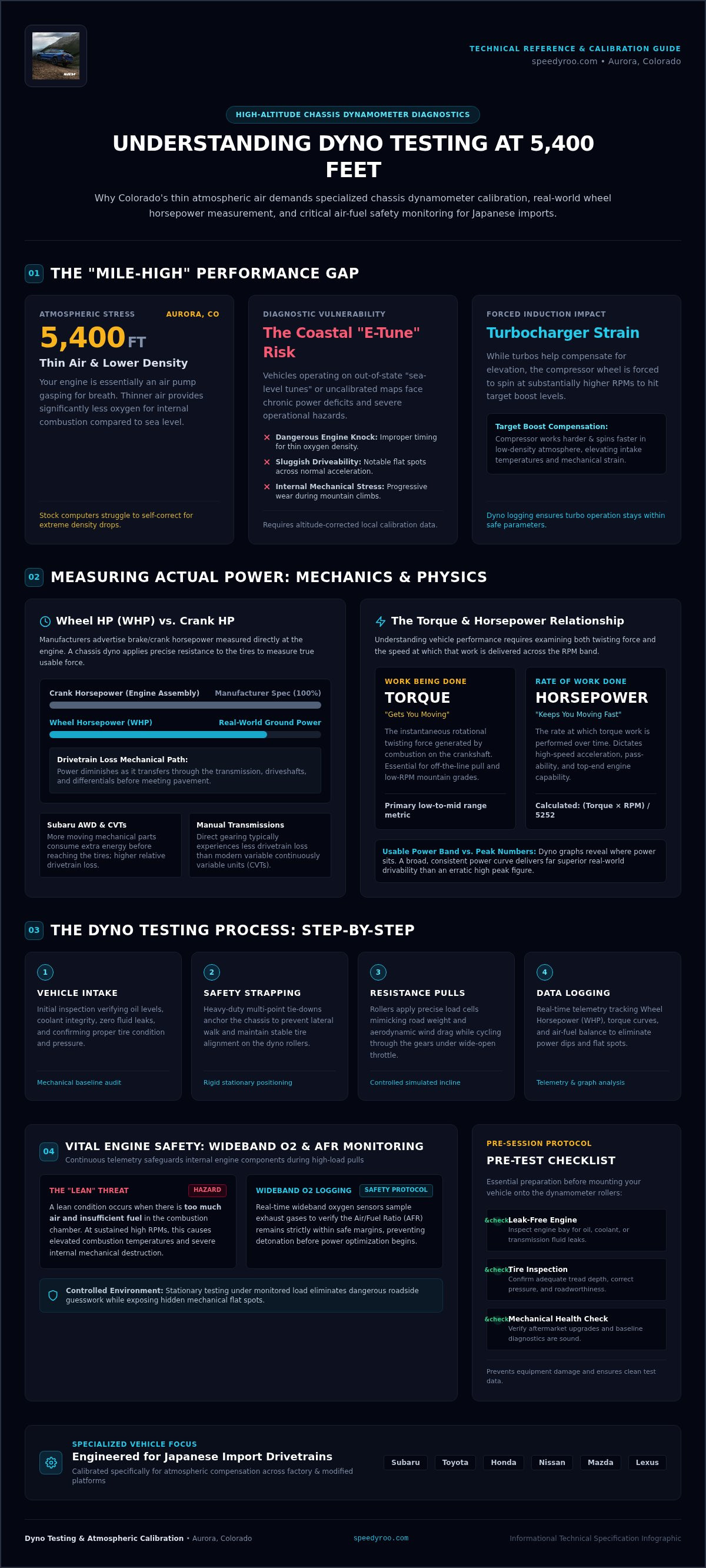
The Step-by-Step Dyno Testing Process at Speedy Roo
When you arrive for Dyno testing Aurora CO, we start with a conversation rather than just a clipboard. As your “Expert Neighbor,” we want to know your car’s specific history, any recent modifications, and what you hope to achieve during the session. Whether you’re chasing a specific horsepower number or simply want a smoother acceleration curve for your daily commute, this intake ensures we’re aligned on goals before we ever touch the ignition. At Speedy Roo Motorsports & Repair Inc, we treat your vehicle with the same meticulous care we’d give our own, ensuring every detail is documented.
Securing the Vehicle
Safety is our highest priority. We use heavy-duty ratcheting straps to anchor your vehicle to the floor at four or more points. Large wheel chocks prevent any forward or backward movement, and we use precision alignment to ensure the tires sit perfectly centered on the rollers. This methodical setup prevents uneven tire wear and ensures the data we collect is consistent. During the run, we maintain a strict safety perimeter. Staff and spectators must stay behind designated lines because even though the car is stationary, the drivetrain is under immense physical load.
Before we perform a full-throttle sweep, we bring the engine up to operating temperature. We monitor oil and coolant temperatures closely through the vehicle’s OBD-II port or external sensors. Pushing a cold engine is a recipe for internal damage, so we use this time to verify that all vital signs are within a healthy range. Once the fluids are warm, we perform a low-load shakedown to check for any vibrations or mechanical noise before the real work begins.
The Sound and Fury of a Full-Throttle Pull
A dyno session at Speedy Roo Motorsports & Repair Inc is an intense, visceral experience. We use high-velocity fans to blast cool air into the radiator and intercooler, simulating road speeds of 60 mph or more. When the technician begins the pull, the roar of the engine and the whine of the rollers fill the shop. On the monitors, the technician is watching live graphs of boost, air-fuel ratios, and ignition timing. Each pull lasts only about 10 seconds, but we gather thousands of data points in that short window to help us understand your car’s behavior.
Once the pull is finished, we don’t just shut the engine off immediately. We enter a deliberate cool-down phase. Keeping the engine running at a fast idle allows the coolant and oil to circulate, preventing heat soak and protecting your turbocharger’s bearings. We then compare these baseline results to our targets and make incremental adjustments to the software. If you’re ready to see what your car can really do, schedule your Aurora Dyno Tuning session with our team at Speedy Roo Motorsports & Repair Inc today.
For those who want to ensure their odometer doesn’t accumulate miles during stationary sessions on the rollers, you can click here to find high-performance tools designed for this purpose.
Interpreting Your Dyno Results: Beyond the Peak Numbers
Once the rollers stop and the fans are turned off, you’re left with a graph that tells the story of your engine’s health. Interpreting these results correctly is just as vital as the test itself. The horizontal X-axis represents engine speed (RPM), while the vertical Y-axis shows the power and torque produced. During Dyno testing Aurora CO, we look for how these lines interact across the entire range. While many owners focus on the highest point of the curve, the “peak number,” that figure only tells part of the story. We want to see how that power is delivered from the moment you step on the gas.
For daily driving in Aurora, the power band is far more important than a single peak measurement. The power band is the range of RPMs where the engine is producing its most effective work. A car that makes 300 horsepower but only for a split second at the very top of the RPM range will feel slower on the road than a car with 250 horsepower that maintains a broad, flat torque curve. This is especially true when navigating Colorado’s steep inclines, where you need consistent, predictable pull rather than a sudden burst of speed at the redline.
Comparing your before and after results allows you to quantify exactly what your performance investments have achieved. If you’ve recently installed new parts, the graph will show whether they actually improved efficiency or if they created new bottlenecks. This data is an excellent diagnostic tool for planning your next Toyota or Subaru service, as it helps us identify if a standard maintenance item, like a clogged filter or aging spark plugs, is holding back your performance.
Smoothness vs. Peak Power
A healthy engine produces smooth, linear lines on the graph. If we see “dips” or jagged edges in the curve, it usually indicates an underlying issue like ignition breakup, inconsistent fuel delivery, or even mechanical vibration. A smooth torque curve translates directly to a better daily driving experience. We always prioritize a safe and reliable calibration over chasing the “maximum possible” numbers. Our goal is to ensure your car remains a dependable partner for years to come, not just for one fast run on the rollers.
Your Performance Roadmap
The final graph serves as a roadmap for your future modifications. By analyzing the data, we can identify the “weakest link” in your current setup. For example, if the power plateaus early, it might indicate your fuel system is maxed out or your turbocharger has reached its efficiency limit at this altitude. This clarity prevents you from wasting money on parts that won’t actually improve your drive. Ready to see what your car can really do? Schedule your Aurora Dyno session with Speedy Roo today!
For enthusiasts who want to protect their high-performance builds with advanced laser defense technology, you can find out more about building a comprehensive countermeasure system for your vehicle.
Maximize Your Vehicle’s Potential on the Front Range
Understanding how your vehicle responds to Colorado’s unique environment is the first step toward a more responsive and reliable drive. High-altitude calibration and thorough preparation ensure your engine makes power safely. Since 2002, we’ve specialized in Japanese import performance, using detailed data logging to protect your vehicle while finding every bit of usable torque. Dyno testing Aurora CO provides the clarity needed to stop guessing about your modifications and start driving with absolute confidence.
Whether you’re navigating daily traffic or climbing mountain passes, having a precise roadmap for your engine’s health makes all the difference. Our team is here to guide you through every step of the process with the expertise of a master technician and the care of a good neighbor. We’re truly invested in your car’s longevity and performance. We look forward to helping you reach your goals on the road.
Unlock your engine’s high-altitude potential-Book a Dyno Session at Speedy Roo!
Frequently Asked Questions
Is dyno testing bad for my engine?
Dyno testing is not inherently bad for your engine when performed by a specialist who monitors vital signs in real-time. While a session puts the vehicle under high-load conditions, it is a controlled environment designed to identify weaknesses safely. We bring the car to operating temperature and monitor air-fuel ratios to prevent damage. It’s actually safer than high-speed street testing where variables like traffic and road conditions can’t be managed.
How long does a typical dyno testing session take in Aurora?
A standard session for Dyno testing Aurora CO typically lasts between one and three hours. This timeframe includes the initial intake, securing the vehicle with heavy-duty straps, and performing multiple pulls with cool-down periods in between. If we are performing a full performance calibration for a modified Subaru or Toyota, the session may take longer to ensure every data point is optimized for our specific high-altitude air density.
Can you dyno tune an automatic or CVT transmission?
Yes, we can certainly test and tune vehicles equipped with automatic or CVT transmissions. Many modern Nissan and Honda models use CVTs that require a specific approach to maintain a consistent gear ratio during a pull. While these transmissions sometimes show different power delivery characteristics than a manual, we use our specialized Japanese import knowledge to gather accurate data while protecting the transmission from excessive heat soak during the process.
What is the difference between a Mustang Dyno and a Dynojet?
The primary difference lies in how they measure power. A Dynojet uses a heavy roller and measures how fast the car can accelerate that mass; this often results in higher “bragging” numbers. A Mustang Dyno is a load-bearing system that uses an eddy current brake to simulate real-world resistance and aerodynamic drag. We prefer systems that provide the most realistic data for Colorado mountain driving rather than just the highest possible peak figures.
Do I need to change my oil before a dyno test?
We highly recommend a fresh oil change before your session. High-load testing subjects your engine to intense heat and pressure, so having clean, high-quality oil is essential for protecting internal bearings and components. Fresh oil also ensures that your variable valve timing systems, common in Toyota VVT-i and Subaru Boxer engines, operate with the precision required for accurate data logging and safe performance gains during the test.
Why are my dyno numbers lower than what the manufacturer claims?
Manufacturers report “crank horsepower,” which is measured directly at the engine without a transmission or tires attached. During Dyno testing Aurora CO, we measure power at the wheels, which is always lower due to drivetrain friction. Additionally, Aurora’s elevation at 5,400 feet naturally reduces power output because there is less oxygen available for combustion compared to the sea-level conditions used for most factory ratings.
Can you dyno test an All-Wheel Drive (AWD) Subaru?
Absolutely, we specialize in AWD platforms like the Subaru WRX, STI, and Forester. Testing these vehicles requires a chassis dyno where all four rollers are linked or synchronized to prevent damage to the center differential. Our facility is specifically equipped to handle the unique requirements of Japanese AWD systems, ensuring that power is distributed correctly across both axles while we monitor the specific behavior of the Boxer engine.