
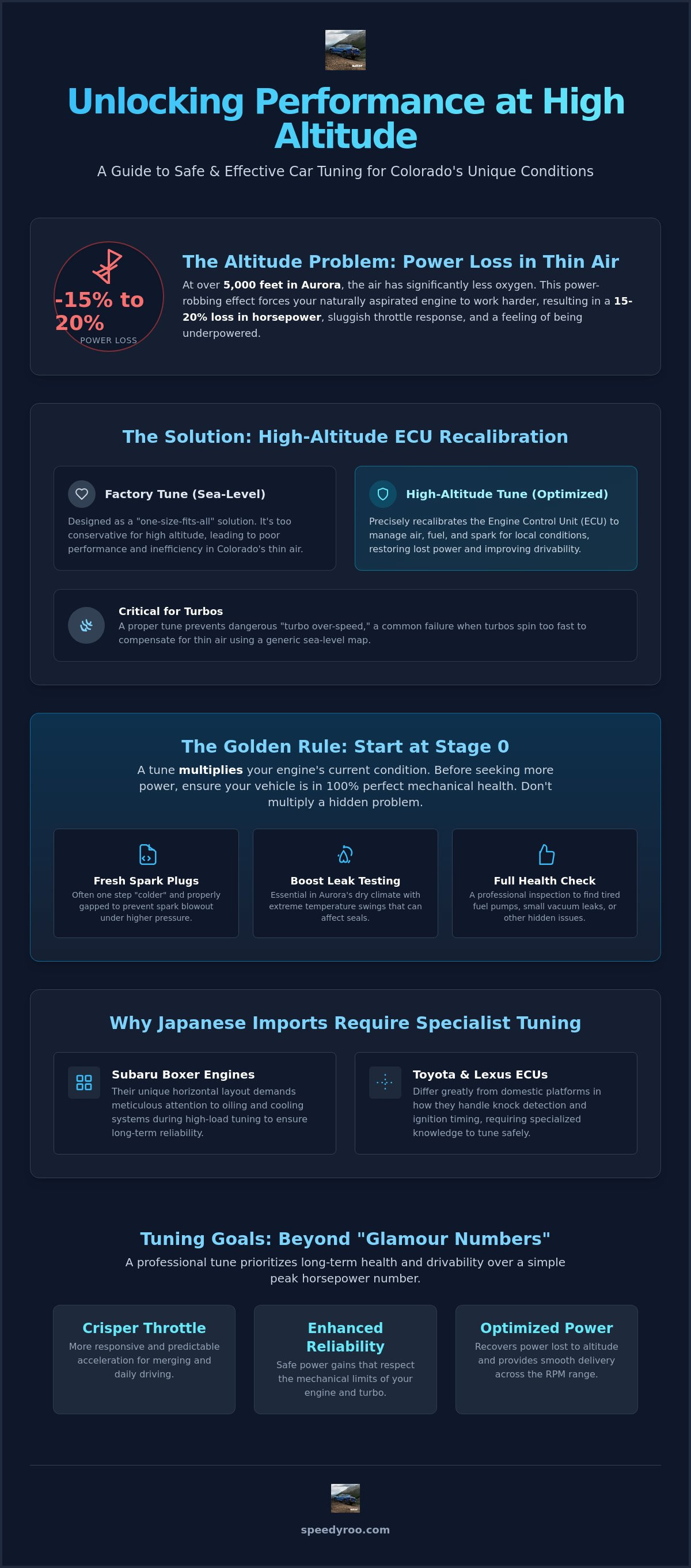
Did you know your Japanese import loses roughly 15% to 20% of its naturally aspirated horsepower the moment you drive it into Aurora? At over 5,000 feet, the thin air makes your engine work harder just to keep up with traffic, often leaving your throttle feeling sluggish and unresponsive. If you’ve been looking into performance car tuning Aurora CO enthusiasts trust, you’ve likely encountered a sea of conflicting advice about DIY chips versus professional maps. It’s natural to feel concerned about the long-term health of your Subaru or Toyota when pushing for more power, especially with the risk of aggressive tunes causing mechanical failure.
We’re here to help you navigate these thin-air challenges safely. This guide explains how to unlock your vehicle’s true potential by tailoring engine calibrations specifically for Colorado’s unique driving conditions. You’ll learn why starting with Stage 0 maintenance is the most critical step for any build, how professional dyno tuning provides safer gains than a generic base map, and what it takes to achieve a crisper throttle response without sacrificing reliability. Whether you’re commuting through the city or climbing mountain passes, understanding the science of high-altitude tuning ensures your car performs exactly as it should.
Key Takeaways
- Understand the science of ECU recalibration and how it specifically overcomes the power-robbing effects of Aurora’s high-altitude environment.
- Learn the “Stage 0” requirements to ensure your vehicle’s mechanical health is fully prepared for the demands of increased power.
- Discover why professional performance car tuning Aurora CO services utilize in-house dyno testing to provide safer, more precise results than generic software flashes.
- Identify the critical roles that local fuel quality and cooling management play in protecting your engine during steep mountain climbs.
- Establish a rigorous post-tune maintenance schedule designed to preserve the long-term reliability of your specialized Japanese import.
Understanding Performance Car Tuning in Aurora CO
Performance car tuning is often misunderstood as a simple quest for the highest possible horsepower numbers. In reality, it’s a sophisticated process of recalibrating your vehicle’s Engine Control Unit (ECU) to better manage the relationship between air, fuel, and spark. Think of the ECU as the brain of your car. By refining its logic through engine tuning basics, we can improve how your engine responds to your right foot. While factory settings are designed to be safe for a wide range of global climates, they’re often too conservative for our specific environment. Manufacturers must ensure a car runs just as well in the humid heat of Florida as it does in the freezing winters of Minnesota. This “one size fits all” approach leaves significant room for local optimization.
When we discuss performance car tuning Aurora CO drivers need, we focus on efficiency and drivability. It isn’t just about winning a drag race; it’s about ensuring your Subaru WRX or Toyota Supra feels responsive when you’re merging onto I-225 or climbing a steep grade. A well-tuned car should feel smoother, more predictable, and more capable in everyday situations. We take the “Expert Neighbor” approach by prioritizing the long-term health of your engine over “glamour numbers” that might look good on paper but cause mechanical strain in the real world.
The Science of High-Altitude Engine Calibration
At over 5,000 feet, Aurora’s air is significantly thinner than at sea level. This lower oxygen density directly impacts your engine’s volumetric efficiency. For turbocharged Japanese imports, the turbo must spin faster to move the same mass of air that it would easily handle at the coast. This is called “turbo over-speed,” and it’s a common cause of failure for cars running generic “sea-level” tunes. A proper high-altitude calibration adjusts the wastegate duty cycles and fueling targets to keep the turbo within its safe operating range while still recovering the power lost to the thin atmosphere.
Why Japanese Imports Require Specialist Tuning
Japanese platforms have unique engineering quirks that require a specialized touch. For example, the Subaru Boxer engine has a distinct horizontal layout that demands meticulous attention to oiling and cooling during high-load tuning sessions. Similarly, Toyota and Lexus ECU architectures differ greatly from domestic platforms in how they handle “knock” detection and ignition timing. At Speedy Roo, we have spent over 20 years specializing in these specific brands. We understand the nuances of these engines because we’ve been servicing and tuning them in the Aurora community since 2002. This experience allows us to provide performance car tuning Aurora CO owners can rely on for both power and peace of mind.
How to Prepare Your Vehicle for a Performance Tune
Many enthusiasts believe that a custom map is the first step in a build. In reality, it should be the final piece of the puzzle. Before you begin the process of performance car tuning Aurora CO, your vehicle must reach what we call “Stage 0.” This term refers to a state of 100% mechanical health where every factory component is performing exactly as intended. A tune is a multiplier of your engine’s current state. If you try to tune a car with a small vacuum leak or a tired fuel pump, you aren’t just losing out on power. You’re creating a dangerous environment where the ECU might compensate in ways that lead to catastrophic mechanical failure.
We always recommend a thorough professional inspection before any dyno session. Our team looks for the small details that often get overlooked during routine oil changes. While we push for higher output, we remain committed to following federal anti-tampering laws to ensure your vehicle stays compliant and reliable. If you’re unsure where your Japanese import stands, starting with a comprehensive pre-sale inspection or a dedicated pre-tune health check is the smartest investment you can make.
The Stage 0 Maintenance Checklist
Japanese platforms like the Subaru WRX or Nissan Z have specific maintenance needs that become critical under higher boost levels. Your preparation should include:
- Fresh Spark Plugs: We often suggest one step “colder” plugs for modified cars. Proper gapping is essential to prevent spark blowout when cylinder pressures increase.
- Boost Leak Testing: Aurora’s dry air and extreme temperature swings can cause rubber intake boots to crack. A smoke test can find hidden leaks that would otherwise cause your turbo to overwork.
- Fluid Refresh: High-quality synthetic oil and fresh coolant are mandatory. Tuned engines generate more heat, and your fluids are the first line of defense against wear.
Essential Hardware Upgrades for Aurora Drivers
Colorado’s altitude presents unique cooling challenges. Because the air is less dense, it carries away less heat from your radiator and intercooler. Upgrading to a larger top-mount or front-mount intercooler is often necessary to prevent “heat soak” during mountain climbs. Additionally, if you plan on running E85 or high-boost maps, your factory fuel injectors and pump may reach their limit quickly. You can read more about brand-specific requirements in our guide to Subaru Performance Tuning in Aurora: Unlocking Power for Colorado Altitudes. Ensuring your hardware can support your power goals is the only way to tune with confidence.
Executing the Tune: A Step-by-Step Calibration Process
Executing a professional tune is a methodical, data-driven process that bears little resemblance to the “plug-and-play” chips often marketed online. While “Off-The-Shelf” (OTS) flashes are a common entry point, they’re typically designed for sea-level conditions and generalized engine health. They don’t account for your car’s specific wear or our unique 5,000-foot elevation. For true performance car tuning Aurora CO enthusiasts can trust, a custom dyno session is essential to bridge the gap between “good enough” and “optimized for Colorado.”
Our philosophy as an “Honest Specialist” means we prioritize safety margins and long-term reliability over “glory numbers.” A high peak horsepower figure might look impressive on a social media post, but if it causes your engine to knock during a summer climb up a mountain pass, it isn’t a successful tune. We focus on creating a broad, usable power band that improves your daily driving experience while keeping your Japanese import’s mechanical components within their safe operating limits.
Baseline Testing and Diagnostic Logging
The process begins with baseline testing. We secure your vehicle to our in-house dyno and perform initial runs to record current horsepower and torque. More importantly, we monitor the Air-Fuel Ratio (AFR) and boost levels. This stage acts as a final diagnostic; if the logs show “knock” or the ECU pulling timing, it indicates a problem that must be solved before we add power. You can find more detail on this in our Dyno Tuning Aurora CO: The Complete Resource for Performance Calibration.
Iterative Mapping and Real-World Simulation
Once we have a clean baseline, the iterative mapping begins. This involves a cycle of small, calculated adjustments and verification pulls:
- Step 3: We adjust tables for boost, fueling, and ignition timing in small increments, monitoring how the engine responds to each change.
- Step 4: We simulate real-world Colorado loads. We can apply resistance to the dyno rollers to mimic the strain of an uphill climb on I-70, ensuring the tune remains stable under heavy load.
- Step 5: We perform a final drivability check. This confirms the car feels smooth during partial throttle and idle, ensuring it remains a pleasure to drive in Aurora traffic.
Data logging is the backbone of this entire workflow. Every pull generates a digital footprint of your engine’s behavior. We analyze this data to ensure that the increased performance doesn’t come at the cost of safety. By the time you leave our shop, you’ll have a vehicle that’s not only faster but also more efficient and better prepared for the demands of high-altitude driving.
Optimising for Colorado: Heat, Fuel, and Altitude
“Will my car overheat if I tune it?” is the most common question we hear from local enthusiasts. It’s a valid concern. In Aurora, we deal with a combination of low air density and high summer temperatures that can stress any cooling system. However, a professional tune actually makes your car safer. By building in specific safety buffers for our environment, we prevent the engine from running too lean or pushing too much boost when conditions get harsh. Proper performance car tuning Aurora CO specialists provide focuses on protecting the engine during steep mountain climbs where heat is most likely to build up.
Our fuel quality is another major factor that dictates how we calibrate your ECU. In Colorado, our “premium” gasoline is typically 91 octane, while sea-level states often have access to 93. This lower octane rating means the fuel is more prone to pre-ignition, or “knock,” under high pressure. Because of this, we must be more conservative with ignition timing than a tuner in a coastal city. We adjust the timing maps to ensure your Japanese import remains reliable on the fuel actually available at our local pumps.
The 91 Octane Reality in Aurora
Since we lack 93 octane, we have to find other ways to maintain performance without risking engine damage. This is where specialized knowledge of Japanese platforms becomes vital. For those seeking more aggressive power safely, E85 (ethanol) is an excellent solution. Ethanol has a much higher effective octane rating and provides a significant cooling effect as it evaporates in the intake tract. This is a massive advantage in our dry, high-altitude climate. You can learn more about these brand-specific adjustments in our guide to Toyota Performance Tuning Aurora: Unlocking Power and Efficiency.
Managing Heat Soak in the High Desert
Thin air is a poor conductor of heat. This means your intercooler and radiator have to work much harder to shed thermal energy than they would at lower elevations. We often see “heat soak” during stop-and-go traffic on Havana Street or while pulling a heavy grade on I-70. For Subaru owners, the factory top-mount intercooler is often the first bottleneck. Upgrading your cooling system is just as important as increasing your boost levels. If your hardware is already struggling with heat, it might be time for Subaru Turbo Repair in Aurora: Specialist Solutions for Your Performance Engine to ensure everything is operating at peak efficiency.
Managing these environmental variables is what separates a generic “off-the-shelf” map from a professional calibration. We monitor your Intake Air Temperatures (IATs) and program the ECU to pull back power safely if the engine gets too hot. If you’re ready to optimize your vehicle for our unique Colorado environment, schedule an appointment for Aurora Dyno Tuning today.
Post-Tune Care: Maintaining Your High-Performance Machine
Once your vehicle leaves the dyno, it’s no longer just a standard commuter. It is now a high-performance machine that requires a more proactive approach to maintenance. Many owners mistakenly believe that a professional calibration is a “set it and forget it” service. In reality, performance car tuning Aurora CO enthusiasts should treat their calibration as the start of a more rigorous care routine. Because your engine is now operating closer to its mechanical limits, the margin for error is smaller. Keeping a close eye on your vehicle’s health ensures that the power gains we achieved remain safe and consistent for years to come.
We take pride in being your “Expert Neighbor” throughout the life of your car. Tuning isn’t just about the numbers we see on the rollers; it’s about the longevity of your investment. As your hardware wears or as you add new components, your tune may eventually need a “refresh” to stay optimized. We’re here to help you interpret what your car is telling you, ensuring that every mountain pass you climb is handled with confidence and precision.
Adjusted Service Intervals for Tuned Engines
High-output Japanese engines, particularly those with turbochargers like the Subaru WRX or Nissan Z, put significantly more stress on their lubricants and ignition components. Standard factory intervals are no longer sufficient for a modified build. We recommend the following adjustments:
- Oil Changes: While factory manuals might suggest 5,000 or 7,500 miles, 3,000 miles is the new standard for tuned engines. High heat from increased boost levels breaks down synthetic oil more rapidly.
- Spark Plug Replacement: Tuned engines often use “colder” heat range plugs that can carbon up or wear out more quickly due to higher cylinder pressures. Inspecting or replacing them every 10,000 to 15,000 miles prevents misfires.
- Drivetrain Care: Don’t overlook your transmission and differential fluids. Increased torque puts extra load on these components, so checking for burnt fluid during every other oil change is a wise habit.
The Importance of Digital Monitoring
Modern tuning often utilizes handheld programmers or dedicated gauges that allow you to see exactly what the ECU is thinking in real time. Learning to read your boost levels and Air-Fuel Ratio (AFR) is part of being a responsible owner. If you notice a “stutter” under heavy load or see a “Check Engine” light, it’s important to stop and check your data logs immediately. Seasonal changes in Aurora, from our scorching summer afternoons to sub-zero winter mornings, can occasionally necessitate minor adjustments to account for shifting air densities. If you’re ready to ensure your car is truly prepared for the road ahead, schedule your pre-tune inspection with Speedy Roo today!
Take the Next Step Toward Optimized Performance
Recalibrating your vehicle for Colorado’s thin air is about more than just speed; it is about achieving a balance of efficiency and long-term reliability. We’ve explored how “Stage 0” preparation and professional dyno sessions protect your engine while recovering the horsepower naturally lost at 5,000 feet. By prioritizing high-altitude calibration and a rigorous post-tune maintenance schedule, you ensure your Japanese import thrives in our unique high-desert climate. Understanding these variables is the key to unlocking potential without compromising the health of your engine.
Since 2002, Speedy Roo has served as Arapahoe County’s trusted specialists for Japanese imports. Our team provides dyno-proven results for Subaru and Toyota platforms, using our specialized knowledge to build safe, responsive maps tailored to local fuel and atmospheric conditions. If you’re ready to experience the full potential of your vehicle with performance car tuning Aurora CO experts, we are here to guide you through every step of the process. Book Your Performance Tuning Consultation at Speedy Roo today to get started. We look forward to helping you drive with confidence and precision on every mountain pass.
Frequently Asked Questions
Is performance tuning legal in Aurora, CO, regarding emissions?
Performance tuning is only legal if the software or hardware has a California Air Resources Board (CARB) Executive Order (EO) exemption. Reprogramming an ECU without this exemption is considered emissions tampering under Colorado law. Individual fines for a first offense can reach $200, while businesses face much steeper penalties. Always ensure your performance car tuning Aurora CO specialist uses compliant software to remain street-legal and pass your biennial emissions inspection.
How much horsepower can I safely add to my Subaru WRX without forged internals?
Most stock Subaru WRX engines can safely handle between 300 and 350 wheel horsepower before the factory pistons and connecting rods reach their reliable limit. While some enthusiasts push beyond these numbers, we prioritize safety margins to ensure your car survives daily driving and mountain climbs. Pushing for higher output typically requires upgrading to forged internals to manage the increased cylinder pressures and heat generated at high altitudes.
Does tuning my car void my factory warranty in Colorado?
Tuning your car can lead to a denied warranty claim if the manufacturer determines the modification caused a specific mechanical failure. Under the Magnuson-Moss Warranty Act, a dealer cannot void your entire warranty just because you tuned the car, but they can refuse to cover powertrain repairs. Since an ECU flash affects nearly every engine component, most dealerships will see the “flash count” and attribute engine or transmission issues to the tune.
What is the difference between a “box tune” and a custom dyno tune?
A “box tune” is a generic, off-the-shelf map designed to work on a wide variety of cars in different climates. A custom dyno tune is a bespoke calibration created specifically for your individual vehicle and Aurora’s thin-air environment. Custom tuning allows us to account for your engine’s specific wear and hardware modifications, resulting in a much smoother power delivery and higher safety margins than a one-size-fits-all software flash.
Can I tune my car for better fuel economy instead of just power?
Yes, you can certainly tune for better fuel efficiency. By optimizing the air-fuel ratio and ignition timing for partial-throttle cruising, we can improve the engine’s overall thermal efficiency. While most people seek out a tune for increased performance, a well-calibrated engine often sees a slight improvement in miles per gallon during highway driving. The engine doesn’t have to work as hard to maintain speed when the ECU logic is optimized for our local elevation.
How long does a typical professional performance tuning session take?
A standard professional tuning session usually takes between three and five hours. This time includes securing the car to the dyno, performing baseline diagnostic runs, and conducting multiple iterative mapping pulls to refine the calibration. We also spend time simulating real-world loads, such as steep grades, to ensure the tune is stable. If we find minor mechanical issues during the diagnostic phase, the process may take longer to complete safely.
Do I need to run premium gas after my car has been tuned?
Running premium gasoline is mandatory for almost all tuned Japanese imports in Colorado. Because a tune increases boost and advances ignition timing, the engine requires the higher knock resistance found in 91 octane fuel. Using lower-grade gasoline in a tuned car can cause the ECU to pull timing to prevent damage, or worse, lead to catastrophic engine failure under load. We always calibrate our tunes specifically for the 91 octane fuel available at local pumps.
What happens if I drive my Aurora-tuned car to a lower altitude like sea level?
Modern ECUs use barometric pressure sensors to detect changes in altitude and will automatically adjust fueling to compensate for denser air. A car tuned for Aurora’s high altitude will generally run slightly richer and more conservatively at sea level, which is a safe condition for the engine. However, if your tune was built with very aggressive boost targets, it’s a good idea to monitor your gauges when driving in oxygen-rich environments to ensure the turbocharger doesn’t over-boost.